Search This Blog

Showing posts with label Aulse Hicks. Show all posts

Sunday, September 8, 2019

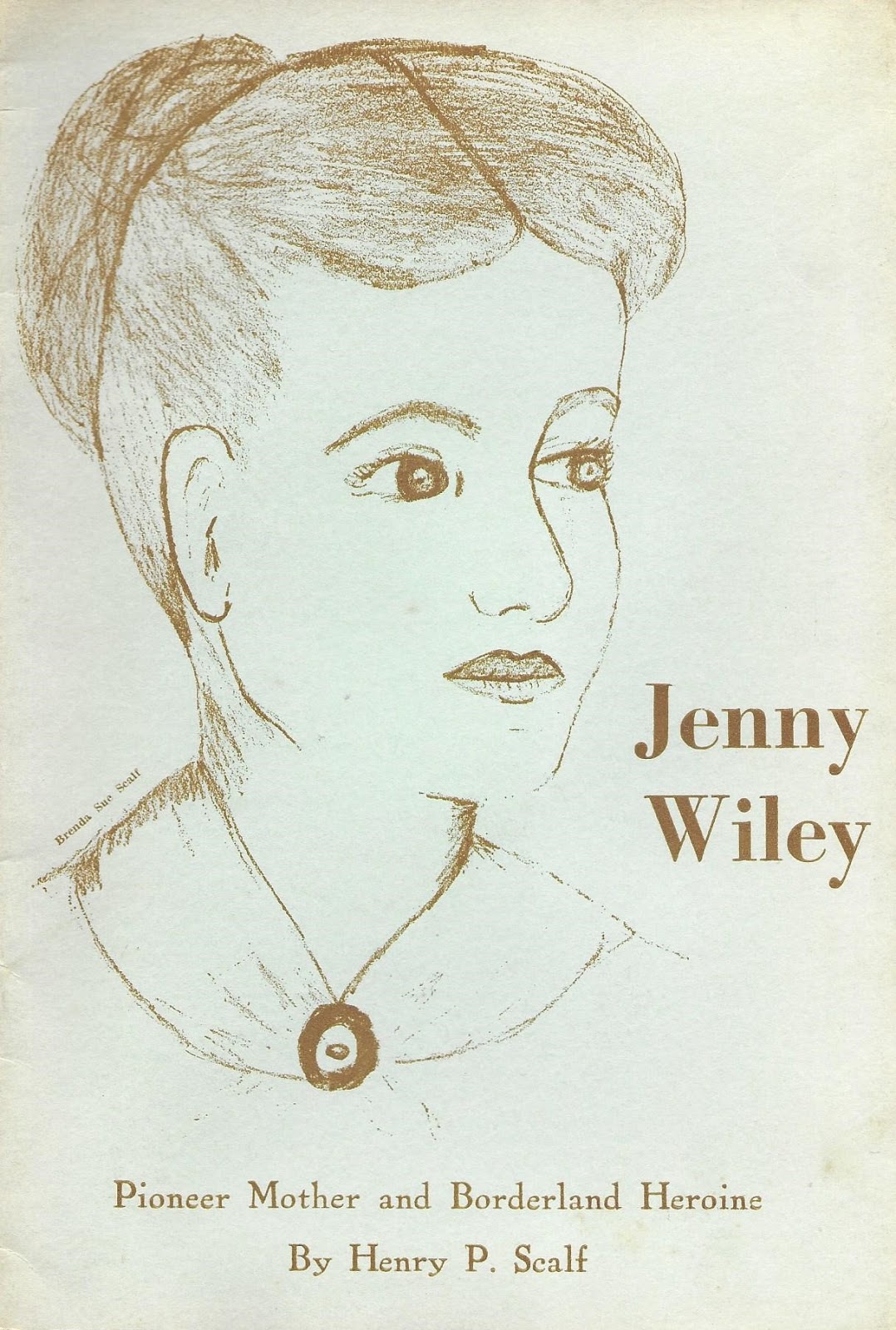
"Jenny Wiley Pioneer Mother and Borderland Heroine" by Henry P. Scalf--Book Review

Scalf, Henry P. Jenny Wiley Pioneer Mother and Borderland Heroine (Prestonsburg, Kentucky. Prestonsburg Publishing Company Press, 1964)


The story of Jenny Wiley and her capture by and escape from Native Americans on about October 1, 1789, in what is now Johnson County Kentucky has been told, retold, exaggerated, blown all out of proportion, and moved from fact to legend to myth over the intervening 220 years.  It has resulted in at least one musical theater production which has been a regular and now intermittent production of the  summer musical theater named after her along with the state park in Prestonsburg, Kentucky, where this little 16 page pamphlet was produced by Henry P. Scalf in 1964.  Scalf was a newspaper writer, author of several such pamphlets and about a half dozen genealogical books during his lifetime.  Much of his writing, documents, and books are in the Special Collections Department at the University Of Pikeville Library which I have used more than once in my research. I own one of his dozen or so self-published genealogical books about the Stepp-Stapp Families of America.  His best work was done in the fields of newspaper writing and genealogy.  This Jenny Wiley pamphlet was produced about 10 years after the formation of the Jenny Wiley State Park The date of this pamphlet coincides with the formation of the Jenny Wiley Summer Music Theater in 1964 and was likely an attempt by Scalf to capitalize on that event or, perhaps, to help support the push to form the theater.

Late in this work, Scalf states that "Ever with the Wiley story have been stories of the unusual, the strange and fanciful.  Some of these were added by descendants and other mountain folk for the tale of her captivity penetrated deeply into the consciousness of a people, becoming after the lapse of many decades an important element of their folklore."  Scalf was absolutely correct to make that statement and much of the general public opinion about the Jenny Wiley story today in Eastern Kentucky, Western Virginia, and Southern West Virginia is nothing more or less than folklore.  While it is a fact that Jenny Wiley was captured by and successfully escaped from her Native American captors after witnessing the deaths of her brother and children, much of what is frequently accepted as fact in the region today is nothing more than myth, legend, puffery, and prevarication.  It has long been impossible to differentiate the truth from the fiction.  But this woman has become a solid and permanent part of the historical beliefs in the region.  Harry Caudill wrote a terrible novel, "Dark Hills To Westward",  about the Jenny Wiley story and there have been nearly a half dozen other highly fictionalized books about her.   A highly fictionalized, but enjoyable musical play was written about her and performed to rave reviews hundreds of times in the theater at Jenny Wiley State Park.  Her grave on a ridge near River, Kentucky, is frequently visited by her descendants and total strangers who are enamored of the tales of her privation, grief at the deaths of her children, and her miraculous escape. I have to admit that I have visited her grave once myself.  This is an interesting little pamphlet to read if you can find a copy.  It will hold your interest.  But do not automatically assume that every word in it is a fact.  It contains no references to any historical documents and no professional method of crediting sources was used. At the time of the events not a great deal of documentation took place due to a variety of factors including the harsh conditions under which the people lived in the area, the high rate of illiteracy at the time, the persistent need for everyone to devote nearly all their time to survival and self-preservation, and the simple fact that paperwork was not a daily task of anyone.  The story was told by the people who were parties to it, passed down over more than 200 years through the oral story telling tradition, and has grown out of all proportion to the bare truth at the time the events happened.

Jenny Wiley lived until 1831 and died at the age of 71 more than 40 years after her capture.  The area at the time was genuinely on the edges of white civilization in America.  My own third-great-grandfather, Aulse Hicks traveled to Prestonsburg, Kentucky, sometime between 1790 and 1810 and we do not have a single historical document about his life.  I wonder if he might have known the Wiley family.  I have always admired the courage and fortitude of anyone who would pick up what little they could pack onto a horse or mule and a draft ox which might have also doubled as a milk cow, and stride off westward into Eastern Kentucky from the relative safety of much more heavily settled Western Virginia in the time of Daniel Boone and Jenny Wiley. 

I would also say that if you are doing genealogical research related to the Big Sandy and Tug River valleys the Scalf papers at the University of Pikeville Library are well worth a visit but you should contact the library archivist first to schedule a visit and access to those papers. 

Wednesday, December 28, 2016

My Appalachian DNA

For several years, my wife and I talked intermittently about having our DNA analyzed but never seemed to get around to it.  Finally, last summer, we both sent off DNA kits to Ancestry DNA.  After about six weeks, we got the results back and much like everyone else who has DNA analysis done, we found a couple of surprises.  I had heard a far too common Eastern Kentucky rumor, prevarication, and old wives' tale that my paternal third great-grandfather, Aulse Hicks, had been the son of a man named Charles Renatus Hicks, who had been the first mixed blood chief of the Eastern Band Of Cherokee.  There had always been two schools of thought about this purported connection.  Most of us who had done much in depth genealogical research leaned strongly toward the opinion that there was far too insufficient proof to justify the common belief and there was too much geographical distance between the well known homes of Charles Renatus Hicks in Spring Place, Georgia, and the area of Western Virginia from which Aulse Hicks emigrated to Prestonsburg, KY, about 1790 to 1810.  In the misguided attempt to connect Aulse Hicks to Chief Charles Renatus Hicks, various people had tried to change Aulse's first name from Aulse to Austin or Augustus despite the fact that every piece of paper he ever signed in Floyd County Kentucky as a minister and well known man had been signed Aulse.  There has also never been found a list of the names of the children of Chief Charles Renatus Hicks which listed either an Aulse, Austin, or Augustus.  In my own mind, I was clearly convinced that the connection between the two was purely the work of too many overly active imaginations which wanted to fulfill the oft repeated Appalachian fantasy of "being descended from a full blooded Cherokee Indian".  I freely admit that as I learned more about Chief Charles Renatus Hicks I grew to respect him highly as a successful man in a difficult world.  I would have loved to learn that I was descended from a man who was the first mixed blood Chief of The Eastern Band of Cherokee, who was bilingual and wrote and spoke both English and Cherokee, acted as a primary interpreter for the tribe and the US military, served as a primary sub-chief for many years, owned one of the largest private libraries in the country as an Indian, and died as the Primary Chief of the tribe.  But I knew better and my DNA analysis proved me correct.  

My Father, Ballard Hicks, Photo By Roger D. Hicks


At this point, I will burst bubbles of fantasy for many descendants of Aulse Hicks and other Hicks' in Eastern Kentucky that they are "descended from a full blood Cherokee Indian".  My genealogy is Hicks on both sides.  My father was Ballard Hicks, a second great grandson of Aulse Hicks with the documentation to prove it.  My mother was Mellie Hicks, the granddaughter of Hence Hicks, whose name I have also seen misspelled and misconstrued in various ways in order to support the Chief Charles Renatus Hicks fantasy.  I have seen Hence Hicks mistakenly identified as being named Henderson or Hensley when I knew numerous people in my childhood who knew him well. He was a well known ambush murder victim in 1935 and every public record about him calls him only one name, Hence Hicks.  Both sides of my family were in Knott County in the late 1700's to early 1800's.  I have always said that I am lucky I wasn't born with a square head and that I suspect that if the truth can ever be proven it is highly likely that "grandpa" came through the Cumberland Gap alone.  By that I mean that I suspect that our original ancestor to emigrate to Kentucky came into the region very early in the settlement process, had a large family which dispersed widely, and eventually converged again to intermarry a few generations later after all family memory and the nearly non-existent record keeping of the time had completely forgotten about any family connections three or four generations in the past.  

Now let's get to the results of the DNA Analysis and burst some of those bubbles.  The first, and most painful bubble to be burst involves Native American DNA.  I, Roger D. Hicks, well-documented third great grandson of Aulse Hicks and a Hicks on both sides,  have absolutely no Native American DNA.  The major aspect of the analysis that was not a surprise also confirmed what most Eastern Kentucky genealogists have believed for years.  Ninety-eight percent of my DNA came from Europe and seventy-seven percent of it came from Great Britain and Ireland.  That was no surprise whatsoever.  But there were a couple of other minor surprises and two fairly major surprises left in the DNA. I have seven percent DNA from Scandinavia.  I also have two percent DNA from the Iberian Peninsula and less than one percent each from Finland/Northwest Russia and Eastern Europe.  But the bigger surprise was that I have less than one percent DNA from each of Southern Asia and Nigeria.  Since I have learned of the connections to Southern Asia and Nigeria, I have tried to imagine just how that interaction took place at a time which must have been at least eight or ten generations in the past, roughly two hundred years or more.  With most of my DNA coming from Europe and Great Britain in particular, someone in my far distant bloodlines had to be a bit of a world traveler.  Was an ancient grandfather a sailor who followed the canvas to points in Africa and Asia?  Was an ancient grandmother a slave who was raped by a slave trader?  Or did a pair of my distant ancestors both find themselves stranded in isolation somewhere in a place and time where the most logical response for their own good was to assume an interracial marriage?  I doubt that I will ever find the answers unless the religion of some group of my ancestors or another is correct and we all end up in a common hereafter either sitting around a cooking fire in the darkness, sailing a common vessel on seas yet unknown, or sharing iced tea on a shady porch and telling the stories in whichever place of exactly how we all came to be.  Sorry about all those bubbles!  

Woots Hicks Cemetery Photo by Roger D. Hicks