Search This Blog

Showing posts with label Tug River Valley. Show all posts

Monday, January 30, 2023

The Big Sandy River Influence On American Culture


The Big Sandy River Influence on American Culture

The Big Sandy River has had an amazing amount of influence on American Culture over the last 100 years with a number of musicians, educators, writers, folklorists, and politicians coming out of the region which is in great contrast with the total population of the area drained by the river.  Formed by the Tug River and the Levisa Fork along the Kentucky, West Virginia border it drains Boyd, Lawrence, Johnson, Floyd, Pike, and part of Knott counties in Kentucky and Wayne, Mingo, and McDowell counties in West Virginia.  The region in both states contains only about 300,000 people and the population has been in flux at various times as outmigration has often taken place in conjunction with ebbs in the coal business which has been the primary economic driver in the region.

Yet, this region has produced an astounding number of important figures in American history including many of the country’s most popular musicians, a significant number of educators with national reputations, and several significant politicians.  The list from Boyd County includes The Judds including the actress and social activist Ashley Judd, Billy Ray Cyrus, and the Goins Brothers who were not natives but spent most of their lives in the region.

 Lawrence County has produced Ricky Skaggs and the multi-media artist Nyoka Baker Chapman who is also an official of the Huntington League of Women Voters.  The great Appalachian educator and writer Cratis Williams for whom the graduate school at Appalachian State University is named was also from Lawrence County. The former Chief Justice of the United States Fred Vinson was born in the Lawrence County Jail while his father was jailer there.  He also was a major economic officer in the administration of Franklin D. Roosevelt during the recovery from the Great Depression prior to his appointment to the court.  Former Kentucky Governor Paul Patton was also born in Lawrence County and was county judge executive in Pike County. He also served a term as lieutenant governor and was a major driver of the expansion of the University of Pikeville as both president and board member.

Johnson County has produced, and continues to produce an astounding number of important musicians including the Webb sisters, Loretta Lynn, Peggy Sue, and Crystal Gayle; Hylo Brown; Chris Stapleton;  and the minor Bluegrass band Five Miles From Nowhere.  Few Americans realize that the actor Richard Thomas of The Waltons is the son of a New York ballet dancer who grew up in Johnson County and Thomas often spent his summers with his grandparents in Paintsville.  The country singer Tyler Childers was born in Lawrence County and grew up in Johnson County.  Brett Ratliff, an old time musician and singer, also grew up in Johnson County. John Pelphrey who is a well known basketball coach and a member of the University of Kentucky team referred to as The Unforgetables also grew up in Paintsville, Kentucky, and has since been a head coach at the University of Arkansas, South Alabama University, and Tennessee Tech University where he still coaches today.  

Floyd County produced one of the greatest collectors and publishers of folk songs and folk tales, Leonard Roberts, who produced a half dozen books of his collected songs and stories from Appalachia and was a professor at Pikeville College until his death before it achieved university status.  Dwight Yoakam was born near his grandparents’ home in Betsy Layne in Floyd County and often refers to his Eastern Kentucky history despite having spent most of his childhood in Ohio.  Floyd County also produced the founder of the band Goose Creek Symphony, Charlie Gearheart.  The famous Bluegrass singer Tommy Webb is also a native and resident of Floyd County. McDowell in Floyd County produced the significant Appalachian painter and art professor Tim Sizemore who taught for many years at Prestonsburg Community College. The well known artist Russell May lived his entire life Floyd County.  In Wheelwright, Kentucky, Carol Stumbo and her English students produced the significant literary journal “Mantrip” for ten years along with the assistance of Albert Stewart, a highly admired poet and editor from Knott County. Floyd County also produced the man who is generally conceded to have been the best high school basketball player of all time, Kelly Coleman.   

Pike County is famous for having produced Patty Loveless but lesser known for having been the home of the early country singer Molly O’Day. The former Kentucky Poet Laureate Lillie D. Chaffin was also born in Pike County, spent most of her life there, and was a professor at Pikeville College.  The country musician, song writer, and night club owner Marlo Tackett grew up in Floyd County and ran a well known night club in Pike County for many years.

Although Knott County is not fully drained by the Big Sandy River, a significant portion of it is and the Floyd County Times in Prestonsburg was, for many years, the primary newspaper serving Knott County.  Due to the small size of Hindman, the county seat of Knott County, most people on the northern side of the county did their business for many years in Floyd County and students from that area were also bussed to Floyd County schools for many years due to the lack of paved roads in the county.  Knott County has produced Albert Stewart, the poet who founded “Appalachian Heritage” magazine and taught for many years at Alice Lloyd College.  Knott County also produced Verna Mae Slone who became a best selling author in her late 60’s. The most important writer of Wiccan books, Jessie Wicker Bell, was raised at Mousie in Knott County and produced her literature under the Wiccan name Lady Sheba.  Her ashes were scattered in the Wicker Family Cemetery at Mousie.  The county was also home for many years to James Still and Mae Stone, both connected to the Hindman Settlement School, both widely read authors, neither of whom grew up in the area.  Similarly, William Howard Cohen, a poet and professor at Alice Lloyd College came to the area and produced significant works while there. Cohen was also chosen as a Cultural Delegate to the 1968 Mexico City Olympics where he read his poetry and later produced a book of poems about the experience. 

I have not studied the important cultural figures from the West Virginia side of the Big Sandy River drainage as extensively as I have the Kentucky side but the Appalachian author Lee Maynard grew up in Crum, West Virginia in Wayne County and wrote extensively about the region.  In fact, his “Crum Trilogy” refers several times to the border conflicts which sometimes occurred between adolescent natives of the two states across the watery boundary.  Fannie Belle Fleming, known more widely as the burlesque star Blaze Star, was born in Wayne County. 

McDowell County West Virginia produced two very important Appalachian authors, Denise Giardina and Homer Hickam. Giardina is a liberal political activist in her spare time and made an unsuccessful run for governor. Hickam spent his career at NASA as a scientist after he and a group of other high school students won a national science competition.   

It is truly exceptional that such a small geographic area in what is sometimes disparaged as a struggling region could have produced so many influential and successful individuals.  There are also a large number of these people who grew up just outside the environs of the Big Sandy but were significantly influenced by the culture of the area.  Those include Keith Whitley, Don Rigsby, and his brother John Rigsby all of whom have been important musicians who grew up in Elliott County.  Don Rigsby also was Director of the Center for Traditional Music at Morehead State University for a time.  Tom T. Hall, one of the greatest song writers in the country as well as an important novelist and short story author, grew up in Carter County and worked for a time as disc jockey in Prestonsburg, Kentucky, on the Big Sandy.  Magoffin County also produced the Bluegrass singer and attorney Charlie Sizemore who played with Ralph Stanley for several years before quitting to go to college at Prestonsburg Community College and on to law school.  Magoffin County also produced Tom Whitaker who was a significant Appalachian artist and art professor at Prestonsburg Community College.  Magoffin County also produced the minor country singer Rebecca Lynn Howard and two Lexington, Kentucky, television weather forecasters, Chris Bailey and Jim Caldwell. The country singer Gary Stewart grew up in Letcher County and often played in Pike County in his early career.  All of these people, while not directly growing up in the Big Sandy River area, grew up within a few miles of the river and were influenced by the culture of the river basin. 

Sunday, September 8, 2019

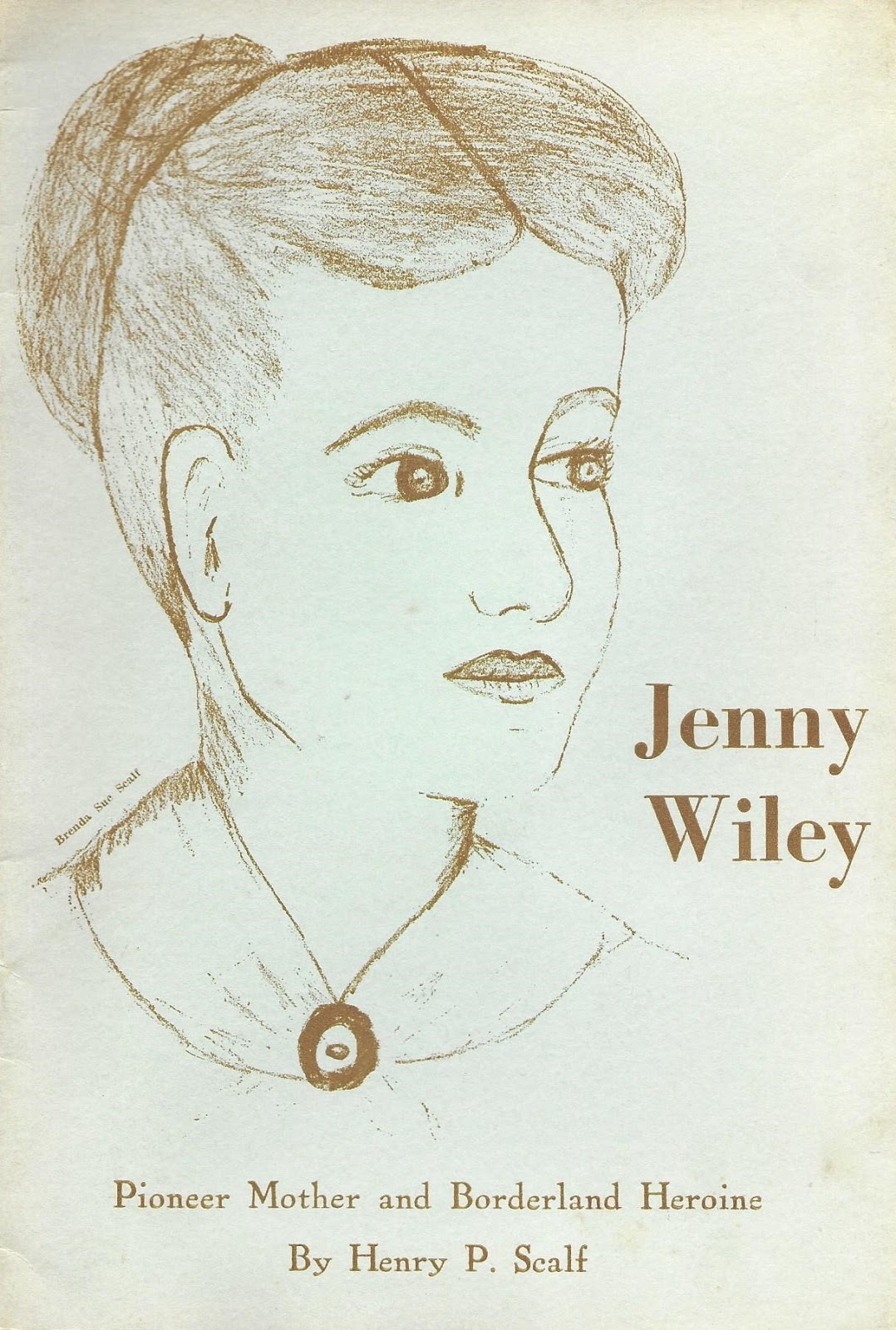
"Jenny Wiley Pioneer Mother and Borderland Heroine" by Henry P. Scalf--Book Review

Scalf, Henry P. Jenny Wiley Pioneer Mother and Borderland Heroine (Prestonsburg, Kentucky. Prestonsburg Publishing Company Press, 1964)


The story of Jenny Wiley and her capture by and escape from Native Americans on about October 1, 1789, in what is now Johnson County Kentucky has been told, retold, exaggerated, blown all out of proportion, and moved from fact to legend to myth over the intervening 220 years.  It has resulted in at least one musical theater production which has been a regular and now intermittent production of the  summer musical theater named after her along with the state park in Prestonsburg, Kentucky, where this little 16 page pamphlet was produced by Henry P. Scalf in 1964.  Scalf was a newspaper writer, author of several such pamphlets and about a half dozen genealogical books during his lifetime.  Much of his writing, documents, and books are in the Special Collections Department at the University Of Pikeville Library which I have used more than once in my research. I own one of his dozen or so self-published genealogical books about the Stepp-Stapp Families of America.  His best work was done in the fields of newspaper writing and genealogy.  This Jenny Wiley pamphlet was produced about 10 years after the formation of the Jenny Wiley State Park The date of this pamphlet coincides with the formation of the Jenny Wiley Summer Music Theater in 1964 and was likely an attempt by Scalf to capitalize on that event or, perhaps, to help support the push to form the theater.

Late in this work, Scalf states that "Ever with the Wiley story have been stories of the unusual, the strange and fanciful.  Some of these were added by descendants and other mountain folk for the tale of her captivity penetrated deeply into the consciousness of a people, becoming after the lapse of many decades an important element of their folklore."  Scalf was absolutely correct to make that statement and much of the general public opinion about the Jenny Wiley story today in Eastern Kentucky, Western Virginia, and Southern West Virginia is nothing more or less than folklore.  While it is a fact that Jenny Wiley was captured by and successfully escaped from her Native American captors after witnessing the deaths of her brother and children, much of what is frequently accepted as fact in the region today is nothing more than myth, legend, puffery, and prevarication.  It has long been impossible to differentiate the truth from the fiction.  But this woman has become a solid and permanent part of the historical beliefs in the region.  Harry Caudill wrote a terrible novel, "Dark Hills To Westward",  about the Jenny Wiley story and there have been nearly a half dozen other highly fictionalized books about her.   A highly fictionalized, but enjoyable musical play was written about her and performed to rave reviews hundreds of times in the theater at Jenny Wiley State Park.  Her grave on a ridge near River, Kentucky, is frequently visited by her descendants and total strangers who are enamored of the tales of her privation, grief at the deaths of her children, and her miraculous escape. I have to admit that I have visited her grave once myself.  This is an interesting little pamphlet to read if you can find a copy.  It will hold your interest.  But do not automatically assume that every word in it is a fact.  It contains no references to any historical documents and no professional method of crediting sources was used. At the time of the events not a great deal of documentation took place due to a variety of factors including the harsh conditions under which the people lived in the area, the high rate of illiteracy at the time, the persistent need for everyone to devote nearly all their time to survival and self-preservation, and the simple fact that paperwork was not a daily task of anyone.  The story was told by the people who were parties to it, passed down over more than 200 years through the oral story telling tradition, and has grown out of all proportion to the bare truth at the time the events happened.

Jenny Wiley lived until 1831 and died at the age of 71 more than 40 years after her capture.  The area at the time was genuinely on the edges of white civilization in America.  My own third-great-grandfather, Aulse Hicks traveled to Prestonsburg, Kentucky, sometime between 1790 and 1810 and we do not have a single historical document about his life.  I wonder if he might have known the Wiley family.  I have always admired the courage and fortitude of anyone who would pick up what little they could pack onto a horse or mule and a draft ox which might have also doubled as a milk cow, and stride off westward into Eastern Kentucky from the relative safety of much more heavily settled Western Virginia in the time of Daniel Boone and Jenny Wiley. 

I would also say that if you are doing genealogical research related to the Big Sandy and Tug River valleys the Scalf papers at the University of Pikeville Library are well worth a visit but you should contact the library archivist first to schedule a visit and access to those papers. 

Wednesday, November 28, 2018

"Conquerors Of The Dark Hills" by Rufus Mitchell Reed--Book Review


Reed, Rufus Mitchell: Conquerors Of The Dark Hills (New York, Vantage Press, 1979)


Once in a while we stumble into a book which surprises us with its quality, applicability to our needs, and general utility.  For me this was such a book.  I bought my copy from a local speculator in antiques and collectibles who had bought most of the estate of a local newspaper writer and poet who had known many of the published authors in Eastern Kentucky in particular and the whole of Kentucky in general.  My copy was autographed by the author and inscribed to the aforementioned local newspaper writer.  The book was published by Vantage Press which, for several years, was the largest vanity press in America before losing $3.5million in damages in a civil suit due to having defrauded several hundred authors.  Vantage also lost all credibility and eventually went out of business in 2012.  But this book is a reasonably high quality hardcover and my copy was still in its paper dust cover which is also in good to very good condition.  But enough about the physical state of the book.  Let's talk about its writing, content, and applicability to my needs as a student, researcher, and writer in the areas of Appalachian Studies and Appalachian Literature.  

Rufus Mitchell Reed Photo by The Reed Family

Rufus Mitchell Reed was born in 1895 in Martin County Kentucky near Lovely, Kentucky, in the Tug River Valley.  He lived his entire life in Martin County and worked most of that time as a surveyor.  But he was also apparently a student of Appalachian Culture, the local genealogy and history, and the flora and fauna of the entire Tug River Region.  His writing is well above average and I am somewhat surprised by the fact that he had published the book with a vanity press.  The quality and accuracy of the work and comprehensive nature of his knowledge about Appalachia in his time were more than sufficient for a regional press to have published his work.  He also published several volumes of poetry  over the course of his lifetime, none of which I have ever read.  But as soon as I can lay hands of copies of his other books, I will gladly purchase, read, write about, and retain them in my ever growing collection of Appalachian books.  

Rufus Mitchell Reed Photo by The Reed Family
"Conquerors Of The Dark Hills" can best be described as memoir but it addresses a significant number of aspects of life in the Tug River Valley in the late nineteenth and early twentieth centuries.  The book was published in 1979 when the author was eighty-four years old and I am sure it was his last ditch effort to have his impressions of his life and those of his family and neighbors recorded for posterity.  He is an articulate, skillful writer whose grammar, syntax, and style are well within the good to better category.  His knowledge of Appalachian Culture, history, and the area in and around Lovely, Kentucky, and the Tug River Valley are comprehensive, accurate, and honest.  This is a book which deserved to have been printed by a legitimate academic press which could have successfully marketed it across the wider Appalachian area. 

The chapters discuss early Kentucky and Appalachian history and a variety of topics of everyday life in the period from about 1800 to 1980.  It is a book which draws the reader in, makes you eager to read every word of it, and leaves you wishing for more when you reach the end far too soon.  For the fledgling student of Appalachia, it is wonderful source of cultural information.  For the accomplished Appalachian scholar it is a useful source of first hand information about life in the Tug River Valley in the early twentieth century.  It left me wishing I could have known Rufus Mitchell Reed, Rufe as he was known by his family and friends.  Due to the vanity press publication, there are a limited number of copies to be found on the open market and some of them are a bit steeply priced by sellers of rare books.  But I will gladly recommend to the reader that you buy one when you can find it.  You will not be disappointed.  

The individual chapters address several of the same topics I have addressed in the life of this blog plus several others such as education, hog killing, family life in Appalachia, Appalachian religion, digging ginseng, and hoedowns.  If you can find your copy, read it, enjoy it, hang on it for dear life, and arrange to pass it on to another lover of Appalachia when you die.