Search This Blog

Showing posts with label India. Show all posts

Wednesday, August 28, 2024

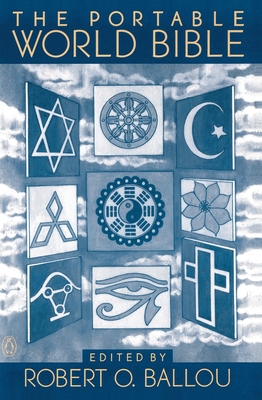
"The Portable World Bible" Edited by Robert O. Ballou, Observations On A Book To Help Settle Some Conflicts

The Portable World Bible (Portable Library) 

Many years ago, I was blessed to take an Introduction To World History course at Alice Lloyd College in Pippa Passes, Kentucky, under a man named Dr. Billy Rojas, Ph. D., who had come to ALC from the Chicago area as I recall.  Billy, as he preferred to known by everyone he knew, required that students in all his history courses buy, and actually read sections of this book.  Billy taught history from a viewpoint which was strongly focused on how religion and, particularly how differences in religion had influenced the flow of history over time.  This book is edited by Robert O. Ballou, according to his publisher, Penguin Random House, brought to countless contemporary readers much of the world’s religious thought, which he selected, interpreted, and arranged in view of modern man’s quest for ultimate truths and values. His book, "The Portable World Bible" which has been in constant publication since its original publication in 1944, and is constantly relied on by students in many disciplines along with thousands of ministers, rabbis, imams, and priests.  The book is broken into seven sections with each being composed of many of the key scriptures from most of the world's leading religions.  It is an excellent resource for anyone who is interested in world religious beliefs, conflicts between believers in two or more of those beliefs, or simply anyone who wants to learn more about any particular major religion. 

The sections are labeled The Hindu, The Buddhist, The Parsi, The Jew And The Christian, The Moslem, The Confucianist, and The Taoist.The book actually begins with a General Introduction and each of the sections begins with a specific introduction of about 10 to 15 pages.  While a detractor could make the arguments that the book is a bit aged for today's world, or that it omits a few religions which have significant numbers of adherents worldwide, it is still a wonderful book for anyone who wants to actually understand how the religions of the world interact, conflict, and, oftentimes, agree.  I have depended on it for some fast answers ever since the first time I ever read it in Billy Rojas' history class.  I also have a friend of twenty years who is a minister in a rather conservative form of Christianity and a graduate of a seminary who also depends on it.  For me, it is just as productive as any other book I can find when I need fast answers about key texts in any of the religions it discusses.  Rarely will anyone write or edit a book which will still be in print more than 75 years after its initial publication. And I believe that this book will still be in use and publication in another 75 years. It is especially useful when we consider the perpetual, and currently volatile conflicts in the Middle East which are rooted almost entirely in religious differences based on three major religions whose most sacred sites are in a markedly small geographic territory in which their claimed sites often overlap.  If you don't know about this book, at least look at a copy in a book store or library and decide if it is useful to you.                 


Tuesday, May 25, 2021

"Same Sun Here" by Silas House and Neela Vaswani--Book Review


This is an adolescent book by Silas House and Neela Vaswani which has been widely applauded for several reasons.  It is a cooperative work by Silas House, who is the Director of The Loyal Jones Appalachian Center at Berea College, and Neela Vaswani, who has written several other books in a couple of genres including short stories and memoir.  This is the first book I have read by either author.  I read it primarily because my wife and I bought it to possibly give to our 11 year old nephew in Wisconsin and wanted to review it before sending it to him.  The book is written in the form of pen pal letters between a 12 year old Appalachian coal miner's son, River Dean Justice, and an Indian immigrant girl, Meena Joshi, of the same age in Chinatown in New York City.  Obviously, each of the authors wrote the letters for the child of their own heritage and I am willing to assume the book was produced primarily through e-mail exchanges between the authors.  The two children are both bright, quite emblematic of each of their native cultures, and have grandmothers who are very important parts of their lives.  River's "Mamaw" is his primary caregiver due to health and/or mental health problems of his mother who spends most of her time in bed and, for most of the book, takes little active part in his parenting.  Each of the children is facing and attempting to deal with personal and family problems which are common in their cultures and geographic areas.  River's father is an unemployed coal underground coal miner who has gone to South Alabama to find work and comes home only when he can.  Meena's father works in a catering company in New Jersey and comes home only on his days off and both father's are forced to stay near their work at times instead of returning home.  Meena's parents and older brother have immigrated to New York when she was quite young and left her in the care of her grandmother, Dadi, in India for several years due to problems related to money.  Both children love their grandmother's deeply.  

As the book progresses, a coal company opens a mountain top removal mine on Town Mountain overlooking the town near which River's family lives and also overlooking his school where he is a member of the middle school basketball team.  Meena's family live in an illegally sublet rent controlled apartment in Chinatown and they are very close to the elderly Chinese woman whose son is actually the legal tenant of the apartment in which they live.  They are always in fear of being evicted because landlords can sell such apartments for high dollar if they can get rid of the tenants.  River's grandmother is an active member of an anti-strip mining group and fighting to stop the mountain top removal project.  Eventually, Meena's gradmother dies in India, River becomes more actively opposed to strip mining and mountain top removal, and Meena's family continues to live in fear of eviction and homelessness.  The book is loaded with current hot button political issues in both locations with environmentalism, rent control tenant's rights, immigration, and the economic issues related to the low end working class.  

As the book nears its climax, River's basketball team is practicing in the school gym when a massive rock slide caused by the mountain top removal strikes the school and injures several of the players.  Meena's family and all of the other tenants are evicted and become homeless.  River and his grandmother join a protest in Frankfort, Kentucky, and River accidentally becomes a media darling with a planned trip to New York to appear on television and hopefully to finally meet Meena.  The book is well written, especially in light of the fact that is uses the authorial techniques it does.  The social issues discussed are timely and important in America.  This book has a great deal of merit and is well worth buying for an adolescent reader, especially such a reader in a liberal leaning family.  It says a great deal about inclusivity, environmentalism, immigration, Appalachia, tenant rights, and discrimination against both the Appalachian poor and immigrants.  I would suggest that, for the average adolescent reader, it would be a good idea for a parent or grandparent to read the book either before or with the child and have a structured discussion of the social and political issues it raises.  It is a very unique book and well worth placing in your child's private library.