Search This Blog

Showing posts with label Paintsville Kentucky. Show all posts

Tuesday, July 22, 2025

"Poems To Ponder" by Alva Rice

Alva Rice produced one small, self-published collection of poetry to my knowledge which was printed in 1965, two years before his death. The printing company was Young Publications in Appalachia, Virginia. The book contains roughly 30 poems about life in Eastern Kentucky with some leaning toward being nature poetry and others which are reflections of family life including one which talks about young boys playing, most likely at some family affair. Rice used a lot of rhyme and sometimes exercied a bit of poetic license with regard to his rhymes. None of the poems are remarkable for the level of talent they show but they are a good look into every day family life in Johnson County Kentucky in the middle of the twentieth century. In particluar, Rice mentions a place called Little Mine Creek. I found the copy of the book which I own in a local Goodwill Store and bought it since I have a great deal of trouble ignoring anything which can be said to be autographed and this one is inscribed "Your Frien, Alva", and in the same handwriting contains the name Escom Chandler. The fly leaf of the book also contains the names of his wife Erma Maxine and three daughters Alice Evelyn, Mary Kathryn, and Betty Lou. As I often do when I encounter such self-published books, I did a quick internet search and located the burial place of Alva Rice and his wife in the Price Cemetery in Johnson County Kentucky. I also located a Find A Grave memorial for a fourth daughter, Phyllis Deane Rice, who died in a car wreck according to her tombstone at the age of 13 in 1957, ten years before the publication of his book of poems.

Monday, August 2, 2021

Hiking At Paintsville Lake State Park!


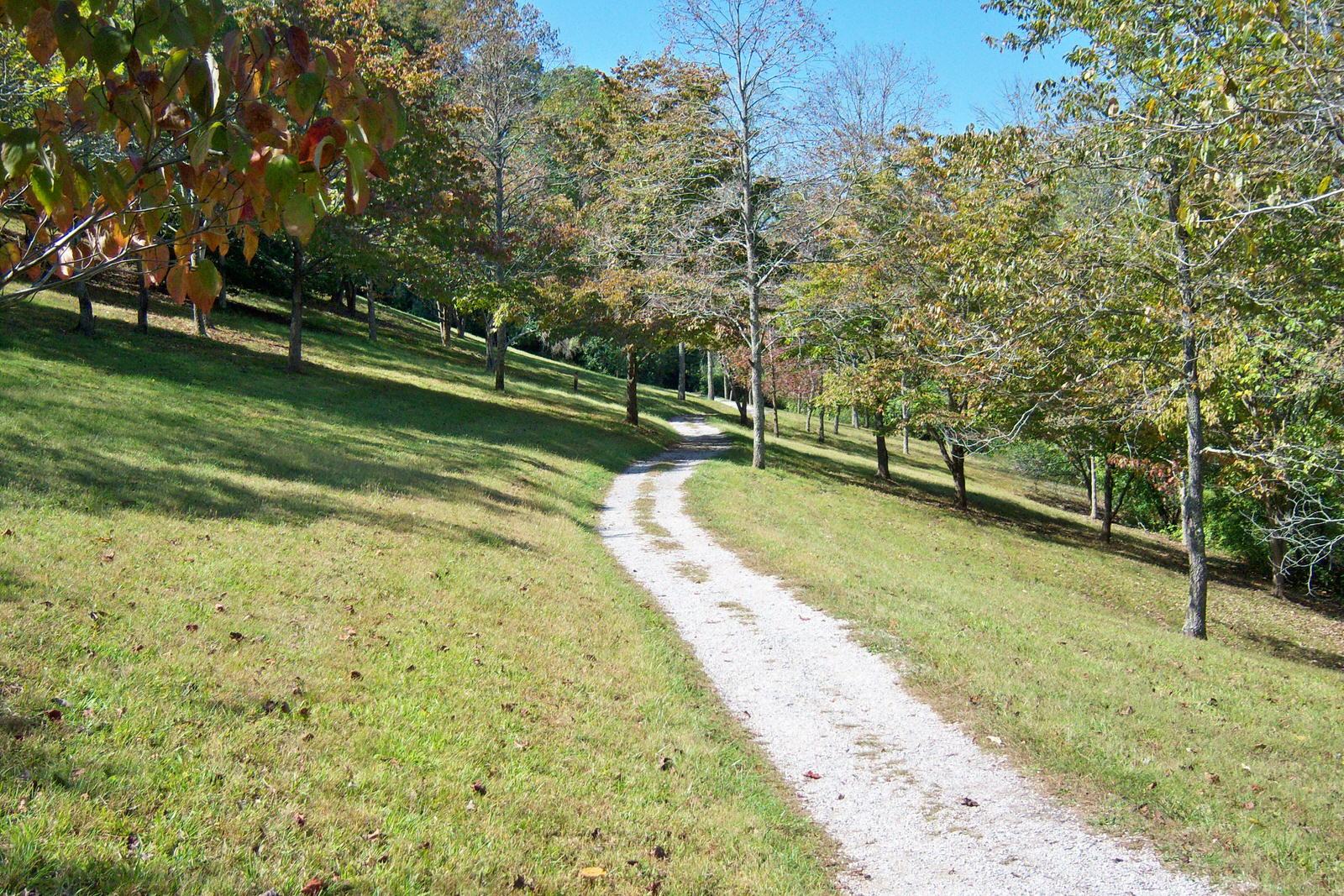
The photo above is a stock photo of the prettiest portion of what is known as the Kiwanis Hiking Trail at Paintsville Lake State Park which is a trail I hike regularly and just hiked today, in fact.  The trail actually begins near the Kentucky Mountain Homeplace which is also well worth a visit.  You can park in their parking lot, and out of courtesy, as far from their headquarters building as possible and start your hike at either end of the trail which makes a loop around the Army Corps of Engineers headquarters and the Kentucky Mountain Homeplace.  The trail has a couple of slight uphills or downhills but is actually rated, in my mind, as easy.  The section in the photo is just east of and below the Corps of Engineers headquarters and a few hundred yards from the beginning on the highway near KMH.  Paintsville Lake and the marina area are below the trail at this point and just east of it.  A small section of the lake is visible from the trail along with part of the marina area.  Then the trail goes away from the lake, crosses the emergency spillway (or gives you the option of shortening your hike a little by taking the emergency spillway until you rejoin the loop of the main trail near the SW corner of the KMH property.  I actually took that option today although I usually hike the entire loop of the trail with an extra twist or two thrown in.  The main loop is more tree shaded, feels a bit more isolated, and has a generally prettier look than the emergency spillway which is actually a cut through in the hillside which leaves a flat grassy area maybe 100 yards wide which functions as the emergency spillway.  

When I say that I throw in an extra twist or two to my hikes here,  what I mean is that I usually park at the spillway near the public restrooms and public trout stocking area, maybe take one full loop around the spillway area and then hit the face of the dam, go straight up the dam to the highway which crosses there to access the Corps of Engineers office and KMH.  I hike straight up several of the flood control lake dams in Eastern Kentucky and I recommend it if you are a strong hiker with a good heart and lungs, strong legs, and a good back.  But all these dams are steep, high, and tough.  The Paintsville dam is especially tough since it has a large area of boulders about 100 feet from bottom to top all across the dam due most probably to some past seepage problem.  Do not attempt this dam unless you are pretty tough and nimble.  The second twist I throw in my hikes here is that when I have hiked about 90% of the entire loop and I am back in the area overlooking the spillway where I park,  I hit the woods downhill toward the spillway.  It is typical Eastern Kentucky woodland, steep, and rocky.  It also has a couple of places where you could fall 30 feet or so.  But in this area, there is an ancient rock shelter, not a cave, but a rock shelter, overhang, whatever you want to call it which I am sure was used historically by both early native peoples and some of the first settlers in the Paint Creek area as temporary shelter.  It would sleep about a half dozen people and IT IS NOT LEGAL TO CAMP IN IT but it is a nice spot to stop for a few minutes at the end of a hike, cool off, and consider how it might have been used historically.  Paintsville Lake and the Kiwanis Trail is a nice hike whether you are looking for a relatively easy loop or if you want to make the loop more difficult as I do.

Saturday, May 18, 2019

"The Autobiography Of John E. Buckingham Appalachian Financier" by John E. Buckingham, et. al---Book Review

John E. Buckingham was born in Paintsville, Kentucky, in 1874 and rose to power as a former student and loyal assistant to John C. C. Mayo, the individual who is generally given most credit for arranging the purchase, development, and eventual decline of the coal fields and the coal industry in the entire Big Sandy River Valley.  Buckingham served loyally as the most obvious right hand man to Mayo beginning shortly after Mayo began buying and selling thousands of acres of mineral rights in Kentucky under the notorious broad form deeds.  Buckingham was eventually listed as the president, CEO, or chief operating officer of a half dozen or so small banks in the coal towns, including Wayland, Blackey, Hi Hat, Paintsville, and other coal camp towns in the eastern region of Kentucky.  During the Great Depression, all of those banks except the one in Paintsville went bankrupt and were liquidated under the National Recovery Act.  Yet, amazingly, Buckingham was elected to both the presidency of the Kentucky Bankers Association and the office of State Treasurer of Kentucky.  He had a street named after him in the coal town of Van Lear, Kentucky, which is most famous for having been the hometown of both Loretta Lynn and her sister, Crystal Gale.  Buckingham Mountain, which is located on the ridge which separates Right Beaver Creek from Left Beaver Creek, is also named for John E. Buckingham.

Buckingham wrote an autobiography which is entitled “The Autobiography of John E. Buckingham, Appalachian Financier,”  and was originally published under the auspices of a vanity press during Buckingham’s lifetime and was eventually republished with a second vanity press, Gateway Press, Incorporated, in 2008.  The book was rereleased in 2008 from Gateway Press with the names of Robert M. Conley as editor and John Buckingham Browning as “consultant”.  Browning is the grandson and namesake of John E. Buckingham.  The book does give some first-person insight into the life and accomplishments of John C. C. Mayo and John E. Buckingham.  But any reader should approach it with a jaundiced eye.  Other than the Paintsville bank, which survived the depression by being merged into another institution, Buckingham did not mention by name a single one of the other banks which collapsed during the depression.  He also only used the term “depression” only once in the book and always referred to that horrible period in American history by the somewhat bleached out misnomer of “the panic of 1929”.  Buckingham also discusses several other economic failures in coal mining, lumbering, oil, and gas in terms which are clearly intended to portray both himself and John C. C. Mayo in charitable terms regardless of the topic. The book was obviously a major attempt to self-aggrandize in an apparent attempt to leave a lasting favorable impression of the author on his readership.  The book was also only very superficially edited and is replete with errors of spelling, grammar, and syntax.