Search This Blog

Showing posts with label University of Pikeville. Show all posts

Wednesday, August 4, 2021

"My Curious and Jocular Heroes: Tales and Tale-Spinners from Appalachia" by Loyal Jones--Book Review


For many years, Loyal Jones has been the dean of Appalachian scholars and is one of the founding fathers of the field of Appalachian Studies.  But like most other people who earn a preeminent position in any field, he also had mentors, teachers, professors, and a wide collection of others who helped shape him into the scholar and writer he is.  Loyal Jones is now fully retired at age 93 after a long career as a professor, writer, and creator of the Loyal Jones Appalachian Center at Berea College.  I have been influenced greatly by Loyal Jones and his work and have written about him extensively on this blog.  He wrote at least two of the most important books in the field of Appalachian Studies, "Appalachian Values" and "Faith and Meaning in the Southern Uplands".  He also wrote several books of Appalachian humor with his co-author, Billy Edd Wheeler, who is sometimes better known as a song writer. 

This book, which was published in 2017 by The University of Illiniois Press may well be Loyal Jones' last book since he is now 93 and no longer living in Berea, Kentucky, near the college where he spent his academic career.  This book pays homage, both in biographical essays and the inclusion of selected works, to four of his professional heroes, three of whom he knew personally: Cratis D. Williams; Bascom Lamar Lunsford; Leonard Roberts; and Josiah H. Combs.  These men were all experts in the field of Appalachian Folk Music and Appalachian Humor which includes the world famous Jack Tales.  The book, as mentioned above, is composed of biographical chapters about each man and an immediately following section of folk songs, folk tales, or jokes each man is credited with documenting and publishing in their work.  This book is a wonderful assessment of the lives and academic careers of each of these men and a tribute to the extensive work they performed in collecting these songs, stories, jokes, and riddles which have been passed from person to person in an oral tradition which predates the English settlements in the Tidewater region.  Each of these men were also well educated and worked professionally but the book also makes apparent that each of them was most likely happiest when he was sitting in a hickory bottom chair on a porch in some isolated hollow in Appalachia listening to songs and stories being told by a local resident who often had no formal education but had spent their lives hearing, remembering, and retelling these stories, singing these ancient folk songs, and passing them on once again so they would be preserved in the record over time.  

Josiah H. Combs was the first graduate of the Hindman Settlement School and obtained a doctorate from the Sorbonne in Paris.  He worked as a professor of languages in several major universities and published several collections of these stories and songs in his lifetime.  Cratis D. Williams rose from a one-room school in Lawrence County Kentucky to become the dean of the graduate school at Appalachian State University and wrote a master piece doctoral dissertation about the literature of Appalachia.  He was also, like Loyal Jones, one of the founding fathers of the field of Appalachian Studies.  Bascom Lamar Lunsford was both a collector of these historic tales and songs and a performer as well.  He also happened to be an attorney and founder of the eponymous folk festival which still exists today at Mars Hill University in Mars Hill, North Carolina.  

Leonard Roberts grew up in Pike and Floyd Counties in Eastern Kentucky and was a multi-instrumental performer and college professor at both Berea and the University of Pikeville.  He is known as one of the greatest collectors of Appalachian folk songs and folk tales. He founded the University of Pikeville Press which published some of his work.  His two best known books, "Up Cutshin and Down Greasy" and "Sang Branch Settlers", are both required reading for anyone who wants to learn about Appalachian folk tales and folk songs.  He died far too young in a wreck with a coal truck near his home in Betsy Layne, Kentucky.  

Loyal Jones did a masterful and loving job of writing about the lives of each of these men whom he refers to as "my curious and jocular heroes" in the title of the book. He explains in the book his use of the multi-definitional word "curious" to describe these men.  Curious can mean both inquisitive, inquiring, and odd or strange.  Each of these men fits that definition in the most positive manner.  They were odd in that they chose to spend their lives collecting, recording, and passing on these stories and tales which most of their neighbors never bothered to remember.  And each of them was deeply curious about their native world in Appalachia and wanted to learn all they could about it in order to preserve and propagate that knowledge.  If you love Appalachia and Appalachian Studies, you need to come to know these five wonderful men with Loyal Jones included as their equal and biographer.  If you love a good folk tale, often leaning to the ribald, you will love these men and this book.  Read it and enjoy it, and learn some of these songs and stories to pass on along your way. 

Thursday, April 23, 2020

"Poetry II" edited by Lillie D. Chaffin--Book Review

Lillie D. Chaffin served as the editor of this little pamphlet of 23 pages and was a Kentucky Poet Laureate and a literature award in the name of her and her husband is still being awarded by Morehead State University.  She was the author of several chap books and the Appalachian children's book "We Be Warm Till Springtime Comes", which is one of my favorites in all of Appalachian Literature.  This book we are discussing here was published under the name of Poetry Press, Pikeville, Kentucky, and I suspect was only issued in a small number of copies, most likely less than 1,000.  It also may very well have been self-published in some cooperative arrangement by the poets included.  It will be difficult to locate if you decide you want to try to find a copy.  I bought it in a pile of rare Appalachian books and pamphlets out of a partial estate a friend of mine bought in Morgan County Kentucky.  The stated theme of the poetry is "Marriage" which is not in the title on the cover but is on the inside cover as a part of the publication information.  

The only poet of any note besides Lillie D. Chaffin to be included is Jane Stuart, the daughter of Jesse Stuart.  In my estimation, her poem is not particularly good.  The list of other poets includes Mildred Williams Boggs, Camella Joy Schreyer Thompson, Lois Duncan, Rae Cross, Jan Faires, Frederika Blankner, Jan Seale, Lena Winston, Lyn Lifshin, Thelma Scott Kiser, Phyllis Maples, Travis, Du Priest, Nell Abbott, Mary Newton Baldwin, Florence Holmes Ryan, L. R. Wagner, Fred W. Wright Jr., and Harry Brown.  I always try to include a full author list when I locate and write about these small edition books and pamphlets since it is sometimes possible that surviving family members of authors will not even know that the writing by their family member ever saw print.  If you turn out to be one of those people with a connection to an author, I sincerely hope you locate a copy.  

For me, the best poem in the book is "Discovery After Marriage" by Lois Duncan.  It is composed of four stanzas with a loose and irregular rhyming pattern which occurs in only part of the lines.  But it is well worth reading.  The first stanza reads: 

"I, who was never beautiful before you came,
I, who turned my face when loveliness passed by, 
Oh, suddenly there is nothing in the world as beautiful as I!"  

The poem then progresses through two more stanzas describing how a body "which has lain asleep so long...could be stirred to flame."  That is a good way to end a stanza about improved self image if I ever saw one.  

The fourth and concluding stanza reads:

"I am a silent bird who finds that it can sing.
I am a tree who stood all winter long with branches cold and bare
And now I wake, and it is spring."  

In my opinion, that is poetry worth reading.  If you find a copy of this little pamphlet somewhere, preserve it, read it, enjoy it, and pass it on to someone else with similar interests when you feel ready to die.  Or donate it to the special collections department of some Appalachian college library. 

Thursday, March 28, 2019

"A Brief Introduction to Kentucky Mountain Literature" by The Eastern Kentucky Education Association--Book Review

Recently, I strayed into and bought a rare copy of this little thirty-two page pamphlet from 1948 which was compiled and published by the classroom teachers of the Eastern Kentucky Education Association.  Books like this which are originally published in small printings and in pamphlet form rarely survive.  I found it in the tail end of a large estate, part of which had been bought from the executor by a friend of mine who is in the antique business. (I told that friend and I am telling all of you: "Do Not Put Glued Stickers On Vintage Or Antique Books, Pamphlets, Posters, Photos Or Art Works.")  It is highly unlikely that any of my readers will ever see a physical copy of this piece.  If you do find one that is not already in a library or the collection of someone who will protect it and pass it on, then you should buy it, protect it, and make arrangements for it to be placed in a library special collections department when you no longer have a use for it.  I would go so far as to even suggest that if you find it you should place it in the Special Collections of the Allara Library at the University of Pikeville.  

Now, back to the literature in the book itself.  A committee of four people is listed in the foreword as having been in charge of the arrangements: Chairman William M. Justice of Hellier, KY; Dorothy Lewis of Sandy Hook, KY; Eula Norris of Ashland, KY; and, Margaret Preston of Ashland, KY.  It is highly probable that the works by some of the authors presented could be the only extant publicly available examples of their work.  The most notable writers to be included are James Still; Jean Thomas, the Traipsin' Woman; J. T. Cotton Noe, a former poet laureate of Kentucky and a professor at the University Of Kentucky; and Jesse Stuart.  I have chosen to include a full list of contributors to this work since it is likely that some of them may not have publicly available works in any other setting or format.  If you recognize a writer and have been unable to access their works, send me a message on my public e-mail account at rchicks@mrtc.com and I would gladly scan and send those works to you with the understanding that they would be handled under strict observance of copyright law.  The full list of names of contributors is as follows: William M. Justice; Bess V. Smith; A. A. Page; Mrs. Edgar R. Mays; Mark Hager; Ruby Dell Baugher; Truda McCoy; Rosa Messer Bradley; Jean Thomas; James Still; Sylvia Trent Auxier; Madge Ann Pinson; S. D. Osborne; Evalena Gilbert Spears; Woodridge Spears; J. T. Cotton Noe; Jesse Stuart; and Nancy P. Turner.  I sincerely hope at least one of you finds a writer here whose work you have been trying to locate and save.

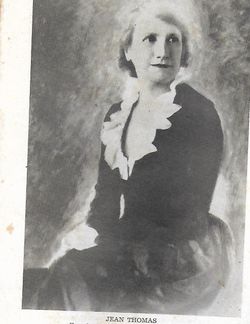
From my point of view, the most important and informational piece of writing in the book is that by Jean Thomas, The Traipsin' Woman, of Ashland, KY.  I must confess that I knew who she was and that she had been an important musicologist who collected and preserved folk songs in the Appalachian Region.  But I had never read her works, done research about her, or written about her in my work about the Big Sandy River and its influence on American culture.   I promise my readers that I will correct those mistakes in the near future.  Jean Thomas was born in Ashland, KY, and lived the great majority of her life there until her death at the age of 100 in Ashland.

Jean Thomas, "The Traipsin' Woman"--Photo by the Thomas Family


Jean Thomas had grown up as Jeanette Mary Francis de Assisi Aloysius Narcissum Garfield Bell in Ashland, Kentucky.  She eventually had a brief marriage which produced no children, traveled America and, perhaps, the world until she went to work as a traveling court reporter in Eastern Kentucky where she became fascinated by the folk ballads and singing styles of the Appalachian mountaineers whom she met in the court house towns.  She went on to found the American Folk Song Society and the American Folk Song Festival which took place at Carter Caves State Park from about 1932 until 1972.  It is a real tragedy that neither the American Folk Song Society or the festival have survived to help perpetuate the unique balladry, the Appalachian balladeers, and the early folk songs which traveled with our ancestors from the British Isles.    But Jean Thomas did write several books which are now hard to find on used book sites and no longer in print.  If you find copies of her books, buy them, preserve them, and pass them on when you die.  They are a major part of the work Jean Thomas devoted her life to in an attempt to preserve this wonderful set of Appalachian cultural assets. 

William M. Justice is also an interesting member of this group.  The personal papers of his daughter, Alice Justice Kinder are in the aforementioned Special Collections Department of the University of Pikeville.  The description of her papers on their website contains this biography of William M. Justice:
"William McKinley Justice was a product of the eastern Kentucky mountains into which he was born on November 27, 1893. Although he did not attend school until he was a teenager and did not receive his high school diploma until his mid-twenties, William Justice thirsted not only for personal knowledge, but to educate others in the mountains as well. A tireless promoter for Pikeville College, her traveled to a number of cities in the mid-west and north to raise money for the local school and help educate the youth of eastern Kentucky. Graduating from Berea College in 1929, Justice spent the next thirty years educating the youth of Pike County. From 1940-1959, Justice served as the principal at Hellier High School.
Justice loved the written word, and published five volumes of poetry. Named a Kentucky Colonel in 1968, Justice had the honor of having one of his poems read by Adlai Stevenson before the United Nations Assembly. He also penned an unpublished biography which was later finished by Alice Kinder and published in Willie-Boy and The Call of the Kentucky Mountains. William McKinley Justice died on July 22, 1968, at seventy-four years of age." (Special Collections Department, University Of Pikeville)
The Jesse Stuart story which is included in the book is "A Penny's Worth Of Character" which is arguably the best known of his half dozen or so children's books which are still being published and sold by the Jesse Stuart Foundation.   It appears to have been an earlier or abridged version of that well known story and there is no notation concerning any previous publication. 

The essay "Our Beloved Hills" by Mrs. Edgar R. May of Langley, Kentucky, in Floyd County addresses the issue of prejudice toward Appalachians and is quite interesting for the time.  It begins: "Much has been written about Eastern Kentucky, but generally only the dark side is seen in print.  While it is true that many undesirable conditions do exist here, progressive citizens have a right to resent being judged by the lowest classes in the mountains.  This is no less unfair than if the slums of cities were regarded as typical of urban life."  While this opening does not clearly defend these "...lowest classes in the mountains...", it does go on the remainder of the essay and make several good points in defense of Appalachian people and addresses some of the negative aspects of the discrimination which has been prevalent against Appalachians for at least a hundred years. 

I know I am repeating myself but if you stray into a copy of this little book buy it, keep it, protect it, and pass it on to someone or some institution which will preserve it for the future researchers into Appalachia and Eastern Kentucky.