
The image above is a print of a painting of the 100 plus year old home in which the greatest Appalachian storyteller Ray Hicks spent nearly his entire life. The original painting was called "Ray's Moon" by Bob Timberlake and depicts the house which was located on Old Mountain Road above Banner Elk, North Carolina and stood for 121 years until the wee hours of the morning of Tuesday, May 25, 2021, when it was burned to the ground in a fire whose origin is so far unknown. Although Ray Hicks died on April 20, 2003, and his wife Rosie died on January 31, 2014, it was reported by HCPress that the Hicks family still owned the house and the farm on which it was located. The photograph belows is of Ted Hicks, the son of Ray Hicks, and the old house as it was when the family was living in it. Ray Hicks' children were at least the third generation to live in the house.
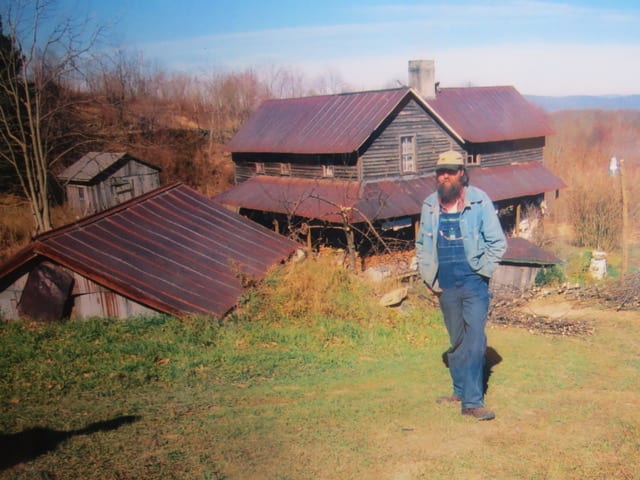
This old house was much more than a house. It was a symbol of the North Carolina High Country lifestyle of self-sufficiency, farming, herb gathering, instrument making, story telling, and subsistence farming which the Hicks family and their neighbors had practiced for at least 200 years. The house and its loquacious owner have been immortalized in books by Robert Isbell, Thomas Burton, Shannon Hitchcock, Christine Pavesic, and Owen Smith. It had also been the scene of several video recordings of Ray Hicks practicing the Appalachian storytelling for which he was the acknowledged grand master for the majority of his life. Several of those recorded stories and/or interviews are still available on YouTube. I have been fascinated by the life and story telling of Ray Hicks for less time than I should have been. I only became interested in his works over the course of the last year or so and began to read books about him and his wife Rosie secondary to having studied the work of Leonard Roberts, who was also a great storyteller, collector, and author in his own right. But, Ray Hicks was the man other Appalachian story tellers tried to emulate and always came up short in the effort.
Sherrie Norris of High Country Press wrote the best report of the tragic fire which consumed the Hicks home on the morning of May 25, 2021, and that story can be found on the High Country Press web page. But their web service is not very conducive to links in other articles or websites and her article is best found with an independent Google Search using some phrase such as "Ray Hicks Home Burns". I will quote some from Ms. Norris' excellent, highly personal, and very well written article because her appreciation for and love of Ray Hicks, his stories, and the old house shine through that article in a way which anyone who did not personally benefit from knowing Ray could never equal. Early in the article, Sherrie Norris says this:
"Many of us who were “lucky enough” will carry memories for our lifetime of climbing the curves to Old Mountain Road, looking out over the expansive, majestic view of four states, as Hicks often pointed out, and descending the worn pathway down to the place he called home."
Ms. Norris' article also makes it apparent that her love of the place included the house, the farm, the surroundings, and the lifestyle which Ray Hicks and his family had practiced for many years and continued to practice long after many others around them had abandoned that lifestyle.
"Built by his grandfather, the house stood as a shrine of sorts, welcoming guests for decades from near and far. Whether we sat on the steps of the porch beside the woodpile, on the woodpile, in a ladder-back chair, or inside the house around the old wood stove — in awe of the unique father of Jack Tales himself — visitors were entertained and captivated, all at once. Even after his death, his closest followers gathered at the house in his honor several times in an effort to keep his memory alive. When he died in 2003 at the age of 80, Hicks left behind a legacy that will not soon be forgotten."
Importantly, Ray Hicks' legacy was built of far more than the old house and that legacy will survive. But the house was an important part of Ray Hicks and that legacy. The old house with its ever present woodpile on the porch, the old cane bottom chairs for the frequent visitors who came to sit at Ray's feet and listen to his tales, and that old wood burning stove which Ray had uniquely crafted in the living room to heat the massive, old, poorly insulated house, were all a part of the total picture presented by the lanky 6' 7" Ray Hicks whose favorite way to spend time was passing on the Jack Tales and other stories he had learned and preserved in his 80 years on Beech Mountain. In addition to preserving the tales he had heard during his formative years, there are also dozens of stories which Ray created in his own right.
Ray Hicks was a self-made man who never amounted to much in the world when it came to money but he had a great deal of wealth in the thousands who gravitated to him and his tales of common people who overcame uncommon problems; killed giants; escaped witches, ghosts, and goblins; used common sense and everyday objects to always win in the end. Ray Hicks won in the end and he won every time some new visitor traveled to Beech Mountain to sit on the porch of that old house and listen to this man with little education, a wonderful way of telling the stories of his childhood and his life, and a compassionate, all encompassing love for the common man and woman who always got back up and fought on against long odds to win in the end. When that old house burned, North Carolina and America lost a cultural icon and a symbol the American pioneers who landed in the Tidewater and traveled deep into the mountains in order to build a new life and a new freedom far away from European plagues, kings, and ironclad class systems. But the memories of Ray Hicks and that old house will always live on.


