Search This Blog

Showing posts with label Boone North Carolina. Show all posts

Thursday, May 27, 2021

Watauga County, NC, Has Lost An Important Cultural Asset

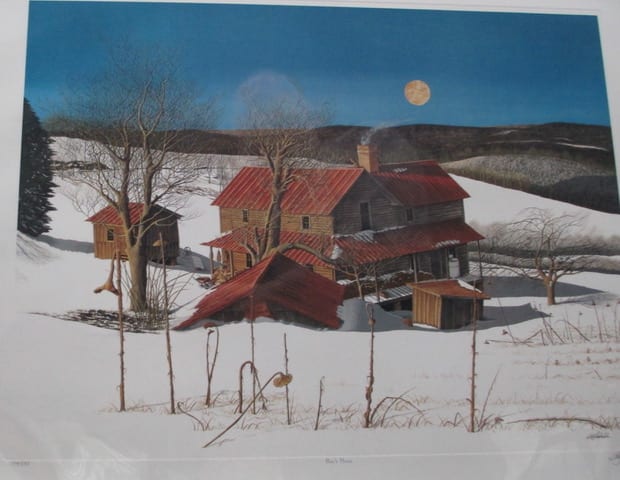
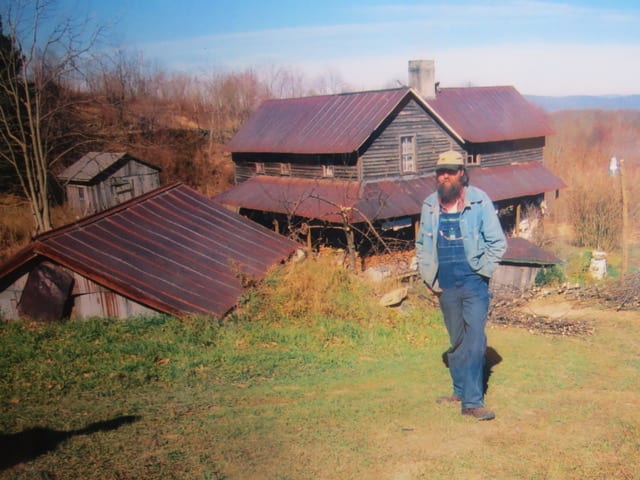
The image above is a print of a painting of the 100 plus year old home in which the greatest Appalachian storyteller Ray Hicks spent nearly his entire life.  The original painting was called "Ray's Moon" by Bob Timberlake and depicts the house which was located on Old Mountain Road above Banner Elk, North Carolina and stood for 121 years until the wee hours of the morning of Tuesday, May 25, 2021, when it was burned to the ground in a fire whose origin is so far unknown.  Although Ray Hicks died on April 20, 2003, and his wife Rosie died on January 31, 2014, it was reported by HCPress that the Hicks family still owned the house and the farm on which it was located.  The photograph belows is of Ted Hicks, the son of Ray Hicks, and the old house as it was when the family was living in it.  Ray Hicks' children were at least the third generation to live in the house.  

This old house was much more than a house.  It was a symbol of the North Carolina High Country lifestyle of self-sufficiency, farming, herb gathering, instrument making, story telling, and subsistence farming which the Hicks family and their neighbors had practiced for at least 200 years.  The house and its loquacious owner have been immortalized in books by Robert Isbell, Thomas Burton, Shannon Hitchcock, Christine Pavesic, and Owen Smith. It had also been the scene of several video recordings of Ray Hicks practicing the Appalachian storytelling for which he was the acknowledged grand master for the majority of his life. Several of those recorded stories and/or interviews are still available on YouTube. I have been fascinated by the life and story telling of Ray Hicks for less time than I should have been.  I only became interested in his works over the course of the last year or so and began to read books about him and his wife Rosie secondary to having studied the work of Leonard Roberts, who was also a great storyteller, collector, and author in his own right.  But, Ray Hicks was the man other Appalachian story tellers tried to emulate and always came up short in the effort.  

Sherrie Norris of High Country Press wrote the best report of the tragic fire which consumed the Hicks home on the morning of May 25, 2021, and that story can be found on the High Country Press web page.  But their web service is not very conducive to links in other articles or websites and her article is best found with an independent Google Search  using some phrase such as "Ray Hicks Home Burns".  I will quote some from Ms. Norris' excellent, highly personal, and very well written article because her appreciation for and love of Ray Hicks, his stories, and the old house shine through that article in a way which anyone who did not personally benefit from knowing Ray could never equal.  Early in the article, Sherrie Norris says this: 

"Many of us who were “lucky enough” will carry memories for our lifetime of climbing the curves to Old Mountain Road, looking out over the expansive, majestic view of four states, as Hicks often pointed out, and descending the worn pathway down to the place he called home."

Ms. Norris' article also makes it apparent that her love of the place included the house, the farm, the surroundings, and the lifestyle which Ray Hicks and his family had practiced for many years and continued to practice long after many others around them had abandoned that lifestyle.  

"Built by his grandfather, the house stood as a shrine of sorts, welcoming guests for decades from near and far. Whether we sat on the steps of the porch beside the woodpile, on the woodpile, in a ladder-back chair, or inside the house around the old wood stove — in awe of the unique father of Jack Tales himself — visitors were entertained and captivated, all at once. Even after his death, his closest followers gathered at the house in his honor several times in an effort to keep his memory alive.  When he died in 2003 at the age of 80, Hicks left behind a legacy that will not soon be forgotten."

Importantly, Ray Hicks' legacy was built of far more than the old house and that legacy will survive.  But the house was an important part of Ray Hicks and that legacy.  The old house with its ever present woodpile on the porch, the old cane bottom chairs for the frequent visitors who came to sit at Ray's feet and listen to his tales, and that old wood burning stove which Ray had uniquely crafted in the living room to heat the massive, old, poorly insulated house, were all a part of the total picture presented by the lanky 6' 7" Ray Hicks whose favorite way to spend time was passing on the Jack Tales and other stories he had learned and preserved in his 80 years on Beech Mountain.  In addition to preserving the tales he had heard during his formative years, there are also dozens of stories which Ray created in his own right.  

Ray Hicks was a self-made man who never amounted to much in the world when it came to money but he had a great deal of wealth in the thousands who gravitated to him and his tales of common people who overcame uncommon problems; killed giants; escaped witches, ghosts, and goblins; used common sense and everyday objects to always win in the end.  Ray Hicks won in the end and he won every time some new visitor traveled to Beech Mountain to sit on the porch of that old house and listen to this man with little education, a wonderful way of telling the stories of his childhood and his life, and a compassionate, all encompassing love for the common man and woman who always got back up and fought on against long odds to win in the end.  When that old house burned, North Carolina and America lost a cultural icon and a symbol the American pioneers who landed in the Tidewater and traveled deep into the mountains in order to build a new life and a new freedom far away from European plagues, kings, and ironclad class systems.  But the memories of Ray Hicks and that old house will always live on.  


Friday, May 21, 2021

"The Last Chivaree" by Robert Isbell--Book Review


Over the last several months, I have become more interested in Appalachian oral storytelling and traditional Appalachian folk songs than I had ever been.  Although I had never really heard many of the traditional folk tales and Jack tales, I had always been aware of them.  But I became interested in the work of the great deceased Appalachian storyteller Ray Hicks and have also learned of the work of Josiah H. Combs and others.  I was gifted a book called "Beech Mountain Man" about a nephew of Ray Hicks named Ronda Lee Hicks and based on audio recordings of Ronda Lee Hicks by the great Appalachian author, professor, and researcher Thomas Burton whom I had met at a large serpent handling church service in Western North Carolina.  I had also obtained, read, and written about "Rosie Hicks And Her Recipe Book" by Donnie Henderson Shedlarz which had also been edited and published by Thomas Burton after the death of Ms. Shedlarz.  All of these things led me to become more interested in Ray Hicks, his life and work.  


This book has apparently been produced and published in two different editions and under two different titles for some reason or other.  The author, Robert Isbell, also produced another book under the title "Ray Hicks Master Story Teller Of The Blue Ridge".  But, it seems this was just a reissue of "The Last Chivaree" which might have been done by the publisher, University Of North Carolina Press, in an effort to take advantage of the popularity and/or death of Ray Hicks.  The title, based on the Appalachian practice of the chivaree, may also have been using too obscure a word to increase sales.  A chivaree was a practice of throwing a party or, in come cases, a harassing event after a wedding.  I had heard of the word and the practice as a child from my father, Ballard Hicks, who told of chivaree's being practiced in his early days in the late 1800's and early 1900's in Knott County Kentucky.  Since I am writing more than one hundred years after that time, I probably owe my readers the explanation that my father was sixty-four years old when I was born and I benefited culturally from having him tell me the culturally based events of his early days.  I also benefited from the fact that I grew up in a country store and regularly heard my father and other men his age tell stories about their young days.  As my father described a chivaree, the harassment portion of the event involved a large group of friends, relatives, and neighbors of the bride and groom who showed up at their home for the wedding and threw a party.  But the party would often last all night long and part of the object was to keep the newly married couple up all night and prevent the immediate consummation of the marriage.  My father said this would involve both singing, dancing, story telling and simple noise making when all else failed.  The partiers might even resort to banging on pots and pans or shooting guns off into the night to disturb the newlyweds.  One of my father's favorite stories said that at one such marriage and chivaree that newlyweds had managed to go upstairs into the loft of the old log house to go to bed and the crowd below had dwindled down to only a few tired and quieter people who fell silent.  So his story goes, they suddenly heard the newlyweds talking in bed.  The dialogue went like this: 

Husband: "Well, I'm yours and you're mine."  

Wife: "Yes, we are."

Husband: "Well, you make the first move."  

The chivaree actually plays only a small part in Robert Isbell's book and is discussed only once in a brief section.  But this is an excellent book if you are interested in the life of Ray Hicks or Appalachian folk tales, Jack tales, or folk songs. It also gives an excellent account of life in Watauga County North Carolina in the early to middle twentieth century.  Robert Isbell knew Ray and Rosie Hicks well for many years and recorded numerous encounters with them.  The book is based on those recordings.  The book contains several of Ray Hicks' favorite stories and a few traditional folk songs as well as an excellent accounting of the life of the Hicks family in Watauga County.  Ray Hicks was a fascinating man who had grown up in poverty but was very self sufficient in subsistence farming and a variety of other rural agrarian occupations.  But, despite his fame, he never gained much money in his entire life.  He spent nearly all of his life in the aged farm house in which he was raised and within sight of the home of one set of his grandparents.  His wife Rosie had grown up in walking distance of Ray and their courtship took place almost exclusively on foot.  Ray would walk several miles to the home of Rosie's parents and spend the evenings sitting in front of the large stone fireplace in the little house which is described as "having ground hog hides nailed on the outside walls".  

This is an excellent book for the student of Appalachian Folkways, folk songs, Jack tales, and the rural, mountain lifestyle of the late nineteenth and early twentieth century.  It is easy to locate on most used book websites and is well worth reading.  


Tuesday, November 6, 2018

"Beech Mountain Man" by Thomas Burton---Book Review

Burton, Thomas: Beech Mountain Man (Knoxville, Tennessee, University Of Tennessee Press, 2009)

Thomas G. Burton is a professor emeritus of English at East Tennessee State University and an acknowledged expert in the field of Appalachian Studies and, particularly, in the area of Appalachian Serpent Handling.  His books on that subject are two of the best, most accurate, and most respected by the serpent handlers themselves.  But this book we are discussing today is not one of those books.  While it is subtitled "...The Memoirs Of Ronda Lee Hicks", it is not truly memoir.  In my opinion, it is much more accurate to describe it as oral history.  The format of the book is primarily direct, dialect transcriptions of audio tapes which Dr. Burton recorded with the subject, Ronda Lee Hicks, in the home of Rosa Hicks, the widow of the great Appalachian story teller Ray Hicks who was also a cousin to Ronda Lee Hicks.  The book is transcribed into relatively short sections on particular subjects which Hicks discussed during the taping.  Those sections are then combined in several chapters also on common subjects such as work, the military, and drinking.  There are short, generally single paragraph introductions written by Thomas Burton at the beginning of each section and chapter.  The tapes were transcribed with a solid attempt to be precise and ethical in rendering the unique sub-regional dialect of Appalachian English which Ronda Hicks spoke.  However, it is not my impression that the transcription was conducted according to strict linguist rules from any professional association of linguists.  

The foreword is written by John Shelton Reed, Professor Emeritus from the University Of North Carolina, and sheds some light on the possible intentions of the author.  In his foreword, Reed makes this important statement: "...Hicks is a classic example of a well-known type, the Bad Man.  The Bad Man may not be bad in all ways...but this is definitely someone you don't want to cross, or even seriously annoy, because he may respond with abrupt, brutal, and overwhelming violence."   It is my belief that Thomas Burton intended to produce a book which would, by first person anecdotes, deliver a studious rendition of the life of one such Bad Man. The Bad Man is just as much an iconic figure in America as the Folk Hero exemplified by Paul Bunyan, Mike Fink, and Johnny Appleseed.  Real, living Bad Men have included the recently murdered James "Whitey" Bulger, Clyde Barrow, and Billy The Kid.  In my work in the human services professions, I knew numerous men, and a few women, who would have fitted into the rubric of The Bad Man.  My favorite client of all time was a man who walked into my office one day, introduced himself, and went on to say "You've probably heard of me.  I killed my brother down the road in front of ten witnesses, shot him six times."  Then he went on to tell the full story of the murder, why he committed it, and of his time in prison. We went on to have a mutually productive professional relationship for several years. In many ways, he was a great deal like Ronda Lee Hicks.   

Ronda Lee Hicks also exhibited, in his recorded stories, many key symptoms of at least two genuine mental health or substance use disorders according to the DSM-V, the book which psychiatric practitioners use to formulate appropriate, empirically rendered diagnoses of those with mental health problems.  Ronda Hicks drank heavily most of his adult life and freely admitted and discussed it with Thomas Burton.  He also committed numerous acts of violence which were minimally sufficient to require his arrest.  He served time in prison on two separate occasions.  Yet, he was also a man who could show a capacity to help others, to be considerate, loyal, and giving under certain circumstances.  To put it lightly, he was an enigma.  

The book is well worth reading for the student of Appalachian Studies, linguists, corrections or mental health professionals, and quite simply those who enjoy knowing about Bad Men.  It is not the best of the works I have read by Thomas Burton and, perhaps some day, I will reread his better books and write about those on this blog.