Search This Blog

Showing posts with label dialect. Show all posts

Tuesday, September 17, 2019

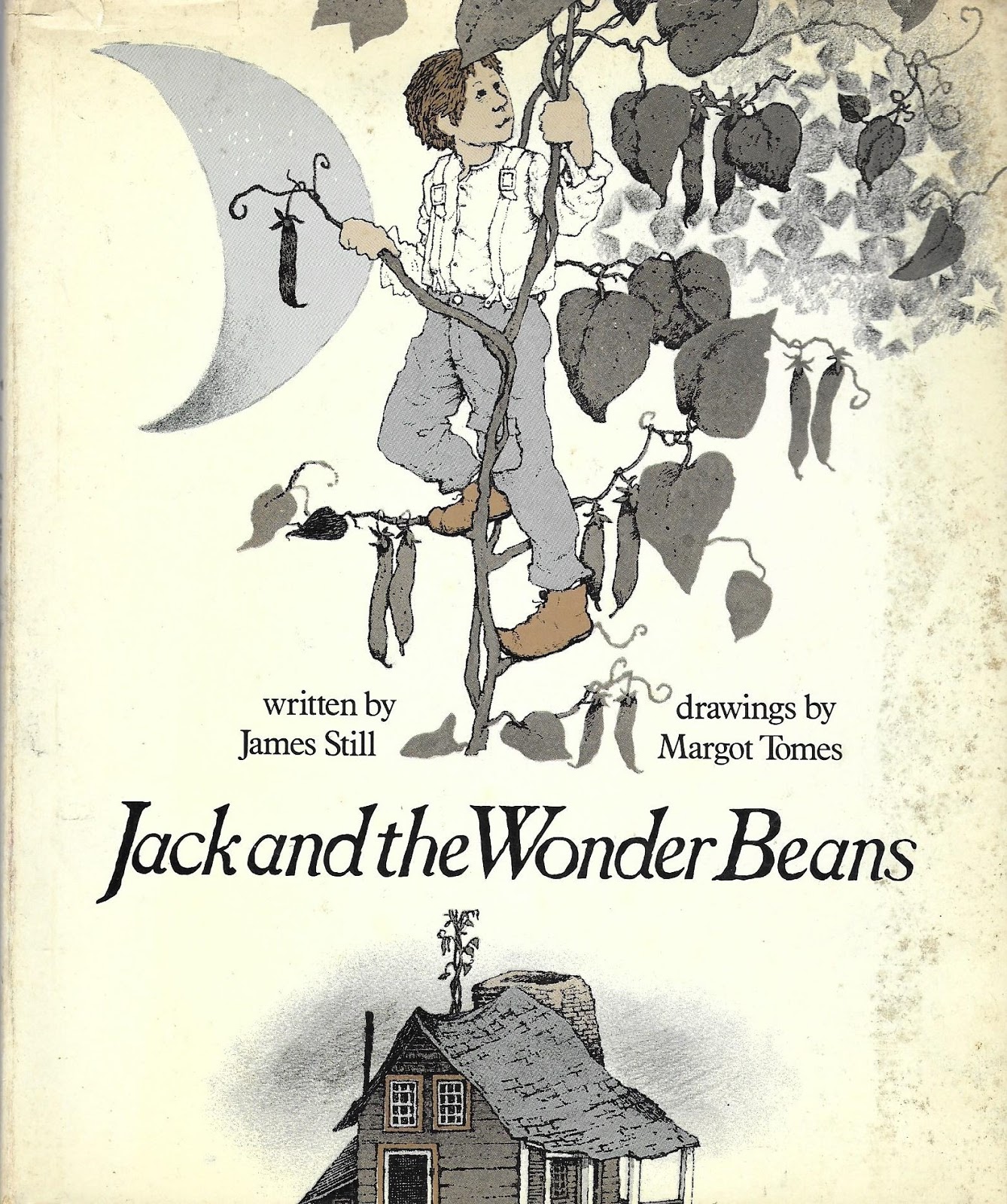
"Jack And The Wonder Beans" by James Still--Book Review

James Still--Photo by University Of Kentucky

Still, James & Illustrated by Margot Tomes. Jack and the Wonder Beans. (New York, G. P. Putnam's Sons, 1977)

This is James Still's Appalachian adaptation of the classic fairy tale "Jack and the Bean Stalk".  It is somewhat heavy on dialect and humor and yet it is probably better for your children than a simple fairy tale.  As for children and fairy tales, I would be a lot better satisfied if the majority of American and Appalachian children were being raised on fairy tales than computer based games of mass destruction.  We never seemed to have nearly as many problems with our children when their parents were sitting by their beds reading them stories about woodcutters chopping up criminal wolves in order to save little red haired girls than we are now when we hand each child some form of electronic device and leave them to their own devices with games in which weapons of mass destruction are used against the general public.  This book is one of at least three little books which G. P. Putnam's Sons published for James Still at the height of his national popularity which was rooted in the success of "River of Earth".  Two of the others are "Way Down Yonder On Troublesome Creek" and "The Wolf Pen Rusties Appalachian Riddles & Gee-Haw Whimmy Diddles".  For all three of these books, Putnam used New York illustrators which I suspect was a convenience to the publisher.  I also suspect the books might have been more authentically Appalachian if they had been illustrated by genuine Appalachian artists.  


"Jack and the Wonder Beans" makes a legitimate attempt to utilize Appalachian dialect, at which James Still was an acknowledged expert, while also attempting to not make the language unreadable for the general public.  I suspect that the original text, as Still would have sent it to the publisher, was considerably more rooted in dialect.   The dialect in the book seems "cleaned up" at times especially when you compare it to the dialect in "River of Earth" or his short stories.  The art work also seems at times to be much more generically "Southern" than truly Appalachian.  But the book is loaded with expressions I heard as a child in Knott County such as "a hog on ice" and "feet as big as corn sleds".  Any reference to a corn sled can generally be assumed to be Appalachian or Southern.  In all my travels over half of America and a bit of Mexico and Canada, I have never heard anyone outside Appalachia refer to the family corn sled and I have to admit that I have recently used a reference to "that fancy corn sled" which Old Saint Nick drove "behind them funny looking deer". Corn sleds have always been handy both on the farm and in a bit of writing intended to educate the outside world about Appalachia.  I commend James Still for having reverted to the use of a corn sled in this book. 

While this book is a bit dated, which is not unusual in the many books I have read and written about on this blog.  But it is well worth reading both for children and adults.  I often read children's literature when I want a break from more academic reading.  This book is also widely sold on used book websites and should be easy to locate.  If you want a reminder of the old Appalachian dialect of your ancestors, this is a good place to start.  

Monday, September 9, 2019

"River Of Earth" by James Still--Book Review

James Still--Photo by University Of Kentucky

This novel by James Still is frequently referred to as "the quintessential Appalachian novel" and at times even as "the best Appalachian novel ever written".  I agree that it is a wonderful novel with beautiful use of dialect which is very difficult to produce accurately without becoming maudlin.  Still did an excellent job of dealing with the classic Appalachian dialect of my native and his adopted Knott County Kentucky.  The novel is narrated by a young boy of about 8 or 10 whose family is overburdened with poverty, illness, death, and deprivation.  They move back and forth from the hillside farm on which the story begins and the coal camp nearby where the father works whenever he is able.  The mother is devoted to her family and the family farm where she eventually buries her most recent child who dies of poverty and malnutrition.  Another son loses some fingers from playing with a blasting camp during their stay in the coal camp.  Three worthless relatives of the weak father move in on the family anytime they begin to do well and have an extra meal or two available.  They contribute nothing to the family and generate strife between the father and mother.  In this book (The Hills Remember: The Complete Short Stories Of James Still), Still writes in (his version of) the dialect which my parents, grandparents, aunts, uncles, cousins, and the customers in our country store spoke during my childhood.  Other than Mildred Haun, Still may well be the best writer in Appalachian dialect.  But one word used by Still always sticks in my craw as a native Knott Countian.  That word is "chaps" to refer to children and I never heard any of the native speakers around whom I spent my childhood use that word to refer to children.  I suspect the word "chaps" was imported by James Still into his novel subconsciously from his native Eastern Alabama.

" When I wrote about "The Hills Remember: The Complete Short Stories Of James Still", I discussed his dialect writing in comparison to that of Mildred Haun and I append that discussion here: Still is also frequently referred to as one of the better, if not the best, writers in Appalachian dialect.  I do not dispute that he is a fine writer in Appalachian dialect.  But I will always believe that Mildred Haun is a far superior writer of Appalachian dialect.  Her classic work "The Hawk's Done Gone" is far and away the best dialect writing ever done in Appalachian Literature.  As I said earlier, I spent the first twenty years of my life in Knott County Kentucky, was educated there through high school and began my college education at Alice Lloyd College.  I was also reared by my parents, maternal grandparents, and an extended family of aunts and uncles who all grew up in Knott County early in, and in some cases before the turn of the twentieth century.  I know Knott County Appalachian dialect as well as any human on earth and I must insist that there are times when I see that  James Still wrote linguistic expressions which I never heard from my parents, grandparents, aunts, uncles, farmers at the livestock sales or jockey grounds, or the elderly customers at my parents' country store.  The one word which he used frequently, especially in "River Of Earth" and his short stories and which I never once heard in Knott County is "chaps" in reference to small children.  In my childhood, small children were "young'uns", "chillun", "yard apes", "curtain climbers", and several more conventional, less colloquial terms.  But they were never "chaps".  I suspect that is an expression from Still's youth in Alabama.  Getting back to the comparison between Still and Haun, I will defend Still to the degree that the two of them were writing dialect based on two different subregions of Central Appalachia.  I have also traveled extensively in the Cocke County, TN, area where Haun spent her life and did extensive research among Appalachian serpent handlers there.  The two subdialects have significant differences.  But Haun's consistency and accuracy in writing dialect is superior to James Still's.  It is also worth noting that it is only 63 miles from Harrogate, TN, where Still attended college to Newport, TN, where Haun lived her life.  I do not know that Still ever spent time in Newport but since he and Haun both attended Vanderbilt University it is possible that he did know her and might have even visited the area which would have also exposed him to the dialect which she wrote so admirably.  It is also possible that Still's travels from Chambers County Alabama to Claiborne County Tennessee to Davidson County Tennessee to Knott County Kentucky could have provided a plethora to opportunity for Still to blend the dialects of the four to a degree that not even he recognized."

I do not mean to disparage James Still as an Appalachian writer.  He is a wonderful writer and his work, especially "The River Of Earth", has been taught in classes in colleges and universities all across America and several foreign countries.  But after 68 years of life arising in and being deeply influenced by Knott County, I am firmly convinced that I understand the local dialect as well as anyone on earth.  And, if I am allowed to move on from the discussion of his dialect writing to a simple discussion of the novel as an example of outstanding literature, I firmly believe that it borders on being a masterpiece.  But there are other writers who have lived and written in, of, and about their native Appalachia whose work rivals Still's and I would never go so far as to say any of them have written "the best Appalachian novel".   I believe that appellation is still up for grabs.  I believe that supporters of Harriett Simpson Arnow, Denise Giardina, Gurney Norman, Wilma Dykeman, and Thomas Wolfe can all make rational arguments that each of these authors has written "the best Appalachian novel".   

But let me close by saying that James Still was a wonderful novelist.  In my opinion, he was a far better novelist than a poet for which he actually is often praised more highly.  This novel is arguably a masterpiece and will always be worth reading because of the strong characterizations, the building and resolution of conflicts throughout, and the stark, simple, powerful language which draws the reader into this book and leaves her wanting more and also wanting to help this family fight against their unending struggle to survive.  It is wonderful writing. 

Tuesday, November 6, 2018

"Beech Mountain Man" by Thomas Burton---Book Review

Burton, Thomas: Beech Mountain Man (Knoxville, Tennessee, University Of Tennessee Press, 2009)

Thomas G. Burton is a professor emeritus of English at East Tennessee State University and an acknowledged expert in the field of Appalachian Studies and, particularly, in the area of Appalachian Serpent Handling.  His books on that subject are two of the best, most accurate, and most respected by the serpent handlers themselves.  But this book we are discussing today is not one of those books.  While it is subtitled "...The Memoirs Of Ronda Lee Hicks", it is not truly memoir.  In my opinion, it is much more accurate to describe it as oral history.  The format of the book is primarily direct, dialect transcriptions of audio tapes which Dr. Burton recorded with the subject, Ronda Lee Hicks, in the home of Rosa Hicks, the widow of the great Appalachian story teller Ray Hicks who was also a cousin to Ronda Lee Hicks.  The book is transcribed into relatively short sections on particular subjects which Hicks discussed during the taping.  Those sections are then combined in several chapters also on common subjects such as work, the military, and drinking.  There are short, generally single paragraph introductions written by Thomas Burton at the beginning of each section and chapter.  The tapes were transcribed with a solid attempt to be precise and ethical in rendering the unique sub-regional dialect of Appalachian English which Ronda Hicks spoke.  However, it is not my impression that the transcription was conducted according to strict linguist rules from any professional association of linguists.  

The foreword is written by John Shelton Reed, Professor Emeritus from the University Of North Carolina, and sheds some light on the possible intentions of the author.  In his foreword, Reed makes this important statement: "...Hicks is a classic example of a well-known type, the Bad Man.  The Bad Man may not be bad in all ways...but this is definitely someone you don't want to cross, or even seriously annoy, because he may respond with abrupt, brutal, and overwhelming violence."   It is my belief that Thomas Burton intended to produce a book which would, by first person anecdotes, deliver a studious rendition of the life of one such Bad Man. The Bad Man is just as much an iconic figure in America as the Folk Hero exemplified by Paul Bunyan, Mike Fink, and Johnny Appleseed.  Real, living Bad Men have included the recently murdered James "Whitey" Bulger, Clyde Barrow, and Billy The Kid.  In my work in the human services professions, I knew numerous men, and a few women, who would have fitted into the rubric of The Bad Man.  My favorite client of all time was a man who walked into my office one day, introduced himself, and went on to say "You've probably heard of me.  I killed my brother down the road in front of ten witnesses, shot him six times."  Then he went on to tell the full story of the murder, why he committed it, and of his time in prison. We went on to have a mutually productive professional relationship for several years. In many ways, he was a great deal like Ronda Lee Hicks.   

Ronda Lee Hicks also exhibited, in his recorded stories, many key symptoms of at least two genuine mental health or substance use disorders according to the DSM-V, the book which psychiatric practitioners use to formulate appropriate, empirically rendered diagnoses of those with mental health problems.  Ronda Hicks drank heavily most of his adult life and freely admitted and discussed it with Thomas Burton.  He also committed numerous acts of violence which were minimally sufficient to require his arrest.  He served time in prison on two separate occasions.  Yet, he was also a man who could show a capacity to help others, to be considerate, loyal, and giving under certain circumstances.  To put it lightly, he was an enigma.  

The book is well worth reading for the student of Appalachian Studies, linguists, corrections or mental health professionals, and quite simply those who enjoy knowing about Bad Men.  It is not the best of the works I have read by Thomas Burton and, perhaps some day, I will reread his better books and write about those on this blog.  


Friday, November 24, 2017

Mildred Haun Conference--Walters State College, Morristown, TN, February 2-3, 2018

The 2018 Mildred Haun Conference will take place at Walters State College in Morristown, TN, on February 2-3, 2018.  The featured author at this year's conference, in addition to Mildred Haun, will be Marie Manilla, whose work I have written about on this blog and also previously published a review of her novel, "T he Patron Saint Of Ugly", in the Appalachian magazine "Now And Then".  Marie Manilla is a native and current resident of Huntington, WV, and the great majority of all her published work focuses on Appalachia with just a wee bit based on Texas which she knows well.  Manilla is often the featured writer at conferences these days which focus on the literature of Appalachia and she well deserves that attention.  

The focus of the conference is titled "Who Tells Our Stories: History, Haints, and Happenings".  I apologize for the fact that I did not mention this conference on this blog before the submission deadline for papers and presentations had passed.  The conference staff are also establishing an online journal this year which will publish the best papers from the conference where they will be available for the foreseeable future.  I will be presenting a paper at the conference on Saturday afternoon, February 3, 2017.  That paper is titled "Mary Dorthula White and Saint Garnet: Saints Or...?"  The paper will examine similarities in and differences between two major female characters, one each of which was created by Haun and Manilla: Mary Dorthula White, the protagonist/narrator of Haun's book, "The Hawk's Done Gone" and Saint Garnet del Vulcano, the protagonist/narrator of Manilla's book, "The Patron Saint Of Ugly".  

If you have not read the work of either of these women, you should spend the money to alleviate that void in your knowledge of Appalachian Literature, especially Appalachian Literature by and about women.  Marie Manilla is a graduate of the University of Iowa Writer's Workshop which has furthered the education of Flannery O'Connor, John Irving, and Wallace Stegner.  It is arguably the best masters degree level creative writing program in the country.  Admission to this program in and of itself is a statement that the applicant has demonstrated talent well above the average. 

Mildred Haun was a 1937 masters degree graduate of Vanderbilt University under the well known writing professors John Crowe Ransom and Donald Davidson.  Haun only published one book of fiction, the aforesaid "The Hawk's Done Gone", which is one of the finest little books ever produced in the state of Tennessee.  She wrote the stories in the book during her writing classes and never sought to publish another book.  Her masters thesis "Cocke County Ballads And Songs" is widely considered one of the best collections and examinations of the folk songs of Appalachia ever assembled.  The book, "The Hawk's Done Gone", is a unique work in many ways.  It is an outstanding use of Appalachian dialect in a fictional setting.  The dialect used in the book is that of Cocke County Tennessee around the turn of the twentieth century at the time of Mildred Haun's childhood.  It is a shame that she never wrote and published more both in the fields of fiction and non-fiction.  The book also bridges the gap between the novel and a collection of short stories with a central narrator and protagonist in most of the stories and a central cast of recurring characters.  The book does have a rough time line which runs parallel to the narrator's life which further blurs the line between novel and short story collection.  It is a book well worth reading for many reasons.

I would love to see all of the regular readers of this blog at the conference.  I will also look forward to reading comments on this blog from those of you who have read or will read the works of both Haun and Manilla. 

Monday, August 28, 2017

Thoughts About Writing Dialect

I am somewhat omnivorous in my reading within a few reasonable bounds.  I will read almost anything with the exception that I generally never read what I call "drugstore fiction".  By that, I mean that I will generally never read anything that can be found on the paperback racks at your local small store, dollar store, or other such general market businesses.  The one exception I make to that rule is that I do sometimes read the work of Dean Koontz who, at his best, is a better than average writer with intelligent, original, well constructed, plots which will hold the attention of most discriminating readers.  At his worst, Koontz is a typical drugstore fiction author.  Like most other authors who consistently crank out one or more books a year, he does not always produce his best work and sometimes, he, his agent, and publisher inflict some fairly low grade work on the ever receptive fan base he has developed over the years.  

I like to read with some variety although my first love will always be Appalachian literature, both fiction and non-fiction.  I am a native born, native educated, and proud Appalachian and I never apologize for it.  Several of the best writers America has ever produced came from Appalachia: Pearl S. Buck, Thomas Wolfe, Albert Stewart, Loyal Jones, P. J. Laska, Bob Snyder, and several others both living and dead. I do frequently find myself reading other literature from other areas, some in the social sciences where my degrees are rooted; history both Appalachian and World; poetry from the recognized masters; anthropology; and the natural sciences.  I often deliberately use a book from one of these areas to break up long term periods of nothing but Appalachian Literature. 
This post has been primarily caused by a little book I reread today from the fields of African American and children's literature, "Flossie & the Fox" by Patricia C. McKissack and illustrated by Rachel Isadora.  I had bought and read the book originally when I was employed as a mental health therapist in a juvenile treatment facility at a time when state licensing agencies were particularly focused on the consistent provision of culturally diverse group therapy and culturally diverse encounter experiences.  I dug it out of a pile of books today because my wife and I have had our seven year old nephew in our home for about two weeks and I am particularly focused on diminishing the amount of time he spends with what I consider to be his obsession with "Mine Craft" an internet based game whose value I seriously doubt.  "Flossie & the Fox" was published in 1986 and some readers and parents might consider it a bit dated.  The book is described by the author as "...a story from my youth, retold in the same rich and colorful dialect of the rural South."  It is an African American story about a young girl on a plantation who is sent to deliver some eggs to a neighbor of her mother's.  She is warned before she leaves home about a fox which has been stealing a lot of eggs and which cannot be caught by the local hounds.  In the story, she meets the fox and enters into a lengthy conversation, argument, or discussion with him in which she denies believing that he is actually a fox.  Told in rich African American dialect from the rural, agricultural south, the story moves quickly with humor, insight, and grace.  The little girl and one of the local hounds ensure that the eggs make it to their intended destination.  In spite of its age and particular cultural focus, it is a book which is worthy of any young reader's attention.  For those of us who are interested in southern or African American dialect, it is also interesting to the adult reader. It is a story about a young child learning self sufficiency, confidence, and inner strength.  I am glad my nephew's presence caused me to dig that little work out and reread it.  I freely recommend it to both you and your children or grandchildren.

It also reminded me of a fairly new friend of mine, an African American woman who grew up in poverty and lived to retire from the federal government.  She also happens to write some highly readable memoir material.  The dialect material in "Flossie & the Fox" might not be totally accurate in today's south.  But it is a rich window into the language spoken on plantations, farms, and small town streets in a dozen states running from Maryland to Florida and from Georgia to East Texas.  I rarely write in dialect and do not always see the value in using it.  Any culturally based dialect is worth saving for posterity whether it is Appalachian, African American, or Viet Namese American or any other.  Dialect written well and accurately can be a joy to read and learn.  Dialect written poorly and inaccurately can be a painful caricature of a culture and a people.  There is nothing in the world worse than bad dialect written by a person who knows little or nothing about what they are attempting to create.  Thank God that Patricia C. McKissack knew what she was writing about. 


Sunday, April 16, 2017

"The Hills Remember The Complete Short Stories Of James Still" Book Review

Still, James and Ted Olson (Editor) 2012  The Hills Remember The Complete Short Stories Of James Still (Lexington, University of Kentucky Press) 


Growing up in Knott County Kentucky where James Still lived for most of his 94 years, I knew about James Still at about the same time I became aware of Appalachia and Appalachian Studies sometime in the late 1960's. I honestly do not recall the first time I met James Still.  I cannot say that James Still and I were friends but we were acquaintances and I was flattered to be able to refer to him as Jim to his face.  I was also able to introduce Jim Still and my long time friend and mentor, National Book Award Finalist P. J. Laska at a James Still reading at Black Swan Books in Lexington, KY, sometime in the early 1990's.  As I recall, it was some time shortly after the release of the "Wolf Pen Notebooks". That was a highly interesting evening for several reasons.  Lexington socialite Anita Madden was at the reading wearing a pair of skin tight bright blue pants and she and Jim flirted for most of the evening.  If you have never seen an 85 year old man flirt with a 60 year old woman and find that flirtation reciprocated, I highly recommend it as entertainment especially if the man and woman are of the caliber of Madden and Still.  After the reading, Laska, Still, and I went to eat at a Shoney's Restaurant on North Broadway near the Springs Motel where he usually stayed when he was in Lexington.  We stayed in the restaurant until about 1am talking about Appalachia, literature, Appalachian Literature, Still's travels around the world, the Southern Appalachian Circuit of Antioch College writers group of which Laska and I were both members, and the triumvirate of Appalachian writers of which Still was a member, the 1929 class from Lincoln Memorial University which included Still, Jesse Stuart, and my friend and mentor as well as Laska's professional colleague, Don West.  That evening deserves to be addressed in a completely separate blog or essay and will be some day.  

James Still Photo by University Of KY


Over the years I had read large chunks of Still's writing but had never had the pleasure of reading his complete short stories.  I recently bought the book "The Hills Remember..." and plowed through it in something less than record time.  It contains 53 stories of which a couple are published in the book in two versions, usually one as it was published in a magazine and another as it was included later as a chapter of a novel or part of a major short story collection. Still  had a practice of often publishing short stories in magazines and later using them as book chapters both as originally published and sometimes with significant edits.  "The Hills Remember..." is believed to contain every extant story written by Still.  Ted Olson, the editor, did an excellent job of locating, editing and collating the works.  Olson had worked with Still prior to his death, was aware of his idiosyncrasies, and was an excellent choice as the editor.  The stories are arranged in somewhat chronological order as they were originally written or published and contain all the stories which were included in "River Of Earth", "The Run For The Elbertas", "Pattern Of A Man", and "On Troublesome Creek".  The book is an excellent way for the economically minded reader to achieve as broad as possible a sampling of Still's short fiction.  But I would not recommend that the person seeking to fully understand his prose output read the book and assume they are done.  The stories which were included in "River Of Earth" are not always exactly as they were published in the novel. There may also be slight differences in these versions of the stories included in "The Run For The Elbertas" and the other two aforementioned collections.  The stories which are included as chapters in the novel "River Of Earth" are also not necessarily published in this collection along the timeline of the novel.  If you are a real aficionado of Appalachian Literature or James Still, you will want to read his entire body of work.  Still was a widely known short story author in America as evidenced by the body of stories which were previously published in national magazines such as "Atlantic", "Yale Review", and "Virginia Quarterly Review".  This book attempts, in part, to reassert Still as a major American short fiction author in addition to his prior recognition as a novelist and poet.

The book contained several stories I had not read and several of those are well above average.  The first and best surprise I received from the book was a story called "Sweet Asylum" which is set in James Still's native Alabama.  This story is about an Alabama cotton plantation owner who is deep in debt, widowed, and seeking a way to resolve his debts and save his family plantation.  It is a masterpiece which instantly reminded me of the work of Kate Chopin.  In terms of technique, it is highly reminiscent of her classic "The Story Of An Hour".  It is not quite as masterful a work but uses the same type of double twist ending to slam doors in the faces of both the protagonist and the reader. It may well be the best short story James Still ever wrote.  James Still has so thoroughly been identified as a master author of Southern Appalachia that many of his readers either forgot or never knew that he was born and grew up in Chambers County Alabama, an area that is very different culturally and physically from Knott County Kentucky and Central Appalachia. I should state for the record that I have traveled extensively in Alabama in general and Chambers County in particular and know that area quite well.  James Still did, however, spend the great majority of his life in Knott County and Appalachia and will forever be seen as an Appalachian author.  He went to Lincoln Memorial University in 1925 and graduated there in 1929 as a member of that incredible threesome of Appalachian writers: Still, Don West, and Jesse Stuart. LMU is located in Harrogate, TN, in Claiborne County, which is just as much the heart of Appalachia as Knott County. Hindman, KY, and Harrogate, TN, are only 100 miles apart.  During his time at LMU and later throughout his life, Still was a classmate and friend of both Jesse Stuart and Don West. During that time frame, John Crowe Ransom and the Agrarians and Fugitives were key components of the literary world at LMU. Collectively, Still, West, and Stuart of the LMU Class of 1929 are arguably the best single graduating class of regional writers to ever graduate from any university in the same academic year. That is a particular feather in the hat of LMU since it is a decidedly small university with only 1,675 undergraduate students as of this writing. Still then completed a Master of Arts Degree in English at Vanderbilt University in Nashville.  After completing his work at Vanderbilt he was employed by the Hindman Settlement School and remained in Knott County for the rest of his life.

The second observation I made as I read "The Hills Remember..." was that in many of Still's short stories there is a level of violence which could almost be called gratuitous.  Several of his stories, including one which I consider among his best, culminate in or originate from murder.  The second story in the book and the title piece "The Hills Remember" is a fine piece of work but also inordinately violent.  The main character, Old Aus Hanley "...had a graveyard all his own across Stormspur filled with men he had killed."  As the story begins, Aus Hanley is lying in a pool of his own blood after being ambushed by a drunk man, shot in the back by someone whom no one in the area  would have believed capable of murder and especially not capable of the murder of Aus Hanley.  A crowd gathers to watch Aus Hanley die.  The sheriff arrests the drunken perpetrator and stands near the victim also waiting to see him die.  The crowd all believe that one of Aus Hanley's family members who are too far away to attend the death will eventually seek revenge against the shooter.  But Aus Hanley calls the sheriff from his death throes to bring the shooter to him so he can learn who killed him.  The story concludes with Hanley pulling his murderer close to him and "...his right arm lunged in a single driving stroke toward Luke's breast...The handle of a Barlow knife protruded from his breast."  With his final dying act, the murdered man has also murdered his killer.  It is a wonderful story but the level of violence portrayed is well beyond that found in most short American fiction.

Speaking as a native of Knott County which is generally assumed to be the setting of most of Still's work, I must say that it is not a level of violence I found common in the time I was growing up there. I was born in Knott County roughly 20 years after James Still moved to the county.  I grew up in a country store in the Beaver Creek area of the county. My father was born in 1887 on Bruce at Mousie and lived most of his early life in Mousie, not far from Hindman where Still lived.  My mother had been born and reared on Rock Fork Creek in still another area of the county.  I was exposed to people from all over Knott County and the surrounding area.  Although I knew several people during my childhood who either had already or later committed murder, the area was never as violent as Still portrayed it in many of his stories.  A second story which is incredibly violent is called "The Scrape".  In that story, two men induce the protagonist to tie their arms together with a wire, take charge of their guns, and observe as they fight with knives to a mutual death.  "Jiddy produced a wire...He ordered me to tie an end around his left wrist, and the other about Cletis's.  A thing they had agreed on.  I did what I was bid do..."  The story ends with both men dead in the dirt road and the narrator heading off toward his original destination with the comment "I thought about Posey Houndshell.  Nobody stood between me and her." 

I must admit that I have not read the two books which might help me to further understand the violence in Still's fiction.  They are: "James Still In Interviews, Oral Histories, and Memoirs" by James Still and the aforementioned Ted Olson; and, "James Still: Critical Essays On The Dean Of Appalachian Literature" edited by Ted Olson and Kathy H. Olson.  What I would really love to see is a book length work solely addressing that issue of violence in Still's work. 

Still is also frequently referred to as one of the better, if not the best, writers in Appalachian dialect.  I do not dispute that he is a fine writer in Appalachian dialect.  But I will always believe that Mildred Haun is a far superior writer of Appalachian dialect.  Her classic work "The Hawk's Done Gone" is far and away the best dialect writing ever done in Appalachian Literature.  As I said earlier, I spent the first twenty years of my life in Knott County Kentucky, was educated there through high school and began my college education at Alice Lloyd College.  I was also reared by my parents, maternal grandparents, and an extended family of aunts and uncles who all grew up in Knott County early in, and in some cases before the turn of the twentieth century.  I know Knott County Appalachian dialect as well as any human on earth and I must insist that there are times when I see that  James Still wrote linguistic expressions which I never heard from my parents, grandparents, aunts, uncles, farmers at the livestock sales or jockey grounds, or the elderly customers at my parents' country store.  The one word which he used frequently, especially in "River Of Earth" and his short stories and which I never once heard in Knott County is "chaps" in reference to small children.  In my childhood, small children were "young'uns", "chillun", "yard apes", "curtain climbers", and several more conventional, less colloquial terms.  But they were never "chaps".  I suspect that is an expression from Still's youth in Alabama.  Getting back to the comparison between Still and Haun, I will defend Still to the degree that the two of them were writing dialect based on two different subregions of Central Appalachia.  I have also traveled extensively in the Cocke County, TN, area where Haun spent her life and did extensive research among Appalachian serpent handlers there.  The two subdialects have significant differences.  But Haun's consistency and accuracy in writing dialect is superior to James Still's.  It is also worth noting that it is only 63 miles from Harrogate, TN, where Still attended college to Newport, TN, where Haun lived her life.  I do not know that Still ever spent time in Newport but since he and Haun both attended Vanderbilt University it is possible that he did know her and might have even visited the area which would have also exposed him to the dialect which she wrote so admirably.  It is also possible that Still's travels from Chambers County Alabama to Claiborne County Tennessee to Davidson County Tennessee to Knott County Kentucky could have provided a plethora to opportunity for Still to blend the dialects of the four to a degree that not even he recognized. 

Do not allow anything I have said in this post to leave you with the impression that I do not respect and value the writing of James Still in all genres in which he wrote.  He is definitely at the vanguard of writers about Appalachia.  His short fiction can stand up well in comparison to nearly any other writer in American Literature.  The book "The Hills Remember..." is a compulsory read if you intend to believe or say that you understand the literature of Appalachia.  Buy a copy and read it sometime soon.  You will enjoy it greatly.