A member of the Facebook group "Appalachian Recipes And Chat", Carolyn Stroble-Gross, read my post about
Turkey Craw Beans and asked me if I knew about what she prefers to call Leather Britches which is a perfectly acceptable name for what I prefer to call Shucked Beans. Since I posted this blog post earlier today on September 11, 2020, I have received one comment from a reader who says her grandmother called them "Fodder Beans" which I had never heard. Here is her comment.
Anna-Marie O'Shea was the
commentor and this is what she said: "My grandmother called them “fodder
beans”. She put them in the sun on cookie trays to dry. They sure were
good." This name for the beans, which I assume is a very localized regional variant in name was also verified by Lucy Lowe-Hill. After I had posted the original blog post of this article, I saw my friend, Bill Best, a retired Berea College professor and national expert on Appalachian Heritage food crops, and we discussed the fact that this blog post was going wild with readers, comments, likes, and shares on Facebook. I brought up the question with Bill about "Fodder Beans" and he reminded me that Harriet Simpson Arnow had written briefly about what she called "Fodder Beans" in her book, "Seedtime On The Cumberland" which is actually a companion book to her work, ""Flowering Of The Cumberland". I hope to sometime write about both these books on this blog. Each of them is a masterpiece in Appalachian history, culture, sociology, and life. In "Seedtime On The Cumberland", Arnow has this to say on pages 412 & 413:
"Dried green beans, known as shuck or fodder beans, needed an even long cooking but in winter made a fair substitute for green beans, and in drying them in summer the onld ones followed much the same recipe as that given in a Nashville newspaper of 1811, save they did not put in a teaspoon of sugar. However, the main bean in winter was the dried bean, almost always boiled, for beans boiled with bacon and less often ham hocks, were to the Cumberland partly what the baked bean was to New England, though in that country of abundant meat, beans and peas together were never as important as in New England." (Harriet Simpson Arnow, "Seedtime On The Cumberland", pp. 412-413)
 |
| Shucked Beans, Photo by West Virginia Mountain Mama |
But I grew up all my life hearing them called Shucked Beans by everyone around me and nearly all of those people were doing as my parents were and making shucked beans every year to eat all winter long every winter. Shucked Beans have been produced and eaten in the mountainous regions of Central and Southern Appalachia for at least three hundred years. My most distant known ancestors were in Eastern Kentucky by at least 1790 and I am certain they were making and eating Shucked Beans then. I honestly have not seen Shucked Beans in any region of the country outside Central and Southern Appalachia other than those areas of the Midwest where native Appalachians moved to in the Great Migration following World War II. I know many members of my extended family in the area north of Fort Wayne, Indiana, who regularly dry and eat Shucked Beans but that area is also widely affected by Appalachian Culture in other ways also due to the large number of Appalachian migrants who moved there. I also know many people in that area who grow large gardens, hunt and eat a wide variety of wild game animals, hunt mushrooms, and live a basic subsistence lifestyle although most of them are working five days a week in an industrial factory.
When I was growing up, we always dried our Shucked Beans on a string as they are shown in the photo above. But if you have ever spent a day or two stringing beans and threading them on that twine with a darning needle you know that it is not pleasant work. The only thing that gets most people through the annual effort to make Shucked Beans in this manner is the knowledge as they work that on some cold, snowy, winter day they will be eating those beans cooked with a sizeable chunk of hog jaw which is how we always cooked them.
 |
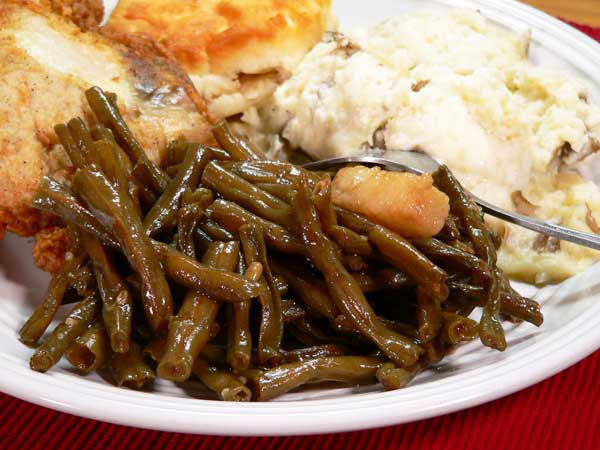
| Shucked Beans At Supper Time, Photo by Taste of Southern |
I learned long ago that the best way to make Shucked Beans is to string and break them just as if you were going to cook them that day. Then you take the beans and place them on a white sheet either on a blacktop driveway or on a tin roof. You must always bring the drying beans inside the house at night before they become wet with the dew in order to prevent them from becoming moldy or mildewed. On days when it rains, the beans obviously cannot go outside. What I also have learned to do in recent years, is to place the partially dried beans both on rainy days and overnight between sunny days spread out on that same sheet on an unused bed under a ceiling fan on its lowest setting. They will actually continue to dry in this fashion. I have actually produced Shucked Beans a few years in long rainy spells when they were rarely outside in the sun. Shucked Beans are finished drying when they are so dry in that sheet that they rattle a bit like a rattlesnake rattle when you pick them up and shake them in the sheet. Then we bag them up in plastic freezer bags in meal sized portions and put them in our freezer. When I was growing up, we usually stored Shucked Beans in empty fifty pound lard cans with a few pods of hot pepper in the cans to prevent them from becoming infested with insects, or as we called it then, "to keep them from getting buggy". But just as I like them broken and dried on a sheet better than strung on twine, I also like them better in the freezer than in a lard can. I have also seen a few people dry Shucked Beans by placing them on a sheet inside a parked car, generally on the back window ledge. I do not like that practice and I believe it changes the flavor in a noticeably negative way. I have also seen people use a food dehydrator to attempt to make Shucked Beans and I just do not like the flavor they have there. They come up short in what I call the "earthy" flavor. In fact since I first posted this blog post, I have had at least one comment on Facebook that the author bemoaned the use of a dehydrator because they did not taste like her mother's had.
Here is a photo by Frank Barnett of our mutual friend, Bill Best with his recently made shucked beans. I was with Bill a few days ago as he was breaking and starting to dry these beans. The photo was sent to me on October 8, 2020, by Frank. If you share or use the photo, please give Frank Barnett appropriate photographer credit.
When it comes to what kind of beans to use to make Shucked Beans, I prefer good, clean, long White Half Runners. But I have seen others use nearly every kind of bean grown commonly in Appalachia to make them. But White Half Runners, when they are a pure strain without negative mutations and have been grown properly and picked at their prime, are always, long, clean, straight, flavorful, and dry into great beans. When they are cooked, I have known a few novices in the world of Shucked Beans who do not like the flavor which always baffles a true Shucked Bean eater. That flavor is what I call "earthy". When they are right, it is almost similar to picking up a handful of dirt and tasting it which is markedly different from the flavor of freshly picked and cooked White Half Runners. As I understand it, that earthy flavor comes about because as a part of the drying process, or dehydration, the minerals in the beans become more concentrated and the flavor changes. The fact that Shucked Beans never fully rehydrate in the soaking and cooking process also has contributed, I am certain, to the name Leather Britches. Many people insist on having some form of meat, usually beef or pork, in a meal with Shucked Beans as a side dish. I am perfectly content with Shucked Beans, with maybe a few potatoes thrown in with the hog jaw, as the main dish and a big pone of cornbread and, maybe, one other vegetable such as corn as the complete meal. My wife grew up in Wisconsin, about halfway between Milwaukee and Green Bay and never saw a Shucked Bean until she married me and came to Eastern Kentucky in her twenties and she loves good Shucked Beans. I have seen a few other converts to Shucked Beans who met them later in life. But I also tend to believe they are an acquired taste and if you have been fed them mashed up in your mother's plate with a fork as a baby being introduced to your first solid foods, you will never be happy in life if you do not get a few "messes" of Shucked Beans every winter.
 |
| Strings Of Still Green Shucked Beans, Photo by Taste of Southern |