Search This Blog

Showing posts with label shucked beans. Show all posts

Friday, August 25, 2023

This Year's Shucked Beans--August 2023


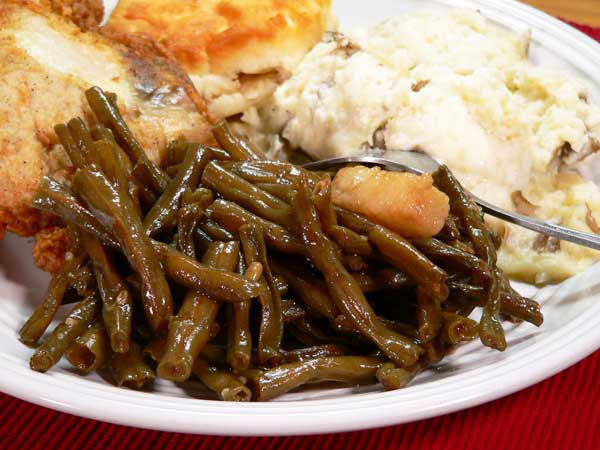
The photo above is not great but it is the best I got at the time, about a week ago, near the middle of August 2023, when I was close to completing making shucked beans from two bushels of White Half Runners I had bought at what has become a relative deal of $30.00 per bushel in Floyd County Kentucky.  In past bad years, I have paid as much as $60.00 a bushel for good, clean Half Runners.  In the past, I have written on this blog about making and eating shucked beans which some people refer to as Leather Britches.  In recent years, I have been blessed to develop friendships with both Bill Best and Frank Barnett, two of the most experienced heritage bean experts in all of Appalachia.  I grew up eating and helping raise and make shucked beans in Knott County Kentucky.  Since I met both Bill and Frank, I have written a few other bean based blog posts including one about The Dog Eye Bean and The Eagle With Spreading Wings Bean, two of the most unique and colorful heritage beans in the region.  I also wrote another post called "Lazy Wife Greasy Beans, A Lesson In Appalachian Nomenclature", a post which I owe Bill Best for since he was the first to introduce me to the Lazy Wife Greasy Bean which has become one of my favorite beans at the supper table.  Also, indirectly from learning from Bill Best about the Cherokee Purple Tomato, I wrote a post about "Multi-Cropping In The Appalachian Garden", a post which was deeply rooted in my own childhood during which I helped my parents in our one acre garden to raise Irish Potatoes, Hickory King Corn, White Half Runner Beans, and Cushaws all in the same ground with the potatoes being planted, hoed twice and then having the corn and beans planted between the potato hills, and scattering Cushaw seeds here and there among the other three crops.  In short, I have always been interested in the traditional Appalachian food items on which I was raised.  But knowing Bill and Frank has increased both my knowledge and interest in traditional Appalachian Heritage Crops even though I stopped raising a garden several years ago due to both my intense work schedule as a substance abuse and mental health therapist and the serious health problems from which my wife Candice suffers.  Even though I don't garden currently, I buy traditional food stuffs any time I can, freeze quite a few items for winter consumption, and strive to learn as much as I can about those heritage crops.  Which brings me back to my freshly made shucked beans for 2023.  

I always make my shucked beans by stringing and breaking them and then drying them on a white sheet on my blacktop driveway until they rattle when I pick them up in the sheet to bring them into the house at night to be placed on an empty bed with a ceiling fan on the lowest setting circulating air over them at night.  This year, our 13 year old nephew, Connor Nehlson from Sheboygan Falls, Wisconsin, was visiting with us for a week and got his first lesson in how to string and break beans.  He did work consistently on two occasions for about an hour which might have been his best work performance of his life.  The average Appalachian child of my youth would have had some dressing down if that had been their production for a day but training a child to work is a work in progress and I think the hour's performance might have been close to a record for Connor.  We got a bit of rain on two of the days when the beans were drying and I had to bring them in the house on those days for time under the fan instead of in the sunshine. I can't prove it empirically but I firmly believe that  drying in the sunshine, as opposed to being dried in a food dehydrator or by some other means gives them a far better flavor.  And I told someone who responded to my post on a Facebook post about drying beans that "there is no sweeter sound on earth than that rattle when you pick up a sheet full of shucked beans off the driveway to bring them into the house to be individually packaged in freezer bags for winter storage.  There is also no better taste on earth than a pot of shucked beans which have been soaked overnight to re-hydrate them and then cooked slowly with a nice chunk of smoked hog jaw thrown in for extra flavor.  


Friday, September 11, 2020

Making And Eating Shucked Beans

A member of the Facebook group "Appalachian Recipes And Chat", Carolyn Stroble-Gross, read my post about Turkey Craw Beans and asked me if I knew about what she prefers to call Leather Britches which is a perfectly acceptable name for what I prefer to call Shucked Beans.  Since I posted this blog post earlier today on September 11, 2020, I have received one comment from a reader who says her grandmother called them "Fodder Beans" which I had never heard.  Here is her comment.  Anna-Marie O'Shea was the commentor and this is what she said: "My grandmother called them “fodder beans”. She put them in the sun on cookie trays to dry. They sure were good."  This name for the beans, which I assume is a very localized regional variant in name was also verified by Lucy Lowe-Hill.  After I had posted the original blog post of this article, I saw my friend, Bill Best, a retired Berea College professor and national expert on Appalachian Heritage food crops, and we discussed the fact that this blog post was going wild with readers, comments, likes, and shares on Facebook.  I brought up the question with Bill about "Fodder Beans" and he reminded me that Harriet Simpson Arnow had written briefly about what she called "Fodder Beans" in her book, "Seedtime On The Cumberland" which is actually a companion book to her work, ""Flowering Of The Cumberland".  I hope to sometime write about both these books on this blog.  Each of them is a masterpiece in Appalachian history, culture, sociology, and life.  In "Seedtime On The Cumberland", Arnow has this to say on pages 412 & 413:
"Dried green beans, known as shuck or fodder beans, needed an even long cooking but in winter made a fair substitute for green beans, and in drying them in summer the onld ones followed much the same recipe as that given in a Nashville newspaper of 1811, save they did not put in a teaspoon of sugar.  However, the main bean in winter was the dried bean, almost always boiled, for beans boiled with bacon and less often ham hocks, were to the Cumberland partly what the baked bean was to New England, though in that country of abundant meat, beans and peas together were never as important as in New England." (Harriet Simpson Arnow, "Seedtime On The Cumberland", pp. 412-413)

Shucked Beans, Photo by West Virginia Mountain Mama
But I grew up all my life hearing them called Shucked Beans by everyone around me and nearly all of those people were doing as my parents were and making shucked beans every year to eat all winter long every winter.  Shucked Beans have been produced and eaten in the mountainous regions of Central and Southern Appalachia for at least three hundred years.  My most distant known ancestors were in Eastern Kentucky by at least 1790 and I am certain they were making and eating Shucked Beans then.  I honestly have not seen Shucked Beans in any region of the country outside Central and Southern Appalachia other than those areas of the Midwest where native Appalachians moved to in the Great Migration following World War II.  I know many members of my extended family in the area north of Fort Wayne, Indiana, who regularly dry and eat Shucked Beans but that area is also widely affected by Appalachian Culture in other ways also due to the large number of Appalachian migrants who moved there. I also know many people in that area who grow large gardens, hunt and eat a wide variety of wild game animals, hunt mushrooms, and live a basic subsistence lifestyle although most of them are working five days a week in an industrial factory.  

When I was growing up, we always dried our Shucked Beans on a string as they are shown in the photo above.  But if you have ever spent a day or two stringing beans and threading them on that twine with a darning needle you know that it is not pleasant work.  The only thing that gets most people through the annual effort to make Shucked Beans in this manner is the knowledge as they work that on some cold, snowy, winter day they will be eating those beans cooked with a sizeable chunk of hog jaw which is how we always cooked them.
 
Shucked Beans At Supper Time, Photo by Taste of Southern
I learned long ago that the best way to make Shucked Beans is to string and break them just as if you were going to cook them that day.  Then you take the beans and place them on a white sheet either on a blacktop driveway or on a tin roof.  You must always bring the drying beans inside the house at night before they become wet with the dew in order to prevent them from becoming moldy or mildewed.  On days when it rains, the beans obviously cannot go outside.  What I also have learned to do in recent years, is to place the partially dried beans both on rainy days and overnight between sunny days spread out on that same sheet on an unused bed under a ceiling fan on its lowest setting.  They will actually continue to dry in this fashion.  I have actually produced Shucked Beans a few years in long rainy spells when they were rarely outside in the sun. Shucked Beans are finished drying when they are so dry in that sheet that they rattle a bit like a rattlesnake rattle when you pick them up and shake them in the sheet.  Then we bag them up in plastic freezer bags in meal sized portions and put them in our freezer.  When I was growing up, we usually stored Shucked Beans in empty fifty pound lard cans with a few pods of hot pepper in the cans to prevent them from becoming infested with insects, or as we called it then, "to keep them from getting buggy".  But just as I like them broken and dried on a sheet better than strung on twine, I also like them better in the freezer than in a lard can.  I have also seen a few people dry Shucked Beans by placing them on a sheet inside a parked car, generally on the back window ledge.  I do not like that practice and I believe it changes the flavor in a noticeably negative way.  I have also seen people use a food dehydrator to attempt to make Shucked Beans and I just do not like the flavor they have there.  They come up short in what I call the "earthy" flavor. In fact since I first posted this blog post, I have had at least one comment on Facebook that the author bemoaned the use of a dehydrator because they did not taste like her mother's had.  
 
Here is a photo by Frank Barnett of our mutual friend, Bill Best with his recently made shucked beans.  I was with Bill a few days ago as he was breaking and starting to dry these beans.  The photo was sent to me on October 8, 2020, by Frank.  If you share or use the photo, please give Frank Barnett appropriate photographer credit.  


When it comes to what kind of beans to use to make Shucked Beans, I prefer good, clean, long White Half Runners.  But I have seen others use nearly every kind of bean grown commonly in Appalachia to make them. But White Half Runners, when they are a pure strain without negative mutations and have been grown properly and picked at their prime, are always, long, clean, straight, flavorful, and dry into great beans.  When they are cooked, I have known a few novices in the world of Shucked Beans who do not like the flavor which always baffles a true Shucked Bean eater.  That flavor is what I call "earthy".  When they are right, it is almost similar to picking up a handful of dirt and tasting it which is markedly different from the flavor of freshly picked and cooked White Half Runners.  As I understand it, that earthy flavor comes about because as a part of the drying process, or dehydration, the minerals in the beans become more concentrated and the flavor changes. The fact that Shucked Beans never fully rehydrate in the soaking and cooking process also has contributed, I am certain, to the name Leather Britches. Many people insist on having some form of meat, usually beef or pork, in a meal with Shucked Beans as a side dish.  I am perfectly content with Shucked Beans, with maybe a few potatoes thrown in with the hog jaw, as the main dish and a big pone of cornbread and, maybe, one other vegetable such as corn as the complete meal.  My wife grew up in Wisconsin, about halfway between Milwaukee and Green Bay and never saw a Shucked Bean until she married me and came to Eastern Kentucky in her twenties and she loves good Shucked Beans.  I have seen a few other converts to Shucked Beans who met them later in life.  But I also tend to believe they are an acquired taste and if you have been fed them mashed up in your mother's plate with a fork as a baby being introduced to your first solid foods, you will never be happy in life if you do not get a few "messes" of Shucked Beans every winter. 

Strings Of Still Green Shucked Beans, Photo by Taste of Southern

Tuesday, August 27, 2019

Multi-Cropping Small Plots In The Appalachian Garden

Hickory King Corn--Photo by Hoss Tools
Recently, I shared a Facebook post from my friend Dawn Whiteside Rubin on the Facebook group "Appalachian Cooks" about what the post described as an early Native American practice of multi-cropping what they referred to as "The Three Sisters" in their gardens.  The three sisters were corn, green beans, and squash.  When I shared the post to the "Appalachian Cooks" group, I did so with a prefatory comment that when I was growing up in Knott County in Eastern Kentucky my family had always done the same thing.  The original Facebook post stated that the squash vines would cover the ground and eliminate most weeds.  I don't remember it being exactly like that.  And in our practice at home, we always raised four vegetables in the same space: Hickory King Corn, White Half Runner Beans, Irish Potatoes, and Cushaw, which is a large form of crook neck squash which can sometimes weigh more than twenty pounds each.  We always planted our potatoes as early as the ground was thawed and dry enough to plow.  Since potatoes were one of the key staple crops we raised, we wanted to eat them as early as possible.  Potatoes can actually be planted in the fall in small amounts such as a single row for early eating potatoes in the following spring.  After the winter has set in enough to prevent the potatoes from sprouting, you can dig a row in your garden deep enough to get the seed potatoes a bit below the hard freeze line and then place your smallest potatoes, those too small to eat productively, in the row you have dug if they have a couple of eyes.  Then it is best to cover them, or even surround them with a mulch of dead leaves, grass clippings, or hay and straw to help insulate them, then cover them up with plenty dirt and wait for spring.  As soon as the ground thaws enough for the soil to warm and potatoes to sprout, they will sprout and start to grow.  This often happens well before you could have plowed the garden, planted potatoes, and gotten them to sprout.  If all goes well, that single row of potatoes will be blooming about the time you have hoed your others the first time.  You can begin to gravel potatoes out of that row for meals well before your other, primary crop are blooming.  You eat out of that row until they are gone and plow it or till it for another crop such as spring greens, onions, radishes, or lettuce. For those you who have  never heard the term graveling applied to potatoes, it means that when they start to bloom it is about the correct time to use your fingers to dig into the side of a hill to see if you have new potatoes about the size of a golf ball or bigger.  If so, you dig up that hill and use them to make new potatoes and gravy. If you don't have eating sized new potatoes, just put the dirt back in place and that sample hill will still grow and produce. If you have new sweet peas by that time, you can also use them with cream gravy which makes a wonderful early spring meal. Of course, the   ideal spring meal would also include wilted lettuce and green onions if you have everything ready to eat at the same time.

Pontiac Red Potatoes--Photo by Burpee's Inc.


Let's get back to the original motivation for this blog post, what the Native Americans apparently called "The Three Sisters".  Our version of this was not referred to as anything other than "planting the garden" or maybe "planting corn and beans" but you already know that we planted more than just corn and beans in this manner.  We began by planting our potatoes early, usually a one hundred pound bag of seed potatoes which had generally been halved at least if they had sufficient eyes and sometimes even cut into thirds or fourths if they were large enough with sufficient eyes. You should never cut a seed potato into pieces which only have one eye since sometimes and eye can prove to be infertile or simply not sprout for some unknown reason.  We might have laid our rows out with what we called balks, the space between the actual rows, being a bit wider than usual because of all the different vegetables in them.  When the potatoes sprouted and had been howed, usually twice, and the weather was warm enough to plant beans and corn, we would plant Hickory King Corn and White Half Runner Beans between the hills of potatoes.  We usually planted three grains of corn and two or three beans in each hill and thinned them to only the two strongest plants of each variety when they were hoed the first time.

White Half Runner Beans--Photo by Etsy
We did the best we could to hoe the corn and bean hills twice or to, at least shave the weeds out from between the hills of the various kinds of produce growing in this obviously busy space.  But I still do not recall that having squash or cushaw growing randomly between the rows ever produced enough leaves to prevent the need for chopping out the weeds. After the corn grew up to about three feet, the bean vines were already twined around them and reaching for the sky.  As long as the corn sprouted and grew, it was never necessary to spend time bending to pick beans.  Sometimes, that Hickory King Corn and the accompanying beans would grow in excess or seven or eight feet and it became necessary to bend the corn stalks over to pick the beans and whatever roasting ears we decided to eat from the field corn when the time was right.  Also, always remember that Hickory King Corn will get hard quickly.  If you intend to eat it as roasting ears, you need to do that a bit before the ears are totally full. In some cases, Hickory King Corn can reach ten feet in a rich soil. Many people cannot adapt to the heavier flavor of the Hickory King field corn but we all loved it.   As for the beans, we used them fresh as soon as they were full usually cooked with a good sized hunk of smoked hog jaw.  But the majority of the crop were divided between canning and drying as shucked beans. The majority of the Hickory King Corn was picked in the fall and saved for livestock feed and next year's seed corn.  We also used the corn blades and stalks for fodder for our livestock.  We cut what we called "top fodder" by cutting, bundling, and shocking the stalks complete with leaves above the top ear of corn.  The bottom blades we pulled for blade fodder and also saved it in bundles.  Most livestock will simply not eat the heavy bottom stalks of corn so we just plowed that under at plowing time. 

Cushaw--Photo by Eden Brothers
The cushaw never required any hoeing and produced enough of the oversized hard shelled squash to fill our needs for the winter. We loved it cut into chunks and baked with butter and brown sugar or molasses.  We saved the extra cushaws as long as we could in a cellar or smoke house but it usually will begin to rot before winter is over so you need to watch it closely and eat it early if needed.  But I have learned lately that cushaw is a very good vegetable for freezing and my wife and I try to freeze enough each year now so that we can eat cushaw all year around.  It works really well in a Food Saver vacuum sealer.  I always laugh when I see cushaws being used only for lawn decoration at Halloween.  I can assure you that cushaw is a wonderful food and you need to try one this fall. Cushaws are also excellent as the main ingredient in autumn pies or canned as cushaw butter.  If you want it in a pie, just use your favorite pumpkin pie recipe and it will work beautifully.  If you want to use it canned as cushaw butter, just remove the flesh from the shell and prepare it with your favorite apple butter recipe.  It really is a wonderful vegetable and one of my favorites. 

I sincerely hope that this blog post has helped some of you to see how you can maximize usage of the small garden in Appalachia or anywhere else.  By doing this form of multi-cropping with these four vegetables, you can turn out a ton of food in an amazingly small amount of space.  Have fun in your next year's garden. 

Thursday, November 23, 2017

Thanksgiving With Family At A State Park Lodge

Today, my wife Candice and I had Thanksgiving Dinner with ten other members of our extended family at the Jenny Wiley State Park Lodge which has recently been refurbished after a major fire.  There were twelve of us at the dinner which had at least a couple of hundred diners during the time we were there.  Apparently, nobody wants to cook a traditional Thanksgiving Dinner anymore.  We represented three generations of our maternal grandparents' descendants.  There were four of us first cousins there from the seven which were raised by our mothers, sisters Mellie Hicks Hicks and Ellen Hicks Terry. Two of that original seven are now dead.  There were three spouses or significant others of that group, one daughter of my cousin Jack Terry, one daughter of my cousin Greg Terry, and several of Jack's grandchildren.  This was the first time many of us in the family had met Greg's daughter, Shay, who suddenly appeared in his life not long ago after finally learning who he biological father is.  Neither of them had known of the identity or existence of the other until very recently.  That, in and of itself, made it an interesting meal. 

The buffet was served in a large dining room, one of two, which must have seated at least a hundred people.  The staff worked constantly and kept drinks refilled, dirty plates bused, and minor requests for information answered.  I am certain they never received, in that kind of setting, anywhere near what they deserved in tips. The standard 18% for large groups would be in order in that setting.  I tried my best to be reasonable with my tip and so did at least one other in our party.  The setting, twelve people spread along the length of a long table, did not do a lot to benefit conversations.  The tables were a bit too close together and the overall layout of the room made traffic to and from the buffet a bit congested.  Salads, vegetables, and meats were on a steam table along the left side of the room with both sides open for self service.  Desserts were on two tables along the perpendicular  wall on two tables with only one side open for self service.  A staff member was on the right side of the room slicing and serving ham and roast beef from another table with heat lamps.  This setup caused too much traffic across the room, back and forth, and sideways.  

The food was generally acceptable but not outstanding by any measure.  When I got to the turkey to serve for my wife Candice, I found a wet mess of shredded turkey in the bottom of a hotel pan.  There were a couple or three dishes on that steam table which kept eliciting questions among strangers to the tune of "do you know what that is".  The salad makings were a bit too few to make a good salad for the person with vegetarian leanings.  The coleslaw was good and made along a traditional Eastern Kentucky recipe.  The green beans came straight out of an institutional can.  The pies, pecan, peanut butter, and pumpkin, were straight out of a box.  The baked Alaska was good and made on the spot.  The roast beef was far overcooked for my taste without a wink of pink in sight.  The ham was minimally acceptable.  Overall, this was a large restaurant buffet designed to minimally please diners who did not have high expectations without minimizing the potential profit from the occasion.  Nearly every time I have eaten at Jenny Wiley State Park Lodge, which is a frequent choice of some of my relatives who live close to it, I have left once again convinced that most of the other state park lodges in which I have eaten do the job better, especially Natural Bridge State Park Lodge.  I nearly always prefer Natural Bridge to other parks and the setting is usually far more picturesque.  

After the dinner, we hung out for a short time in the lodge lobby talking and split up until this coming Saturday when we will get together for a second dinner at the home of a cousin in Prestonsburg which is a much better idea.  I had told a friend in an e-mail today that I would rather eat bologna sandwiches in a genuine family setting with family than a high class buffet in a restaurant setting anytime.  This dinner convinced me I was correct in that statement.  A home cooked meal with shucked beans, hog jaw, ground hog, squirrels, pinto beans, corn bread, cushaw, and hominy would be far better anytime.