Search This Blog

Wednesday, November 28, 2018

"Conquerors Of The Dark Hills" by Rufus Mitchell Reed--Book Review


Reed, Rufus Mitchell: Conquerors Of The Dark Hills (New York, Vantage Press, 1979)


Once in a while we stumble into a book which surprises us with its quality, applicability to our needs, and general utility.  For me this was such a book.  I bought my copy from a local speculator in antiques and collectibles who had bought most of the estate of a local newspaper writer and poet who had known many of the published authors in Eastern Kentucky in particular and the whole of Kentucky in general.  My copy was autographed by the author and inscribed to the aforementioned local newspaper writer.  The book was published by Vantage Press which, for several years, was the largest vanity press in America before losing $3.5million in damages in a civil suit due to having defrauded several hundred authors.  Vantage also lost all credibility and eventually went out of business in 2012.  But this book is a reasonably high quality hardcover and my copy was still in its paper dust cover which is also in good to very good condition.  But enough about the physical state of the book.  Let's talk about its writing, content, and applicability to my needs as a student, researcher, and writer in the areas of Appalachian Studies and Appalachian Literature.  

Rufus Mitchell Reed Photo by The Reed Family

Rufus Mitchell Reed was born in 1895 in Martin County Kentucky near Lovely, Kentucky, in the Tug River Valley.  He lived his entire life in Martin County and worked most of that time as a surveyor.  But he was also apparently a student of Appalachian Culture, the local genealogy and history, and the flora and fauna of the entire Tug River Region.  His writing is well above average and I am somewhat surprised by the fact that he had published the book with a vanity press.  The quality and accuracy of the work and comprehensive nature of his knowledge about Appalachia in his time were more than sufficient for a regional press to have published his work.  He also published several volumes of poetry  over the course of his lifetime, none of which I have ever read.  But as soon as I can lay hands of copies of his other books, I will gladly purchase, read, write about, and retain them in my ever growing collection of Appalachian books.  

Rufus Mitchell Reed Photo by The Reed Family
"Conquerors Of The Dark Hills" can best be described as memoir but it addresses a significant number of aspects of life in the Tug River Valley in the late nineteenth and early twentieth centuries.  The book was published in 1979 when the author was eighty-four years old and I am sure it was his last ditch effort to have his impressions of his life and those of his family and neighbors recorded for posterity.  He is an articulate, skillful writer whose grammar, syntax, and style are well within the good to better category.  His knowledge of Appalachian Culture, history, and the area in and around Lovely, Kentucky, and the Tug River Valley are comprehensive, accurate, and honest.  This is a book which deserved to have been printed by a legitimate academic press which could have successfully marketed it across the wider Appalachian area. 

The chapters discuss early Kentucky and Appalachian history and a variety of topics of everyday life in the period from about 1800 to 1980.  It is a book which draws the reader in, makes you eager to read every word of it, and leaves you wishing for more when you reach the end far too soon.  For the fledgling student of Appalachia, it is wonderful source of cultural information.  For the accomplished Appalachian scholar it is a useful source of first hand information about life in the Tug River Valley in the early twentieth century.  It left me wishing I could have known Rufus Mitchell Reed, Rufe as he was known by his family and friends.  Due to the vanity press publication, there are a limited number of copies to be found on the open market and some of them are a bit steeply priced by sellers of rare books.  But I will gladly recommend to the reader that you buy one when you can find it.  You will not be disappointed.  

The individual chapters address several of the same topics I have addressed in the life of this blog plus several others such as education, hog killing, family life in Appalachia, Appalachian religion, digging ginseng, and hoedowns.  If you can find your copy, read it, enjoy it, hang on it for dear life, and arrange to pass it on to another lover of Appalachia when you die. 

Tuesday, November 27, 2018

The Mixed Blessings Of Having Writers As Friends

As I have said on several occasions in this blog, I have known and been mentored by several of the most important writers in Appalachia.  I have had published writers as friends, mentors, professors, and colleagues since I was in my early teens.  I have written about several of those relationships and people on this blog over the last seven years.  I have benefited greatly, in a variety of ways, by having known these people.  I do not say that all of them have been glowing examples of the human race.  One or two I have known have been many of the things most people work diligently to try to never become. A few others have been nearly everything decent, honorable, and caring humans strive to become.  At least one of these relationships extends all the way back to the early 1970's.  Others have only been my friends for a few years.  Yet at least one of those brief friendships is one of my closest today.  For a time I was a member of a group of Appalachian writers, both professors and students, which is thought of by many in the fields of Appalachian Studies and Appalachian Literature as having been one of the more significant groups of writers in Appalachia.  

However, knowing numerous writers  is, in general, a bit like knowing all of the dogs in your neighborhood or the racehorses at your favorite track.  Some of them will bite without provocation.  Some will be your best friend so long as you have food to eat, a warm house, or something to drink or smoke.  Some of them will be winners.  Some will always finish well behind the pack.  Some will only be consistent consumers of favors and influence while others will be consistent producers of both great literature and fond memories.  Over the last few weeks I have had occasion to be reminded of this for several reasons.  I recently acquired a few books from the estate of a lesser known poet and newspaper writer in my area and most of those books had been autographed by their authors and given to the writer  of whose estate I had managed to buy part.  During her lifetime, she had known many of the most influential writers in the state of Kentucky.  During my lifetime, I have done the same with a similar group of writers from both Kentucky and West Virginia.  I also have a similar collection of books written, autographed, and presented to me by writers I have known.  I even bought a wood stove once from one of the most famous Kentucky writers without anything other than home heating having ever been discussed between us.  

Also during this recent period, I acquired four or five books written by two or three of my friends.  One of those friends I have known since about 1995.  The other I met just this past summer.  One is an excellent writer.  The other is not.  I have been in fairly regular contact with both over the time I have known the later.  The recent friend has provided me with warmth, friendship, and respect.  The other, whom I have known much longer has been in contact on superficial levels and been less than forthcoming in many ways.  The new friend, during the course of writing their third published book, sought my input and even included a piece of a great writer's production in that book to make a point.  It was not the point I would have made with the same excerpt but I do know that my friend had never before seen that writer's work until they knew me and chose to use the work mentioned when I made them aware of it. They also listed me in the "Acknowledgements" page of the next book for having critiqued the previous book and for "providing a bottomless well of research material."  The second writer, whom I have known considerably longer also published a couple of books recently which would have been better left in a manila envelope under a bed for some auctioneer, yet unborn, to include in a box lot at an estate sale.  At some point, I offered this second mistakenly ambitious writer some constructive criticism pending their willingness to hear it.  I never even got a response which in some ways did not surprise me.  I refer you once again to my earlier metaphor about dogs and racehorses.  The new friend has produced a well written, respectable book which will not likely ever be famous due primarily to that person's total aversion to seeking or achieving advantages by virtue of doing anything that is not modest and humble. But  their work is likely to be kept in some bookshelves for the foreseeable future.  The other produced a book which would, as I said earlier, have been better placed elsewhere other than in the public market.  At about the same time this series of exchanges was transpiring, a third writer friend who works in several areas has been well reviewed by random strangers over the last several decades asked me to consider providing input on an upcoming book which leads me to believe that my input is not totally worthless.  

To put all this in a neat little package, or at least as neat a package as possible, I will say that despite having been bitten and ravaged by fleas on a few occasions in addition to having been kicked, pawed, and dragged by several horses, I still pet strange dogs, admire and sometimes even bet on new horses, waste my time picking up strays, and have even paid to neuter two stray kittens lately.  I will probably not stop expressing my opinions to writers whom I know and some I have still not met. 

Monday, November 26, 2018

The Murder Of Chief Deputy Bristol Taylor

Chief Deputy Bristol Taylor Photo by The Taylor Family

On Friday, November 23, 1973, Knott County Kentucky Chief Deputy Bristol Taylor was shot and killed while responding to a call about a drunk and disorderly man at the Blue Star Restaurant in Mousie, Kentucky. As he and another deputy, Herman Gibson, approached the shooter's vehicle the man, who was later identified as Marvin Gibson, opened fire on them with a .357 caliber revolver.  He shot Chief Deputy Taylor four times. The other deputy was shot once and wounded.  In a subsequent trial, the shooter was only convicted of manslaughter and sentenced to 16 years in prison.  Chief Deputy Taylor was a U.S. Army veteran and had served with the Knott County Sheriff's Department for four years. He was survived by his wife Fern and four children, Tony, Deronda, Mickey, and Gary.  He was only twenty-nine years old and had been the Chief Deputy Sheriff in Knott County about four years.  He was buried in the Taylor Family Cemetery on Branham's Creek Road in Knott County.  

Marvin Gibson was able to win a change of venue to Pike County Circuit Court in Pikeville, Kentucky.  The trial was under the jurisdiction of Pike Circuit Judge E. N. Venters. During the brief trial in 1974, Marvin Gibson admitted to the crime. He was convicted of manslaughter in Taylor’s death and of wounding Herman Gibson. He was sentenced to a total of 16 years in prison by Judge E.N. Venters.

Chief Deputy Bristol Taylor & Family Photo by Troublesome Creek Times

Due to a complex schedule, I have not searched either newspaper or court records from the time of the murder and trial of the shooter, but I remember the shooting and sentencing of the killer.  The fact that the killer was only convicted of manslaughter and sentenced to only sixteen years after having killed a deputy and wounding another is a travesty of the highest order.  In today's world, most killers of police officers all across the country receive life sentences without the possibility of parole.  I will pursue the newspaper coverage of this incident and the trial proceedings and bring this post more up to date in the near future.  With Kentucky Parole Board standards at the time, it is highly likely that the killer was out of prison before Chief Deputy Taylor's youngest child was legally an adult.  

In 2012, based on efforts by State Representative John Short, the Kentucky General Asembly passed a resolution to name Kentucky 1393, Branham's Creek Road where the family cemetery is located, the  Deputy Bristol Taylor Memorial Highway. The ceremony to dedicate the highway was held on Friday, June 22, 2012, near the Taylor Cemetery, where Bristol Taylor is buried. The ceremony was open to the public and was attended by numerous public officials, family members, and law enforcement officers.  The ceremony began with the Presentation of Colors by Knott County DAV Chapter 171 with Arthur Mullins acting as their Commander. Kyra Short sang the National Anthem. Pastor McCoy Taylor held prayer and State Rep. John Short spoke and presented the formal declaration from the state legislature to the Taylor Family. Bristol Taylor’s sons Mickey and Tony spoke on behalf of the family.  The family unveiled the sign designating the highway as the Deputy Bristol Taylor Memorial Highway. A crew from Highway District 12 installed signs at the intersection of Ky. 899 and Ky. 1393 and at the intersection of Ky. 1393 and Ky. 582.

Bristol Taylor had been born to Everett and Mattie Short Taylor on March 17, 1944. He served in the U.S. Army and the U.S. Army Reserves from 1960- 1966, including a tour of duty in France. When Taulbee Pratt was elected Knott County Sheriff in 1969, he appointed Taylor chief deputy. He served in that capacity until his death.  While many law enforcement and judicial practices were markedly different in 1973, than they are today, it is unconscionable that a competent judge and jury could have only convicted the shooter of the lesser charge of manslaughter in what was a cold blooded murder and attempted murder.  The designation of a minor country road in honor of Chief Deputy Bristol Taylor was a commendable but less than sufficient act in light of his proven dedication to serve his country and community over an extended period both in the military and law enforcement.  Chief Deputy Bristol Taylor deserves more to be done in his honor.  


Monday, November 19, 2018

Morgan County Kentucky Court House Annex--WPA Construction

Morgan County Courthouse Annex Front (East) Photo by Roger D. Hicks

The Morgan County Kentucky Courthouse Annex is for all intents and purposes the actual Morgan County Courthouse since what is known as the courthouse is actually leased to the Appalachian Regional Healthcare System.  It holds the offices of the County Judge Executive, the County Clerk, the Sheriff, the Property Valuation Administrator, and meeting rooms for the Fiscal Court composed of the County Judge Executive and the Magistrates.  There is also a gymnasium on the ground floor and the basement is leased to a day care program.  This building is the most historic building in the county.  It was built by the Works Progress Administration (WPA) in the heart of the Great Depression and originally served as the local high school.  It was dedicated by First Lady Eleanor Roosevelt and Kentucky Governor Happy Chandler.  There is a large bronze plaque in the main hallway discussing this historic building and its history.  I will add photos of the interior and the information on the plaque in a few days.  I shot these exterior photos on Sunday, November 18, 2018, in order to do it at a time when there were not large numbers of cars in the parking lots or heavy passing traffic.  The photos are not perfect and I apologize for that.  When I can locate better photographs by other people and gain permission to use them, I will add those.


Morgan County Courthouse Annex (Northeast Corner View) Photo by Roger D. Hicks

The building is an excellent example of Depression Era stone work by the Works Progress Administration (WPA) which was one of the many New Deal programs instituted by President Franklin D. Roosevelt in order to bring the country out of the Great Depression which had been caused by the economic mismanagement of the Hoover administration.  These WPA stone buildings were built all over the southeastern United States where local stone was available of acceptable quality.  They are rapidly disappearing and all of them which are still in useful condition need to be restored and saved.  Thanks to some interesting circumstances and the high quality of the stone work this wonderful building has survived and remained in productive use almost every day since the day it was opened.  

First Lady Eleanor Roosevelt Photo by Yousuf Karsh


President Roosevelt issued an executive order on May 6, 1935, which established the Works Progress Administration (WPA) at a time when the national unemployment rate was 20%.  The WPA was the greatest infrastructure operation in the history of the country.  It employed several million  previously unemployed people and in the eight years of its existence it built more than 4,000 new school buildings, 130 new hospitals, 9,000 miles of storm drains and sewer lines, 29,000 new bridges, 150 new airfields, paved and repaired more than a quarter million miles of roads and planted 24 million trees.  Many of those schools, hospitals, sewer lines, bridges, airports, and roads were in areas which had not had such infrastructure previously and many of them are still in daily operation today in one capacity or another whether or not they are being used for their original purposes.  The Morgan County High School, now known as the Morgan County Court House Annex was simply one small project among thousands of others nationwide which the WPA was building at the time.  In June of 1943, the WPA was disbanded after national unemployment had  dropped to less than 5% as a result of the economic recovery and the effort to build war time armaments.  But it will always be one of the most important economic and infrastructure programs in the history of the country. 

Photo of Kentucky Governor Albert B. "Happy" Chandler Photo by Murat Shrine

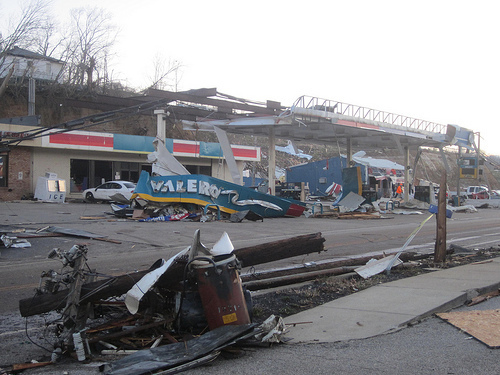
On March 2, 2012, the town of West Liberty, Kentucky, was literally destroyed by a major tornado but the Court House Annex withstood the blast which killed six people in the county and destroyed nearly every other major public building within the city limits.  I am adding two photos from the aftermath of the tornado to show just how clearly the town was destroyed around this magnificent building.  But the WPA stonework withstood the tornado with some damage to roof and windows which was easily repaired as the effort to rebuild the town began.

Downtown West Liberty After The Tornado Photo by CNN

Gas Station Across Street From Courthouse Annex After Tornado Photo by Flickr

The two photos immediately above were taken by professional photographers in the next few days after the West Liberty Tornado in early March 2012.  So far, I have been unable to locate a photo of the Court House Annex taken immediately after the tornado and will continue to search for one and post it when I can. It appears that since the building withstood the tornado with little damage the professionals were looking for "real disaster" photos and did not focus on the Court House Annex But the first photo immediately above of the gas station directly across the street from the Court House Annex shows some of the damage in the immediate area.  The sidewalk visible in the foreground of the photo is directly in front of the Court House Annex.  The photographer would have been standing in the edge of the small parking lot beside the Court House Annex.  The old wood sided Morgan County Board of Education building which stood directly to the south of the Court House Annex was immediately destroyed as was the John F. Kennedy Public Library which stood directly to the north side of the parking lot from which the photograph above was shot.  Diagonally across the street to the northeast, the building in which a physical therapy facility was operated and had originally been an automobile dealership was also completely destroyed.  Diagonally across the street to the southeast, a Dollar General store was totally destroyed.  Without the high quality stonework of the WPA, the Court House Annex would not exist today.   


Morgan County Courthouse Annex (North View) Photo By Roger D. Hicks


This historic WPA building still functions perfectly well as the primary site of Morgan County Kentucky government operations and is likely to continue to do so for many years in the future. It deserves to be added to the National Register of Historic Places and I will begin to work in the near future to see if I can facilitate that along with help from as many citizens of Morgan County and the general public as can make a phone call, sign a petition, write a letter, or send an e-mail to the appropriate agencies and people to support the effort.  Placement on the National Register would further guarantee for the foreseeable future that this wonderful, iconic, and historic WPA project would be protected, honored, and preserved as it should. 
Morgan County Courthouse Annex (Northwest Corner View) Photo By Roger D. Hicks


Morgan County Courthouse Annex (West/Rear View) Photo by Roger D. Hicks


Morgan County Courthouse Annex (South West Corner View) Photo by Roger D. Hicks

Morgan County Courthouse Annex (South View) Photo by Roger D. Hicks

Morgan County Courthouse Annex (Southeast Corner View) Photo by Roger D. Hicks

Morgan County Courthouse Annex (East/Front View) Photo by Roger D. Hicks

Friday, November 16, 2018

Mass Murder In Allen Kentucky 1981

As mass murder has become almost a daily occurrence in the United States with three hundred and seven being reported in 2018 as of November 16, 2018, we tend to generally believe that it is a relatively recent phenomenon.  But that is not entirely true.  Mass murders have been happening in America since at least since 1966 when Richard Speck murdered eight nurses in one night in Chicago.  On Labor Day in 1949 what is generally believed to be the first mass murder in America occurred when Howard Unruh murdered thirteen people in Camden, New Jersey.  But this blog is generally centered on subjects within Central and Southern Appalachia.  The first mass murder I remember in Appalachia happened in Allen, Kentucky, in October 1981 when five men were murdered in an auto parts store in Allen, Kentucky, less than twenty miles from where I grew up in Dema, Kentucky, and about three miles from Banner, Kentucky, where I operated an auction house for several years.  

On Friday, October 16, 1981, William "Okie" Bevins, a seventy year old retired miner walked into a small auto parts store on the banks of the Big Sandy River and shot eight men, fatally wounding five of them.  According to news coverage of the event at the time, Bevins drove back to his home at Printer, Kentucky, after the murders, dropped the gun down a hand dug well and was sitting on his porch when the arresting officers arrived.  He claimed that he had been bitten by a spider earlier in the day and had no memory of any of the day's events afterward.  Bevins had been convicted of a previous murder in 1930. He had served seven years on a life sentence in that case.  Witnesses who knew Bevins and at least one of his victims believed that the murders had occurred because of an ongoing relationship with the wife of one of the dead men,  twenty-eight year old Roger Click of Allen.  The other seven men, including the three wounded survivors, all seem to have been only what the military calls "collateral damage".   The general consensus at the time was that Bevins simply intended to murder all the witnesses to the crime.  As is common in such crimes, Bevins was transferred to the Laurel County Jail in London, Kentucky, for his own protection and claimed during the investigative interviews conducted there that he did know Roger Click who had previously rented a house from him and that Click always paid his rent on time.  

The other victims of the shooting were Rufus Hamilton, whom Bevins claimed he had worked with in the mines for more than ten years, Roger Hatfield, 34, Mohawk, W. Va.; Jarvey Hamilton, 27, Grethel, Kentucky, and Michael Halbert, 28, Allen, a co-owner of the auto parts store.  According to the testimony of his thirteen year old brother, Roger Click called home from the store just seconds before he was murdered.  Stanley Click, 13, answered the telephone at the home of their mother. He said the person on the other end didn't identify himself but Stanley Click was certain it was his brother.  He told investigators that "Roger yelled out as loud as I ever heard, 'God help me, Mommy!' Then it sounded like a belt popping, I handed the phone to Mommy and she heard it, too." At least one other witness, Tommy Joe Reitz, testified that he saw Bevins and Click arguing outside the store before Click went inside and asked to use the telephone.  Reitz went on to say that he saw Bevins follow Click inside the store and left immediately.  Autopsy reports on the bodies of the five victims revealed that each of them had been shot between two and eight times and colloquial reports from the area always agreed that Bevins had shot each victim at least once after they fell to make certain that they were dead. The story was so unusual and violent that it actually made the New York Times.  Sadly, in today's world, such stories of mass murder do not survive much longer than the victims. 

Bevins initially plead not guilty and a jury trial began in Floyd Circuit Court in Prestonsburg, Kentucky.  But following early testimony, Bevins instructed his legal counsel to withdraw his plea of not guilty, entered a plea of guilty to all charges, and ask for the judge to proceed with sentencing.  The judge sustained the motion by counsel and proceeded to sentence Bevins to death.  On March 20, 1986, the Kentucky Supreme Court delivered a ruling on an appeal by Bevins in which he claimed nearly a dozen errors in the trial and sentence.  The ruling stated "We have conducted an independent review of these circumstances and conclude that these circumstances exceed any minimum threshold justifying capital punishment. The sentence is not excessive or disproportionate to the death penalty imposed in other cases.  The judgment is affirmed."  In 1972, the US Supreme court ruled in Furman v. Georgia that the death penalty was unconstitutional and Bevins' death sentence was commuted to life.  He died in prison. 

Thursday, November 15, 2018

A Moderately Thankful Thanksgiving


On November 22, 2017, I wrote a Thanksgiving post titled Another Thanksgiving With Little To Be Thankful For.  I had written a similar post the previous year titled Thanksgiving 2016 So Little To Be Thankful For.  This year I am somewhat more positive than in the two previous years about conditions in America but we still have a great deal to be genuinely fearful and disgusted about.  We got a very mixed result in the November elections at a time when America should have been voting straight Democratic.  We were able to regain Democratic control of the House Of Representatives but we failed to gain control of the US Senate at a time when control of both houses of congress would have assured that we could put an end to the illegal occupation of the White House by TRAITOR & Spawn Of Satan Trump.  Democrats gained control of a total of seven governors offices that had previously been held by Republicans. We should have won every one of those offices which were up for grabs.  In Kentucky's 6th Congressional District, Lt. Col Amy McGrath (Ret.) lost to Andy Barr in Central Kentucky despite being supported by former Vice President Joe Biden and most of the living former governors of Kentucky.  With the US Senate race in Florida still hanging in the balance as of today, November 15, 2018, Democrats have lost one seat in the Senate.  But we did gain control of Senator John McCain's seat in Arizona with a win from US Senator elect Kyrsten Sinema, the first openly bisexual senator to be elected in America.  

We can look forward to a House under Democratic control and the likelihood of significant investigations being carried out into the crime spree of TRAITOR &  Spawn Of Satan Trump.  Congressman Elijah Cummings will most likely be the chair of the House Oversight Committee and once again he will prove his courage, patriotism, and commitment to democracy by investigating TRAITOR & Spawn Of Satan Trump’s tax returns as well as delving into dealings between the federal government and the Trump International Hotel near the White House.  But it does not appear likely that we will see a successful impeachment of the worst traitor in world history unless one of the investigations or the Mueller investigation can unearth video evidence depicting him giving US classified information to Russia.  Kentucky Senator Mitch McConnell will do literally anything to help TRAITOR & Spawn Of Satan Trump cling to his illegally gotten power and position.  In many ways despite the wins in elections across America, we are still facing the possibility that the crime spree will continue until January 20, 2021.  And if that occurs, it will be a real tragedy.

We are facing an unprecedented and unconstitutional attack on the free press!  At least three female African American reporters have been verbally attacked by TRAITOR & Spawn Of Satan Trump.  Jim Acosta and his employer CNN have been forced to sue TRAITOR & Spawn Of Satan Trump in US District Court because Mr. Acosta's White House press credential was revoked out of spite because he had the courage to ask justifiable questions about the crimes of TRAITOR & Spawn Of Satan Trump.  These attacks on a free press are an early indicator of pending Fascism if America is not rescued from the Russian Owned Criminal Syndicate which lives in the White House.

Millions of US citizens in Florida, Texas, and California are being denied appropriate disaster services following natural disasters of both hurricanes and raging wildfires which have killed hundreds, left hundreds of thousands homeless, and destroyed billions of dollars worth of personal property, real estate, and public buildings and services.  Such deliberate refusal of necessary services to US citizens in the wake of disasters has never been seen before and will, hopefully, never be seen again if we do the right thing and indict, convict, impeach, and imprison TRAITOR & Spawn Of Satan Trump.  

But I began this blog post by saying that this is a moderately thankful Thanksgiving.  We do have control of the US House of Representatives.  We did win a few governors offices.  We do have Elijah Cummings prepared to stand up for America one more time.  We do have a committed Resistance in America and I am proud to be a part of it.  You should be too!


Wednesday, November 14, 2018

REQUIEM FOR A UNION

The Slow, Sad Death Of The UMWA

In an Associated Press story dated September 5, 2015, we were informed that Patriot Coal had just shut down the last union mine in Kentucky.  In another story from "Coal Age" dated February 15, 2015, the magazine commented on the fact that the UMWA was now unrepresented in the Illinois Basin, one of the richest and historically most productive coal fields in North America.  These two stories served in many ways as a preliminary journalistic epitaph for the once mighty United Mine Workers of America which in its prime had more than half a million dues paying members across America and Appalachia.  The United Mine Workers had been one of the leading unions in the entire effort to organize American labor, fight for worker's rights, and to pave the road for most of the human services and environmental agencies and legislative achievements which had, until August 5, 1981, been considered to be mainstays of the relationship between corporate employers and the work force which performs their bidding.

Photo Of John L. Lewis by AZ Quotes


It has never been my good fortune to be a member of a labor union.  But I grew up in a strongly union oriented family on Right Beaver Creek in Knott County KY and my maternal uncle Mabry Hicks was a member of the UMWA for his entire career as a miner and I was allowed to read his United Mine Workers Journal every month as soon as he finished with it.  I started out liking the joke page and the stories it contained about the places and people I recognized from time to time.  But, over the course of time, along with the strong union orientation of my entire family, the journal helped me to develop an understanding of the tenuous and sometimes antagonistic relationship between labor and business.  I have lived in the Appalachian coal fields of KY and WV most of my life. I have also traveled fairly extensively through the coal fields of several other states including VA, TN, OH, PA, and IL.  My parents operated a small country store throughout my childhood and I was sometimes a patient, for minor childhood problems, at the UMWA owned hospital at McDowell, KY.  I saw on a regular basis what could be accomplished in Appalachia and America if workers organized, gained union representation, and held firm to their union principles both individually and collectively.  I saw the difference in wages and benefits workers received in union operations as opposed to the smaller, non-union punch mines. "Punch Mine" is the colloquial name given to leased operations which large companies placed in the hands of small operators because they were too expensive or too risky for the large operators to choose to assume the liability of their operation. The leasing operators would assume all the liability and pray to make a fortune by paying as little as possible to employees with few to no benefits above their substandard wages. In addition to receiving the royalties on any coal these leases produced, the large corporate owners also often leased or sold old, worn out, and shoddy equipment to the lease operators who were often starting out with nothing more than a foreman's license, a naive desire to succeed, a shaky credit rating, and no capital.  These operations were nearly always in coal seams with bad bottom, bad top, water, or gas. Quite a few of them had the entire combination. Many of them were also off the beaten paths of the railroads and any coal produced had to be trucked many miles to customers which naturally lowered the price of the product. It was always high risk for the lease operators and a guaranteed win for the corporations which held the mineral rights. If a ton came out the company got their cut and if the roof caved in, the mine exploded, or employees were killed or injured in a multitude of other ways the leasing operator took the fall. And if that operator went broke, gave up, or got killed themselves another ambitious and gullible individual was always standing by under the mistaken belief they could succeed in the same lease.

UMWA Journal Cover--Photo by Lorne Blair Rare Books


 I saw the benefits union miners received from the chain of hospitals operated by the UMWA in Appalachia.  I have personally been inside the hospitals at McDowell, KY; Beckley, WV; Hazard, KY; South Williamson, WV; West Liberty, KY;  and Man, WV.  The Man location was closed years ago. The entire chain is now operated independently as the Appalachian Regional Healthcare System.  I had known the wonderful work the hospitals and their dedicated staff performed on a daily basis before the union sold them off to lower expenses tied to a long list of elderly retirees, decreasing membership, and myriad other economic factors. I still use the West Liberty, Kentucky, location and the chain does provide good care in the region.  But it is not nearly as patient centered as it was when the UMWA owned it. 

Map Of The Illinois Basin Coal Field by USGS Energy Resources Program


I have watched as the numbers of UMWA members and UMWA mines steadily decreased over the past thirty or forty years. In the late 1930's, the UMA had about 800,000 members nationwide and was a social and political force to be reckoned with. But in today's world, there are less than 50,000 members and many of those are rapidly aging retirees.  From a high of 11,000 members in Logan County, WV, at the height of the coal boom to a current low of only a few hundred in the county, union membership steadily decreased all across the nation and union negotiating power has also persistently and fatally shrunk in direct proportion to the percentage of coal production tied to the union.

We will examine several reasons which I believe are tied directly to the steady deterioration of the UMWA.  Some of these reasons began more than forty years ago and the most prominent of those is the steady, ongoing war against union labor in particular and most mainstream labor in general which hit full swing in the early days of the Reagan Administration and which has continued under every Republican president and congress this country has elected since 1980.  This war against union labor has also been combined with a consistent effort to deregulate nearly every industry in the country by the Reagan White House and every subsequent Republican White House.  The first major blow in this two pronged effort was the firing of the air traffic controllers.  At the time, I was working as a horse farm foreman in Central Kentucky and spending little time in Appalachia.  But I knew at the time that the firing of the controllers was simply a first blow against organized labor in general.  The AFL-CIO chose not to become involved in the issue because they had endorsed Reagan and mistakenly believed that it was too early to end their supposed honey moon with the White House.  I believed at the time and still do that the AFL-CIO and organized labor in general should have stepped up and supported the controllers wholeheartedly and, if necessary, by means of a general one day nationwide strike by every union laborer in America.  Such an action could have proven instantly that organized labor collectively held a great deal of power and would not allow the White House to peremptorily terminate several thousand of the most critical and highly specialized union workers in America.  When organized labor quietly sat on their hands and watched the air traffic controllers be fired and replaced with poorly qualified and inadequately trained workers, the door was opened through which big business and the subsequent Republican administrations would chisel away at the superstructure of organized labor, workers rights, fair pay, and every other benefit which union women and men had won over the previous century.

The great majority of union labor contracts negotiated in America since that time have been, in one way or another, giveaway contracts.  In nearly every one of them, labor has lost either pay, benefits or both. Perhaps, the worst of these giveaway contracts was the one signed by leadership of the Teamsters Union and approved by their membership vote which stripped numerous benefits from the United Parcel drivers and laborers in 2013.  Beginning with that negotiation process, United Parcel couched their efforts to strip union workers of their rights and benefits in such terms as "seeking driver flexibility" which was a misnomer for the company's effort to broaden the job descriptions and increase the work load for drivers.  Such efforts across a large number of unionized companies steadily chiseled away at the strength and viability of unions.

Map Of Appalachian Basin Coal Field by Energy Data Exchange US Department of Energy

Additionally, the UMWA suffered from serious and permanently detrimental periods of leadership.  Beginning with the presidency of W. A. "Tony" Boyle from 1963 to 1972, a long period began when the union was deliberately and criminally mismanaged by its leadership.  In 1969, Joseph "Jock" Yablonski ran for the presidency of the union with strong support from the membership, the best of intentions to reshape the union back into the worker centered entity of its early years, and a great deal of likelihood of winning.  In September of 1969, even before the election, which was held on December 9, Boyle plotted to have Yablonski murdered, embezzled the money to pay for the crime from union funds, and arranged to have three men hired to commit the crime.  The murderers actually killed Joseph "Jock" Yablonski, his wife, and adult daughter all in their Pennsylvania home on December 31, 1969.  Boyle was indicted and convicted of embezzling union funds to make illegal election contributions in 1973 and sent to federal prison.  He was indicted for the murder for hire scheme in September 1973 and sentenced in April 1974 to three consecutive life terms. He died in prison in 1985.

Photo of Joseph "Jock" Yablonski by YouTube


In December 1972, Arnold Miller, a West Virginia mainstream miner who had previously run unsuccessfully for the state legislature, was certified to succeed Boyle as the union president.  Despite his apparent honesty and good intentions, Miller proved to be less than maximally effective as a union administrator.  His term lasted until 1979, and was marked by naive and inept decision making on the part of Miller and those who revolved in his orbit of power and influence.  At the time of his election, the union had about a quarter of a million members but a series of wildcat strikes, legislative attacks on the union, and increasing automation caused the membership to steadily shrink throughout the administrations of Miller and his immediate successor Sam Church who also proved to less than effective as an administrator even though he had been vice president since 1977.  Church was succeeded by Richard Trumka in 1982.  Richard Trumka did have a brief history as a working miner but became an attorney before returning to work for the UMWA in 1974 as a staff attorney.  Trumka is now president of the AFL-CIO and it appears that his intentions from the start were to achieve a higher office than the presidency of the UMWA.  While he had all the skills, education, and training necessary to be a strong president, his overall personal goals seem to have prevented him from focusing on  the needs of the union membership.  Since December 1995, the UMWA has been under the leadership of Cecil Roberts and that term has been not much more than a caretaker administration as union membership, representation among the active mining work force, and overall political and social power have steadily shrunk to the pitiful state in which it exists today.

During the week of June 18-25, 2018, in  "The Nation" magazine, America's best political magazine, a short article by co-authors Bryce Covert and Mike Konczal under the title "Union Strong" presents a graphic which shows that unionized workers which represented 30% of all American labor in 1955 now represent only 11% as of 2017.  The graphic goes on to show that union workers receive 10-20% higher pay than non-union workers, that workers of color benefit as much as 5 times the income boost from membership that white workers receive which serves to provide them with racial parity in terms of pay and benefits.  Therefore, the woman or man of color in the workforce has a great deal to gain from active membership in and unstinting support of a trade union.  And, as income disparity grows like a bloom of red algae all across America, the graphic goes on to educate us to the fact that "if union membership had stayed at 1950's levels, the growth in income share of the top 10% would have been reduced by 50%."  Those figures and facts from Mr. Covert and Mr. Konczal quickly and simply illustrate just how tragically the union membership shrinkage over the last 50-60 years has damaged the American workforce in general.  Those damages are no greater anywhere than in the coalfields which were previously represented by the United Mine Workers of America.   

In addition to the above mentioned problems of leadership, the UMWA was facing that constant stream of Republican attacks on workers rights and organized labor from January 1981 to the present day.  Beginning with the administration of President Bill Clinton, with its populist focus, coal companies, coal brokers, and industrial coal consumers began a structured attack on the UMWA, federal safety and environmental regulators, and coal mine laborers in general.  The US steel industry was shrinking due to foreign competition and industrial coal sales were shrinking commensurately.  The coal companies needed someone to blame for their problems. So they invented the purely fictitious "War On Coal" and couched it as an organization which was intended to protect the interests of front line workers.  Coal companies and industrial coal consumers poured hundreds of millions of dollars into the "War On Coal" which was and always will be a lie.  There never was a "War On Coal".  The only war being waged at that time was a coal company financed "War Against Regulation And The Working Class".  The companies incorporated a non-profit organization they called "Friends Of Coal" in order to draw in secondary coal related businesses and their owners all across the country.  They sought membership in these efforts from the front line miners, local small business owners, politicians at all levels, and anyone else dumb enough to fall for the idea that positive and constructive labor, production, and environmental regulations by the Clinton and Obama Administrations constituted their purely fictional "War On Coal".

This industrial public relations warfare was also augmented with a broad ranging, well funded effort to elect and control politicians at all levels ranging from governors and senators down to city council members and magistrates.  If you were a candidate who was willing to parrot the propaganda of the coal industry and vote in their favor on issues ranging from a single city ordinance regulating the weight and speed of coal trucks all the way up to destroying federal environmental policy and law, you were their candidate and they would put money and influence into your campaign.  They managed to turn West Virginia and Eastern Kentucky in particular into Right Wing Radical Repugnican voting fiefdoms of their overall goal of destroying labor laws, public health care, black lung law, workers compensation, and environmental laws not just in the coal fields but nation wide if they could. 

As an adjunct to the "War On Coal" and as the political influence of that fictitious entity has spread, they have managed to play a major role in the election of disgraced coal operator Jim Justice as Governor of West Virginia.  Since his misguided election, he actually changed his party affiliation from Democrat to Repugnican and has fully endorsed the destructive crime spree of TRAITOR & Spawn Of Satan Trump. According to the Lexington Herald Leader, Justice owes more than $2.5 million dollars in taxes to at least five Kentucky counties in which he has previously mined coal.  Despite making public pronouncements that he will pay the debts, not even a minimal amount has been received.  In West Virginia, he has also been ordered to pay $9.4 million dollars on a defaulted loan.  That kind of public action, or inaction as the truth may be, makes Justice the ideal candidate for support from coal operators and TRAITOR & Spawn Of Satan Trump.  Despite his avowed loyalty to TRAITOR & Spawn Of Satan Trump, coal field employment continues to drop in West Virginia further adding to the problems of both union and nonunion miners.  During the time Justice has occupied the governor's office, the largest mine in West Virginia has shut down. 

The UMWA Pension Fund is in deep trouble and the union has sought congressional actions to save these critical payments to retired and disabled miners.  But the Repugnican congress has been far less than receptive to bailing out the pension fund.  The lives and survival of most of the retired and disabled miners hang in the balance and it is not likely that congress will take any decisive or permanent action to save the pensions since the miners are a relatively small and rapidly diminishing voting bloc.  The days when being a member of the United Mine Workers of America was a guarantee of lifelong safety, healthcare, and general well being are no more.  

The United Mine Workers Of America has not ceased to be a trade union.  But they have ceased to organize, enroll new members, or maintain a credible political profile.  They are not dead as an organization.  But they are on life support and not likely to survive.  Just as America has lost our last veterans from the American Revolution, the Civil War, and World War I, we will also lose our last union miner in the foreseeable future.  That, my friends is sad state of affair.