


"The Town And The City" was Jack Kerouac's first published novel and was released by Harcourt, Brace, and Company in 1950. It began one of the greatest careers in American fiction for Kerouac and was the initial expression of what would become known as The Beat Writers. I read it the first time in about 1974 after having been exposed to Kerouac by Robert "Bob" Snyder who was the Director of the Southern Appalachian Circuit of Antioch College in Beckley, West Virginia. Bob was a professor, mentor, and friend to me and dozens of other young Appalachian writers. I had no exposure to Kerouac at all prior to that, especially in the public school system of Knott County Kentucky. I might have heard his name but had never read a single thing he wrote until that time. By the time I began to read him, he had published more than a dozen novels and was a household name in most of literate America. I had slowly evolved from a young Appalachian boy who was deeply interested in literature, politics, and the arts into a more developed reader and writer and a hippy and opponent of the Vietnam War. That metamorphosis was complete after my time at the Southern Appalachian Circuit of Antioch College in the company of Bob Snyder and the other faculty and students at what was a small, somewhat experimental campus Antioch had set up as an outreach to what they considered to be disadvantaged groups in several locations around the country. I was immediately enthralled with Kerouac's writing and the first of his books I read was probably "Dharma Bums" or "On The Road". I quickly went on to devour nearly every printed word the man ever wrote and regretted that he did not live to write that much more. He is truly one of the 8 or 10 greatest writers America has ever produced and one of the few about whom it can be said that he actually established, along with several of his friends, a new school of writing.

Recently, on one of my many trips to small "junk stores", I wandered into a first edition copy of "The Town And The City" which I had bought in a small pile of other older, less important books in which I was also interested. As I was going through the owner's small shelf of used books in what is essentially a small antique shop, now on its way out of business to be replaced by a booth in a Peddler's Mall, I saw the title on the spine of the book, pulled it off the shelf and was amazed to see that Kerouac and Harcourt, Brace, and Company had originally published the book under the name "John Kerouac". I never said a word to the owner whom I like personally, but who knows little or nothing about books and writing. I immediately laid the book in "my pile" and moved on, as I always do, to find what I want in such stores and then to negotiate a blanket price for the lot. To say the least, I paid less for the lot than I would have to obtain this book alone which was published under his legal name instead of the pen name he had adopted later and which became how he will always be known to the world. Admittedly, the book is an ex-library copy with typical library markings and some clinging evidence of a former library dust jacket, but it still well worth keeping forever to me.
My wife had previously read only two of Kerouac's books and had liked those: "Visions of Gerard" and "The Subterraneans" which we had actually read together with me reading out loud while she washes dishes which I rinse and put away later. She had tried one of his other more stream of consciousness novels previously and didn't like it at all. So I had decided to try the softer, gentler, deeply loving pair of novels to attempt to hook her on Kerouac. It had worked and now we moved on to this unique copy of "The Town And The City". This book is in most ways a very typical first novel by an American author who is deeply committed to getting himself published. But is also a very good novel, not great, but quite good, well structured with a well developed group of central characters, the Martin family in a small town in Massachusetts and later in New York City. It is about their lives as a family unit and as individuals and is quite long at 499 pages compared to most of Kerouac's later works. It leads us through this large family's lives in the years preceding World War II and the War itself, shows the development of the individual children into unique adults, their individual departure from the family nest, a wonderful old farmhouse on the edge of a small, close knit town. It also depicts the father's descent into gambling, drinking, and losing his small printing company, and eventually the home. He becomes a printer in companies owned by others, and eventually moves with the wife and two youngest children to New York where he works the last of his career and dies old and broken down in a small apartment.
The later sections of the book contain two interesting segments. First, in an encounter on the streets of New York, one of the Martin sons who seems to most closely depict the author himself meets a small group of other young men who appear to depict the young Ginsberg and Burroughs or perhaps Gregory Corso. Another of the characters in that small group is called "the young thug Jack" which is a fascinating way for Kerouac to have described himself. To my knowledge, this is the first time America was exposed in literature to part of the group of people who would become known as The Beat Writers. At the end of the book, the funeral of the father, George Martin, is set in the small New England town in which he and his wife grew up and were married. The depiction in the conclusion of the novel is one which could have been typically been written about a funeral and visitation in almost any small, rural town in America. It could have definitely been written about funerals in general in Eastern Kentucky where I grew up. The entire town turns out to bring George Martin home, say goodbye to him, and bury him in the little country church yard. A large collection of distant relatives from both sides of the family show up, many of whom the Martin children have never met. But all of them seem to remember George Martin and his wife. It is a wonderful depiction of a funeral in rural America and points out just how clearly Kerouac intended to contrast his character's lonely death in a small apartment in the largest city in America as opposed to the funeral which his native small town was willing to provide to one who had not lived there in many years. It is the perfect ending to a long, complex, wonderful first novel by anyone's standards.
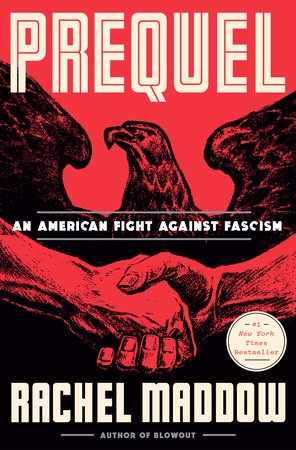
Over the past ten days, I have written two other blog posts which were prompted by a book which I have just completed this morning, August 23, 2023, "Prequel: An American Fight Against Fascism" by Rachel Maddow, the popular television host. The first post, entitled "Fascism In America, Yesterday And Today", was written and posted on August 13, 2023. The second post, entitled "TRAITOR Trump, Adolph Hitler, And The Big Lie", was written and posted just yesterday, August 22, 2023. In general, I rarely write more than one blog post about any book I have read. The two examples of such books I have written about more than once recently are "The River of Doubt: Theodore Roosevelt's Darkest Journey" by Candice Millard, and Bob Deans excellent book, "The River Where America Began: A Journey Along The James".

Each of those books is important in their own way as historical writing. But neither of them is as important as Rachel Maddow's book about the history of early twentieth century attempts to bring Fascism to America. This is a book which is fully loaded with multiple warnings and historical accounts of those attempts to turn the United States into a Fascist stronghold and is an incredibly important book for every concerned American to read before they ever step into a voting booth again. It is an incredibly well researched and documented book whose only flaw is that the writing itself is not the kind that wins literary prizes or leaves the reader consistently spellbound But Dr. Maddow has done a beautiful job of digging through vast piles of dusty, and often obscure, records to document an earlier time when Facism was gravely endangering America. Yes, she is Dr. Maddow, and holds a Ph.D. in Political Science from Oxford University and her research proves she earned it honestly. In this book, she also does a fine job of proving that Fascism still endangers America today, and is actually doing so in a far more terrifying way than it did in the 1930's and 1940's. Although she does not make that claim word for word in the book, any intelligent reader can easily decipher the intent of the book. In my opinion, it is a precursor to a second upcoming book about the ongoing Fascist threat in America and a historically based warning about the imminence of that threat.
I'd like to use a few choice excerpts from the book to prove the point I just made in the earlier sentence about the present danger to America which is posed by TRAITOR Trump and those who support him. The first instance in which the book convinced me that Dr. Maddow was on the right track came in her discussion of the efforts of Senator Robert Rice Reynolds, a North Carolina Democrat who used immigrants as scapegoats for his efforts to support Facism just as TRAITOR Trump has been doing for the past 10 years or so. Reynolds used these words:
"...seeping into this country by the thousands every single month...to take the jobs which rightly belong" to Americans. "I wish to say, and I say it without the slightest hesitation--that if I had my way about it at this hour, I would build a wall about the United States so high and so secure that not a single alien or foreign refugee from any country upon the face of the earth could possibly scale or ascend it." (Prequel: An American Fight Against Fascism" by Rachel Maddow, page 220)
As I said when I first wrote about this book, as soon as I read that quote the person who popped into my head was TRAITOR Trump. Those words sound as if they probably came directly out of his mouth in some rambling rant in front of a crowd of a few thousand of his Fascist and TREASONOUS cult members. That moment is when I first began to realize just how important this book is as we face the most important election in the United States at least since 1860. If we get this election wrong, this country and American Democracy will not survive the next four years. On November 5, 2024, American voters are faced with the most clear cut choice in an election in the history of this country. It is an election in which we are confronted with a choice between a Prosecutor and a Convicted Felon, a Patriot and a TRAITOR, a Skilled Supporter of Sexual Assault Victims and a Serial Rapist, Good and Evil, Right and Wrong, a Powerful Future and a Future Disaster which will not leave a single individual constitutional right intact. It is purely a choice between Good and Evil. As a nation and as individuals, we cannot get this choice wrong. Our entire Democracy is at stake, nothing less!
The next quotation from Maddow's book which I have heard many times, but which struck me immediately in comparison to TRAITOR Trump was this one about Adolph Hitler's Big Lie and is a direct quote from his book, "Mein Kampf":
" The great masses, he wrote, "will more easily fall victims to a great lie than to a small one, since they themselves perhaps also lie in little things, but would certainly still be too much ashamed of too great lies. Thus, such an untruth will not at all enter their heads, and therefore they will be unable to believe in the impossibility of the enormous impudence of the most infamous distortion in others." (Rachel Maddow, quoting from "Mein Kampf", in "Prequel: An American Fight Against Fascism", page 237. )
Let me also say, in clarification, that TRAITOR Trump's name is not even mentioned in this book. But his grossly leering shadow is all through it. His use of Adolph Hitler's Big Lie is the foundation on which his efforts to gain, abuse, misuse, misconstrue, misappropriate power, and destroy American is based. He is first and foremost a pathological liar, and uses those lies to mislead, confuse, and control those members of his cult who are susceptible to them. Just as Adolph Hitler did until the day of his death, TRAITOR Trump uses grandiose, unsupportable lies to gain power over people. It is his favorite tool in his quest to destroy the world around him along with anyone who has sufficient courage to confront him. While it is his favorite tool, it is not his only tool. He also uses fear, intimidation, bribery, psychological manipulation, and a variety of other skills which he developed in his years as a juvenile delinquent son in the shadow of an enabling and destructive father. If you doubt that statement, read his niece Mary Trump's Book, "Too Much And Never Enough: How My Family Created The World's Most Dangerous Man." You might also consider that 40 of 44 people who served him in his cabinet refuse to endorse him today. And 40 lawyers who have all worked in the Department of Justice under Presidents Reagan, George H. W. Bush, and George W. Bush have all endorsed Kamala Harris. One of those lawyers actually is previous Attorney General and numerous others were Deputy Attorneys General. The people who know him and the danger he represents to America are trying desperately to tell the rest of the country the truth about his TREASON!

But as the book progresses in telling the story of early Fascist attempts in America, it becomes a genuine historical biography of one of the worst crime schemes ever perpetrated on an unsuspecting nation, its government, and its people. Hitler's propaganda machine in America was under the charge of one George Sylvester Viereck who was able to engage the support of the great American flyer Charles Lindbergh and several members of the United States Congress. They jointly established a scheme in which congress members who had the incredible power of "franking" which allowed them to mail nearly any written matter they chose to as many people as they chose in the country with the bill for the postage being paid by the United States government. Maddow documents a top secret telegram from the German Charge' D'affaires in Washington to his superior in Berlin in which he said:
"These speeches, whose aim is to prevent America's entry into the war and to ward off all attacks from interventionist politicians, will be printed each time in the American parliamentary publication, the Congressional Record, by these Senators and Congressmen, and then an edition of 50,000 to 1 million copies will be sent by them to specially chosen persons. In this manner, German influence is not visible to the outside, and, thanks to the privilege of free postage enjoyed by American Congressmen, the cost of this large scale propaganda can be kept disproportionately low..." ("Prequel: An American Fight Against Fascism", by Rachel Maddow, page 242)
Later in the book, Maddow points out that the Justice Department official O. John Rogge was able to document at least 24 members of congress who willingly assisted Viereck in his scheme to use "franking" to distribute Nazi propaganda to the citizens of the country at taxpayer expense. Ask yourself this question and answer it honestly: "If 24 members of congress were induced by Germany in the 1930's and 1940's to support the German propaganda effort, in today's world with much more technically advanced means of communication and concealment of the transfer of monetary funds worldwide, and with Right Wing Radical Repugnican people in congress such as Marjorie Taylor Green, George Santos, Ted Cruz, James Comer, Josh Hawley, Jim Jordan, Thomas Massie, Louie Gomert, and Matt Gaetz, just how difficult would it be for Russia and Putin to construct just as destructive and treasonous operation in congress?" Be honest with yourself when you answer that question!

O. John Rogge, the Assistant Attorney General who had uncovered Viereck's scheme as well as the identities of his congressional coconspirators, went to the Attorney General as he was about to depart from the Department of Justice on a speaking tour about his findings, was denied that permission and, bravely stated that he intended to do so anyway, He began his speaking tour and, after his first night's speech was delivered the message by an FBI agent that he had been fired as he sat in a Washington State airport waiting out a weather delay to proceed to another city for another such speech.
In the conclusion of the book, Maddow talks about the fact that the subject(s) of this book, attempted Fascism and those who perpetrated and supported it are still being followed by others who are just as dangerous to democracy and America. She says this in conclusion:
"If we're willing to take the harder look at our American history with Fascism, the truth is that our own story in this wild, uncertain twenty-first century has not an echo in the past but a prequel. For our turn in history--and for the next time this comes around too--we have the advantage of knowing what preceded us. The story of what it took, inside and outside the government, to stop the violent American ultra-right in the run up to World War II--that's a gift from the smart, brave, determined, resourceful, self-sacrificing Americans who went before us. If we learn it, and we choose it, we can inherit their work." (Rachel Maddow, "Prequel: An American Fight Against Fascism", Page 326)

That concluding paragraph from the book tells us all we need to know in order to what we should have been doing all along, "If we learn it, and we choose it, we can inherit their work." That should the goal and the daily effort of every patriotic American in today's world, to inherit the work of those same "...smart, brave determined, resourceful, self-sacrificing Americans who went before us." in the perpetual fight against Fascism, Nazism, Communism, TREASON, Insurrection, Desertion, and the generalized abandonment of the values which motivated the Founding Fathers to build the greatest democracy on the face of the earth.

This is a children's Christmas book by Tom T. Hall. Yes, THAT Tom T. Hall! And, before you remember who he is and disappear without reading the rest of this review, you should know that I am talking about Tom T. Hall, the writer; Tom T. Hall, the novelist; Tom T. Hall, the short story author; Tom T. Hall, the non-fiction author; Tom T. Hall from Olive Hill, Kentucky. Oh, yeah, he wrote a few songs too, eleven Number One songs and about a thousand others all of which are somewhere between good and great. But you do not know the full Tom T. Hall until you have read his books, about a half dozen books in at least four genres: novels, short stories, autobiography, musical instruction books. The man can write and I first encountered his short stories about thirty years ago.

But this book, illustrated by Laura L. Seeley, is a wonderful Christmas books for children in the elementary grades. Yet, it also has value for nearly every other reader. It has spots which will make you laugh out loud and spots which will almost make you cry. Which is what a lot of us have also found in that thousand or so songs the man is most famous for writing. The book is about two children, six and seven, who live in the country across the road from an abandoned house. The book is also somewhat religious in nature since it mentions Jesus Christ. The children live next door to each other, play together daily, and Bobby is the narrator. The book is written in language most second grade students can read and also in language which accurately depicts the thought processes and language of children in that age group. Against their parents' rules, they cross the road, after planning their trip at their Planning Rock, and find that the old house has an evergreen tree growing up through the floor. They decide to decorate the tree as Christmas tree for Jesus and the owner of the property and their parents catch them because the owner has come to visit the house he grew up in one more time before having it torn down. But the book also has a happy ending and you will love reading it for yourself and for the small children in your life. If it does nothing else for you, it will give you a new appreciation for the breadth and depth of Tom T. Hall's talent. That old boy from Olive Hill can write and you should give yourself the gift of experiencing another side of the Tom T. Hall you have probably been hearing on the radio for the last fifty years.


When this novel was first released a reviewer in "The Harvard Crimson" had this to say about it:
"In his latest novel, Robert Penn Warren combines a Southern preoccupation with the past with a typically modern concern with selfhood and alienation. His protagonist literally revels in his aloneness, his rootlessness, his inability to love. Nor is he content with a mere demonstration of his problems; instead, he explains them to us, over and over again, in a style that mixes the lofty literary references of academic--Jed is a medievalist at the University of Chicago--with Faulknerian neologisms and strings of appositives." (Julia Klein, "Harvard Crimson", April 23, 1977)
In the end, Ms. Klein did not write a positive review of Robert Penn Warren's novel and I firmly believe she erred by doing so. While this novel is not another "All The King's Men", Warren's best novel, it is a markedly good novel by a great writer and deserves to be read and appreciated just as much as anything else Warren ever wrote. But, I suppose when you have won three Pulitzer Prizes, one for "All The King's Men" and two for a pair of his books of poetry, you are expected to write stupendously great literature even if your intent was only to produce a grocery list. It seems to me that simply because Robert Penn Warren was never invited to join the group of American winners of the Nobel Prize for Literature some critics and general readers think he can be forgotten, left by the wayside of mass marketed literature, and ignored. The list of American Nobel winners which includes Saul Bellow, Isaac Bashevis Singer, Joseph Brodsky, Sinclair Lewis, Eugene O'Neill, Pearl S. Buck, William Faulkner, Ernest Hemingway, John Steinbeck, and now even Bob Dylan, is a prodigious list and I do not mean to belittle or question the credentials of Bob Dylan by adding him to list as the last person. But I do believe that Robert Penn Warren was just as deserving of a Nobel Prize as any American writer who was ever awarded one and a bit more than a few on that list. When I make a list of the greatest American writers, the names I put on that list are Hemingway, Steinbeck, Faulkner, Buck, Warren, and Flannery O'Connor who also never lived long enough to accumulate a body of literature sufficient to earn the Nobel. I also find it interesting that three of those writers are southern writers, Warren, Faulkner, and O'Connor.
And that last statement brings me to one of the most important misconceptions about Robert Penn Warren. He is sometimes thought of as an Appalachian writer and he definitely was not. He was indisputably a Southern writer. He was a self-avowed member of The Fugitives at Vanderbilt and lived much of his life, especially his academic life, at Vanderbilt University and Louisiana State University neither of which is Appalachian. And his retirement was spent in New England. Yes, Robert Penn Warren was born in Kentucky, Western Kentucky, which is not in Appalachia, not even in the ever expanding political definition of Appalachia used by the Appalachian Regional Commission and the congress which is a purely political definition based totally in pork barrel politics and not remotely culturally based. Warren was born and raised in Todd County Kentucky on the Tennessee border in Western Kentucky far outside both the political and cultural boundaries of Appalachia. He never referred to himself as Appalachian and rightly so. He never wrote Appalachian Literature. He wrote Southern Literature and wrote it just as well as Faulkner and O'Connor, even better at times.
Now that I have made one more diligent attempt to murder the myth of Robert Penn Warren as an Appalachian writer, let's talk about this book which is a damn fine novel about a southern college professor, raised in Alabama, living in Nashville and teaching at a college which we can assume is based loosely on Vanderbilt. The writer and professor moves to Chicago to pursue a doctorate, has an affair with a young Jewish woman there, then marries a young woman from the Dakotas who eventualy dies of cancer. He returns her to her homeland to be buried near her relatives and after her death returns to Tennessee to teach. The novel is filled with very unique, very human, very well written characters who move in and out of the protagonists life which is often centered around a group of friends which his wealthy lover and her husband have collected on their southern farm. The protagonist is drifting loosely along in life, attempting to abandon and deny his youth in the deep south and at times filled with ennui. The death of his wife and her burial in the Dakotas where she grew up is part of the source of that rootlessness but the character is much deeper than one source of ennui. He is drifting through a group of friends and acquaintances who ride fancy horses, attend fancy parties with their fancy friends, and also seem to drift from moment to moment without aim or purpose.
But this is a fine novel filled with excellent character development, precise plotting, and tension which must always seek resolution. It is, admittedly, not "All The King's Men" and it was never intended to be. Warren intended this novel to be "A Place To Come To" and it is. He intended this protagonist to be Jed Tewksbury whose father died drunk falling from a wagon box while attempting to urinate on the hindquarters of a mule only to be found graveyard dead on a dirt road in Alabama with his penis out of his pants. That graphic image haunts Jed Tewksbury throughout the novel and a great deal of his ennui can be said to be rooted both in his childhood poverty and his father's ignominious death and drunken lifestyle along with his mother's eventual love for and marriage to a stepfather whom Jed Tewksbury does not really like and, yet, Jed finds in the end that his little hometown in Alabama is "A Place To Come To". The novel is filled with the characteristic, powerful writing of Robert Penn Warren. He moves through the novel like a world champion boxer scattering a combination of literary left hooks, body blows, and precise three and four words jabs into the mind of the astute reader. If you love good to great literature, southern literature, you need to read this book, and remember as you read it that it was never intended to be "All The King's Men".

Kirk Judd and I passed like ships in the night without ever knowing each other during our time at the Southern Appalachian Circuit of Antioch College in Beckley, West Virginia, in that amazing circle of writers, poets, social activists, teachers, students, unionists, liberals, and outlaws who had been assembled by the great Appalachian poet and educator Bob Snyder. By outlaws I mean those of us who were willing and able to be, to become, to seek to be outlaws in the mold of Mother Jones, John L. Lewis, Jack Kerouac, Bob Dylan, Hosea Hudson, Woody Guthrie, Jock Yablonski, and many others who always Stood Up, Spoke Up, and Spoke Out against evil in its many forms. Kirk Judd and I have still never met but we do communicate now and then since participating in a Zoom Poetry Reading of the posthumous book of poetry, "Milky Way Accent", by our mutual mentor and friend Bob Snyder. Kirk Judd published this book of poetry, My People Was Music, in 2014 with Mountain State Press in Charleston, West Virginia, and I have to admit that I had never read it until he sent me a copy shortly after that Zoom reading which I encourage all of you to view if you did not see it live. And this is a bit earlier in my post than I usually say this, but you should also consider reading Kirk Judd's book which is actually one of three books of poetry he has published. The others were self-published as I understand it, and will be much harder to find copies of on the open market.
Kirk Judd has made public appearances for many years as what can best be described as a performance poet utilizing music and musicians in association with his poetry and this book was actually issued with an accompanying music CD. The book is also noteworthy for the poem, "The Ground of Eden", which is described as a "dual voice" poem and is actually a melding of two separate poems by Judd and Sherrel Wigal with alternating stanzas from each poem on opposite sides of the page. The explanatory notes in the back of the book have this to say about the poem(s): It is a performance piece meant to be read in two voices. The concluding stanza, written by Wigal epitomizes the beliefs and emotions many of us hold dear who have ever lived in West Virginia:
This
This is the land which owns you
This is the ground of Eden
This is the soil
You cannot leave
In many ways, that stanza epitomizes the entire book even though it was not written by Kirk Judd. This book is woven throughout with a deep love of the land, the mountains, the unexplainable soul of West Virginia and the undying devotion of West Virginians for the land, the state, the mountains. Kirk Judd describes himself as a trout fisherman among other things and a great deal of the poetry is rooted in fishing, hiking, living, breathing, in the mountains. One of my favorite poems in the book is called "Spring Prayer On Bald Knob" which describes a hike. One stanza of the rather lengthy poem characterizes much of what I find in the book and that all consuming love of the land:
I make it back to the peak
And now begin to understand how awed I am.
I start the prayer.
I have no tobacco, so I offer water
The only valuable I have with me.
I gave myself years ago.
That stanza takes me back to several experiences of my own, if not hundreds, hiking in the middle of wild, desolate places, living and breathing in the land, the mountains, the surroundings, the creation around me no matter which particular version I, Kirk Judd, or any other reader might hold about the circumstances of that creation. It reminds of standing, staring from one of the highest overlooks into the New River Gorge, or gazing out over a Virginia valley from the top of Stony Man, or taking in deep, woodsy breaths in a deep Appalachian hollow listening to the trickle and babble of the tiny stream at my feet, or the midnight Native American ceremony in which I once partook in a small cave in East Tennessee on the homeplace of Sgt. Alvin York with a few close friends, sweet grass, cedar, and a clay pipe passed hand to hand.
I found several things in this book of poetry and one of them was a collection of common griefs with Kirk Judd of some of the people we both knew at different times in both our lives and theirs, our mentor the great Appalachian poet Bob Snyder, Joseph Barret, Rod Harless, Don West, Connie West, and others. Another of my favorite poems about grief in the book is entitled "The Death of Her Son". The first and last stanza of that poem describe not just that woman's grief but the manner in which many people resolve their grief:
She asked all her questions
in the unanswering hours,
after the preacher had gone
and the boys who brought the flowers
from the funeral home
and all the family and friends
who brought cakes and coffee
and all the food
in dishes with name tags
on the things that needed to be returned...
The sorrow overwhelmed he.
She fell down and wept.
She felt him rise to leave
and, through her tears,
she saw him,
loved him,
and finally,
let him go.
For those of us who have experienced multiple, small, home funerals in the mountains of Appalachia, especially those of us who have seen our friends, loved ones, heroes die too young those two stanzas describe the process of grief and paint a vivid photograph of how we Appalachians have come together to support our friends and neighbors during the hard times of life and death. We have come together carrying our condolences and our contributions in bowls of shucked beans and cushaw, and large, stacked plates of Funeral Bologna sandwiches ground in an old hand cranked grinder which helped us meld cheap bologna, pickle relish, and mayonnaise into something which might not be kind words but clearly demonstrated our unspoken thoughts.

It has been a long time since I began a book and failed to finish it. I was forced to grit my teeth, lay this book down frequently, return to it periodically after I had regained by stomach for it, and finally, with a huge sigh of relief, I got to the end. This book should have been a mea culpa and instead it is an attempt by John Bolton to preserve whatever it is he mistakenly believes is his place in history as something other than a co-conspirator to the TRAITOR Trump for a period of about 18 months which far and away negates any service of value to America he may have ever performed during his previous diplomatic career. I received only two things of value out of reading this massive tome. First, I got a clear picture of the chaos which has reined inside the White House on a daily basis since January 20, 2017, when America allowed a TRAITOR to occupy the White House. I have written in two previous blog posts about the other valuable experiences I received because I read this book. On two occasions, as I was plugging along through this 500 plus page attempt at an alibi, I had encounters with very highly placed physicians in the South Eastern United States and had very open, productive, honest conversations with them about our shared understanding of the treachery of TRAITOR Trump and those around him who have assisted him in his ongoing effort to destroy America in the interests of Russia and Vladimir Putin.
What I have said consistently about this book and what my two physician acquaintances agree with, is that there has always been only one major hiring criterion for those people who have come to work under TRAITOR Trump in his illegal occupation of the White House and that criterion has been criminal intent. Honest, dedicated public servants have not been wanted, sought, or employed in this ongoing conspiracy. My first physician acquaintance stated that he had read about 80 pages of the book and knew he did not want or need to read further. He fully understood my struggle to finish the book but could find no good reason to support me in having finished it. My second physician acquaintance had not even attempted to read the book because he knew quite well what little value there is in it and decided to use his time for better purposes. I honestly wish I had done the same.
But I did find one small statement in the book which I consider worthy of repeating in this blog post. Without digging through the book to find that quote, Bolton stated roughly that in the event TRAITOR Trump should win the 2020 election, an electoral feat which he did not accomplish in 2016, that he would "continue to do exactly what he wants to do" or some close approximation of those words. In that respect, Bolton was absolutely correct. Once TRAITOR, always a TRAITOR, and there has never been a TRAITOR or lower degree than TRAITOR TRUMP. Don't waste your money or your time on this failed attempt at an alibi by John Bolton.


