Search This Blog

Showing posts with label family. Show all posts

Friday, January 30, 2026

The Family Cemetery In Appalachia

The family cemetery in Appalachia has played an important role in social life, local history, and culture since Daniel Boone led the earliest settlers through the Cumberland Gap. The early settlers were coming into a country in which there were no roads, no white or European presence, and no prior history by their own kind of people. It was a rugged and dangerous environment. In a very short time, accidents, child birth, Indian warfare, and disease began to take their toll. Customs and sanitary norms of the time required that the dead be buried immediately. A certain percentage of those deaths took place even before the settlers were near an area where they intended to stay long term. In those cases, the dead were simply buried in the next available bit of ground where it was soft enough to dig. Many of those trail side graves have been lost for centuries. At times of Indian warfare, it was also not unknown for the settlers to make attempts to conceal the graves of their dead. They generally would have done this for two reasons: 1) to conceal losses of able bodied fighters from the enemy; and, 2) due to generally unfounded fears of desecration of the graves. But after settlers had found the piece of land they intended to call home, they buried their dead on their own land. A small piece of land would be chosen at the time the need first arose. The first grave would be dug and that spot would be designated the family cemetery for the Browns, or White's, or Hicks'. These first and most eventual graveyards in Appalachia were usually located on a piece of high ground, often with a good view of the surrounding area. It was often a favorite spot of the head of the household. There was also a common belief that on resurrection morning the dead in Christ would arise with the first rays of the morning sun. The higher elevations usually got morning sunshine earlier than low lying ground. It was also common for graves to be placed with the face of the dead toward the sunrise.

Thursday, August 29, 2024

"The Keeping Quilt" by Patricia Polacco, A Great Children's Book For Multi-cultural Education


Several months ago, I bought a fairly large collection of books from the estate of a retired school principal and this book was in that pile.  It is actually the second book I have read and written about in that purchase.  The other was "The Play Pretty Book", an Appalachian children's book which was produced by a Kentucky based educational non-profit and illustrated by Appalachian artist Tom Whitaker.  I read many different genres of literature and high quality children's literature is one of them.  This book, "The Keeping Quilt" was a winner of the Sydney Taylor Book Award from the Association of Jewish Libraries.  It was also a Carnegie Medal Honor Book.  This book is about a Russian Jewish family which immigrated to the United States with a little girl named Anna who is the great-grandmother of the narrator.  Anna has a much beloved babushka and dress which, naturally, become too small for her in time.  Her mother decided to invite the neighbor women in to hold a quilting bee and make a quilt from the babushka and dress so that Anna can keep something made from her treasured items. The quilt gets passed down from one little girl to another through several generations of the family throughout the life of the book.  

Since my real academic specialty is Appalachian Studies, let me say that this is a wonderful book to be used with Appalachian children since quilts and quilting hold such a special place in Appalachian Culture.  I grew up sleeping under what is called a "tacked quilt" which, instead of being sewn in regular stitches, has yarn "tacks" all over the body of the quilt.  The creator of such a quilt uses a darning needle and a skein of yarn and at uniform distances of about 4 inches in each direction passes the needle through the quilt twice at about the distance of a regular stitch, cuts off the yarn at about 3 inches and ties the two ends in a knot to make a "tack".  As I fell asleep at night, I would doze off holding and playing with the "tacks" on my quilt.  I have known many other Appalachian children who grew up the same way with "tacked quilts".  Thousands of Appalachian children grew up sleeping under regular patchwork quilts also.  The story of a quilt in this book will make a connection in the hearts and minds of most Appalachian children.  It is a great book for use in teaching Multi-cultural Education and Tolerance to young Appalachian children.  


Yes, this book is a bit aged having been published in 1988.  But it is also a timeless book about family, cultural traditions, expressions of love by elders doing things for young children, and quietly makes the point that the family are Jewish.  The book is published in 8 1/2" x 11" format, both written and illustrated by the author who actually wrote more than 50 children's books, and is a wonderful illustrator.  Her illustration style is unique in that most of the page areas are in black and white with only key areas or items in color.  I have included a page or two from the book here to demonstrate the illustration style which serves to strongly emphasize the importance of the key item in each page of the book. If you are a parent or teacher of kindergarten or first grade children, this is an excellent book to begin the discussion of religious tolerance with.  


Saturday, December 24, 2022

Christmas On Beaver When Times Were Hard!


 On Beaver Creek, the times were hard.

We had no taters, had no lard.

All the way from Allen to Kite,

Times were tough, money was tight.

It wasn't any better from Martin to Wheelright.

Both forks were suffering, it felt like a blight.

The mines were down, people were leaving.

Old grandmas sat crying and grieving.

Miners were headed to places off yonder

While mothers of children would sit and ponder

How to feed four, or five or six

Hungry mouths with nothing to fix.

Christmas was just about a week away

And children had learned not to say

Old Santa's name by night or day. 

This had become a mighty hard life

For hardworking husbands and every young wife.

There would be no toys under green trees.

Adults were praying on bony knees.

Smoke houses were empty of the last meat.

The canning was gone, nothing to eat.

Squirrels were in hiding in the highest trees 

Too far to shoot the ones you did see.  

Rabbits had been killed till few were around

And  they all hid warm underground.

Old men were selling their best coon hound

Nothing to feed them, nothing to go around. 

A lot of dry cows were already beef

And acorns were sought under every dry leaf.

Real old men and their real old wives

Said this was the worst time in their lives.

Christmas was less than a week off

And lots of people had started to cough.

Hungry people get sick a whole lot quicker

With nothing to eat and no pot licker.

But somewhere off in them big cities

The ones who had left bought a few play pretties,

Loaded them up with flour, lard, beans, and rice,

They were bringing it home and didn't think twice.

On Beaver they knew they had poor kin

And letting them starve would be a great sin.

In Kendallville, Cincy, Chicago, and Dayton

That Friday afternoon they all were waiting

For quit time to come and time off to start

So they could come home and touch grandma's heart.

They loaded all the good stuff they all could afford

Filled up their tanks and thanked the Lord

They still had good jobs near Christmas day

So they come home and proudly say

We didn't know what you need but thought we should

Bring a few things and maybe we could

Help out some in these hard times,

Sing a few carols, recite a few rhymes,

Cook a few dishes on Christmas day

And thank the Lord while we all pray

That times get better and the mines start up

And grandpa can buy another bluetick pup.

Granny can see her way till spring

And hoe in the garden and softly sing

Those Old Regular songs she likes so much

That she sings with her own special touch.

Maybe the children can get new clothes

And  John L. Lewis will speak out for those

Who need to work now right here on Beaver

So nobody else will have to leave her

To go up north to some strange town

Where family and friends are never found.

We'll all come back to Beaver some day

Settle right in and always stay

On the old home place with the little old house

Where we can be as warm as a mouse,

Right here on Beaver, the creek we love

Which was a gift from above.

Right here where home is in our souls

Where we want to stay until we grow old

Right here on Beaver, both left and right,

Where we can sleep warm every night,

With the peace of Christmas in our lives

With husbands, sons, daughters, and wives.    

Roger D. Hicks, December 24, 2022


Monday, May 24, 2021

"Christmas And The Old House" by Tom T. Hall--Book Review


This is a children's Christmas book by Tom T. Hall.  Yes, THAT Tom T. Hall!  And, before you remember who he is and disappear without reading the rest of this review, you should know that I am talking about Tom T. Hall, the writer; Tom T. Hall, the novelist; Tom T. Hall, the short story author; Tom T. Hall, the non-fiction author; Tom T. Hall from Olive Hill, Kentucky.  Oh, yeah, he wrote a few songs too, eleven Number One songs and about a thousand others all of which are somewhere between good and great.  But you do not know the full Tom T. Hall until you have read his books, about a half dozen books in at least four genres: novels, short stories, autobiography, musical instruction books.  The man can write and I first encountered his short stories about thirty years ago. 

But this book, illustrated by Laura L. Seeley, is a wonderful Christmas books for children in the elementary grades.  Yet, it also has value for nearly every other reader.  It has spots which will make you laugh out loud and spots which will almost make you cry.  Which is what a lot of us have also found in that thousand or so songs the man is most famous for writing.  The book is about two children, six and seven, who live in the country across the road from an abandoned house.  The book is also somewhat religious in nature since it mentions Jesus Christ.  The children live next door to each other, play together daily, and Bobby is the narrator.  The book is written in language most second grade students can read and also in language which accurately depicts the thought processes and language of children in that age group.  Against their parents' rules, they cross the road, after planning their trip at their Planning Rock, and find that the old house has an evergreen tree growing up through the floor.  They decide to decorate the tree as Christmas tree for Jesus and the owner of the property and their parents catch them because the owner has come to visit the house he grew up in one more time before having it torn down.  But the book also has a happy ending and you will love reading it for yourself and for the small children in your life.  If it does nothing else for you, it will give you a new appreciation for the breadth and depth of Tom T. Hall's talent.  That old boy from Olive Hill can write and you should give yourself the gift of experiencing another side of the Tom T. Hall you have probably been hearing on the radio for the last fifty years.  


Friday, March 27, 2020

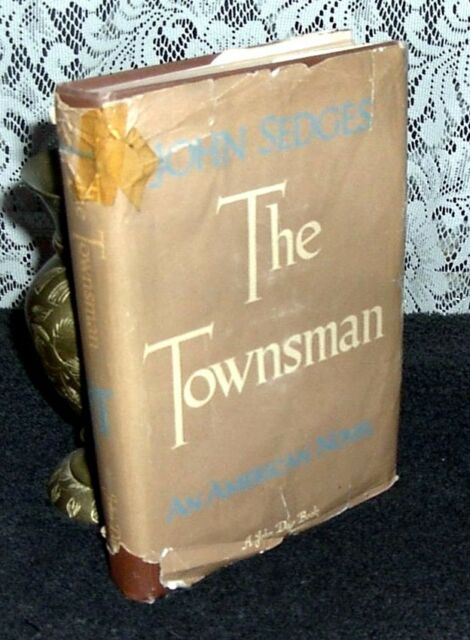
"The Townsman" by Pearl S. Buck--Book Review

Pearl S. Buck wrote and published five novels under the psudonym "John Sedges" during her lifetime after she had returned to America from China.  At the time, her publishers thought that she was being viewed primarily as a Chinese or Asian centered 
writer and that the reading public would be reluctant to buy American centered books by Buck. "The Townsman", "The Long Love" and "Voices In The House" were all published in 1944 and were well received despite the wartime environment which was naturally depressing book sales nationwide. The sales of those two novels under the pseudonym eventually led to the publication of "The Long Love (1944)", "Bright Possession (1952)", and "The Angry Wife (1947)" under the John Sedges pseudonym.  But as Buck is quoted in the foreword  to "American Triptych" a collection of three of the John Sedges novels, eventually someone who knows will talk in such situations and the pseudonym was common public knowledge and no longer used.  

In an earlier blog post, I wrote about a single quotation from "The Townsman" about the American presidency which is suffering from its worst crisis today because of the current Russian Owned occupant of the White House and his inherent incompetence and willingness to destroy the country he betrayed in cooperation with Vladimir Putin and Russia.  You can bet that a book which is good enough to merit a full article
about a single quotation it contains is well worth reading.  "The Townsman" is one novel in "American Triptych: Three John Sedges Novels" and that is the best way to buy it since I do not know of a recent publication of the book.  But it can be found on the customary used book sites such as Alibris and others. Buying it in that format will allow you to enjoy three Pearl S. Buck books for the price of one.  I have to admit I have not yet read the other four John Sedges novels but I fully intend to based on my highly favorable impression of "The Townsman".  This is a long novel of more than four hundred pages but it is well worth the time to read.  The protagonist is Jonathan Goodliffe who, at the beginning of the book, is a teenaged English boy in a large poor family with a hardworking, overburdened mother and a somewhat shiftless father who has big dreams but never fulfills them.  Eventually, the father, Clyde Goodliffe, decides to emigrate to America and the family takes up residence in a brand new, tiny hamlet in the plains of Kansas.  Clyde Goodliffe accomplishes just as little in Kansas as he had in England and as he matures Jonathan becomes the head of the family by default since Clyde leaves all except his favorite son to traipse across Kansas to homestead land.  

As the novel progresses, Jonathan meets and falls in love with the daughter of an itinerant preacher who jilts him to run away with his best friend.  This is a novel of unrequited love; good, solid working class people; and fulfillment of personal commitments by numerous characters including Katie, the woman Jonathan eventually marries and spend his life with.  Jonathan becomes the central figure in the little Kansas town which he nurtures, grows, and keeps in accordance with his beliefs about right and wrong.  The novel serves to espouse many of Pearl S. Buck's own personal beliefs as in the aforementioned quotation about the American presidency, her personal opinions about the equality of the races, and right and wrong.  A set of important figures in the book are a family of former slaves, the Parry's, who have a brilliant eldest son whom Jonathan assists in achieving his dreams.  The Parry parents also play diminished but important roles in the life of the town as a carpenter and a midwife, herb doctor.  

The book is well worth reading as is everything I have ever read by Pearl S. Buck.  I would repeat that it is best bought in the "American  Triptych.." form since you can also enjoy two other John Sedges novels in that format.  Enjoy the book!  It will keep you busy at home for a while as we fight to win against the Corona Virus. 


Tuesday, June 18, 2019

Requiem For A Friend--Dewey Lee Rogers--1942-2019

Dewey Lee Rogers--Photo by the Rogers Family

Sometime in August of 2011, at Banner, Kentucky, I met one of the most unique and interesting people I ever knew.  He was my friend, my auction ring man, and one of the best overall people I ever knew.  I had just opened my weekly consignment auction at Banner which I continued to operate for several years before closing it due to my wife's increasing health problems.  I knew very few people in the area although I had grown up about 25 miles away.  I had not lived or worked in that area in several years.  A slim, neatly dressed man in a white shirt and khaki pants walked into the auction house a few minutes before the sale was scheduled to begin and struck up a conversation.  He never mentioned his name and I never asked for some unknown reason.  But it was obvious that he knew a lot about the auction business. Since most compliance officers with the Kentucky Board Of Auctioneers have always been retired Kentucky State Police detectives and this man was neatly dressed, old enough to be retired, and well versed in the business, I immediately thought he was probably a compliance officer checking out a newly advertised weekly auction.  So I said, "If you work for the board, my license is right over there on the wall.  Go check it out."  Dewey just laughed and said, "No, I don't work for the board."  

Dewey and Lorene Rogers--Photo by the Rogers Family

At the time, I did not have an established auction crew other than my wife Candice who was cashiering, a clerk whose full time job was as  a librarian at the local community college, and a general flunky who had walked in just a day or two after I rented the building and claimed he was a ring man.  I knew fairly soon after I hired him that he was not a ring man and shortly after that I figured out that he was also a thief.  After I started the auction, things were going about as well as could be expected with a green crew and a bad ring man.  Just as it was  becoming apparent that my so-called ring man was incompetent, Dewey just stood up and started working.  Since I had no idea who he was, my first reaction was to tell him to sit down and we would run the sale.  But after about the second item he helped me sell, I realized this old man knows what he is doing.  So I let him work the entire sale and it went much better than it would have otherwise.  After the sale ended, I walked over to him and asked how much I owed him.  He just grinned and said, "You don't owe me nothing."  Then I asked "Are you  coming back next week?"  He just grinned again and said, "I don't know if I am or not," and walked out of the building to his vehicle. About fifteen minutes before the sale was scheduled to start the next week, Dewey came walking in the door.  I walked up to him and said, "Are you going to work tonight?"   He gave me that same grin and asked, "Do you think you need me?"  "I said, "I do but I don't like for people I don't know to work for me.  Who are you?"  He said, "I'm Dewey Lee Rogers."  We shook hands.  He worked that sale and nearly every other sale I ever had in Floyd County Kentucky and we quickly became fast friends until the day he died on May 23, 2019.

Dewey & Lorene Rogers--Photo by the Rogers Family


Our relationship quickly bloomed into a wonderful professional relationship between an auctioneer and a ring man and an even better friendship between two Appalachian men with a lot of common interests.  He had worked as a coal miner and an auction ring man most of his life and lived his entire life on Mud Creek in Floyd County.  He loved auctions and the auction business and he would have been a wonderful auctioneer if he had ever chosen to get a license.  I still don't understand why he never did.  I offered several times to let him serve his apprenticeship under me and he always just said he wasn't interested in having his license.  When we worked auctions, he was absolutely in tune to me and my style of working.  We were a great team and he made me look better and funnier.  He was a very funny man himself and when we were both on top of our game we could have given Laurel and Hardy a run for their money and still run a smooth, fast paced, professional auction at the same time.  It was a tremendous pleasure to work with him.  He made an auction tick like a clock, kept the crowd honest, and did a hundred different things which made him irreplaceable. He knew the great majority of the locals who became our regular customers and passed on valuable personal information about every one of them.  He knew who was honest, who was not, who wrote bad checks, who stole, and who you could trust. In a short time, I realized that if I ever had a million dollars in a cardboard suitcase and needed a place to park it, I could hand it to Dewey and say "I'll pick this up in a week or two."  It would have been there untouched when I went back to get it. I always make a practice of introducing my crew at the start of each auction for two reasons.  The customers need to know who is working the auction and what their job is and the staff need to be recognized instead of ignored and treated like burger flippers or temps in what should be a full time job.  I quickly developed a stock introduction for Dewey.  At the start of every sale, I would introduce him to the crowd by saying, "This is Dewey Rogers.  He has worked for every auctioneer since Adam had to sell Abel's personal property."  It might have been an exaggeration but it was simultaneously close to the truth.  Dewey had been attending auctions since he was old enough to travel anywhere alone and he had worked as a ring man for somewhere in the neighborhood of fifty years. He knew a lot about people and a lot about most kinds of merchandise and how to get an honest dollar out of anything.  He understood, just like me, that at every auction someone is in control.  It is either the auctioneer or the crowd and it should always be the auctioneer.  We worked together to the point that we were both proud to tell anybody who asked what each of us thought about the other.  To me, Dewey was the best ring man alive.  To Dewey, as he often said, I ran the best country auction anywhere around. 

Dewey Rogers--Photo by the Rogers Family


Dewey also had a lot of similar interests to my own.  Despite having a minimal amount of formal education, he was very intelligent, loved books and history.  He also loved to meet people and was literally the definition of gregarious.  He never saw a stranger and if he met one he knew them before they parted ways.  He absolutely loved his wife of fifty years, Lorene Hamilton Rogers, and he made it clear to anyone who asked. The last photo above is my favorite photo of Dewey and Lorene.  I don't believe it is possible to see that photo of a man and a woman, both well past their prime, staring into each other's faces without knowing that they were in love even if you do not know another thing about them.  Lorene passed away on September 11, 2018, a few months before Dewey and he was lost in many ways after that.  His health deteriorated and his daughter, Nonie Justice, and her husband moved into his home and took care of him until his death.  With medication and effort, Dewey managed to return to doing some of the things he loved until the day of his death.  He was able to visit some family and friends, to drive on his own, and to enjoy some aspects of his life until his final day.

I have lost a wonderful friend and professional associate.  Dewey's family has lost a father and a hero in many ways.  The community has lost someone to admire.    

Saturday, November 25, 2017

Another More Traditional Thanksgiving Dinner With Family, Saturday, November 25, 2017

Today, Saturday, November 25, 2017, we drove to Prestonsburg, KY, again for a second, more traditional Thanksgiving Dinner with family, most of whom had been at our earlier state park lodge buffet Thanksgiving Dinner.  A couple of faces were different but the attendance was about the same, roughly a dozen.  The meal was at my cousin Judy Terry McGuire's house in Prestonsburg where we seem to get together about once a year.  Judy's husband, Eddie McGuire is an excellent cook and raises a large garden each year, cans and freezes a lot of vegetables, and does an excellent job with a lot of homegrown food.  Most other attendees bring some sort of side dish and it turns into a large, traditional Thanksgiving meal with turkey, ham, sweet potatoes, mashed potatoes, rolls, coleslaw, cakes, pies, etc.  This year, with the temperature at midday around the high fifties, anybody who wanted to could spend some time outside while others watched football and talked inside.  

As I had said in my earlier post about the buffet dinner on Thursday at Jenny Wiley State Park Lodge, I would rather have a traditional family meal with family in a home setting even if I was eating bologna sandwiches.  Actually, I haven't had funeral bologna for while and that might be an interesting twist for a family holiday meal sometime.   How about a menu of funeral bologna, peanut butter, brick cheddar, and other sandwiches with the only rule being that any item brought to the dinner would need to have been available in a small country store in Knott County Kentucky about 1958.  You could maybe add a few roasted or boiled chestnuts, paw paws if you could manage to save a few until late November, an allowance for grocery mix candy, chocolate drops, and sugar stick candy for dessert.  That could generate a lot of old memories and a lot of long winded stories.  I might try that sometime...Kentucky Border Bologna and crackers.  But you can no longer find saltine crackers with all four squares still together for sandwich making instead of the current method of selling them in single squares in a cellophane tube.  Maybe add a few Koolickles.   For those of you who don't know about Koolickles, they are dill pickles soaked for several days in a large jug of your favorite flavor of Kool Aid.  I think this idea could be turned into a good meal for those who remember the old times. 

Thursday, November 23, 2017

Thanksgiving With Family At A State Park Lodge

Today, my wife Candice and I had Thanksgiving Dinner with ten other members of our extended family at the Jenny Wiley State Park Lodge which has recently been refurbished after a major fire.  There were twelve of us at the dinner which had at least a couple of hundred diners during the time we were there.  Apparently, nobody wants to cook a traditional Thanksgiving Dinner anymore.  We represented three generations of our maternal grandparents' descendants.  There were four of us first cousins there from the seven which were raised by our mothers, sisters Mellie Hicks Hicks and Ellen Hicks Terry. Two of that original seven are now dead.  There were three spouses or significant others of that group, one daughter of my cousin Jack Terry, one daughter of my cousin Greg Terry, and several of Jack's grandchildren.  This was the first time many of us in the family had met Greg's daughter, Shay, who suddenly appeared in his life not long ago after finally learning who he biological father is.  Neither of them had known of the identity or existence of the other until very recently.  That, in and of itself, made it an interesting meal. 

The buffet was served in a large dining room, one of two, which must have seated at least a hundred people.  The staff worked constantly and kept drinks refilled, dirty plates bused, and minor requests for information answered.  I am certain they never received, in that kind of setting, anywhere near what they deserved in tips. The standard 18% for large groups would be in order in that setting.  I tried my best to be reasonable with my tip and so did at least one other in our party.  The setting, twelve people spread along the length of a long table, did not do a lot to benefit conversations.  The tables were a bit too close together and the overall layout of the room made traffic to and from the buffet a bit congested.  Salads, vegetables, and meats were on a steam table along the left side of the room with both sides open for self service.  Desserts were on two tables along the perpendicular  wall on two tables with only one side open for self service.  A staff member was on the right side of the room slicing and serving ham and roast beef from another table with heat lamps.  This setup caused too much traffic across the room, back and forth, and sideways.  

The food was generally acceptable but not outstanding by any measure.  When I got to the turkey to serve for my wife Candice, I found a wet mess of shredded turkey in the bottom of a hotel pan.  There were a couple or three dishes on that steam table which kept eliciting questions among strangers to the tune of "do you know what that is".  The salad makings were a bit too few to make a good salad for the person with vegetarian leanings.  The coleslaw was good and made along a traditional Eastern Kentucky recipe.  The green beans came straight out of an institutional can.  The pies, pecan, peanut butter, and pumpkin, were straight out of a box.  The baked Alaska was good and made on the spot.  The roast beef was far overcooked for my taste without a wink of pink in sight.  The ham was minimally acceptable.  Overall, this was a large restaurant buffet designed to minimally please diners who did not have high expectations without minimizing the potential profit from the occasion.  Nearly every time I have eaten at Jenny Wiley State Park Lodge, which is a frequent choice of some of my relatives who live close to it, I have left once again convinced that most of the other state park lodges in which I have eaten do the job better, especially Natural Bridge State Park Lodge.  I nearly always prefer Natural Bridge to other parks and the setting is usually far more picturesque.  

After the dinner, we hung out for a short time in the lodge lobby talking and split up until this coming Saturday when we will get together for a second dinner at the home of a cousin in Prestonsburg which is a much better idea.  I had told a friend in an e-mail today that I would rather eat bologna sandwiches in a genuine family setting with family than a high class buffet in a restaurant setting anytime.  This dinner convinced me I was correct in that statement.  A home cooked meal with shucked beans, hog jaw, ground hog, squirrels, pinto beans, corn bread, cushaw, and hominy would be far better anytime. 

Wednesday, May 24, 2017

"Still Life With Plums" by Marie Manilla--Book Review

Manilla, Marie 2010 Still Life With Plums (Morgantown, WV, Vandalia Press)


I just took a long, quiet drive across the West Virginia I have always loved courtesy of Marie Manilla, one of the Mountain State's finest writers.  This collection of short stories is set primarily in West Virginia with a bit of Texas thrown in for good measure.  But the author's primary setting, source of knowledge and folkways, and the home place of her heart is West Virginia, the West Virginia that is found in the lyrics to "The Green Rolling Hills Of West Virginia". 

"The green rolling hills of West Virginia
Are the nearest thing to heaven that I know
Though the times are sad and drear
And I cannot linger here
They'll keep me and never let me go."

That line "though the times are sad and drear and I cannot linger here they'll keep me and never let me go" personifies this book in many ways.  Several of the stories are set among times, places, families, and individuals who are "sad and drear".  But nearly every character in the book has learned the truth that West Virginia will "keep me and never let me go".  They have found the sources of both their pain and their pleasure in that sweet, dark, heart warming, shimmering green, and dreary land between the Ohio River and the headwaters of the Potomac.  Thanks to Ms. Manilla, these characters are generally able to resolve that pain and relish the pleasures of life.  As I read this book, I was reminded of the song writing of Dolly Parton in such songs as "Mountain Angel" and "These Old Bones". Marie Manilla has that same ability to reach into the soul of a flawed character who is generally not responsible for her flaws but found them at the hands of others.  

"Still Life With Plums" is a book to be read slowly, thoughtfully, and deeply.  These characters are real people that you and I have both known and often loved with a love that was deepened and strengthened by many shared mornings fueled on water gravy and a thin hoe cake.  These characters have a few too many patches on their britches and the cold winter winds blowing down the Guyandotte or the Gauley have cut right through their pea coats on the way to the mine, factory, or company store.  Marie Manilla understands West Virginia and her people as only one of their own can comprehend.  She creates characters out of the whole cloth of a life lived in that land built from secession, independence, and hardship.  These characters find connections, assistance, and subsistence among others like themselves, strong despite having been bowed, compassionate in addition to being tough, loving despite having been discarded, and proud Mountaineers in the face of all that history of having been discriminated against.  They are my people.  They are your people.  They are the people of Cabell, Wayne, and Summers Counties.  They are the people of the industrial and chemical river and the people of the log woods and coal fields.  They are people you should meet and come to know.  They are people you should take a long, quiet ride with across the green rolling hills of that beautiful, blessed paradise we call our mountain home. 

Wednesday, November 30, 2016

"We Be Warm Til Springtime Comes" by Lillie D. Chaffin BOOK REVIEW

Until recently I had never read anything by Lillie D. Chaffin even though she was from Pikeville, KY, and had served as Kentucky's Poet Laureate in 1974.  She also has an Appalachian Literature award named for her at my Alma Mater, Morehead State University.  After having read her children's book, "We Be Warm Till Springtime Comes", I have to admit I had been remiss by not having read her work.  I strayed into the book during an expedition to a small antique store which a friend owns where I sometimes buy a few items for my personal collection.  On that trip, I bought a few books of Appalachian or Kentucky interest and "We Be Here..." was one of them.  It was published in 1980 by Macmillan and illustrated by Lloyd Bloom.  The copy I bought was in excellent condition with the dust jacket in nearly perfect shape, still contained the original poster of one of the illustrations by Bloom.  It also contained a signed letter and post card from Ms. Chaffin to the previous owner.  I would probably have bought the book even if it were not purely Appalachian.  

The book is intended for juvenile readers from about the third to sixth grade and is a most genuine Appalachian story about a poor family living in poverty in the mountains in the middle of a hard winter.  The family is composed of a mother, a son about ten years old, and a small daughter.  The family is facing an increasingly hard winter with no coal or wood to burn for heat.  The son makes a decision, over the mother's objections, to go to the coal bank on the hill behind their house to dig for coal to help them survive the winter.  This is one of the most genuine and authentic Appalachian stories I have ever read.  Although we never burned coal when I was a child, the family farm on which I was raised in Knott County Kentucky contained the remains of two coal banks where previous owners of the land had dug for what is known locally as "house coal".  

For those of you who have no knowledge of coal banks, they are small holes dug into a coal seam which is at or near the surface for purposes of gaining access to enough coal to heat a home and fire a cast iron cook stove or "step stove" as most of them were known. But after several years of digging, a coal bank might be as much as hundred feet deep inside a hillside.  Few of them ever had a solid roof and roof falls were numerous. I have never dug coal in a coal bank.  I was very lucky to have a family who lived somewhat above the level at which many of our neighbors did.  But I grew up with and went to school with several children, mostly boys, who had to dig house coal in order to facilitate family survival.  I went to high school with three children whose father whom I knew was killed accidentally by a mishandled charge of dynamite during an effort to obtain house coal from a coal bank.  

The inherent danger of digging in a coal bank combined with the hard winter and poverty work to make this a very tense book for a young reader.  But it is an excellent book for such readers at the same time since it focuses on the boy's self sufficiency, honor, and determination to help his mother and sister survive the winter.  His willingness to take a potentially fatal risk to assist his family is the heart of the story.  It is wonderful story and well worth reading.  I will take the time to find and read more of Lillie D. Chaffin's work and so should you.  

Lloyd Bloom's illustrations for the book appear to have been originally rendered in charcoal and present only a few shades of black, white, and grey.  In another setting, they might be considered a bit goth.  But they do an excellent job of increasing the tension of the book and stressing the dangerous potential of the effort.  Go online at a good used book site and find a copy.  You will enjoy this book a great deal.  

Monday, December 9, 2013

Christmas Hospitality In Appalachia

An Interesting Evening In Menifee County Kentucky
This past Saturday, December 7, 2013, my wife Candice and I took  a trip from our home in White Oak, Morgan County Kentucky down US460 into Frenchburg, KY, the county seat of Menifee County to post some handbills for an upcoming auction.  Along the way, we stopped at nearly every kind of business one can find in a small county in Kentucky or in Appalachia in general for that matter.  Altogether, the trip was probably about 80 miles since it is roughly 35 miles from our home to Frenchburg and we took a bit of a side trip to Cannel City on our way home.  We spent the biggest part of the afternoon on this trip, had a ball, and experienced one heartwarming dose of Appalachian hospitality like I had not seen in a while.  We put out a few handbills along the way and came to the Oldfield Farm Store and Mize, KY, post office where we once again saw a US Post Office being run inside a privately owned business which does not happen much anymore.  Mize is one of the small post offices which came up for possible closing last year as the post office management tried to complete a plan by which it can become profitable again.  But, like many other small post offices across the country, Mize escaped the budget axe at least for the present. 
After a brief stop at Mize, we travelled on west into Menifee County.  Along the way, I reminded Candice of a place just across the county line which we had visited several years ago known as the Swamp Valley Museum.  It had been run for about 50 years by a man named Clayton Wells who also had several old log buildings full of assorted antiques along with his country store.  Clayton Wells is now dead and I told Candice the store was probably closed.  But as we rounded the curve, I saw wood smoke coming from the store chimney and surmised that maybe Clayton's children were continuing to run the store.  We pulled in and I walked inside just as I would have in the past only to find that the store was actually closed and now being used by his children, widow, and other younger descendants as a family gathering place.  But I was invited inside the store anyway by Clayton's son, Gary Wells, a former deputy coroner of Menifee County and current member of the volunteer fire department.  There was a large number of the family in the old building which has been kept just as it was when Clayton was alive.  There was a large cast iron Dutch oven full of homemade beef soup steaming on the wood stove and Gary Wells, the cook, quickly invited us to have a bowl.  I told him I would have to check with Candice, who is in a wheelchair, to see if she was interested. Candice usually stays in the van when I am making short stops rather than make the effort to get in and out of buildings which are not handicapped accessible.  It turns out she was interested in going inside and eating with the Wells Family and Gary and one of his brothers helped me get her up the single step & through the door into the store.  The family made room for us, passed out paper bowls & plastic spoons for the soup, and gave us both a cold Ale 8 One, the national soft drink of Eastern Kentucky.  Ale 8 One is a mild ginger ale made exclusively in Winchester, KY, not far from Frenchburg & is drunk daily by thousands of Appalachian Kentuckians.  It probably deserves a separate post at some time in the future since it  is a Kentucky institution.  The store, although it is just as it was the last time I was there in about 2001, is no longer operating.  This was a family gathering in a place that is near and dear to their hearts and which had become a shrine dedicated to family memories.  But they still invited two strangers in, fed us, talked for about an hour about country stores, antiques, local politics, family life in Appalachia, and a dozen other topics just like we were all old friends.  They even allowed us to bring our 13 year old Dachshund, Giggles, into the store too.  She walked around in the floor along with a small great grandchild of Clayton Wells and was ignored just as if she was also a member of the family.  The soup was great.  The hospitality was a wonderful reminder of how people all across Appalachia used to treat strangers.  It reminded me of many visits I made as a traveling salesman or simply a traveler to many stores and homes across Appalachia in the last 60 years. It also reminded me of how many times I had seen my parents doing the same thing in our country store in the 1950's & 1960's.   The experience was a bright spot near Christmas which showed us the Christmas spirit as it had been long ago and may well never be very often again.  We enjoyed it greatly and I will post some photos in the near future of the Swamp Valley Museum and Store since I did not have my camera with me.  Perhaps in the spring I will go back on a Saturday when I can find the family in and take photographs for a while. 
For now I will let a description suffice.  The store is a small wood frame structure with a low porch in front.  Nearly every square inch of the building is covered with vintage to antique advertising and political signs.  The parking lot is slightly graveled and gets muddy in wet weather.  There is an old wire corn crib right beside the store and a fine old log house full of antiques  which used to serve as the Swamp Valley Museum about 75 feet downstream on the side of the parking lot.  It is fine place to visit although it is no longer being operated commercially and I would not expect the Wells Family to always be this hospitable to the random stranger.   But it is a fitting reminder of life in general stores in Appalachia when I was a child. 
When we started back home, we took a side trip to Cannel City, KY, to stop in at the Caney Valley Grocery which I have mentioned in this blog in the past.  It is an old wood frame two story store, still being operated by Roger Finch and family and also filled with antiques.  I was pleased to see a small display case full of vintage to antique patent medicines on the top shelf in the store to protect it from too many hands.  I had sold Roger Finch most of the patent medicines a few weeks ago and he was so enamored with them he brought the antique display case down from the upstairs antique shop to display them.  They include Dr. Drake's Glesco, Old Settler water treatment, Cloverine Salve, and several other items no longer on sale anywhere.  Altogether, it was a fine day on the road in Appalachia and I cannot wait to do it again.  I highly recommend a day long drive along US460 in Eastern Kentucky anytime one can find the time.  The remaining two lane sections of the highway contain some very interesting places to stop, visit, take a few photographs, talk a while, and occasionally see a bit of the Appalachia I remember from my childhood. US460 runs all across Kentucky from the Virginia border in Pike County to the intersection with US60 in Frankfort.  It is well worth spending a day or three driving all the remaining two lane sections in a leisurely trip to see a few reminders of life as it used to be.   At some point in the future, I will try to write a longer post about US460 in the My Favorite Places In Appalachia collection.  But for now I just hope it is also one of your favorite places. 


****************************************************************************
UPDATE: September 25, 2019

The Jesse Stuart Foundation has just released a new book called "True Christmas Stories From The Heart Of Appalachia" and it includes my story, "Christmas On Beaver Creek", along with stories by Jesse Stuart, Cratis Williams, Bill Best, and my two good friends Edwina Pendarvis and Emily Steiner. It has 43 stories from 39 different authors. I have a few copies with my autograph and a personal inscription for whomever you choose which are available at the same price the publisher charges for unautographed copies.  They are $25.00 each plus $3.00 shipping which is what the publisher has set as the price.  I will accept payment through PayPal at rchicks@mrtc.com   You can contact me at Roger D. Hicks, 65, Highway 1081, West Liberty, KY 41472,606-743-2087, or e-mail at rchicks@mrtc.com  Merry Christmas!


Friday, November 29, 2013

PAW PAW, THE NATIONAL FRUIT OF APPALACHIA!

THE BEST KEPT SECRET IN THE WORLD OF FRUIT
Paw Paw Tree With Fruit photo by Southern Living


When I was growing up in Knott County Kentucky in the 1950's and 1960's, my family regularly ate nearly every fruit, nut, or vegetable we could harvest from wild plants within a few miles of our home.  Some of those items we also planted on our property and regularly harvested and ate their produce in our home.  Some of the plants we regularly kept on our land included hazel nuts, walnuts, beech nuts, hickory nuts, blackberries, raspberries, poke, huckleberries (blueberries for those who do not speak Appalachian English), plantain, and my personal favorite the paw paws.  We had three large trees on our property and both were in our chicken lots which caused us to have to do extra work to protect the fruit from the chickens.  We had two adjoining lots for our chickens and two chicken houses.  One lot was near our pump house and actually had a corner post and gate behind the pump house which was literally at the corner of the building.  We also had a large, heavily bearing paw paw tree about three feet from the gate at the corner of the building which was literally against the woven wire fence.  At fruit bearing time about half of the paw paws fell outside the lot and about half fell inside.  Our other chicken lot, up the hill on the upper side of this first lot had two large, heavily bearing trees in the middle of the lot.  As paw paws began to ripen we would shut all our chickens in the lower lot since having them there would cost us at most about half the fruit from one tree as opposed to all the fruit from two trees.  We would also often shut the chickens in the house at afternoon feeding time and only release them to the lot after we had picked up the fallen fruit in the morning.  We would go to great lengths to protect our fruit.  But I still don't know why the trees had been planted in the chicken lots in the first place.
I loved to go with my father, during my childhood, to visit his brother, my Uncle Timothy Hicks, at his home in the head of Bear Fork near Mousie, KY.  Uncle Tim loved paw paws just as much as anyone I ever knew.  He had several trees planted along his backyard fence and ate them every year.  He was also the first person I ever saw who packaged them in the skin and froze them for winter use.  His favorite dessert after a good meal was to go to the freezer and remove a frozen fruit for thawing and eating.  I have tried freezing them myself and never been able to get it right.  We would also go sometimes to other sites where paw paws were known to grow if our own trees were bearing poorly.  That happened about every other year since paw paws are often a hit and miss fruit producer with a heavy year followed by a thin bearing year.  At least once, we went to the head of Bruce at Mousie where my father had grown up and got to see the old farm he grew up on in addition to finding a few paw paws. 

My Uncle Tim Hicks (who loved paw paws) and My Aunt Ida Hicks Photo by the Hicks Family

But for the uninitiated, I probably need to explain exactly what paw paws are.  The tree is a naturally occurring second growth plant in the entire region of Central or Southern Appalachia.  They grow to about 20 or 30 feet in height in open areas and often occur in clusters since they reseed themselves in a downhill pattern if the fruit is not harvested.  The worst aspect of paw paws in my mind is that they have a short life since they are second growth vegetation.  About 20 to 30 years is a long life for a tree. The scientific name is Asimina triloba.  They begin to bear sometime between 3 to 8 years in age and usually have about a 20 year productive life.  When we first found and rented our home in West Liberty, KY, a large, wonderful, heavily bearing tree was in maturity about 10 feet from our driveway.  When I realized it was there, I knew I was home.  That tree lasted about 10 years after we moved in and eventually bought our house.  It  bore large, sweet, tasty fruit in abundance for most of its life and eventually reached that point where it suddenly ceased to bear and died.  I mourn that tree still today but I keep other young trees descended from it on my property and will to the day I am unable to care for them. 
The fruit of the paw paws is a medium green to black in color with black being a stage my father always referred to as "meller". The fruit will be a round cylinder shape with just a bit of tendency to be kidney shaped and large ones will be about 4 to 6 inches in length and about 3 inches in diameter. They are filled with dark brown, kidney shaped, flat seeds about the size of  a large butter bean. The seeds make paw paws a bit of a nuisance to eat since there are at least as many seeds as there is volume of edible pulp.  Each seed is covered in an envelope of edible flesh and between each pair of seeds there is a small area of edible pulp.  I always break mine in half and begin sucking each seed out one at a time, removing the fruit with my tongue & teeth and moving on the next.  About 3 large paw paws will usually serve as a good dessert for me.  But I can also actually make a meal of them eating until I cannot hold anymore.  Average sized fruit are about 3 to 4 inches long and usually less than 3 inches in diameter. The perfect stage at which to eat them is when brown to black spots begin to appear on the skin and the fruit has softened to a consistency about like a ripe tomato.  Paw paws are very hard to describe with regard to flavor.  I frequently hear them described as tasting "just like a banana".  It is my opinion that the same people who describe paw paws this way also describe frog legs as tasting "just like chicken".  It is my opinion that these people in both cases are deficient in at least one of the following: taste discrimination, cooking skills, olfactory skills, or descriptive vocabulary.  I have eaten paw paws since long before I was old enough to remember.  They do not taste like a banana.  They taste "just like paw paws" and nothing else just as well cooked frog legs taste "just like frog legs" and nothing else.  Paw paws have a heavy, heady, fruity odor and taste which is sweet, pungent, mellow, aromatic, and totally unique just as well cooked frog legs have a clean, sweet, mildly fishy, unforgettable taste.  Both will always bring a real eater back to the table time after time, year after year, tree after tree, creek after creek whether they are picking up paw paws or gigging frogs. 
Paw paws have been found to be a very nutritious fruit with tremendous commercial potential but no one seems to ever find an effective commercial application for them.  Kentucky State University runs a research project which has been cultivating, cross breeding , preserving and researching paw paws for quite a few years with at least a partial  goal of finding commercial applications for the fruit.  I commend their work wholeheartedly but have sincere doubts that they will ever bring about the existence of commercially productive orchards.  The general public has never bought into paw paws with lasting desire.  But many native Appalachians eat them every year, keep a few trees near the house, and work to preserve them for all time. The KSU website which is very informative can be found at: KY State University Paw Paw Project .
I know hundreds of native Appalachians who wait eagerly each year for September and the season for paw paws to ripen.  I have had numerous people raise my stinginess to new levels by asking permission to harvest paw paws from my home trees.  But I would love to see the fruit become the newest in thing in order to ensure their widespread acceptance.  I doubt that this day will ever arrive.  But I will always do my part to protect, propagate, and disseminate the paw paws I love.  I hope you do too. Anyone can feel free to contact me about seeds by mail if interested provided you are willing to pay the shipping and a small fee commensurate to whatever they sell for at the time on E-bay.  And if you have never had them, find your way to Central Appalachia next fall and find a tree so you can say you have tried the National Fruit of Appalachia. 


Monday, November 25, 2013

THANKSGIVING 2014 A FEW THINGS TO BE THANKFUL FOR

A LIST OF THINGS TO BE THANKFUL FOR IN APPALACHIA
 
1) After nearly two years, my hometown, West Liberty, KY, is recovering slowly and steadily from the devastating tornado of March 12, 2012.
2) I am generally healthy and working well in more than one area.
3) Appalachian culture continues to survive in the face of increasing pressure to assimilate into the vanilla pudding of generality.
4) Most of the poor, ill, elderly, and minority citizens of Appalachia and the country in general will have adequate medical coverage in the near future.
5) Alison Lundergan Grimes has a real chance of being a part of a general return to sanity in government.
6) Senator Rand Paul has consistently proven himself to be an idiot and is rapidly heading toward being unelectable at any level. 
7) Appalachian power is heading toward more and more power plants which will not burn coal.
8) I have found after returning to this blog that I not only had a few loyal readers but I am also picking up a few more.  Acceptance is sometimes the only reward a writer needs.
9) I have a wife, a 13 year old Dachshund, a wonderful female cat rescued from an Indiana barn 7 years ago, and a 16 pound, blue eyed half Siamese tom cat who all love me and insisted on being mentioned in this list.