Search This Blog

Showing posts with label Christianity. Show all posts

Wednesday, August 28, 2024

"The Portable World Bible" Edited by Robert O. Ballou, Observations On A Book To Help Settle Some Conflicts

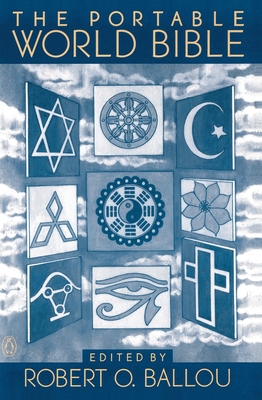
The Portable World Bible (Portable Library) 

Many years ago, I was blessed to take an Introduction To World History course at Alice Lloyd College in Pippa Passes, Kentucky, under a man named Dr. Billy Rojas, Ph. D., who had come to ALC from the Chicago area as I recall.  Billy, as he preferred to known by everyone he knew, required that students in all his history courses buy, and actually read sections of this book.  Billy taught history from a viewpoint which was strongly focused on how religion and, particularly how differences in religion had influenced the flow of history over time.  This book is edited by Robert O. Ballou, according to his publisher, Penguin Random House, brought to countless contemporary readers much of the world’s religious thought, which he selected, interpreted, and arranged in view of modern man’s quest for ultimate truths and values. His book, "The Portable World Bible" which has been in constant publication since its original publication in 1944, and is constantly relied on by students in many disciplines along with thousands of ministers, rabbis, imams, and priests.  The book is broken into seven sections with each being composed of many of the key scriptures from most of the world's leading religions.  It is an excellent resource for anyone who is interested in world religious beliefs, conflicts between believers in two or more of those beliefs, or simply anyone who wants to learn more about any particular major religion. 

The sections are labeled The Hindu, The Buddhist, The Parsi, The Jew And The Christian, The Moslem, The Confucianist, and The Taoist.The book actually begins with a General Introduction and each of the sections begins with a specific introduction of about 10 to 15 pages.  While a detractor could make the arguments that the book is a bit aged for today's world, or that it omits a few religions which have significant numbers of adherents worldwide, it is still a wonderful book for anyone who wants to actually understand how the religions of the world interact, conflict, and, oftentimes, agree.  I have depended on it for some fast answers ever since the first time I ever read it in Billy Rojas' history class.  I also have a friend of twenty years who is a minister in a rather conservative form of Christianity and a graduate of a seminary who also depends on it.  For me, it is just as productive as any other book I can find when I need fast answers about key texts in any of the religions it discusses.  Rarely will anyone write or edit a book which will still be in print more than 75 years after its initial publication. And I believe that this book will still be in use and publication in another 75 years. It is especially useful when we consider the perpetual, and currently volatile conflicts in the Middle East which are rooted almost entirely in religious differences based on three major religions whose most sacred sites are in a markedly small geographic territory in which their claimed sites often overlap.  If you don't know about this book, at least look at a copy in a book store or library and decide if it is useful to you.                 


Wednesday, February 28, 2024

On A Second Reading Of "The Silver Chalice" by Thomas B. Costain


When I entered Knott County High School at Pippa Passes, Kentucky, in September of 1964, I remember thinking that the little one room library was the finest collection of books that I had ever seen. When I began to write this post, I sent a message to my friend and former high school teacher Mary Lois Jacobs who was able to tell me that the books in the Knott County High School Library had primarily been donated by Alice Lloyd College and that there were about 2,000 books in the collection, mostly fiction.  She also stated that the faculty had been disappointed in the lack of sufficient non-fiction in the collection. Prior to entering high school, the only lending library I had access to was a summer book mobile program which stopped at our country store at Dema once a week during the summer vacation from school.  I had visited the Kendallville, Indiana, library a few times during some summer visits to my sister's home there but I had never been a regular user of such a fine library.  Today, I know that the collection at KCHS would be considered woefully deficient in most public high schools in America.  The other distinct memory I have retained from that time is that on one of the first occasions I took a lengthy, perhaps epic, novel off the shelves and asked to check it out that Cloys Thornsbury, the librarian, gave me a somewhat askance gaze and asked me something to the effect of "are you sure you can read that". I'm sure I answered "yes" and I'm also pretty sure I actually finished whatever book I checked out.  Three of those first long novels I remember reading are this one, "The Silver Chalice" by Thomas B. Costain, along with his "The Black Rose", and "The Count of Monte Cristo" by Alexandre Dumas.  I don't recall that Cloys asked me that question again after I had read, returned, and could discuss those three books.  

Recently, in one of my frequent visits to some surplus store where I often buy used books, I strayed into a weathered copy of "The Silver Chalice", bought it, and committed myself to rereading it.  I can now report that the mission has been completed.  Thomas B. Costain was a Canadian born journalist and mass market writer who produced 14 novels, 8 non-fiction historical works, and 4 co-edited collections of short stories by major authors.  His major novels were generally massive works with plots, counter plots, historical settings and characters, and multitudinous casts of characters.  His works can be argued to have not been quite great works but they were well written, meticulously researched, and generally popular on the mass market.  "The Silver Chalice" is an example of all those qualities.  

The primary protagonist in this novel is a totally fictional young artist named Basil who has been sold into slavery by his uncle under Roman law upon the death of his father before he attained the age of majority.  Basil's freedom is arranged by the Apostle  Luke who does so because he has been chosen by the early Christian church to locate and hire an artist to create a frame to hold the cup which was used by Jesus Christ and the Apostles for the sacrament at the Last Supper.  The frame is to be made of silver and the cup is to be surrounded by small busts of the Twelve Apostles.  The freedom of Basil and the commission to create the frame are financed by the Biblical person Joseph of Arimathea who is the same man who is credited in the Bible with having provided his own tomb for the burial of Jesus.  As the novel progresses, Basil falls in love with the granddaughter of Joseph of Arimathea and eventually marries her just minutes before her grandfather's death.  But they have previously agreed that the marriage is one of convenience only because her father is not a Christian and would not agree to continue to finance the work after his father's death.  The newly weds leave Jerusalem for Antioch, outside the reach of Jewish law and the Jewish high priest and his co-conspirators who seek to find and destroy the cup.  Basil goes on a long journey to locate the living disciples and create their busts from actual memory after meeting them.  Along the journey, Basil decides that he has not only come to realize that he loves his wife Deborra but that he also has been converted to Christianity.  Just in case any of you want to read the novel and can actually locate a copy on some of the used book websites, I won't spoil the story by disclosing the conclusion.  Just know that this novel is well worth reading whether or not you are religious.  It moves quickly from scene to scene, from crisis to crisis.  The characters are realistically rendered, both known historical persons and those who are purely fictional.   It is filled with fascinating people including a Chinese prince who befriends Basil, Luke, and Deborra; an Arabic camel driver who seeks to become an important trader; a villain who is also a magician; and a manipulative, beautiful, and dangerous female assistant to that magician.  Basil even spends some time in the home of the Roman emperor.  If you can find it, I can't more highly recommend a historical novel.  And, I was very pleased to be rewarded by those wonderful memories from my teen years by the second reading of the book.  


Monday, May 24, 2021

"Christmas And The Old House" by Tom T. Hall--Book Review


This is a children's Christmas book by Tom T. Hall.  Yes, THAT Tom T. Hall!  And, before you remember who he is and disappear without reading the rest of this review, you should know that I am talking about Tom T. Hall, the writer; Tom T. Hall, the novelist; Tom T. Hall, the short story author; Tom T. Hall, the non-fiction author; Tom T. Hall from Olive Hill, Kentucky.  Oh, yeah, he wrote a few songs too, eleven Number One songs and about a thousand others all of which are somewhere between good and great.  But you do not know the full Tom T. Hall until you have read his books, about a half dozen books in at least four genres: novels, short stories, autobiography, musical instruction books.  The man can write and I first encountered his short stories about thirty years ago. 

But this book, illustrated by Laura L. Seeley, is a wonderful Christmas books for children in the elementary grades.  Yet, it also has value for nearly every other reader.  It has spots which will make you laugh out loud and spots which will almost make you cry.  Which is what a lot of us have also found in that thousand or so songs the man is most famous for writing.  The book is about two children, six and seven, who live in the country across the road from an abandoned house.  The book is also somewhat religious in nature since it mentions Jesus Christ.  The children live next door to each other, play together daily, and Bobby is the narrator.  The book is written in language most second grade students can read and also in language which accurately depicts the thought processes and language of children in that age group.  Against their parents' rules, they cross the road, after planning their trip at their Planning Rock, and find that the old house has an evergreen tree growing up through the floor.  They decide to decorate the tree as Christmas tree for Jesus and the owner of the property and their parents catch them because the owner has come to visit the house he grew up in one more time before having it torn down.  But the book also has a happy ending and you will love reading it for yourself and for the small children in your life.  If it does nothing else for you, it will give you a new appreciation for the breadth and depth of Tom T. Hall's talent.  That old boy from Olive Hill can write and you should give yourself the gift of experiencing another side of the Tom T. Hall you have probably been hearing on the radio for the last fifty years.  


Thursday, September 24, 2020

A Reading Assignment For Self Professed Christians!


 At least ever since early summer of 2015, I have heard many people say "I am a Christian and I support Donald Trump."  I have a little reading assignment for those of you who have found yourselves in this group.  I would like to suggest to you that you take up your Bible, preferably the King James Version which is the closest in existence to the original Hebrew, Aramaic, and Koine Greek languages in which the various books of the Bible were written, and begin reading the Gospels, Matthew, Mark, Luke, John, and Acts.  Read slowly and carefully and, if you have them rely heavily on a comprehensive Bible Dictionary and Concordance.  It might also help in this exercise if you have what is called a Red Letter Edition of the Bible in which what are supposed to be the direct words of Jesus are in red type.  As you read, every time you come to one of the directives about how a Christian should live their life from either Jesus or the twelve disciples quietly and honestly ask yourself "Did Donald Trump ever do that?"  The answer will always be a resounding "No!".  After you have completed reading these five books of the Bible and honestly responding to the question about each directive from Jesus or the twelve disciples, flip to the back of the Bible and read "Revelation".  Every time you come to one of the signs of the coming of the Anti-Christ, sit quietly and honestly ask yourself "Could this apply to Donald Trump?"  The answer will also nearly always be a resounding "Yes!"  


If you complete this assignment honestly, you will come to the realization that no one can be a practicing Christian and support Donald Trump.  If you find yourself in that position, I would suggest that you spend a few minutes deciding which it is you would be better off giving up, Donald Trump or your self professed Christianity.  Have a nice day!


Saturday, January 13, 2018

"The Running Man Flying High For The Glory Of God" by Orville Rogers with Barbara Norris--Book Review

Roger, Orville with Norris, Barbara, The Running Man Flying High For The Glory Of God (Franklin, Tennessee. Clovercroft Publishing, 2016) 


Orville Rogers was born in relatively poor Oklahoma farm family in 1917 and when he was fairly young his father ran off to never be heard from again until Rogers encountered a half-sister when he was nearly eighty and learned that their father had died drunk in a flop house.  But, with the help of mother, grandparents, and a couple of uncles, Orville Rogers accomplished an exemplary life as a commercial airline pilot, oilfield investor, a volunteer pilot for a religious organization upon his retirement, a board member of a couple of religious organizations, and a world record holding elderly runner. He is still alive today at 100 and managed to run a mile on his last birthday. I chose to read this book, which is outside my normal purview, after seeing Orville Rogers featured on a television news show as he approached his centennial.  I always respect and pay attention to elderly achievers and did so even when I could not have been thought to be even approaching that aged status.  I still remember the well known Old Regular Baptist Preacher Clabe Mosley who was said to have preached a three hour sermon on his 102nd birthday when I was only 7 years old.  I have also come to understand that if I wish to live as long as two of my half-sisters and reach centenarian status that I must exercise and maintain as much of my physical condition as I can.  Orville Rogers did not begin running until he was about sixty and is still doing so today although not at the same pace at which he set several senior citizen records.  I thought Orville's book might be something I could learn from in the field of physical fitness for the aged.

The book was written with a named ghost writer, Barbara Norris, and I am not a fan of ghost written books.  But at 97 or 98, I can understand why Orville Rogers might have thought it was wise to use a professional writer if for no other reason than to ensure that the job would be finished in the event he died.  I am only superficially aware of Clovercroft Publishing, the vanity press which Rogers and Norris used to produce the book.  But the book itself is professionally acceptable in terms of printing, paper, photographic reproduction, and most other areas.  It does have a typical amount of typographical errors which one is likely to find in books from such companies.  

Orville Rogers led a sufficiently interesting life to keep me reading until the end when, at times, I knew I had better things to do with my time.   The book moves along in a manner which keeps the reader awake without ever approaching the status of literature.  Rogers and Norris tell his life story in a direct timeline fashion from poor Oklahoma farm boy to millionaire pilot, investor, runner, and religious believer.  But, for my original purpose of learning about physical fitness for the elderly, the book fall short.  It simply discusses how Rogers met Kenneth H. Cooper, M. D., who runs the Cooper Clinic in Dallas and wrote the early physical fitness book "Aerobics" in 1968 and has been a well known proponent of running and physical fitness for many years.  The book virtually leaves training routines untouched and focuses primarily on the religious life of Orville Rogers.  Shortly after I read the book, I saw in the media that Orville Rogers family threw a major birthday party for his 100th birthday and collectively ran a hundred miles in his honor with Mr. Rogers joining his family for the last mile.  It is good to know that even at 100 he has not given up running in which field he holds several world records for competitors in their 80's and 90's.  

If you are seeking an autobiography about an airline pilot or a religious believer and volunteer, you will find this book worth reading.  If you are looking for literature or advice or running, don't bother.  But I still hope Orville Rogers lives another hundred years and runs every day of his life.