Search This Blog

Showing posts with label Elkhorn Coal Company. Show all posts

Friday, February 10, 2023

Murder And A 25 Cent Piece Of Scrip(1)

I have been doing some work related to a cemetery in Wayland, Kentucky, where several of my relatives are buried including one of my great-grandmothers, a great uncle, an uncle, and an aunt.  During the course of this effort, I have added obituaries for several of the people buried there to their memorials on Find A Grave.  During that effort, I found not an obituary for one man but rather two sizeable news stories in the archives of the Floyd County Times which are located on the website of the Floyd County Library which maintains a fairly large and very useful local history collection containing newspaper files, historic photographs, a few sound recordings, and assorted other items of interest to both amateur and semi-professional genealogists and researchers.   

The man whose obituary I found contained in those two news stories was named John Franklin "Frank" Collins who died on May 27, 1934, at the age of 40.  Frank, as he was known, died at the hands of a local store owner in Estill, Kentucky, just a few miles from where Frank worked, lived, and has been buried for nearly ninety years. Frank was shot on a Saturday which would have been his day off from his job at the Elkhorn Coal Company mine in Wayland. He died the next day on a Sunday and a warrant was issued for the charge of murder against his assailant on Tuesday due to the fact that it was also Memorial Day on Monday.  Below is the full text of the article from the front page of the Floyd County Times edition of June 1, 1934.  It is interesting that the story about Frank's death is one of three stories about murders in the area that week.  Another story details the news of a shooting in which the victim survived. Admittedly, Frank Collins died almost twenty years before I was born in the area at Lackey in Knott County about a mile from Estill where Frank died.  I spent the first six years of my life on Steele's Creek. About a mile from the store in which I spent those first six years is the mouth of Steele's Creek, the site of the town of Wayland and the Elkhorn Coal Company mine where Frank worked.  I spent the next 14 or so years living in a second store my father had built at Dema, Kentucky, in Knott County about three miles from Wayland.  I have extensive knowledge of the area and its history. 

 Under the headline "Murder Warrant Issued For Craft" with the subhead "Estill Merchant Charged With Fatal Shooting Of Frank Collins Saturday", the news story/obituary about the murder of Frank Collins appeared in the June 1, 1934 edition of The Floyd County Times.  

"A warrant charging John Craft, Estill merchant, with murder was issued here Tuesday, following the death of Frank Collins, 40 years old, from the effects of a revolver bullet fired into his neck Saturday afternoon by Craft.  Craft had already been arrested and brought here Sunday morning when he was booked on a charge of shooting and wounding.  He executed $5,000 bond.  Collins died in the Beaver Valley Hospital, Martin, later Sunday.  Craft's bullet struck him low in the neck, ranged downward, and emerged from his back.  The shooting took place in Craft's store.  According to the merchant, Collins came into the store where he engaged in an altercation with Sol Bradley, who knocked him down.  Craft ordered the men outside, he said.  In the meantime, he stated Collins' small daughter had made a 15 cent purchase at the store offering 25 cents in scrip(1) as payment.  The merchant said he  had no scrip(1) change and soon after Collins and the child returned to the store, the father starting an argument over the change.  When Collins advanced on him with a knife, the merchant said he fired.  The other version of the affair, as told to Tbe Times, says that Craft was drunk and Collins was being taken from the store by his wife and a man when Craft leaped across a counter and fired.  This statement claims that Collins was unarmed.  The victim was a son of Mart Collins.  He is survived by his widow and five children.  Funeral rites were conducted Tuesday under the direction of G. D. Ryan, in the Collins Cemetery, three miles above Wayland.  Ministers officiating at the funeral were M. C. Wright and Earl Howard of the Regular Baptist Church. 


The photo above is of the Beaver Valley Hospital in Martin, Kentucky, where Frank Collins was treated before his death. The building no longer exists. It was typical of many small, privately owned, small town hospitals in the coal fields in the first half of the twentieth century.  It had only minimal surgical and little or no intensive care capacities and would not have been capable of providing appropriate care, by today's standards, for a victim of a serious gunshot wound. It was also not common for anyone to be transported to other larger, better equipped hospitals in the 1930's.  The hospital sat at the upper end of the town of Martin at what is now the location of the Nelson-Frazier Funeral Home.  I have actually received minimal outpatient care there as a teenager.  

When we read the newspaper story of the shooting and death of Frank Collins, we are struck by several aspects of the story.  First, Frank Collins was murdered in the sight of his small daughter.  I have little doubt that the child, who is unnamed in the newspaper stories, was traumatized by that event for the rest of her life.  Second, there are clearly two very conflicting stories about the shooting.  The shooter, John Craft, claimed he shot Frank Collins in self defense when he was threatened with a knife.  Mrs. Collins and one other person, the man who was helping her take Frank out of the store, both apparently claimed that Frank was unarmed and suffered the  gunshot as they were taking him out of the store.  Third, Craft claimed that Frank had been knocked down by a man named Sol Bradley during some sort of altercation.  Yet, the news story contains no statement from Sol Bradley.  I cannot say that I ever really knew Sol Bradley but I knew in my childhood who he was and never heard a negative word about him regarding brawling or any other sort of violent behavior.  But it would be interesting to know if there was some sort of family, business, or friendship connection between Sol Bradley and John Craft.  Fourth, and this is the most striking aspect of the entire story, the 25 cent piece of scrip(1) and the 10 cents of change owed seems to have been a key element of whatever happened.  It would be shocking to think that John Craft was willing to kill a man over 10 cents in change owed on a 25 cent piece of scrip(1).  It would be just as shocking to know that he was willing to kill a man over the entire 25 cent piece of scrip(1).  And, of course, there is also the accusation by Frank's widow and the unknown man who was helping her take Frank out of the store that John Craft was drunk.  There is a great deal left unsaid in that news story which we do not know and which would have given us a far better understanding of why John Craft was willing to shoot and kill Frank Collins.
 
In the September 21, 1934, edition of the Floyd County Times, a single sentence is tacked onto the end of a story about another man from the area who had been convicted of an unconnected murder.  That sentence reads: John Craft was on trial Thursday, as The Times went to press, charged with the murder of Frank Collins at Estill.  

There is another news story in the Floyd County Times the following week on September 28, 1934, under the headline "Craft Draws 21 Years In Prison".  The subhead to that story refers to a different murder case and the two stories are discussed in alternating sections of the single story covering both.  The opening paragraph of the story discusses Craft's conviction for the Frank Collins murder.  
"For the second time within a week, a jury in the Floyd Circuit Court gave a 21 year penitentiary sentence to a man accused of murder.  John Craft, accused of the murder of Frank Collins at Estill a few months ago, received the last sentence. 

The next two paragraphs in the story discuss two completely unrelated murder cases before resuming the discussion of the sentence given to John Craft.  

"In the trial of Craft, the Commonwealth gave evidence showing that he had shot Collins after the latter had been knocked down in an altercation with a man named Bradley and after Craft, a merchant, had ordered Collins to leave his store.  This testimony claimed that Collins was offering no resistance and had turned to leave when shot.  The defense sought to show that the merchant fired, thinking that Collins was armed and fearing that he would kill Craft."  

And that is the entirety of the newspaper coverage of the murder of Frank Collins and the trial and sentencing of John Craft for that murder.  Just as the first newspaper story left unaddressed several issues the disclosure and discussion of which would have made the coverage far more enlightening, this story also leaves several unanswered questions about the case.  First, who testified in the trial?  Were the only witnesses John Craft and the Widow Collins, who is not named by first name in either story?  Did Sol Bradley or the man who was helping Mrs. Collins take her husband out of the store testify?  Did the prosecutor and judge force Frank's small daughter to testify?  Did the police officer(s) who arrested John Craft and interrogated him testify?  Second, was medical evidence presented to the court by the doctor in charge at Beaver Valley Hospital which could have proven where Frank Collins was standing in relation to John Craft when he was shot?  Third, who was John Craft's attorney?  Fourth, was the issue of a 25 cent piece of scrip(1) and 10 cents in change owed ever raised in court?  Could that issue, if it was raised, have increased the jury's willingness to set a lengthy sentence in the case?  

Since I first became aware of the murder of Frank Collins and began writing this blog post, I have not had time to drive to Prestonsburg, Kentucky, the county seat of Floyd County and search for the Circuit Court records at the Circuit Court Clerk's office.  I will do that in the near future and, if those records exist, I will obtain copies of them and add the information they contain to this blog post.  I also have easy access to whatever employment records are still extant for the Elkhorn Coal Company which are now in the possession of the Wayland Historical Society and I will also search those records to see what pertinent information they might contain about Frank Collins. It is also possible that John Craft might have worked for that company for some time before owning his store just as my own father did before owning his.  I will also search for John Craft's employment records.  This is a very interesting small town Eastern Kentucky murder case from the heart of the Great Depression and the involvement of a 25 cent piece of scrip(1) in the events makes it even more intriguing.  Did John Craft murder Frank Collins just because of a 25 cent piece of scrip(1) or the 10 cents in change which he did not have in scrip(1)?  Was either amount of coinage worth the price of a poor coal miner's life? 


(1) I just cannot pass up one very necessary opportunity to act as a member of the Grammar Police.  The word "scrip" does not have a "t" at the end.  It is spelled "SCRIP" not "SCRIPT".  Scrip is a form of corporate currency which is rarely used in the world today but was common in the early 20th century in America especially with large coal mining and timber companies.  A "Script" is a written communication such as a "Script" for a play, movie, speech, or oral presentation.  "Script" can also be used to describe a general form of type face either on a computer, typewriter, or printing press.  

Tuesday, January 31, 2023

Coal Mine Fatalities In Elkhorn Coal Company Letcher County Mines


Elkhorn Coal Company Accident Report Book 1942-1955

While working on a large, somewhat related research project in the Elkhorn Coal Company records at the Wayland Historical Society, Wayland, Kentucky, I located and became tangentially interested in the “Elkhorn Coal Company Accident Report Book 1942-1955.  The book is a handwritten, folio sized, expandable record book with removable stiff paper pages some of which are written on both sides and some on the front only.  For my research purposes, I was primarily interested in the fatalities only.  The book contains thirteen fatal accidents which occurred between January 7, 1943, and January 20, 1956.  These fatalities are recorded in red ink as compared to the other non-fatal accidents which are all in black ink.  The names of the victims of these accidents are Frank Adams; Bill Tilley; Charlie Russell; Stacy White; Amos G. Bryant; Charlie Johnson; Lafayette Johnson; C. D. Hampton; William Breeding, Jr.; Arvil Breeding; Riley Little; Print Bullion; and George Washington.  All were single fatality accidents. 

When I attempted to cross reference these fatalities with the list of thirty-five names of miners on the “Dedication” page of the “Twentieth Anniversary…of Local Union 5895 United Mine Workers Of America 1933-1953”, none of the names in the “…Accident Report Book...” matched any of the names in the “…Anniversary…” book.  I considered the possibility that these miners could have not been members of the UMWA at the time of their deaths and it seemed highly unlikely that all of them could have been killed before being initiated as union members.  My second attempt to locate the correct answer to the discrepancy involved searching in the individual employee records in the files of the Historical Society.  None of these victims matched any of the names of the printed list of Elk Horn employees in the historical society records for the Wayland operation. 

My next attempt to reconcile the discrepancy involved checking the online issues of the Floyd County Times in the “History” collection of the Floyd County Public Library which are available at: http://history.fclib.org/floyd-county-times   After having searched for each of the thirteen fatalities in at least two weeks’ editions of the newspaper, I still found none of the thirteen men listed in news stories relative to their accidental deaths.  Throughout its long history under the ownership/editorship of Norman Allen, the Floyd County Times was always highly diligent about covering all deaths in the county.  At this point, I knew that it was definitely unlikely that the men listed as victims of fatalities in the “…Accident Report Book…” had actually been working at Wayland at the time of their deaths. 

My next attempt to locate these men involved searching each name in the memorials section of the incredibly useful and accurate Find A Grave website which I often use and contribute to on a regular basis.  That feature of their website can be found at: https://www.findagrave.com/memorial  and is highly useful to veteran genealogists and the person who is simply searching for an occasional lost friend or relative.  When I searched for the victims using the filters of full name as recorded in the “…Accident Report Book…”, correct year of death, and Kentucky as the location, I immediately found Frank Adams buried in the Holbrook Cemetery at Mayking in Letcher County. His obituary is located on page 2 of the Mountain Eagle newspaper of January 14, 1943. 

The following information is taken verbatim from the obituary of Frank Adams in the Mountain Eagle Newspaper of January 14, 1943, found online at the Kentucky Digital Library.

“Frank Adams was born October 10, 1883, in Owsley County Kentucky, and departed this life January 7, 1943, at the age of 59 years, 2 months, and 28 days.  On January 1, 1905, he was married to Nannie Burton, to them were born 10 children, 2 of them having passed away in leaving 8 today, who along with his wife and 12 grandchildren still survive him.  The children are Mrs. E. R. Holbrook, James Adams, Charley Adams, Mrs. Enoch A. Holbrook, Mrs. Elmer Amburgey, Mrs. Clarence King, Opal Adams, and Stella Adams.  Frank Adams came to this section in 1919 and has lived all that time at Sergent.  He was faithful employee of the coal company here while it was operating, and since that time has worked elsewhere.  He was a trusted and tried worker and was dependable in every respect.  He made friends with all whom he met; he was a kind hearted and friendly like fellow never saying anything of anyone else and always taking care of his own business.    He had many friends and was highly respected.  He was a devoted husband and father and always ready to help anyone in need and to go to the relief of his neighbors and friends.  As spoken of one of old, it was said of him, "He was a good man", and that speaks of his life.  In his untimely passing, Sergent has lost one of his good citizens, his wife a devoted and true husband, and his children and grandchildren a respected and loving father, and the Company for which he worked a faithful and trusted employee, and the Miners Union one among their best men.  He will be missed much but let us hope in all our loss that it has been his eternal gain.  Funeral services were held at the late home Sunday with Elders J. C. Prince, Dewey Sexton, and G. Bennett Adams and burial in the Holbrook Cemetery.  Burial in charge of Craft Funeral Home.” 


 When I searched for Bill Tilley and Stacy White using those same filters, I immediately found them buried in the Thornton Cemetery at Thornton in Letcher County. Amos G. Bryant is buried in the Englewood Cemetery at Christopher in Perry County.  Charlie Johnson is buried in the Halo Cemetery at Halo in Floyd County. Lafayette Johnson is buried in the Hemphill Cemetery at Hemphill in Letcher County.  William Breeding is buried in the Wright-Collier Cemetery in Letcher County which does not have a listed post office location on Find A Grave.  Arvil Breeding is buried at the Henry Meade Cemetery which also does not have a listed post office location in Letcher County.  Print Bullion is buried at the Whitaker Cemetery at Whitaker in Letcher County. I was able to locate all the listed fatalities except for Charlie Russell, George Washington, Riley Little, and C. D. Hampton in cemeteries in Letcher County, Floyd County, or Perry County.  After about the third correctly located victim, I realized that the “…Accident Report Book…” does not list employees of and accidents at Elkhorn Coal Company in Wayland.  Elkhorn Coal Company operated mines at several locations in Letcher County including Blackey, Cromona, Fleming, Jackhorn, Jenkins, Kona, Mater, Seco, Sergent, Thornton, and Whitesburg.  Basic information about all those companies can be located at:  

http://www.coaleducation.org/coalhistory/coaltowns/coalcamps/letcher_county.htm

Since I have no idea how many friends, relatives, former co-workers, or researchers might be seeking information about these men, I spent the time to send suggested edits to the person who maintains each of their memorials on Find A Grave and hopefully they will add that information to the memorials.  None of these memorials had a written obituary and none contained more than basic information.  I sent those messages in the hope this additional information would assist some unknown persons in the future to complete their personal searches of one or more of these memorials. Within twelve hours, I received a grateful and informative e-mail from a woman named Ellen Beam who is not just the manager and creator of the memorial for Charlie Johnson but also his great-niece.  Her message told me that her grandfather …”William Johnson had a picture of his brother's accident, hanging on the front room wall. It was a drawing showing how Charlie got caught by the machine and drug…my grandpa said he was there when it happened.” I know absolutely that all of these men were employees of some Elkhorn owned entity in Letcher County.  It also seems logical that all of them were probably working for a single Elkhorn entity in Letcher County.  I had thought at first that it could be likely that the full newspaper stories of their deaths can be located in the online archives of  “The Mountain Eagle” which are available at this link:  http://kdl.kyvl.org/?f%5Bformat%5D%5B%5D=newspapers&f%5Bsource_s%5D%5B%5D=Mountain+eagle+%28Whitesburg%2C+Ky.%29

But due to the fact that those archives for the Mountain Eagle are not entered in chronological order and it can take considerable time to locate a particular week’s paper.  Since I began this research, I came into contact with a resident of Letcher County, Richard M. Smith, who owns and actively uses the eight volume record of Letcher County cemeteries.  He assisted me both to verify some information I already had and was able to find some I did not have.   I hope that what I have done so far will benefit others.  Good Luck in that effort!

Roger D. Hicks, M. Ed.

Saturday, August 31, 2019

E. Hawk Moore, Old Regular Baptist Preacher & UMWA Activist

Hawk Moore--Photo by UMWA Local 5895

E. Hawk Moore was an Old Regular Baptist preacher, coal miner, and UMWA member and official in UMWA Local 5895 in Wayland Kentucky where he worked for Elkhorn Coal Company for many years and also served as the local's Burial Committeeman for many years.  He was also a close friend of my father, Ballard Hicks, who was also employed by Elkhorn Coal Company for a few years before leaving the mine to buy a country store and care for his terminally ill first wife.  Hawk, as he was always known, lived about a mile up Steele's Creek from my father's store near the head of the hollow and just above the Steele's Creek Church which he served for years as moderator.  Sadly, that church is no longer in existence other than as a rental house.  I apologize for the poor quality of the photo above but it was the only one I could find of Hawk.  It is a detail of a group photo of the Local 5895 officials which is included in the book "Twentieth Anniversary...of Local Union 5895 United Mine Workers Of America 1933-1953" about which I have also written in this blog.  I am also still searching for further biographical information about Hawk above and beyond what is in that book and what I know personally.  Hawk's name also appears regularly in the Minutes of several other Associations of Old Regular Baptists as a delegate as does the name of Clabe Mosley whom I wrote about earlier.  


I have often seen Hawk's name mentioned in obituaries in the Floyd County Times and I know that the paper's online morgue will contain his obituary which I will quote extensively in a future edit of this blog post.  I believe I will also be able to locate another version of that obituary in the Minutes of The New Salem Association of Old Regular Baptists in the near future.  Although, my father never joined any church, he often attended Old Regular Baptist services with my mother, Mellie Hicks, and knew most of the Old Regular Baptists in the Floyd and Knott County area.  He often traveled to Quicksand Creek in Breathitt County Kentucky to squirrel hunt with Hawk Moore and his son George Moore and a few other men.  They always hunted on the same farm on Quicksand which belonged to some man whose name I do not remember who also was known to make moonshine.  They would travel to Breathitt County to the farm where they were allowed to camp and hunt for as much as a week at a time.  According to my father, part of the deal was that he would always check in with the landowner at his home and inquire as to "where his cow was being pastured".  This was a code phrase which they used so the man would tell them which area of his farm was off limits since that was where his moonshine still was located.  Apparently, the farm was rather large and even with being limited from hunting in one small fork of the hollow or another, they could all still cover plenty ground, kill their limit of squirrels, and avoid interfering with or leaving a trail to the owner's still.  The other part of the deal was that they also bought at least one gallon of moonshine among the lot of them.  I suspect that at times they might have bought several gallons.  For many years until shortly after I was born my father kept a gallon of moonshine in the house for "medicine" but was never a heavy drinker.  

Hawk Moore never drank at all because of his religion but since the other members of the hunting party were able to do so without causing problems he still hunted with them under that setup.  One of my father's favorite stories about hunting with Hawk Moore took place on that farm on Quicksand Creek.  Daddy said he and Hawk were hunting up the same rather narrow, steep, and rocky little hollow one day and Daddy happened to spook a large whitetail buck which was unusual in that time period in Eastern Kentucky.  Hawk was apparently further up the hollow than my father and the deer ran his way.  Both men were hunting with the standard 12 gauge shotguns of the day and probably would not have attempted to kill the deer illegally even if they had been properly equipped.  Daddy said a few seconds after the deer bolted up the narrow, high sided drainage of the hollow he heard Hawk scream something or other like "Whooee!".  Later, he said Hawk said he had been coming down a particularly narrow area of the drainage and the buck nearly ran over him almost literally touching him as the sizeable rack slid past his body.  Hawk was known to make the somewhat humorous claim later that he always believed that my father had been trying to get him killed by driving the deer over him.  They remained friends for life and, as I recall, Daddy made a trip from our new home on Right Beaver Creek to attend Hawk's funeral when he died.  There were also numerous trips through the years between the time we moved from Steele's Creek to Beaver Creek that my parents would hire a driver, since neither of them drove, and travel to Steele's Creek on Sunday to attend the church which was also the church my mother joined.  

I will keep searching for further information about Hawk and edit this post as soon and as extensively as I can. 

Saturday, June 22, 2019

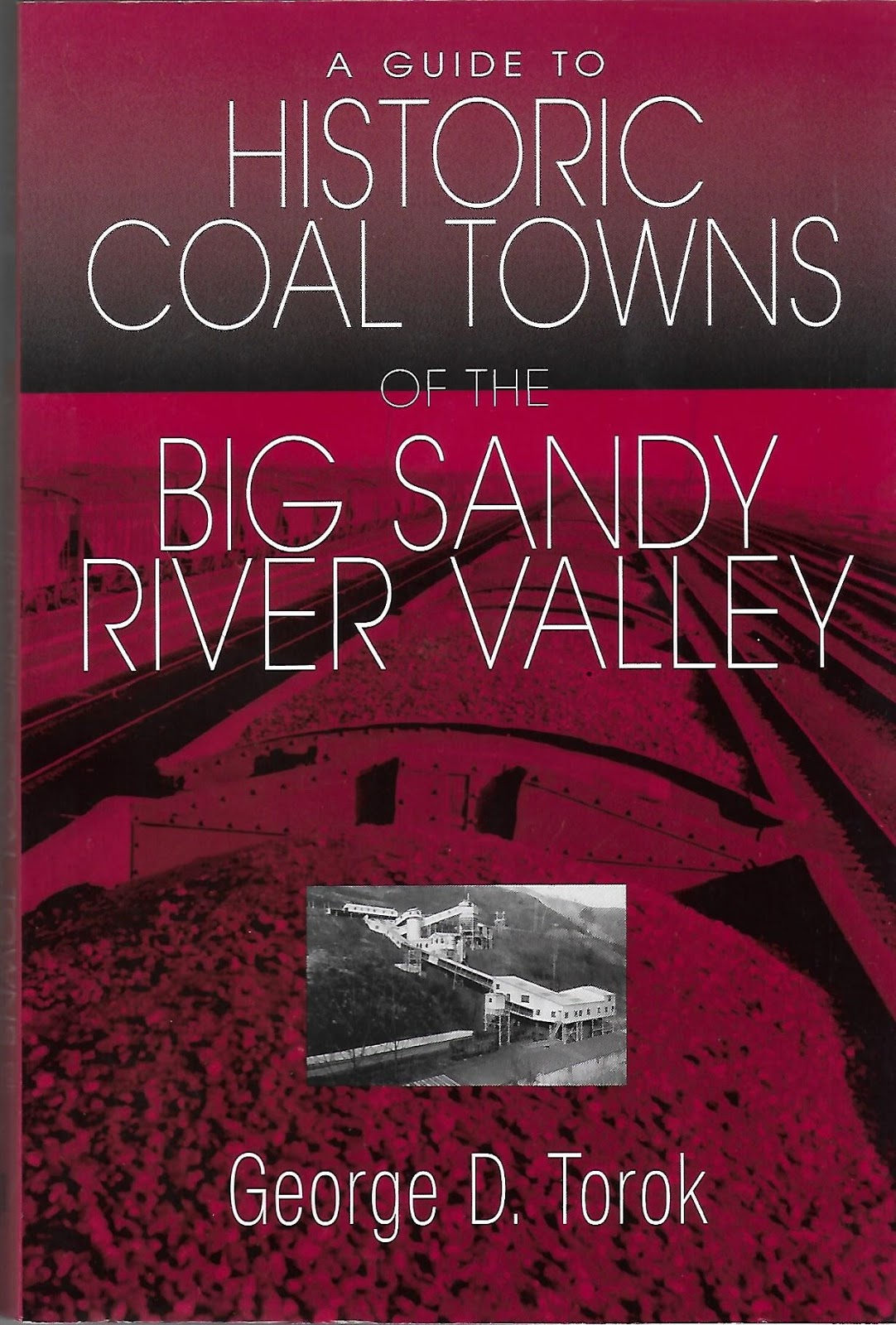
"A Guide To Historic Coal Towns of the Big Sandy River Valley" by George D. Torok--Book Review


While the author only refers to this book as "a guide" both in the title and a few times in the text, it is quite a bit more than a simple guide book.  It is a wonderful and useful piece of work, especially for those who are interested in the coal camp towns along the length of the Big Sandy River and its tributaries.  The author even extended himself a bit beyond his stated geographic region and discusses coal camp towns all the way to Bluefield Virginia/West Virginia and to the towns in Harlan County on the  headwaters of the Cumberland River.  I have no idea how George D. Torok latched onto his decision to write about these coal camp towns but I am very glad he did.  Mr. Torok is a native of Buffalo, New York, and teaches history at El Paso Community College.  But his biography on the cover of this book states that he has "published assorted works on Kentucky history".  I had passed through El Paso twice in October of 2017 but did not know of Mr. Torok or this book at that time.  I would have loved to be able to meet him and discuss this book and his extensive research to produce it.

The book is broken into six chapters, documented with an extensive and well researched bibliography, and supplemented with photographs, documents, and other information from both Mr. Torok himself and several historical sources including  the Eastern Regional Coal Archives, Alice Lloyd College, Elkhorn City Railroad Museum, and Pikeville College Special Collections which I have often used myself for other purposes unconnected to the Big Sandy River or coal camp towns.  It is readily apparent to the experienced researcher that Mr. Torok did a massive amount of work to complete this book including extensive travel in the region which is well documented in the large number of photographs which he personally shot.  He is also able to intelligently write about numerous structures, union locals, individuals, and equipment throughout the course of the book.  

If you consider yourself to be an aficionado of coal camp towns, coal mining or UMWA history, or the geography of the border counties along the West Virginia/Kentucky line, you should read this book.  The bibliography alone is worth buying the book for and will lead the avid reader on a long search for the supporting books, movies, interviews, company documents, and other corroborating information.  This is flatly one of the best pieces of research I have ever seen.  Buy it!  Read it!  Learn from it and use it as the basis for several day trips if you love coal camp towns and their history.  

Friday, March 8, 2019

"Twentieth Anniversary...of Local Union 5895 United Mine Workers Of America 1933-1953" by UMWA Local 5895--Book Review

During a recent research trip to the Wayland Kentucky Historical Society in Wayland, KY, one of the key coal camp towns of the Big Sandy River drainage in Floyd County KY, I was provided a copy of this fifty page book commemorating the first twenty years of UMWA Local Union 5895.  The book was originally written and published by the local union as part of an anniversary celebration in 1953.  It was reprinted by the Historical Society in May 2005.  It is well worth the reading by any student of UMWA history, Floyd County, Wayland, Kentucky, Appalachia, the Big Sandy River, or trade unionism in general.  The book states that "in a regular meeting in May, 1952 ...a motion was passed to instruct the President to appoint a committee and commission them to prepare a history of our local union to be printed in book form...".   The committee was composed of the following members: Nobel Hobbs, Chairman; J. F. Dixon; Lawrence Mount; Charles Burnett; McKinley Parrigin; Robert Hicks; Joe Hicks, Secretary; Pete Mills; E. Hawk Moore; Guy Coleman; Charles Turner; and Roy Lykins.  Let me state for the record that during my childhood and teen years I knew both E. Hawk Moore and McKinley Parrigin.  It is also likely that I am distantly related to Robert Hicks who, along with his brother Joe Hicks, served the local union in a variety of roles for many years.  They were both born at Mousie, KY, the birthplace of my father, Ballard Hicks.  I did not know Guy Coleman but after his death I spent many hours in the home of his widow, Rusha Coleman, because of my friendship with their son Keith Coleman.  Let me also state at the outset of this review of this book that the committee did an excellent job with the book, especially in light of the fact that they were all working full time jobs in the mines, were generally also performing other unpaid duties for the union, and were, in most cases, only educated at the high school level.  The Wayland Historical Society is also to be commended for their efforts to reprint the book and making it available to a larger audience in the second generation copies.  I had never seen a copy of the original text and I am certain that, like many small publishing projects, few copies of the original exist today.  

This book may be only fifty pages but it contains a treasure trove of information for members of all the groups I listed in my opening paragraph.  There are photos and biographies of many of the early officers of Local 5895.  There are nine brief written chapters detailing the first twenty years in the life of the local union.  There are group photos of the local union officers in 1953 and the committee which produced the book.  There is a list of "Some Of Our Firsts" which enumerates more than a dozen key actions and events in the history of the local union.  There is also a brief description of key achievements in the most recent union contract at the time.  There are lists of local union members and their sons who served in WWII and of those members who died in WWII & Korea.  The book also contains a "Public Service Roll" listing members who held elected or appointed positions in the city government of Wayland.  The book is dedicated to a list of 35 "...industrial soldiers who gave their lives in accidents while producing coal..."  in the previous twenty years.  
I found information in this little book which is priceless to me as both a committed believer in organized labor and a writer committed to preserving the history and culture of Central and Southern Appalachia.  I am sure many of my readers will also cherish much of the information which has been preserved in this little masterpiece.  It is a shame that it was not more widely circulated but it has been preserved in the Wayland Historical Society and can be accessed there by contacting the Historical Society.  I am willing to scan and e-mail specific information from the book to my readers who have a genuine and valid interest in reading it.  It is a real tragedy that every union local in the country has not done such a piece of work.  But, as we all know, frequently union members were literally fighting for their lives on a daily basis, working in dangerous occupations for companies which did not care one whit about an individual life of an employee once that person had been replaced.  That brings to mind the old saying in the coal fields of Appalachia that in the early days of coal mining company officials would have rather lost a man than a mule in the mine since another miner could always be hired but a mule had to be bought.  If you ever visit the Wayland Historical Society, try to get a look at this little book, view their wonderful collection of period antiques, and consider giving them a donation to support work like this.  

Thursday, February 28, 2019

Wayland Kentucky Historical Society Trip And Research

Last Saturday, February 23, 2019, I took  a trip to Wayland, Kentucky, in Floyd County to do some research in the Wayland Historical Society records and to meet and spend time with two newly learned cousins on the Allen side of my genealogy.  Sam Bradley and his grandson Alexander Allen, who are both interested in genealogy, coal camp and UMWA history, and the history of the Floyd, Knott, and Wayland areas.  We met and spent about two hours or so searching the records in the Elkhorn Coal Company personnel files which were miraculously saved from being lost by the fortunate accident of having been found in an abandoned building by someone with enough foresight to donate them to the historical society.  The Wayland Historical Society is located in the Wayland, Kentucky, city hall and it also has decent museum of probably close to 2,000 square feet with a large, but somewhat disorganized collection of items related to the history of the coal camps in the area and to the growth of Wayland.  

We spent a lot of time getting to know each other, sharing our common political ideas in favor of democracy, trade unionism, and Democratic politics.  I was amazed to find the personnel records of several members of my family including my father, Ballard Hicks; my maternal grandfather, Woots Hicks; my maternal uncle, Mabry Hicks; my maternal uncle by marriage, Corbett "Carbide" Terry; and several others whom I had known when I was a child.  I was able to copy these records and will use them to further my knowledge of my own genealogy; the history of Wayland, Beaver Creek, and Floyd County; and the history of the United Mine Workers in Eastern Kentucky. Since Sam Bradley and I knew dozens of people in common it was both wonderful to share stories and a bit confusing to realize that we are roughly the same age and had never met.  I look forward to returning to the historical society to research further in their collections and spend more time with Sam Bradley and Alexander Allen.  

I would strongly recommend that anyone who likes to learn about the history of the coal industry, Beaver Creek, Wayland, Floyd County, or the United Mine Workers contact the Wayland Historical Society and schedule a time to visit there and possibly research their collection.  I do have some misgivings that the historical society has a small number of members, appears to not necessarily be well funded, and could be dealt with less favorably by future administrations in city hall.  If you find it in your heart to do so, it would greatly appreciated if you could make a donation, however small, to the Wayland Kentucky Historical Society.  Here is their contact information if you should find it in your heart to mail them a contribution, call for access to their records, or simply send them a post card to say thank you for working to preserve the history of Eastern Kentucky.  2662 KY Route 7, Wayland, Kentucky, 41666, (606) 358-9471.