An ever growing site of non-fiction,flotsam, fiction,memoir,autobiography,literature,history, ethnography, and book reviews about Appalachia, Appalachian Culture, and how to keep it alive!!! Also,how to pronounce the word: Ap-uh-latch-uh. Billy Ed Wheeler said that his mother always said,"Billy, if you don't quit, I'm going to throw this APPLE AT CHA" Those two ways are correct. All The Others Are Wrong.
Search This Blog
Tuesday, September 17, 2024
"The Jungle" by Upton Sinclair, Reading A Great Book Many Years Too Late!
Monday, September 2, 2024
Labor Day 2024, As We Face The Most Important Election In American History
As we celebrate Labor Day this year, I would suggest that we celebrate it with a sense of caution and use it as an impetus to renew our personal commitments to fight to protect the working class, the middle class, and all threatened classes of individuals with our vote on November 5, 2024, to elect President Kamala Harris. Labor Day is a day which was set aside as a national holiday on June 28, 1894, when Democratic President Grover Cleveland signed a federal law making Labor Day a national holiday. Labor Day had previously been celebrated in roughly 30 states. Labor Day has been celebrated ever since both as celebration of the working class and a tribute to all the people who worked over the past 250 years to make America the country and the Democracy it has always been. But this year we are facing the worst attack on the American working class, middle class, elderly, infirm, racial and ethnic minorities, women, children, and nearly every human in America who is, in one way or another, vulnerable to those who have no respect for laws, the US Constitution, constitutional rights, human rights, and any other idea which is intended to protect, defend, educate, provide health care, and all other basic rights to such vulnerable individuals. That attack is being perpetrated by TRAITOR Trump, the Right Wing Radical Repugnican Party, Project 2025, the super wealthy, and those who comprise all such groups and their ideas.
In this election, we have what is actually the most clear cut choice ever posed in an election for an electorate to choose between Good and Evil, Right and Wrong, Human Rights and Total Disregard For Such Rights. The choice is between Vice President Kamala Harris who represents all those positive possible outcomes and TRAITOR Trump who represents all that is Evil and Destructive in the world. Kamala Harris is a person who has spent her life fighting for and defending all that is Good and Positive in the world. TRAITOR Trump has spent his life fighting to destroy literally everything in the world which he cannot find a way to dominate, control, and hoard unto himself. This choice is so simple that it baffles me and millions of other good, decent, rational Americans to understand how any human on earth can fail to understand the simplicity and the seriousness of this choice. TRAITOR Trump and everything he represents is geared to destroy America, American Democracy, Constitutional Rights, Individual Rights, and to wipe all that is good and productive off the face of America.
I am asking each of you who read this to either make or renew a personal commitment to fight every day from now until President Kamala Harris can be elected, protected, and sworn into office to uphold the Constitution, to elect President Harris, and to insist that TRAITOR Trump finally be held criminally responsible for all his crimes against America, American Democracy, the world, and the planet. He must be convicted, sentenced, and imprisoned for his crimes. If he is not, this country cannot survive as a Democracy. We are literally facing a choice between the future of America and the total destruction of all that America and American Democracy represent. We will either save America and American Democracy or we will lose them forever as a result of this election.
Sunday, June 30, 2024
"A Union For Appalachian Healthcare Workers, The Radical Roots And Hard Fights Of Local 1199" by John Hennen
The advertising blurb on the back cover of this book states in part:
"The union of hospital workers referred to as the 1199 sits at the intersection of three of the most important topis in US history: organize labor, health care, and civil rights. John Hennen's book explores the union's history in Appalachia, a region that is generally associated with extractive industries but has seen health care grow as a share of the overall economy."
John Hennen is professor emeritus of history at Morehead State University and this is his third published book. He is a native West Virginian and was educated at Marshall University and West Virginia University. This is his third book. He is an excellent researcher and a damn fine writer. This book is the history of one of the most unique unions in America, Local 1199, a union which defends the rights of healthcare workers in several states, most of which are in Central and Southern Appalachia. But the union was actually chartered and did its first organizing work in New York City. The book provides a scholarly account of the work of original organizer Leon Davis who was an immigrant from Belarus. It also covers the work of Tom Woodruff, another native West Virginian who was educated at Marshall University, and explores the connection between Tom Woodruff and Don West, the founder of The Appalachian South Folklife Center in Pipestem, West Virginia, and co-founder of the Highlander Research and Education Center in New Market, Tennessee. Woodruff and West both taught at the Southern Appalachian Circuit of Antioch College in Beckley, West Virginia, during a time when Woodruff was also running Appalachian Movement Press in Huntington, West Virginia, before Woodruff left those two positions to become an organizer for Local 1199 and began what is a storied career as a union organizer and eventual operating officer.
The book chronicles organizing efforts by 1199 in West Virginia, Kentucky, and Southern Ohio in the 1970's which were both successful and hard fought. The union and its organizers and members were resisted, red baited, and drug through the court systems of nearly every county they attempted to organize in. Hospital administrators frequently hired strike breaking companies which were generally billed as "consultants" and which used every means possible including arrest, red baiting, and general harassment to attempt to break 1199. The union did not win all its organizing effforts but, in the long run, it was more successful in organizing healthcare workers in Appalachia than anyone in the region ever imagined it could be. Across several small communities and small hospitals, they won key strikes, benefited from support among the communities which often had been strongholds of the United Mine Workers of America, and made union membership and its benefits a real part of life and the American Dream for workers who had generally been poorly paid, without benefits, and forced to live and work at the whim of hospital administrators many of whom proved to be just as mercenary as the local coal operators had been in earlier times when the United Mine Workers were attempting to organize coal miners in the early twentieth century.
If you are a student of organized labor, the Appalachian Region, a healthcare worker anywhere in America, or simply a supporter of basic human rights, you should read this book. It is a fine lesson in how determined organizers and union members can win against long odds. This union, its officials, and members lived a proud portion of history in the Appalachian coal fields and their story deserves to be heard wherever workers have felt as Ma Joad did in "The Grapes of Wrath" when she said,
"...it looked as though we was beat. Good and beat. Looked like we didn't have nobody in the whole wide world but enemies. Like nobody was friendly no more. Made me feel kinda bad and scared too, like we was lost and nobody cared... ."
The organizers, national officials, and members of Local 1199 never gave up, never backed down, and never were willing to accept being in a world where it seemed the whole world was their enemy. Read this book! :Union, Yes!
Thursday, February 29, 2024
"Storming Heaven" by Denise Giardina, Notes On Reading A Classic Appalachian Novel
I have often lamented in this blog that I frequently end up reading books far too late which I should have read long ago. This is another of those instances. I had known of Denise Giardina and her work not long after this novel was published in 1987 and had never read it. In fact it is not even the first of her novels which I have read. I had read her fine historical novel "Saints and Villains" a few years ago and, sadly, I have never written about it on this blog which I will try to do in the next few days. But, in my opinion, this is the first Giardina novel anyone unfamiliar with her work should read. Now, after having read three of her books, I don't consider this novel her best but it is the first of her novels about the struggles of coal miners along the Tug River and the border between Kentucky and West Virginia and it should be read before moving on to "The Unquiet Earth" which is the sequel to this novel and the book which I consider to be her best. And, Yes, I will write about that one soon also.
"Storming Heaven" is a fine novel about the coal field wars of the 1920's in West Virginia and Kentucky, and is based on actual events during those incredibly difficult times when many brave Appalachian men and women were fighting and dying in the effort to organize the Appalachian coalfields. While it is based on that epic struggle, Giardina used her poetic license extensively in terms of place names, and rarely mentioned any historical figure by their actual names which I have to assume was at least in part a defensive action which she felt was necessary by the still extant willingness of the enemies of unionization to become overly and unnecessarily litigious in their defense of coal operators to treat their employees as being worth less than a mule since they had to buy mules and could always hire another man if their anti-labor practices killed or disabled another.
This novel is written by a woman who is descended from some of the Italian immigrant workers who were imported to the coal fields during the early days of the coal industry in Appalachia and she knows her story well. I would bet that she heard much of the content of this book at the feet of her older relatives on long winter nights in or near the coal camp towns in which they had worked. Her consummate knowledge of her material is refreshing at a time when it is common for other writers to grab one or two reference books and produce a second rate novel about some aspect of life in America about which they know little other than the probability that a book about their current topic might sell a few thousand copies. She knows the region. She knows the dialect. She knows the coal industry and its absentee owners. She knows the pain, death, and diseases which have befallen coal miners and their families ever since the first underground mine was opened in some remote hollow of Kentucky, West Virginia, Virginia, or Tennessee. This is a fine, honest, sometimes painful book and has easily taken its place beside other novels such as James Still's "River of Earth" and Davis Grubb's "The Barefoot Man". And this book proudly joins Grubb's work in support and admiration of the men and women who fought and died to build a union work place in Appalachia.
The book is written in a somewhat unique style with several different characters being utilized in alternate sections or chapters as the narrator. It is first person writing in multiple voices and it works quite well. Major characters include a pro-union mayor C. J. Marcum in Giardina's mythical town which is based on Matewan, West Vitginia. There is native Appalachian union man Rondal Lloyd who devotes more of himself to the union effort than he does to the woman who loves him deeply. That woman, nurse Carrie Bishop loves both Rondal Loyd and the mountains of the region. She devotes her life's work to helping heal the sick, treat the wounded, love the starving children, and support the union miners and their families in any way she can. But the one thing she cannot do is to maintain a consistent relationship with Rondal Lloyd. He comes and goes, fights every day to win union recognition for miners somewhere in the coal fields and usually returns to Carrie when it convenient for him. Many of the characters in the book are purely fictional but quite a few are clearly based on important figures of the union effort such as murdered Police Chief Sid Hatfield who died on a West Virginia court house steps because he supported the miners and fought by their sides in their effort. The book ends at the Battle of Blair Mountain in the only instance in US history when the federal government used the army to fight American citizens.
This is a fine novel by a writer who knew her subject matter as well as any child of a coal miner can. It is an incredibly well worthwhile book to read. Don't pass it up, especially if you live in the coal fields of America and need a little refresher course on how good men, women, and children died to build unions and fair labor practices in this country.
Monday, September 4, 2023
Ruminations On Labor Day 2023
Labor Day was created by President Grover Cleveland on June 28, 1894. He was a Democrat which is just one more proof, if you need any, that if you want something done for the working class in America you must elect Democrat to all offices at all levels.
This Labor Day in 2023, the United States is very fortunate to have President Biden in office since he has proven over his long and highly successful political career that he is a committed friend of the working class and of organized labor.
Both for the working class and the country in general, organized labor has done more for the country than any other segment of the populace. Unions fought for and won the forty hour week, the eight hour day, paid vacations and holidays, sick pay, company provided health and life insurance, ended child labor, unemployment benefits, workers compensation laws, Black Lung Benefits, disability benefits, the Medical and Family Leave Act, and not one of those benefits of organized labor's work was ever a focus of action by the Republican Party. They were all produced with the cooperation of organized labor and Democratic presidents.
The bottom line for the working class in America will always be that if workers support unions, Democratic elected officials, and the rights of workers we all win.
Thursday, April 1, 2021
"Devil In The Hills", Music About Esau In The Coal Fields by Mary Hott
For those of you who have already read my previous blog post about Esau in the coal fields, you probably know that the music in this CD is not feel good music in most cases. Esau in the coal fields was a practice in which women in coal camps whose husbands, fathers, or other custodial male relative was unemployed due to injury, a strike, or other serious event were able to obtain necessary items at coal company stores through a practice similar to scrip but with much more serious consequences if the debts could not be paid. This practice was first brought to light at the Whipple Company Store in Raleigh County West Virginia. Mary Hott, who is a singer/songwriter from Paw Paw, West Virginia, learned about Esau during the time when the Whipple Company Store was being operated as a privately owned museum by Joy and Chuck Lynn. Because she was deeply moved, as any compassionate human being would have been, by the stories of Esau and the sexual abuse and sexual servitude which it resulted in Mary Hott wrote most of the songs on this CD and recorded it with a well known West Virginia band known as The Carpenter Ants. Her website, "Devil In The Hills", can be found at this link. The CD is composed of ten songs and an introductory sound bite called "A Miner's Perspective". Ms. Hott wrote or co-wrote eight of the songs. the CD ends with Mary Hott's versions of the well known songs "Life's Railway To Heaven" and "Take Me Home Country Roads" both of which have for many years been strongly associated with the Mountain State. The CD is also shipped with a 24 page booklet which includes several historic photos, lyrics to the songs, and Mary Hott's own powerful writing about both the CD and the practice of Esau which prompted this piece of work.
Although I have written about music several times on this blog, I do not recall ever choosing to review a CD before. That should be considered as an indicator of my overall opinion of this CD. The lyrics are powerful. Mary Hott's voice is smooth yet strong, trained yet native to West Virginia in such a way that the CD is clearly authentic, and her vocal range makes the CD a pleasure to listen to if it is not a faux pas to call a CD on the subject of Esau in the coal fields by such a word. Mary Hott and I exchanged internet based messages about this CD and Esau almost immediately after I first learned of the practice of Esau and her information and honesty helped a great deal in the formation of my opinions about Esau. During those exchanges, Mary Hott had this to say, in part, about the CD and Esau:
"I'm careful to not call the Esau scrip "institutionalized" -- it appears it was more localized, and may have originated in railroad culture, but not necessarily known at the upper ownership levels of coal companies. It appears it was mainly a method for keeping families "in their place" and not attempt unionization (or any betterment of their living conditions). And Esau was only a part of the story of the conditions women lived under during that time. My interest started with Esau but soon turned to the overall abuse of human rights, both women and men, of all cultures. My CD package contains a booklet that interprets the background stories as well as explains the historical context." (Mary Hott- personal message to Roger Hicks March 20, 2021)
The CD begins with "A Miner's Perspective" which is a recorded reminiscence by a coal miner in the book "Whipple Company Store Vol 1:Coal Camp Voices" by Joy Lynn. The second track, "They Built A Railroad" was written by Michael Lipton and Mary Hott about the early development of railroads into West Virginia in support of the rapidly burgeoning coal industry. These lines from the lyrics are an excellent portrayal of what was happening in the early days of the coal industry both in West Virginia and in Appalachia in general: "They were building empires from a distance. Monied men from the north and east. They called it progress, taming our wilderness. They left despair and poverty." The third track, "Annabelle Lee" utilizes the name of Edgar Allen Poe's martyred heroine. Poe's lines "That the wind came out of the cloud by night, Chilling and killing my Annabel Lee." are echoed in the lyrics of Mary Hott "At twelve years old she was sold to the agents who sought out her kind. Trafficked by train to the deep, remote coal camp-a comfort girl." And that is the nature of Esau in the coal fields. The fourth track on the CD, "Room Of Lost Souls", combines elements of three different stories which have been told by miner's and their survivors about the cruel, often fatal, consequences for miners who opposed the company and it's enforcers. "Each death a mystery. A warning how it will be. If we think you're a Union man." The fifth track on the CD directly addresses the issue of Esau under the title "Take The Esau". These powerful words by Mary Hott tell the story of Esau in a nutshell: "Mother took the Esau, had no choice. Had no other options, had no voice. Kept us kids from starvin', kept our home. She faced the consequences all alone." The next song, track six, "The Spot", was actually written by Mary Hott and Michael Lipton about a bar near her hometown of Paw Paw, West Virginia, but the song, the story, and the bar are emblematic of many towns, numerous bars, hundreds of coal camps all across Appalachia. "It's anyone's guess at the end of the night. The liquor speaks loud and fuels the fight. In desp'rate times, reach for your revolver, Load one chamber, watch 'em head for cover." The coal fields of Appalachia are filled with literally thousands of stories about desperate men, without hope, bereft of alternatives who sought the alleviation of their pain in coal camp bars and found only death among other men who were often even more desperate and sought some semblance of power with a gun or knife in their hand. The title track of the album, "Devil In The Hills", co-written by Hott and Lipton, returns us directly to the story of Esau in the coal fields: There's a devil in the hills...and he's on the loose. He's a mean one, those company men have the power to abuse." That abuse took many forms in the Appalachian coal fields: murder, beatings, unjustified firings, and the worst form of all, Esau, which preyed on the wives and daughters of miners who were unemployed and powerless, even more powerless than when they were still working. "Rise Up, WV", written by Hott and Lipton, is a call for action, both by the powerless miners, wives, and daughters in the time of Esau and for all West Virginians today in memory of those earlier, unprotected victims and reminds us of the famous words of the West Virginia motto as the personification of that call for justice. "Gotta take a stand for WV. Rise Up, be free. Show the world the way it can be. Mountaineers are always free." The ninth track of the CD, "Blair Mountain Ballad" is a traditional song set to music by Mary Hott which reminds us of the connection between Blair Mountain, the most famous occasion in which miners literally fought for their lives in Logan County against coal company gun thugs with machine guns. Blair Mountain will always stand out as the one occasion in which American citizens were attacked by agents of the US government in support of criminal corporations and an even more criminal sheriff. The last two track on the CD are the traditional songs "Life's Railway To Heaven" and "Take Me Home, Country Roads" which can also be said to personify traditional cultural life in the West Virginia coal fields.
If you are familiar with the coal fields of Appalachia and the struggles of the Appalachian coal miners and their families, you will appreciate this music. If you are unfamiliar with the miners and their struggles, this CD is a good place to start. The description of the CD and its musical styles on Mary Hott's website says The music ranges from bluesy Americana and roots rock to Celtic and
gospel, and the deep groove of the anthemic “Rise Up, WV.” The album is
mostly original songs with two covers, including a unique southern
gospel version of West Virginia’s adopted state song, “Take Me Home,
Country Roads.” And therein lies my one objection to this work. I would have appreciated the CD more if it had been recorded in one cohesive style no matter what that style might have been. Whether it had been in the country and Bluegrass which are so popular in the coalfields or in the popular music played on most radio stations today, it could have been a better, more cohesive product if it had been consistently one style of music. But do not allow my single objection to this CD prevent you from buying, enjoying, and promoting this CD. It definitely deserves your undivided attention. And so does the subject of Esau in the coal fields.
Sunday, March 21, 2021
"Written In Blood" edited by Wess Harris--Book Review
"Written In Blood: Courage and Corruption in the Appalachian War of Extraction" is edited by Wess Harris who is employed by Appalachian Community Services, Inc. located at 229 Birtice Road, Gay, West Virginia 25244, and the book can be ordered directly from Mr. Harris. The book is listed at $19.95 plus shipping and is well worth the price if you have any interest in the Appalachian coal mining industry and the efforts of coal miners to achieve and maintain safety in their relationship with the generally absentee owners of mines in Central and Southern Appalachia. This book was my first contact with what is known as Esau in the coal fields. My earlier discussion of this practice has been read by hundreds, perhaps a few thousand readers on this blog. The book is composed of about 20 generally short chapters written by several of the more important writers in the ongoing effort to accurately portray the history of the Appalachian coal fields. Those authors and/or interviewees include Wess Harris himself; William C. "Bill" Blizzard who was a writer for the Charleston Gazette for many years before being fired for refusing to cross a pressmen's picket line during a labor strike, and who later worked as a professor of West Virginia History and Labor History at the Southern Appalachian Circuit of Antioch College in Beckley, West Virginia; Michael and Carrie Kline whose writing and oral history has been featured in many newspapers and magazines for the past several decades; UMWA official Cecil Roberts; former Mine Safety and Health Administration executive Jack Spadoro; and Joy and Chuck Lynn who previously owned the Whipple Company Store and first brought about awareness and documentation of the practice of Esau in the coal fields.
The book provides an excellent timeline of labor efforts and operator resistance to those efforts primarily in the West Virginia coal fields but also discusses the Adkins Coal Company explosion at Kite, Kentucky, in my native Knott County, along with a discussion of the Martin County Kentucky coal mine blowout of millions of gallons of black water and coal sludge into the Tug Fork River below Warfield, Kentucky. Jack Spadaro's discussion of his inspections and reports at the Adkins facility at Kite, Kentucky, squarely places the blame for the deaths of several miners on the owner's refusal to pay a paltry price for clay "dummies" which were usually inserted into blasting holes behind explosive charges in order to prevent dangerous sparking into the mine's atmosphere during those explosions which could ignite suspended coal dust in the air and which Spadaro found to be the cause of the explosion and the fatalities. Spadaro was also a major player in the research and regulation following both the Buffalo Creek Flood and the Martin County Kentucky mine blowout which caused the severe pollution of the Tug and Big Sandy Rivers and the need for municipalities to shut down 17 water intake facilities downstream from the blowout. It is generally not necessary to explain the Buffalo Creek Flood to most people in coal mining areas since it resulted in the deaths of more than 125 people. Spadaro, Blizzard, and Roberts are all historic figures in the history of the Appalachian coal fields. It is my opinion that, in time, Joy and Chuck Lynn will also be viewed as historically important people in the effort to disseminate the truth about the persistent efforts by the coal industry to stymie organized labor, cover up non-compliance, and minimize the importance of the average worker in one of the most dangerous professions in America.
This book is not a clean, neat, saccharine sweet piece of reading. It tells the cold, hard truth page after page and is not for the timid reader who might have previously been misled into believing the standard propaganda of the typical coal mine operators or acquiescent government officials who would allow anything short of cold blooded murder in order to hang onto a few jobs in the coal fields. The book reports honestly and realistically on opposition to union organizing including the Battle of Blair Mountain in which Blizzard's father, William Blizzard, led UMWA miners in the effort to unionize the Logan and Mingo coal fields in southern West Virginia while facing machine gun fire from coal company hired gun thugs. It also exposes the practice of Esau in the coal fields, particularly at the Whipple Company Store in Raleigh County which I have discussed at length in the blog post linked at the beginning of this story. That is a practice in which wives and daughters of miners who were temporarily unable to work were forced into sexual servitude in order to obtain food or other necessary commodities for their families. That practice was first brought to light by Joy and Chuck Lynn when they were operating the Whipple Company Store as a privately owned museum. They documented numerous accounts of the practice of Esau which were related to them spontaneously by women who had either lived in the coal fields or descended from mothers whose husbands worked in the industry. I spoke at length by telephone with Wess Harris earlier this week about the book and many other issues related to the coal industry in Appalachia. I also made multiple attempts to speak with Joy Lynn this week about many aspects of the book including Esau in the coal fields but was never able to make contact with her other a short e-mail which said nothing. I have also communicated via Facebook Messenger with the West Virginia singer and song writer Mary Hott who has written and recorded an entire CD of songs, "Devil In The Hills", about the practice of Esau and has created a private website at this link both to market her CD and to disseminate the truth about Esau. Joy Lynn has produced two books about the entire experience of operating the Whipple Company Store Museum which can be ordered directly from her and her information can be accessed from Mary Hott's website above.
I repeat that this book is not for the timid or doubtful reader. It will cause you to feel anger, disgust, and a desire to help make the world a better place and that is a good thing. In many circumstances, it is necessary to feel all those emotions in order for wrongs to be righted, evil to be resisted, good to be sown, and for justice to be served. And everyone who has been wronged deserves to have justice even if they never lived to see it while alive in the world. This truly is a story "Written In Blood".
Monday, January 20, 2020
Mourning The West Virginia I Love
Saturday, June 22, 2019
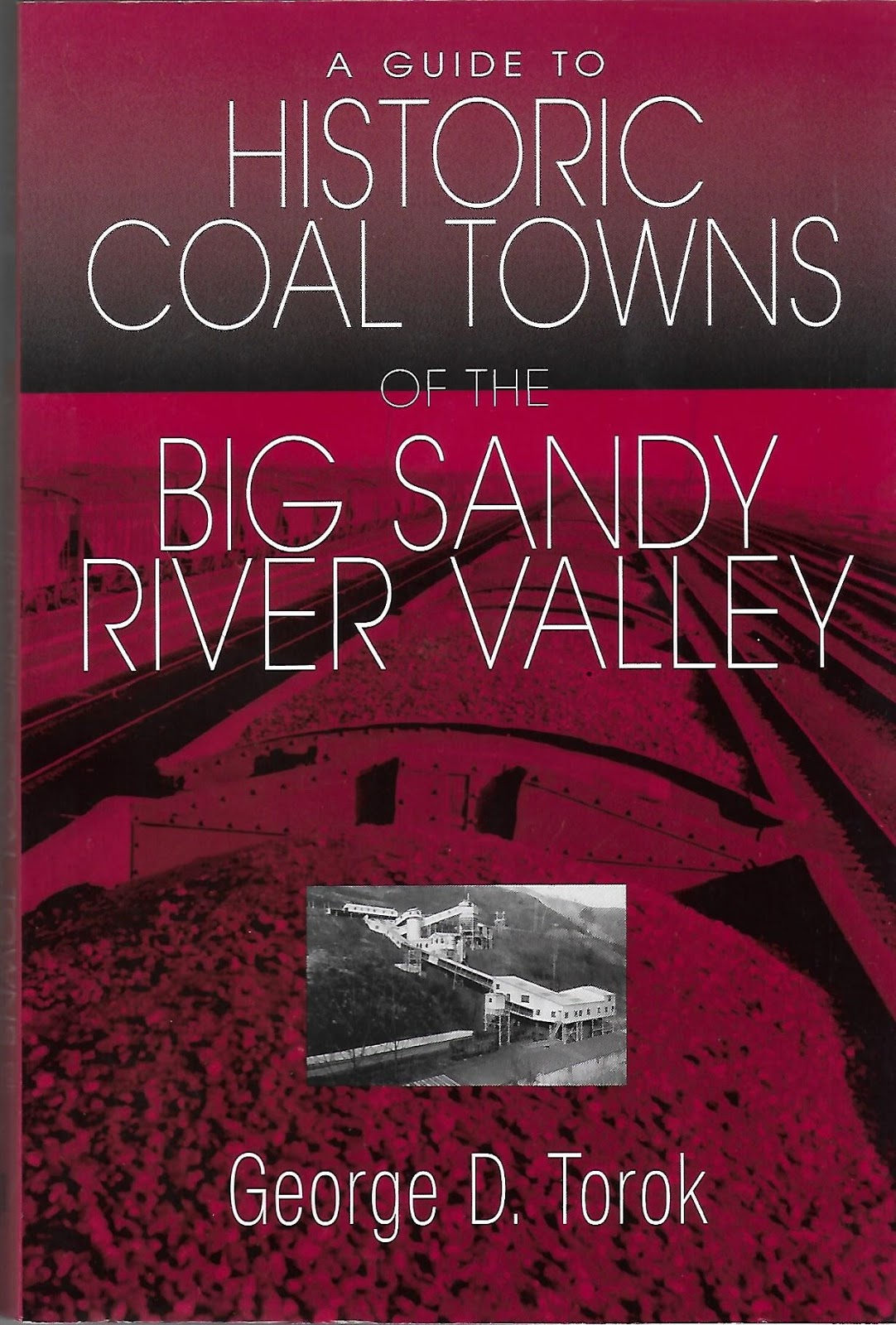
"A Guide To Historic Coal Towns of the Big Sandy River Valley" by George D. Torok--Book Review
Friday, March 8, 2019
"Twentieth Anniversary...of Local Union 5895 United Mine Workers Of America 1933-1953" by UMWA Local 5895--Book Review
Thursday, February 28, 2019
Wayland Kentucky Historical Society Trip And Research
Friday, January 25, 2019
"Under Fire" by Emily Steiner---Book Review
Wednesday, November 14, 2018
REQUIEM FOR A UNION
The Slow, Sad Death Of The UMWA
![]() |
| Photo Of John L. Lewis by AZ Quotes |
![]() |
| UMWA Journal Cover--Photo by Lorne Blair Rare Books |
I saw the benefits union miners received from the chain of hospitals operated by the UMWA in Appalachia. I have personally been inside the hospitals at McDowell, KY; Beckley, WV; Hazard, KY; South Williamson, WV; West Liberty, KY; and Man, WV. The Man location was closed years ago. The entire chain is now operated independently as the Appalachian Regional Healthcare System. I had known the wonderful work the hospitals and their dedicated staff performed on a daily basis before the union sold them off to lower expenses tied to a long list of elderly retirees, decreasing membership, and myriad other economic factors. I still use the West Liberty, Kentucky, location and the chain does provide good care in the region. But it is not nearly as patient centered as it was when the UMWA owned it.
![]() |
| Map Of The Illinois Basin Coal Field by USGS Energy Resources Program |
We will examine several reasons which I believe are tied directly to the steady deterioration of the UMWA. Some of these reasons began more than forty years ago and the most prominent of those is the steady, ongoing war against union labor in particular and most mainstream labor in general which hit full swing in the early days of the Reagan Administration and which has continued under every Republican president and congress this country has elected since 1980. This war against union labor has also been combined with a consistent effort to deregulate nearly every industry in the country by the Reagan White House and every subsequent Republican White House. The first major blow in this two pronged effort was the firing of the air traffic controllers. At the time, I was working as a horse farm foreman in Central Kentucky and spending little time in Appalachia. But I knew at the time that the firing of the controllers was simply a first blow against organized labor in general. The AFL-CIO chose not to become involved in the issue because they had endorsed Reagan and mistakenly believed that it was too early to end their supposed honey moon with the White House. I believed at the time and still do that the AFL-CIO and organized labor in general should have stepped up and supported the controllers wholeheartedly and, if necessary, by means of a general one day nationwide strike by every union laborer in America. Such an action could have proven instantly that organized labor collectively held a great deal of power and would not allow the White House to peremptorily terminate several thousand of the most critical and highly specialized union workers in America. When organized labor quietly sat on their hands and watched the air traffic controllers be fired and replaced with poorly qualified and inadequately trained workers, the door was opened through which big business and the subsequent Republican administrations would chisel away at the superstructure of organized labor, workers rights, fair pay, and every other benefit which union women and men had won over the previous century.
The great majority of union labor contracts negotiated in America since that time have been, in one way or another, giveaway contracts. In nearly every one of them, labor has lost either pay, benefits or both. Perhaps, the worst of these giveaway contracts was the one signed by leadership of the Teamsters Union and approved by their membership vote which stripped numerous benefits from the United Parcel drivers and laborers in 2013. Beginning with that negotiation process, United Parcel couched their efforts to strip union workers of their rights and benefits in such terms as "seeking driver flexibility" which was a misnomer for the company's effort to broaden the job descriptions and increase the work load for drivers. Such efforts across a large number of unionized companies steadily chiseled away at the strength and viability of unions.
![]() |
| Map Of Appalachian Basin Coal Field by Energy Data Exchange US Department of Energy |
![]() |
| Photo of Joseph "Jock" Yablonski by YouTube |
During the week of June 18-25, 2018, in "The Nation" magazine, America's best political magazine, a short article by co-authors Bryce Covert and Mike Konczal under the title "Union Strong" presents a graphic which shows that unionized workers which represented 30% of all American labor in 1955 now represent only 11% as of 2017. The graphic goes on to show that union workers receive 10-20% higher pay than non-union workers, that workers of color benefit as much as 5 times the income boost from membership that white workers receive which serves to provide them with racial parity in terms of pay and benefits. Therefore, the woman or man of color in the workforce has a great deal to gain from active membership in and unstinting support of a trade union. And, as income disparity grows like a bloom of red algae all across America, the graphic goes on to educate us to the fact that "if union membership had stayed at 1950's levels, the growth in income share of the top 10% would have been reduced by 50%." Those figures and facts from Mr. Covert and Mr. Konczal quickly and simply illustrate just how tragically the union membership shrinkage over the last 50-60 years has damaged the American workforce in general. Those damages are no greater anywhere than in the coalfields which were previously represented by the United Mine Workers of America.
This industrial public relations warfare was also augmented with a broad ranging, well funded effort to elect and control politicians at all levels ranging from governors and senators down to city council members and magistrates. If you were a candidate who was willing to parrot the propaganda of the coal industry and vote in their favor on issues ranging from a single city ordinance regulating the weight and speed of coal trucks all the way up to destroying federal environmental policy and law, you were their candidate and they would put money and influence into your campaign. They managed to turn West Virginia and Eastern Kentucky in particular into Right Wing Radical Repugnican voting fiefdoms of their overall goal of destroying labor laws, public health care, black lung law, workers compensation, and environmental laws not just in the coal fields but nation wide if they could.
As an adjunct to the "War On Coal" and as the political influence of that fictitious entity has spread, they have managed to play a major role in the election of disgraced coal operator Jim Justice as Governor of West Virginia. Since his misguided election, he actually changed his party affiliation from Democrat to Repugnican and has fully endorsed the destructive crime spree of TRAITOR & Spawn Of Satan Trump. According to the Lexington Herald Leader, Justice owes more than $2.5 million dollars in taxes to at least five Kentucky counties in which he has previously mined coal. Despite making public pronouncements that he will pay the debts, not even a minimal amount has been received. In West Virginia, he has also been ordered to pay $9.4 million dollars on a defaulted loan. That kind of public action, or inaction as the truth may be, makes Justice the ideal candidate for support from coal operators and TRAITOR & Spawn Of Satan Trump. Despite his avowed loyalty to TRAITOR & Spawn Of Satan Trump, coal field employment continues to drop in West Virginia further adding to the problems of both union and nonunion miners. During the time Justice has occupied the governor's office, the largest mine in West Virginia has shut down.
The UMWA Pension Fund is in deep trouble and the union has sought congressional actions to save these critical payments to retired and disabled miners. But the Repugnican congress has been far less than receptive to bailing out the pension fund. The lives and survival of most of the retired and disabled miners hang in the balance and it is not likely that congress will take any decisive or permanent action to save the pensions since the miners are a relatively small and rapidly diminishing voting bloc. The days when being a member of the United Mine Workers of America was a guarantee of lifelong safety, healthcare, and general well being are no more.
The United Mine Workers Of America has not ceased to be a trade union. But they have ceased to organize, enroll new members, or maintain a credible political profile. They are not dead as an organization. But they are on life support and not likely to survive. Just as America has lost our last veterans from the American Revolution, the Civil War, and World War I, we will also lose our last union miner in the foreseeable future. That, my friends is sad state of affair.


).jpg)