Search This Blog

Showing posts with label Emily Steiner. Show all posts

Sunday, February 7, 2021

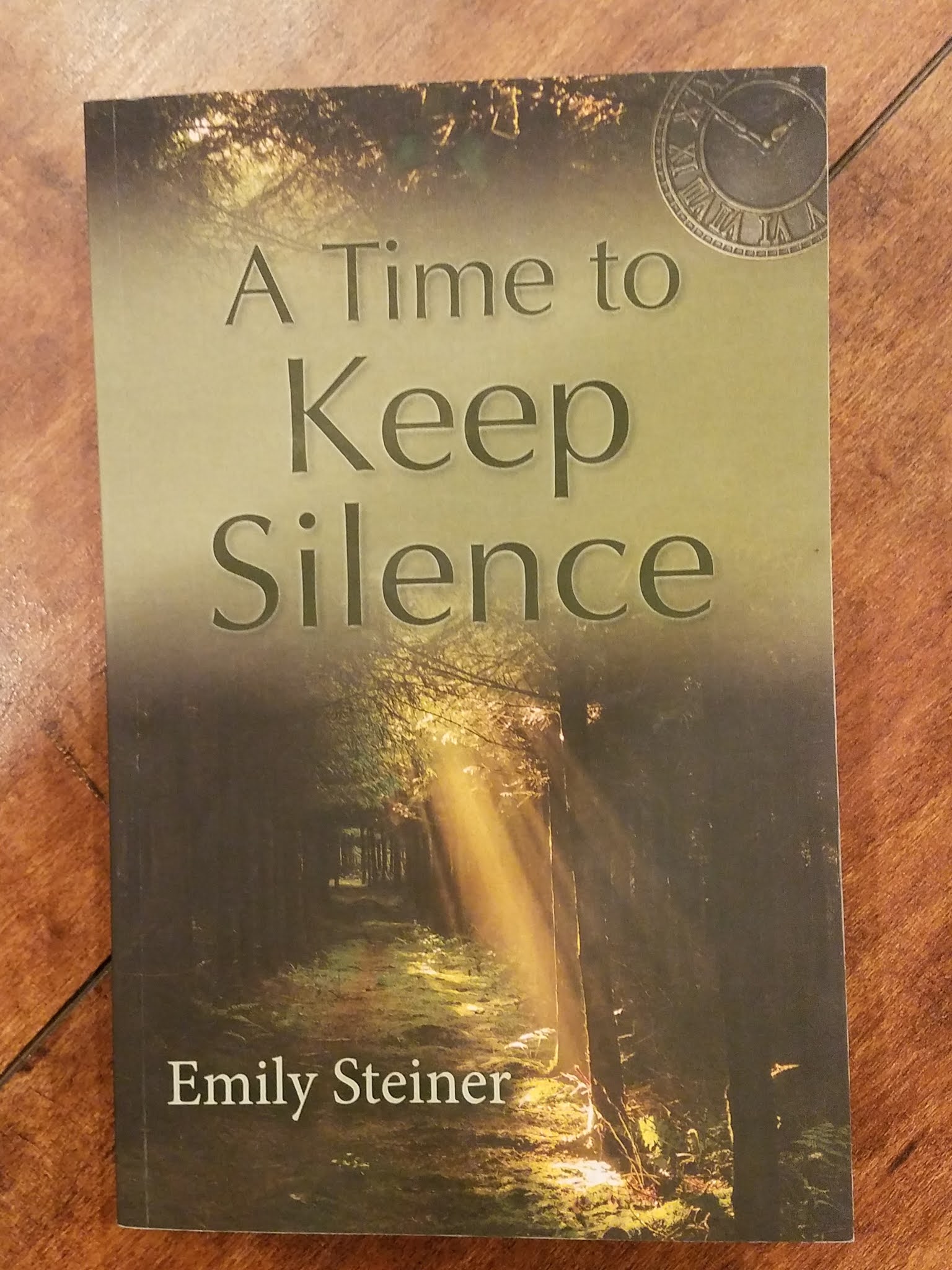
"A Time To Keep Silence" by Emily Steiner--Book Review


 I always enjoy reading books and posting about them on these reviews on my blog post and, in general that is especially true when I write about books which were written by my numerous friends who are authors.  This is not one of those times because I have just read and am now writing about a new book by one of my friends whom I like especially well and I do not like this book nearly as much as I have three others she has written and which I have also reviewed on this blog.  The friend and author to whom I refer is Emily Steiner, a young conservative Mennonite woman whom I have known for about three years.  I respect her talent, her intelligence, her writing, her books, and her commitment to her religion.  I value our friendship and we correspond these days by e-mail since she is teaching in a small Mennonite school in Central Michigan.  We met accidentally, or serendipitously as I prefer to believe, in Old Mill Park near my home in West Liberty, Kentucky, and slightly farther away from her childhood home in Crockett, Kentucky. She was dressed in a traditional Mennonite long dress and head covering and carrying a lap top which is odd among Mennonites.  I had already read her book, "Under The Bridge", which is linked above and which is the first book in her triumvirate of books about a coal mining family in Harlan County Kentucky in the union organizing efforts of the 1920's.  While I disagreed with the book's position that Christianity and trade unionism are not necessarily compatible, I liked the book and her writing quite well overall.  I struck up a conversation with her by asking these exact words, "I don't mean to bother you, but are you Emily Steiner?"  She responded "Yes!" and I told her about having read her book and we had about a half hour conversation about her book, writing on both our parts, Appalachia, and writers I knew.  We established what has been a good, honest, communicative, and respectful friendship beginning that day despite the difficulty of an older, married, non-Mennonite man and a younger, single, Mennonite woman having a friendship which respects the social barriers her religion requires in such cases.  We sometimes read each other's writing, sometimes e-mail, and, if a community occasion makes a face to face meeting possible in her community of origin, we sometimes talk a while in plain view of other Mennonite observers.  It has helped that I am fairly well known by numerous members of her congregation because I have done business with them for quite a few years and have always respected and honored the constraints and barriers their religion places on contacts with outsiders.  

So, to repeat myself, this is a difficult review to write since I like and respect the author a great deal and am not particularly fond of the book.   But please do not assume that I am saying you, dear reader, will not like the book.  It has merit as does all the work I have ever read by Emily Steiner.  So, in order to be absolutely fair to my friend, Emily Steiner, I searched out two other reviews on the internet from other sources who have read the book to see what they thought about it.  An anonymous reviewer on the Goodreads website has this to say about the book: ...A Time to Keep Silence shows the loneliness and misunderstanding that singles can face in a tight-knit Mennonite community. This is a book that an older single may relate to, and those who are married can read to understand the challenges of singles.  I agree wholeheartedly with this reviewers statement that the book "shows the loneliness and misunderstanding that singles can face in a tight-knit Mennonite community". From my point of view, the most valuable thing I got from reading the book is that it gave me an improved understanding of the religious based social customs which govern dating and consideration of marriage among young conservative Mennonites.  But, having lived my life in the greater non-Mennonite community, I tend to believe that the social customs in question place undue burdens on those young church members.  I was left with the impression that, in most cases, young Mennonite women are almost required to accept the first young Mennonite man whom they agree to date as the person they will marry even before their first date.  That is a bit too restrictive for my blood.  

The second review I chose to read about "A Time For Silence" is by a relatively young Mennonite widow who describes herself on her blog as follows: I am Gina, a Mennonite mom who writes about books, broccoli, and baking bread. In May, 2017 my husband was diagnosed with glioblastoma, an aggressive brain cancer, which took his life two years later in May, 2019. These pages share my journey of searching for joy with cancer and widowhood."  I know nothing about Gina other than what I have read on her blog and the fact that Emily Steiner has told me she knows Gina. As it turns out, I have just discovered that Gina was the person whose writing was used in part on the Goodreads website for the first quotation I used about the book since the language is identical on that website to part of Gina's review on her blog which I recommend for anyone who wants to learn more about Mennonites, their religion, and the self-sufficient lifestyle of gardening, canning, freezing, cooking, and other things such as homeschooling and church based childhood education.  I should also say that the photo of "A Time To Keep Silence" which I have used above is taken from Gina's blog, "HomeJoys" as linked above.  I have been unable to locate other independent reviews of the book at this time and will attempt to use quotations in others I might locate in the future to update this review.  

Now to more adequately address my personal issues with this book which Emily Steiner has told me is selling better than any of her previous books.  In fact, she and I had one e-mail exchange when she was actually at her printer, Haines Printing, watching the presses run so she could pick up several hundred more copies of this book.  That could be an indication that I am wrong about the book.  But, the first critique I have of the book is that it is a story which is told in 341 pages and could, I believe, have been told in a more literary manner in 200 or 250 pages at the most.  I have told Emily in an e-mail that I think that a lot of dialogue does little to advance the plot and I stick to that assessment.  The book is broken into 60 relatively short chapters, the longest of which is about 10 pages and several are 1 page.  Emily has explained this to me as a choice she made "to keep people turning pages".  I did keep reading to the end and I will buy and read the other two books which are to follow in this series about the main characters, Justin and Monica, whom I expect to be married by the end of the third book.  I was also put off mildly by one section in the book in which the protagonist, Monica, who is working in a coffee shop she and a friend, Ida Belle, have recently bought and are operating as single Mennonite women. Monica becomes scared of a rough looking non-Mennonite man who is staying in the coffee shop too long, asking a few too many questions and is dressed somewhat inappropriately by Mennonite standards.  To see single Mennonite women operating a business as Monica and Ida Belle do in the book is uncommon but not totally rare.  I regularly do business in a bulk food store which is owned by a woman in Emily Steiner's community of origin.  I also know of a bakery business in that same community which was operated for a time by the former Mennonite divorcee daughter of a devout Mennonite friend of mine.  But I have never known of a Mennonite who pre-judged a person to the degree I perceived in that section of the book.  Monica fears are used as a tension builder before the male in whom she is interested, Justin, enters the shop to buy coffee for himself and his employees.  Monica fights the desire to ask Justin to rescue her from the perceived danger of the rough look man and allows Justin to leave before making the request.  The book also winds to a conclusion without either Monica or Justin taking any action to move their relationship to another level.  It simply ends with the two of them still thinking about the possibility of dating each other but doing nothing to bring it about.  Both are afraid of entering a dating relationship because they have both been unsuccessful in one prior dating relationship.  Both fear the disapproval of the community if they enter a relationship which does not end in marriage.  In the real world, almost no one, except Mennonites apparently, gets married to the first person they date.  In my opinion, no one, not even young Mennonites, should feel compelled to marry the first person who asks them to consider a dating relationship.  I sincerely hope the next two books in this series are better than this one.  But use your own judgment about whether or not you want to read this book, especially if you have read other books by Emily Steiner and enjoyed them.  This could turn out to be the very book you have been hoping you would find.

"A Time To Keep Silence" is available directly from the author, Emily Steiner, for $12.50 plus $3.00 shipping for a total price of $15.50 by check or money order from: Emily Steiner, 5532 N. Shepherd Road, Rosebush, Michigan 48878.  If you have questions, Emily will answer her cell phone in person or return your call if you need to leave a message at 606-495-8090.  But, if you call, please keep in mind that she is a school teacher.  Call after 4pm on weekdays, never on Sunday. 

Wednesday, August 7, 2019

"Under The Juniper Tree" by Emily Steiner--Book Review


Steiner, Emily. Under The Juniper Tree (Haines Printing, Northeast, PA, 2019)

My friend Emily Steiner has just completed and released her fourth novel and the third in her "Lilly Of Appalachia" series about a coal mining family in Harlan County Kentucky.  I have previously reviewed the first two books in the series and apparently played a productive role in the second, "Under Fire", for which Emily provided me the head swelling mention on the acknowledgements page of this book as having been "..a bottomless well of research material".  I must admit that I am flattered since I respect and like Emily a great deal.  All three of the books are directly available from Emily at her home address of Emily Steiner, 155 Memorial Gardens Road, West Liberty, KY 41472.  You can actually call Emily at 606-495-8090 and she will actually answer her own telephone and talk to you immediately or return your calls if she is busy.  The full set of books are available or each may be ordered individually.  This is what Emily says about pricing: "I charge 10.99 plus 2.75 for shipping for a single copy of the new book. (If it’s to someone in KY, there’s also sales tax.) The others are still 9.95, and will be until I reprint them in a few months. Then they’ll all be 10.99. I know this is sort of confusing... If you want to tell your people, I also offer a special in the whole set—28.00 plus shipping."  Since this is a self-published series of books, please allow me to say this about Emily and her professionalism.  Emily is the daughter of the manager of the editorial department at Rod and Staff Publishers, Crockett, KY, one of the two largest Mennonite publishing companies in the country, and she takes her writing and all aspects of publishing seriously.  Rod and Staff are not the publishers or printers of this book although they did publish another of her books which is more directly about life in a Mennonite family.  This book was printed by Haines Printing in Northeast, PA, a small Mennonite owned printer, and I have never seen more professional work from a small printer or publisher.  Based on having seen Emily's three novels, all of which were printed by Haines, I am willing to recommend them without reservations.  They do high quality, fully professional, crisp, tight, slick books which are comparable to the work being done by any publisher in America.  

But let's talk about this novel particularly.  It is the third, and Emily says the final, novel in the series about a poor Appalachian coal mining family from Harlan County Kentucky although most of this novel is set in a fictitious West Virginia called Three Springs.  The protagonist, Lilly Sherman and her husband, coal miner and strongly non-violent preacher Everette Sherman have left Harlan County because Everette's non-violence and refusal to participate in union activity have made him a target of violence during a strike which is detailed in the second novel, "Under Fire".  For those of you who, like me, strongly support trade unionism, let me say that Emily's discussions of and beliefs about trade unionism are strongly based in her Mennonite religion.  It is genuine, a basic part of core beliefs about life, morals, and religion and I respect her for it.  She and I disagree about this aspect of our lives but we disagree amicably and respectfully.  I value her friendship and respect a great deal and I believe that feeling is mutual.  Despite that difference of opinion, this is a book and a series of books that is worth reading for the Appalachian reader or the reader in coal country.  

Emily Steiner--Photo by the Steiner Family
This novel does not directly address the union movement at length and unionism and strikes are not a major part of this book.  Coal mining and life in a coal camp is a major part of the plot of this book.  The key characters of the novel are members of two extended families who live in the two sides of a typical coal camp duplex.  They are realistically drawn, believable, living and breathing humans who are working together to make the most of terrible lifestyle.  Coal camp life is realistically portrayed and I can assure you that Emily has done her research for all three books.  This book is filled with unemployment, coal mine disasters, and untimely death.  My most serious concern about the plot and the eventual resolution of the conflict in the book lies in the fact that the ending is, in my opinion, somewhat unrealistic.  But I am still pleased with the book as I have always been with the work of the author.  Her work is more mature from the first book to this one.  She is growing into the strong, young, female novelist I knew she would become based on the first book.  She is well worth reading and appreciating.  Use the contact information above and order at least one of these books.  Do yourself a real favor and order all three.  You can have the set for just a little more than the price of a hardback bestseller from a major publisher.  You will enjoy this book and it will give you a better understanding of coal camp life shortly after the turn of the twentieth century.  


Friday, January 25, 2019

"Under Fire" by Emily Steiner---Book Review


This book is the second volume in Emily Steiner's "Lilly Of Appalachia" series.  I reviewed the first, "Under The Bridge" on this blog on July 30, 2018.  These books are self-published through Haines Printing in Northeast, Pennsylvania, but that company does not sell the books.  They are available only from Emily Steiner and I will place her contact information at the bottom of this review.  Unlike many self-published books, the printing work is well above average and they are high quality volumes which are only $10.00 each directly from the author.  The stories follow an Eastern Kentucky Appalachian family as they and their relatives are involved in a coal mine strike and the minister husband of the protagonist, Lilly Burchett Sherman, refuses to join the union based on his interpretation of the New Testament admonitions against violence. The father and brothers of Lilly Sherman are union members and one of them is actually shot and paralyzed late in the work as a result of his union activity. I was lucky enough to read much of this book in manuscript and provided my suggestions about it directly to the author who is a friend of mine.  We met shortly after the release of the first book in this series, "Under The Bridge".  The writing in this book is more mature from a professional standpoint than in "Under The Bridge".  It is well-plotted.  The characters are believable, real people, and show the many hours of research which the author has put into the book.
 
Emily Steiner accepted some of my suggestions about the book and flatly refused to take a position in the book in favor of trade unionism which I strongly support.  But, like the characters in the family of the protagonist, Emily Steiner and I have managed to remain friends.  Her objections to supporting unionism are based on her interpretation of the Bible and she is devout Mennonite woman living in our local Mennonite community where I also have numerous other friends and sometimes attend events and write about them on this blog.  I know many of these people well enough and understand their beliefs to a degree that we can disagree and still remain friends.  Emily used one of my suggestions, provided as a copy of the wonderful Jack London description of a scab in a way in which I would never have used it.  But I can say that she at least read it and inserted it in the book with a statement of attribution at the end of the book.    

The book moves along as the strike deepens in a community set in Harlan County Kentucky.  Emily accurately portrays the poverty, destitution, and desperation of the miners and their families and I have to say I like this book.  It is simply not the kind of book I would write or wish to write about a union struggle in Appalachia.  But, like everything Emily Steiner writes, it is well worth reading.  I also suggested to Emily during the completion of the book that she read Davis Grubb's wonderful union struggle book, "The Barefoot Man", which I consider to be the best union novel I have ever read.  I have never heard from her that she found a copy and read it.  I suspect that if she had she might not have ever discussed it with me due to her religious opposition to some of the language and scenes in that book.  But I wish she had read it before she finished this book.  I understand fully that having read "The Barefoot Man" would not have changed her perspective on trade unionism.  But it would have broadened her understanding of the union struggle and given her a deeper knowledge base about trade unionism, the coal fields in Appalachia of the early twentieth century, and the irreplaceable role trade unionism has played in the social development of both Appalachia and the country as whole.  

But, do not allow my difference of opinion with Emily Steiner deter you from reading "Under Fire".  It is an excellent book in many ways.  It is a fine addition to Emily Steiner's ever growing body of work.  She will continue to write and publish novels.  She will continue to mature as a professional writer.  She will come to establish herself, quietly in her own deeply religious manner, as one of the better young writers in Appalachia.  She describes herself in the biographical statement within the book as "...born and raised as a mountain girl in Eastern Kentucky."  I agree with that statement.  However, any description of Emily Steiner must begin with a clear understanding that she grew up in a religious based subculture in Eastern Kentucky which consciously separates its members from the mainstream to varying degrees and her understanding of the primary culture of Appalachia is affected by that separation.  I value her friendship.  I value her ability.  I value this novel.  You will also value this novel regardless of the personal position you take on trade unionism and the way it is deeply ingrained in Central and Southern Appalachia.  
 
"Under Fire" and "Under The Bridge" are both directly available from Emily Steiner at $10.00 each.  She will autograph them and mail them to you.  You can contact her at Emily Steiner, 155 Memorial Gardens Road, West Liberty, KY 41472.  You can call her at 606-495-8090.  She will personally answer her phone and actually talk to you.  When have you known another published author who would do that?  


Tuesday, November 27, 2018

The Mixed Blessings Of Having Writers As Friends

As I have said on several occasions in this blog, I have known and been mentored by several of the most important writers in Appalachia.  I have had published writers as friends, mentors, professors, and colleagues since I was in my early teens.  I have written about several of those relationships and people on this blog over the last seven years.  I have benefited greatly, in a variety of ways, by having known these people.  I do not say that all of them have been glowing examples of the human race.  One or two I have known have been many of the things most people work diligently to try to never become. A few others have been nearly everything decent, honorable, and caring humans strive to become.  At least one of these relationships extends all the way back to the early 1970's.  Others have only been my friends for a few years.  Yet at least one of those brief friendships is one of my closest today.  For a time I was a member of a group of Appalachian writers, both professors and students, which is thought of by many in the fields of Appalachian Studies and Appalachian Literature as having been one of the more significant groups of writers in Appalachia.  

However, knowing numerous writers  is, in general, a bit like knowing all of the dogs in your neighborhood or the racehorses at your favorite track.  Some of them will bite without provocation.  Some will be your best friend so long as you have food to eat, a warm house, or something to drink or smoke.  Some of them will be winners.  Some will always finish well behind the pack.  Some will only be consistent consumers of favors and influence while others will be consistent producers of both great literature and fond memories.  Over the last few weeks I have had occasion to be reminded of this for several reasons.  I recently acquired a few books from the estate of a lesser known poet and newspaper writer in my area and most of those books had been autographed by their authors and given to the writer  of whose estate I had managed to buy part.  During her lifetime, she had known many of the most influential writers in the state of Kentucky.  During my lifetime, I have done the same with a similar group of writers from both Kentucky and West Virginia.  I also have a similar collection of books written, autographed, and presented to me by writers I have known.  I even bought a wood stove once from one of the most famous Kentucky writers without anything other than home heating having ever been discussed between us.  

Also during this recent period, I acquired four or five books written by two or three of my friends.  One of those friends I have known since about 1995.  The other I met just this past summer.  One is an excellent writer.  The other is not.  I have been in fairly regular contact with both over the time I have known the later.  The recent friend has provided me with warmth, friendship, and respect.  The other, whom I have known much longer has been in contact on superficial levels and been less than forthcoming in many ways.  The new friend, during the course of writing their third published book, sought my input and even included a piece of a great writer's production in that book to make a point.  It was not the point I would have made with the same excerpt but I do know that my friend had never before seen that writer's work until they knew me and chose to use the work mentioned when I made them aware of it. They also listed me in the "Acknowledgements" page of the next book for having critiqued the previous book and for "providing a bottomless well of research material."  The second writer, whom I have known considerably longer also published a couple of books recently which would have been better left in a manila envelope under a bed for some auctioneer, yet unborn, to include in a box lot at an estate sale.  At some point, I offered this second mistakenly ambitious writer some constructive criticism pending their willingness to hear it.  I never even got a response which in some ways did not surprise me.  I refer you once again to my earlier metaphor about dogs and racehorses.  The new friend has produced a well written, respectable book which will not likely ever be famous due primarily to that person's total aversion to seeking or achieving advantages by virtue of doing anything that is not modest and humble. But  their work is likely to be kept in some bookshelves for the foreseeable future.  The other produced a book which would, as I said earlier, have been better placed elsewhere other than in the public market.  At about the same time this series of exchanges was transpiring, a third writer friend who works in several areas has been well reviewed by random strangers over the last several decades asked me to consider providing input on an upcoming book which leads me to believe that my input is not totally worthless.  

To put all this in a neat little package, or at least as neat a package as possible, I will say that despite having been bitten and ravaged by fleas on a few occasions in addition to having been kicked, pawed, and dragged by several horses, I still pet strange dogs, admire and sometimes even bet on new horses, waste my time picking up strays, and have even paid to neuter two stray kittens lately.  I will probably not stop expressing my opinions to writers whom I know and some I have still not met. 

Monday, July 30, 2018

"Under The Bridge" by Emily Steiner--Book Review

Steiner, Emily. Under The Bridge ( North East, PA, Haines Printing 2018)


Emily Steiner is a young Mennonite woman living in my home county of Morgan County Kentucky,  This is her first book and was printed by Haines Printing in North East, PA, and self-published by Ms. Steiner.  I did not know Ms. Steiner or her family as I do many of the Mennonites in this county until after I had read her book.  Shortly after reading this book, I was walking in Old Mill Park in my hometown of West Liberty, KY, and saw a young Mennonite woman carrying a laptop computer adn dressed in the typical Mennonite fashion of ankle length dress and head covering.  I asked, "Are you Emily Steiner?" which was a good assumption since she matched the photo in the book and it is not customary for Mennonites to work on computers.  She told me she was Emily Steiner and we struck up a conversation which lasted about thirty minutes and was entirely about literature, her writing, her next book now in progress, and many of the writers I have personally known.   Ms. Steiner work briefly as a school teacher in the local Mennonite School.  She has lived most her entire life in Morgan County. She is currently working two part time jobs and working on her third novel, which will be the second book in this series.  This book is the first in that series of books about a young Appalachian woman named Lilly Burchett.  It is labeled on the cover as Historical Christian Fiction.  But in reality, it is presented as a historical novel about a young native Appalachian woman with no connection to the Mennonite religion but does describe her and her family as church goers to a church without mention of the denomination.  

The story is set in Harlan County Kentucky in the period from circa 1918-1922 or so.  The story is also labeled on the cover as "Well researched and rich with detail; the author's first-hand knowledge of life in rural Kentucky shines through in the vivid and sensitive telling of this classic tale of love, loss, hope, and dreams."  It is an attempt to portray the native Appalachians of Harlan County from a period a century distant by a writer who lives a very different lifestyle not only from those natives of the early twentieth century but also quite different from the local native Appalachians of today in this community.  I bought the book at a local bulk food store which is run by another unmarried Mennonite woman whose extended family I know quite well.  Until I saw the book on a counter, I had no idea that any Mennonite in the area was writing fiction. However, Rod & Staff Publishing, one of the largest Mennonite publishers in the country is located in the county in Crockett, KY, and Ms. Steiner's father works there in the editorial department. Since no conservative Mennonite author or publisher uses the internet or modern marketing practices, you cannot find further information about the books of Ms. Steiner on the internet.  The printer, Haines Printing Company, does maintain a minimally informative website about their services but does not directly market this book or any other they might have printed. Their ownership may or may not be Mennonite. Ms. Steiner is directly marketing the book via her personal phone number and address.  I will provide that address at the end of this review.  

Despite the information listed on the back cover claiming first-hand knowledge and positive research, the book misses the facts on numerous occasions in dealing with Appalachian life in the early twentieth century.   However, based on my numerous contacts with the local Mennonite community and my overwhelmingly positive opinion of the Mennonite people in the area, I am willing to say that I do not believe any of these errors were committed with negative intentions. Since that first accidental meeting in the park, Emily Steiner and I have talked face to face three more times, once at the last day of school at the Faith Hills Mennonite Church School and twice at her part time employment in a Mennonite owned fabric and sewing store.  We also converse fairly regularly via e-mail which, due to the Mennonite religious beliefs and mores, is on an e-mail address which actually belongs to her brother who is a local construction contractor.  The book does perpetuate several of the prevalent myths about Appalachian people of the early twentieth century and of Appalachian people and culture in general. However, since Emily Steiner and I have known each other, I have provided her with some guidance about Appalachian Culture and Literature and given her a long list of mainstream Appalachian books which she is reading diligently and working to make the next novel much more culturally accurate. 

The protagonist in the story is Lilly Burchett, a thirteen year old Appalachian girl who is a member of a large family living in "a cabin" in a hollow near a coal camp and a coal mine in which her father, Bernie Burchett, works. Lilly is described as having "...calloused feet that rarely felt shoes" on the first page and so begins the trail of myths and errors about Appalachia and Appalachian life.  The family is composed of the parents, Lilly, and several other of her siblings.  The story begins in early 1918 as World War I is ending and the surviving soldiers are returning from the battlefields.  Lilly is nearing the time when, as she has already been told by her mother, "...'a woman's place is getting married and raising a family'...and then having babies, having them one after another as fast as all the other mountain women."  Lilly is described as a good student in some areas but not in math.  She wants to grow up to leave the mountains and become a writer.  The title of the story arises from the fact that Lilly frequently stops to think, write, and hide her writings under a bridge over the creek on her way home from school where she dreams about the future. I suspect that several aspects of the character are fictionalized versions of thoughts which Ms. Steiner has had growing up as a young, intelligent woman in a strictly conservative Mennonite family and community. To some degree, she has corroborated that belief and disputed it in others.  Another former Mennonite school teacher in the community who actually taught the same year Ms. Steiner did, whom I have known since childhood, has also stated that he agrees with my assessment that many of the cultural errors in the story are rooted not in any prejudice on the part of Emily Steiner but in the fact that the average young Mennonite woman has little contact with the greater non-Mennonite community.  The character of Lilly is much more fully developed than the other characters in the story.  The writing is above average for a first book but not exceptional by any means. But it shows a great deal of talent and is good enough that I am willing to spend time helping Emily Steiner improve both her knowledge of Appalachian Culture and her base of knowledge about writing and literature in general.  The book is readable and for the naive individual who knows little or nothing about Appalachia of the early twentieth century it could be assumed to be accurate in its depictions of the area and its people.  Therein lies the potential damage to be done by this book and all other books like it which are written about Appalachia without sufficient knowledge of the people and culture. 

The errors in depiction of Appalachian Culture, life, and language continue throughout the book and range from simple errors in language to full blown but unintentional misrepresentations.  Later in that first chapter in a description of the local school teacher's opposition to the coal mining companies she has a minor character state "He don't like the mines because he had two brothers killed in a collapse."  No one in Eastern Kentucky would have used the word "collapse" to describe a roof fall.  The generally used word all over Appalachian coal mining country was then and still remains "roof fall" or could have been a use of the word "kettle bottom" to describe a particular type of roof fall.  It is also interesting that in a book about a coal mining town in Harlan County in 1918 there is no mention of the ongoing effort to unionize the mines.  The United Mine Workers of America was organized in 1890.  Kentucky coal production reached a million tons in 1879 and a major producer at that time was already Harlan County and both the United Mine Workers of America and the International Workers of The World (The Wobblies) were attempting to organize miners in Harlan County by about 1905 or 1910.  Ms. Steiner is currently working on the second book of the series with a working title of "Under Fire", the manuscript of which I have read and offered suggestions about improving it both from a cultural and a writing viewpoint.  Ms. Steniner's intentions are to write a book which does address the union efforts in Harlan County Kentucky but to promote the Mennonite views of non-violence and, therefore, to not promote unionism.  She and I have mutually agreed to amicably disagree on that position and to remain friends. 

Chapter Five of "Under The Bridge" begins with a particularly telling paragraph in terms of its depiction of life in Eastern Kentucky in 1918 as Lilly begins working as a housekeeper for the wife of the local mine manager.  "...Lilly grew accustomed to turning a knob for water, dragging heavy rugs up and down stairs, and cooking multitudes of things beyond cornbread, beans, and fried potatoes."  It is quite interesting that this was written by a young woman who grew up in a family, religious community, and subculture which depends strongly on gardening as a major means of sustenance and who knows quite well that anyone who raises a garden in Appalachia eats far more than "cornbread, beans, and fried potatoes".

Later in the book as Lilly is working as a housekeeper in the home of the mine superintendent and meets a couple who are friends of her employer and his wife and is offered the opportunity to return with them to Louisville to live in their home and further her education.  Because of her father Bernie's objections, Lilly turns down that opportunity and begins anticipating life as a young married woman in the footsteps of all the other women in her life.  It is interesting that across many areas in Appalachia such as Knott, Jackson, and surrounding counties in Kentucky,  and several counties in North Carolina schools were being founded such as The Caney Creek Community Center and the Annville Institute which were assisting numerous students in admission to and attendance at colleges outside the region.  Ms. Steiner seems to have not known about any of this history at the time she wrote "Under The Bridge".  But she is working diligently to remedy the shortcomings in her knowledge of Appalachia and Appalachian Culture and Literature.  "Under The Bridge" can be bought directly from Emily Steiner by calling or writing her at Emil Steiner, 155 Memorial Gardens Road, West Liberty, KY, 41472, or by calling her at 606-495-8090.  The price is $10.00.  The book can also be found at Caney Grocery in Cannel City, KY, at the intersection of KY 1000 and KY 191 between Cannel City and West Liberty.  Despite the negative comments in this review, the book is worth reading and buying.  Her second book, "What Money Can't Buy", a purely Mennonite novel is now released and available at Rod and Staff Publishing in Crockett, KY.