Search This Blog

Showing posts with label West Liberty. Show all posts

Sunday, August 3, 2025

"Artisans Harvest" At Morgan County Wellness Center, August 2, 2025

Yesterday, my wife and I attended Articans Harvest at the Morgan County Wellness Center in West Liberty, Kentucky, which was originally called "Art In The Park" and held at Old Mill Park. But a few years ago, the location was changed due to rainy weather and it has been held at the Wellness Center gym ever since. When it began in the park, it was more a folk art show and sale than what it has become since the move. It is now heavily oriented toward crafts rather and folk art. Minnie Adkins, the famous Elliott County folk artist still attends and Brent Collinsworth from Wolfe County was there last year but did not attend this year. Steve Sargent, who makes nice lamps from whiskey bottles had attended last year but was there only as a spectator this year. There also is a small number of local vegetable farmers who attend to sell a few vegetables. It is not what it used to be. I do understand that since it is organized by the local Agricultural Extension Service office that their funding source probably requires that it include the vegetable farmers and some others such as users of the Extension Service food preparation trainings they sometimes do. But I go primarily to see, and sometimes buy, folk art, and I prefer to see it more heavily oriented in that direction which I am afraid might not happen again. This also reminds me of what used to be called Morgan County Farm, Home, and Family Day which was more oriented toward individual presenters who taught small groups in a classroom setting about a wide variety of topics oriented to life in a rural community. It hasn't been held in several years. But this event now known as Artisans Harvest is a great place to go to meet a few people in the community whom we don't get to see on a regular basis. We ran into Steve Sargent whom I've known for years; Minnie Adkins who is one of my favorite folk artists, and whom I had seen two weeks ago at Minnie Adkins Day in Sandy Hook; Sarah Fannin, the local Extension Agent who was there no doubt in her official capacity; Danny Joe Gevedon, who is a retired banker and friendly acquaintance who also plays Bluegrass bass; Austin and Kathy Shaw, from whom I buy farm fresh eggs; and several others whom I might have forgotten to mention. Since there was only marginal interest in Minnie's somewhat expensive folk art, I was able to spend some time talking to her and got Steve Sargent to take a photo of us. I try to always get a photo with Minnie when we run into each other. Minnie was in a generous mood yesterday and offered to give one of her famous roosters to a female who said she makes handmade brooms. But she declined and insisted on buying one of Minnie's unpainted roosters, staing that getting the rooster was the only reason she had attended the event. Just before we left, Candice happened to drive her wheelchair past Minnie's table, and Minnie promptly stood up and carried Candice a hand carved and painted cardinal which she gave her. It is proudly displayed on a shelf with my two hand painted and carved Evening Grosbeaks from Minnie's cousin Tim Lewis. It was a very community oriented event for us since we saw so many of our friends and acquaintances, got to look at some good crafts work, visit with Minnie, Steve, and Danny. We left the event and chose to drive to the Minor E. Clark Fish Hatchery near Morehead so I could hike. But I will discuss that in a separate post.

Tuesday, September 24, 2024

Me And My Shirt Take A Trip To Two Eastern Kentucky Towns!


This morning my wife Candice & I had a few things we needed from Wal Mart in Morehead, Kentucky, and left home about 11am.  Our first stop was at a McDonald's in one of those towns.  I don't intend to say which McDonalds' or which town in order to protect an intelligent, committed employee of that McDonald's from any potential punitive actions her employers might wish they could use against her.  When I pulled up the food service window, she handed me my order and suddenly said, "I like that shirt."  I thanked her, pointed out that my wife was also wearing a similar kind of Kamala Harris shirt and suggested that she be sure to vote and get out all the votes she can for Harris.  She said, "I'm trying with everybody I can".  Then she added, "We ain't going back."  I loved it.  

Later I was at the meat counter in Wal Mart when I encountered a couple about 35 or so and the man suddenly turned to me and said, "I like that shirt."  We struck up a conversation and they assured me that they are registered and do vote.  They also told me that the wife sometimes wears one of the "Childless Cat Ladies For Kamala" shirts.  Then the husband began talking about the connections between TRAITOR Trump and Vladimir Putin and Russia.  We talked a bit about the theft of the 2016 election in Pennsylvania, Wisconsin, and Michigan about which they agree with me totally.  All together it was a fine day.  I saw one or two of those irritated and ignorant glances when others saw the shirt but no one during the day, including our lunch at Cracker Barrel, said a negative word about our shirts.  And I would actually like it to have happened because it impossible to confront that kind of ignorance if the don't open their mouths.  


Sunday, August 4, 2024

Market In The Park, West Liberty, Kentucky, August 3, 2024


My wife Candice and I attended Market In The Park today, August 3, 2024, in our hometown of West Liberty, Kentucky.  However, today's event was not held in the park as it has been in several years in the past.  Due to an unpredictable forecast with a lot of possible rain, the event was moved to the Morgan County Wellness and Youth Center which sits on a piece of property which is outside town proper by about a half mile but still within the city limits.  The building has a gymnasium, bowling alley, and exercise equipment with a large paved, but poorly engineered, parking area which has too many parking spaces which are too small and make parking difficult in a well attended event, especially when the lot is filled with oversized pickup trucks.  Cars and trucks were parked along the grassy edges of the lot and in an unpaved area across from the main entrance.  But it all seemed to work out well in general.  


The attendance was even larger than I had anticipated.  I have no idea how many vendors were present but it must have been somewhere between 75 and 100. There were also a few local musicians, none of which struck as particularly talented. I had decided to attend this year because the renowned folk artist Minnie Adkins, whom I know slightly was listed as a vendor.  I had just seen Minnie on July 20, 2024, at the annual Minnie Adkins Day in her hometown of Sandy Hook in adjoining Elliott County.  But she is now 90 years old and I treasure every  minute I can spend in her company.  The first person I saw when I entered the building was Minnie who was involved in a warm hug with Danny Gevedon, a retired banker and used car dealer from West Liberty whom I have known and had an acquaintanceship with for about twenty years since the bank he was working for had some business with us.  Danny is also a pretty good woodworker and has been a vendor at this event in the past. But he was not selling any craft works today.  I walked toward them saying, "the next hug is mine" meaning a hug from Minnie. But both stepped toward me and we wound up in a three way hug which was a nice surprise.  Then I quickly encountered a local retired prison captain who, along with his wife, I had sold several loads of good collectible glass for when I was still running my auction house.  We engaged in a fairly long catching up conversation when we were approached by our former Commonwealth Attorney who did my taxes for several years.  I had not seen either of these men in several years and had long conversations with both.  Then I went to Minnie's table and had a brief conversation with her and she surprised me by giving me a small painting of a bird, pictured above, which I will treasure for the rest of my life. It is only a 4" x 4" canvas on a small wooden easel. It is not the only Minnie Adkins piece I have in my collection but this one is different since it was a gift from the artist and I bought the others.  Minnie and I also caught up on the recent serious health problems of her cousin Tim Lewis who has had another brief hospitalization at the VA Hospital in Huntington, West Virginia.  Tim is also a Kentucky folk artist who has a few pieces in the Smithsonian Museum where Minnie also has pieces.  My wife then told me that our friend Steve Sargent was selling shade lamps which he makes using empty whiskey bottles and I moved to his booth where Candice had selected a lamp she wanted to buy.  But I wasn't carrying my check book.  No Problem!  He sold it to me on credit.  I am a regular at a grocery store which his father-in-law and wife operated near my house. We actually went to the store for lunch after we left Market In The Park.  

Most of the vendors were selling more craft works than art works and I wasn't interested in buying any of those.  We did buy a few cucumbers, miniature tomatoes, and banana peppers from a woman who remembered Candice from her days long ago working at the local food stamp office.  We also had brief conversations with a few others who we knew for a variety of reasons.  There was a couple who used to attend my auctions, our local county extension agent who was also present at Minnie Adkins day last month in Sandy Hook, a local school board member whom we have known for several years, and one or two others who had known us for a variety of reasons in the past.  Events like this are always fun to attend in West Liberty since this community and county has actually done a wonderful job of maintaining a variety of rapidly disappearing aspects of a tight knit community which many other places of roughly the same size have long lost.  I have always felt that the West Liberty tornado in 2012 which destroyed a great deal of the town and killed 6 people had a lot to do with the continued cohesiveness of our  community.  Another event, now cancelled, which helped to keep that sense of community intact was the annual summer event which used to be held to raise money for the American Cancer Society.  Known as the Morgan County Cancer Walk, it was well attended and supported by a variety of people in the community and, for a few years, actually had the highest per capita donations in the state.  This has always been a very supportive community for such events and they have also molded the community into a deeply connected and caring place to live.

Wednesday, June 22, 2022

Surviving An Endarterectomy, Or A Little Knife Fight I Won!


About 4  years ago, I discovered that I had a blockage of about 70+ percent in my right carotid artery which I managed to handle with diet changes, exercise, and a little medication for something like 4 1/4 years.  But annual scans showed that the blockage was steadily increasing despite marked decreases in my serum cholesterol, blood pressure, weight, etc.  So a few months ago, I made the decision to have the blockage removed via the endarterectomy process which laymen sometimes describe as a "rotorooter" on the artery.  This involves making a fairly major incision through the skin and muscles of the neck to expose the artery, clamping the blood flow at both ends of the artery area to be cleared, and, as I understand it, literally scraping the accumulated cholesterol plaque out of the exposed inner surface of the artery.  This is not a surgery to be taken lightly.  But, due to the way I had generally behaved since the blockage was first diagnosed, my doctors conceded that I was in generally better physical condition than the great majority of patients who have such a surgery.  I also trusted my surgical team at the University of Kentucky Hospital absolutely and, if I had not, I would never have consented to allow them to play among my arteries.  


My decision was not taken lightly since my wife has been in a wheelchair for more than twenty years and, in the event I had any kind of major catastrophic outcome from the surgery, either my wife alone or both of us together would most likely spend the rest of our lives in a nursing home which is a fate to which no one I know aspires. This issue was further complicated by the fact that I would have to spend at least one night in the hospital if all went according to plan and would have about two weeks of limited physical activity which would make it impossible for me to provide my wife the care she must have on a daily basis.  But her sister, who lives in Sheboygan Falls, Wisconsin, volunteered to come and stay with her/us for a little over two weeks if the surgery could be postponed until after her twelve year old son was out of school for the summer.  My doctor, David Minion, M. D., agreed to the plan and we scheduled my admission and surgery for June 14, 2022, which gave us a few days for my sister-in-law and her son to arrive here and for me to train her in the usage of a Hoyer Lift and the other issues of assisting my wife in and out of bed, shower, toilet, etc.  She adjusted smoothly to the task and I felt safe in leaving Candice at home alone.  

On June 14, 2022, I was admitted to UK Hospital at about 5:30am and the surgery was over by about noon, lasting roughly four hours in the operating room.  The next twenty four hours I had a lot of pain involved in my neck and throat but I was released from the hospital the afternoon of June 15.  I got home uneventfully with massive swelling in my incision area, went to bed as usual about 10pm but couldn't get to sleep.  About 11:30pm, I got up, looked in a mirror, and saw even more swelling in my neck, and came to the conclusion that I had a minor leak from the artery.  Since I couldn't drive at that point, it would have been necessary to have my sister-in-law drive me to the hospital I preferred in Morehead, Kentucky, thirty miles away.  Candice didn't feel safe being left at home in bed when it was impossible to get out and asked me to take an ambulance to the local ARH Hospital in West Liberty where I have not trusted the medical providers and management for several years now.  Against my better judgment, I agreed to go there by ambulance.  I called 911, an ambulance arrived, and I was transported to ARH-ER shortly before midnight June 15, 2022.  ARH has adopted a policy quite some time in the past to contract their ER doctors from some national medical service.  Additionally, about 3 years ago, they ran off the three best prescribing professionals working in that institution, closed the Home Care Store which my wife had used regularly for years, and replaced the medical providers with providers with less experience, credentials, and, in my opinion, at far less pay and benefits which I believe was the primary object of all these actions.  I was admitted, put on an ER bed, hooked to monitors, and left in the room for quite an extended period of time before I was even seen by a doctor.  That doctor finally came in, stood at the foot of my bed looking at me for about 15 seconds, stepped beside the bed and touched my neck, said "that's wonderful surgery", and walked out without saying another word or introducing himself.  Shortly after I arrived, my blood pressure began jumping up and down much like Roy Acuff's yoyo, and little to nothing was done about it.  Finally, after some extended period the doctor came into the room again, looked at me for a few seconds, and left without saying a word.  I was eventually seen by the nurse manager in the ER that night and the next day and she told me that they were seeking a bed for me at UK.  They gave me one or two injections of some short term blood pressure medication which only lowered my blood pressure briefly before it spiked again.  I spent the night in the ER in that cycle with my blood pressure sometimes reaching levels of 190/90 and going as low as 130/60.  Nothing ever came of the alleged referral to UK.  Finally about noon on June 16, I had an exchange with the nurse manager in which I told her I had no faith in the doctor of the upper level management of the hospital and I was considering leaving AMA, Against Medical Advice, since nothing seemed to be happening to improve my condition.  She and the doctor came in at some point for his third encounter with me and I confronted him in her presence about the fact that he had done little or nothing to help me which he denied, stated "you're not going to die", and claimed that the machines could do a far better job of watching my condition than people.  I made a phone call to the Nurse Manager of the vascular surgery team at UK to see if she could facilitate my transfer and she stated she could do nothing.  I then called the office of my primary care provider at Saint Claire Clinic in Sandy Hook, Kentucky, to ask if I could be seen there and she stated, through her nurse, that I should go to UK ER.  At that point, I made up my mind that I was leaving AMA and called my cousin Jack Terry in Louisa, Kentucky, to ask if he could transport me to UK which he agreed to do.  I got out of bed at about 3pm, disconnected my electrodes from my body, walked to the nurses station and asked to have my IV removed, and signed the AMA papers.  I walked out of the ARH-ER after 16 hours of absolutely useless time and traveled to Lexington to the UK ER.  

I signed in there at about 6pm, since it took Jack quite a while to arrive from his house.  The ER at UK is in a major expansion and part of the building is unfinished but in use with patient cubicles on the ground floor with blue tarpaulins for doors and exposed ceilings showing concrete beams, copper pipes, HVAC pipes, no cell phone service in that area, etc.  But the UK-ER team is doing a helluva job in rough circumstances and I respect them a great deal.  They retested every test which had ever been done on me, consulted with the vascular surgery team, and finally I was admitted to a room in the hospital about 4:30am after about 9 hours on site.  They immediately put me on IV antibiotics, and medication to lower my blood pressure.  The nursing staff, lab staff, food service staff, and the members of the vascular surgery team are all wonderful practitioners each of their own personal profession.  They took great care of me, got my blood pressure under control in just a few hours, kept me at least part of four days, and discharged me on June 19, 2022, to return to home.  During the time of my stay at UK, I was told by three different members of the vascular surgery team that I had "done the right thing" by leaving ARH against medical advise.  That is a rare occurrence in health care today to ever hear any member of a medical profession state that other members of their profession have delivered less than exemplary care to a patient.  I really do believe I would have been likely to die if I had remained at ARH and unless I have absolutely no choice, I will never darken their doors again.  What is really sad about this whole situation is that a few years ago, I would have just as strongly defended ARH and their practitioners against all criticism.  But those practitioners are no longer there and most of them left against their will leaving hundreds, probably a few thousand, patients without the quality of medical care they had been receiving from those providers.  I do still have several providers in that hospital in other departments whose work I respect.  But, I have little doubt that they also are on thin ice if they are being paid what they are worth.

This entire episode is an example of how healthcare has often failed in Appalachia.  In this region, we often are served by providers who do not understand our culture, our people, how we think, believe, and live our lives.  Many small regional hospitals in our area are understaffed, underfunded, under governed, and unsafe.  In many ways, large numbers of these hospitals are similar to what was once said by Ralph Nader about the Chevrolet Corvair.  They are "unsafe at any speed".  It is also sad that in the early history of what later became the ARH hospital chain, they were actually owned and operated by the United Mine Workers of America and were shining examples of how health care should be delivered to a depressed area. In explanation of my willingness to openly criticize so large and powerful a corporation, I would point my readers to these two articles on the website of the American Counseling Association which I co-authored with Dr. Heather Ambrose, Ph. D., both of which are rooted primarily in my own work in graduate school.  One of  these articles we delivered at the 2005 National Conference of The American Counseling Association and it is included as a chapter in a book from the ACA on cutting edge advances in counseling.  The other is about culturally appropriate supervision of counselors in Appalachia and is on the ACA permanent website for professionals.  Both articles are frequently cited and quoted in professional articles, books, and graduate school dissertations.  I know whereof I speak both from a personal and a professional viewpoint when I discuss healthcare in Appalachia. 

Sunday, March 10, 2019

Sorghum, Eating It, Comparing And Evaluating It

For a little more than a year now, I have been eating sorghum nearly every day in oatmeal at breakfast.  While that is the most consistently I have ever eaten sorghum, it has never been unusual for me to buy, eat, and keep sorghum in my house.  I grew up with sorghum in Knott County Kentucky and one of my fondest memories is of my father taking me with him once when I was about ten years old to buy sorghum where someone was grinding cane with a mule and cooking sorghum at the edge of the field.  For the past twenty-seven years, I have lived in Morgan County Kentucky, the home of the annual Morgan County Sorghum Festival which takes place the last full weekend in September each year. Morgan County is the heart of Kentucky sorghum country although some people in Liberty, Kentucky, the county seat of Casey County in West Central Kentucky, try to make a claim to the title. I must admit that I have never grown cane or actually made sorghum, but I will insist that I am an expert on the subject.  I have eaten three quarts in the last year.  Over the LAST sixty plus years, I have eaten sorghum made in several states, and in several different counties in my native Kentucky.  Deliberately, over the last year, I have chosen to buy different sorghum each time I have bought it and I am now ready to critique and compare these three varieties at least.  

Holbrook Brothers Pure Sorghum--Photo by Holbrook Brothers


For several years, I have been convinced that some of the best sorghum I have ever eaten has been grown and cooked by Holbrook Brothers Pure Sorghum in West Liberty where I live.  Originally, this variety of sorghum was grown and cooked by Dr. William Holbrook, DVM, and his brother Linville Holbrook.  They grew several acres of cane every year and were major influences on the creation and perpetuation of the Morgan County Sorghum Festival.  Sadly, both of the brothers are now dead.  But a second generation son is carrying on the tradition of growing and cooking the best sorghum in the area.  When I buy sorghum, I look for a rich, brown color; a sweet but not overpowering taste; and a level of thickness which shows me that the people running the cooker were both skillful and unafraid to boil the syrup down far enough to achieve that rich color and taste without scorching the product.  I have always said that there are three qualities that should always be avoided when buying and eating sorghum.  Those qualities to avoid are 1) sorghum that is too thin to the point that it runs rapidly off a spoon or a fork at room temperature; 2) sorghum that is mixed with any other form of sugar, syrup, or other additives.  Never, ever buy sorghum which says on the label that it contains any amount of corn syrup, dextrose, sucrose or any other additive or stretcher.  3) scorched sorghum should be never be used for human consumption.  If it has been scorched, it is good only as an additive to animal feed such as sweet feeds for cattle and horses.  There are two early signs that sorghum has been scorched.  The first is the odor when you open the jar.  If it has been scorched, the smell will tell you in an instant if you are an experienced sorghum eater.  The second sign of scorched sorghum is that it will usually be too thick from having been overcooked. But it is also possible to put a fast scorch on it simply by cooking too rapidly with too high heat. While I love thick sorghum, I also hate scorched sorghum.  The operator of the cooker must walk a fine line between achieving that wonderful color, flavor, and thickness and overheating and scorching the product.  If a sorghum producer, at the point of production on the farm, will not provide you a small spoonful to taste test, walk away and look for sorghum elsewhere.  It is also a great idea to look for sorghum which is being made by an active member of the National Sweet Sorghum Producers & Processors Association.  Their members are generally dedicated sorghum producers and fully committed to the art of making high quality sorghum.  Sometimes, such sorghum might be a little more expensive but it will almost always be worth the difference.  They describe their commitment in the following terms: 

  • Recapturing and fostering the study of the art and science of sorghum production.
  • Developing and disseminating information concerning these subjects to interested parties.
  • Encouraging and promoting the combining of the best methods of the old fashioned sorghum maker with the best of today’s technology to make the best possible products from sorghum cane juice. (National Sweet Sorghum Producers & Processors Association)

The second variety of sorghum I have eaten in the past year was made by Oberholtzer's  Kentucky Sorghum.  It can be bought in a variety of stores and even from Amazon.  I have never been to Oberholtzer's production facilities but I can tell you that, based on the large variety of places I have seen it for sale, it is mass produced.  While it has an acceptable taste and color, it is too thin which is common with mass produced product. I have heard the claim made that Oberholtzer's Kentucky Sorghum is made by an Amish family and I have no cause to doubt that because of the German last name.  It is labeled as "Real" and "Not A Blend" and I have no reason to doubt the validity of those statements.  But it is just not the kind of sorghum you can find if you are willing to make a few phone calls, search the Internet diligently, and ask questions of dedicated sorghum eaters in your area.  Take a drive in the country and find a farm family who are raising less than 20 or 30 acres of cane, cooking the syrup themselves according to methods one of them learned from her parents or grandparents, and, if you are really lucky, you will find them sweating over a pan of syrup, stirring it with brand new hoes, and taking a break with a piece of squeezed cane for a snack.  But, if you don't have the time to find your sorghum that way, come to West Liberty, Kentucky, during the last full weekend of September and find a producer who lives locally, speaks with an Eastern Kentucky Appalachian accent, and offers you a free taste whether they think you are a buyer or not.

Oberholtzer's Sorghum Label--Photo by Roger D. Hicks

The third variety of sorghum I have eaten lately is actually made in Monterey, Tennessee by the Mazelin Family.  It is labeled "Pure" and "No Additives".  But I found it at my local Save-A-Lot grocery store which is a sure sign it is mass produced since Save-A-Lot is a fairly large chain with more than a thousand stores. This sorghum has a fairly good taste and color but is too thin which is also a signal that it is mass produced. The Save-A-Lot chain is headquartered in the Saint Louis area more than four hundred miles from Monterey, Tennessee, which is another indicator that the sorghum is most likely mass produced.  I do not have any particular aversion to this variety of sorghum other than the taste and thinness but I doubt that I will ever buy it again unless I run out and can't find one of my favorite varieties.  I do not consider this variety worth recommending although you, as an individual might come to like it.

Mazelin Family Sorghum Label--Photo by Roger D. Hicks

I understand that some veteran sorghum eaters and producers who read this post might disagree with me and I respect that.  If you have a favorite brand of sorghum, please let me know and if I can locate a jar I will definitely try it.  If you are a sorghum producer and have the desire to have me try and write about your product, get in touch with me either through this blog or at my e-mail ( rchicks@mrtc.com )  and we can arrange to have you send me a jar.  I am also always interested in seeing new recipes using sorghum in any form of food but especially in entrees since there are fewer and fewer people cooking with sorghum other than in baked goods.  Now go out in the area near you and find some local sorghum and try it, especially if you have never eaten sorghum.  When you do that, please send me a message or a comment on this blog so all of us can see what you found and your reaction to it. 

Friday, January 25, 2019

"Under Fire" by Emily Steiner---Book Review


This book is the second volume in Emily Steiner's "Lilly Of Appalachia" series.  I reviewed the first, "Under The Bridge" on this blog on July 30, 2018.  These books are self-published through Haines Printing in Northeast, Pennsylvania, but that company does not sell the books.  They are available only from Emily Steiner and I will place her contact information at the bottom of this review.  Unlike many self-published books, the printing work is well above average and they are high quality volumes which are only $10.00 each directly from the author.  The stories follow an Eastern Kentucky Appalachian family as they and their relatives are involved in a coal mine strike and the minister husband of the protagonist, Lilly Burchett Sherman, refuses to join the union based on his interpretation of the New Testament admonitions against violence. The father and brothers of Lilly Sherman are union members and one of them is actually shot and paralyzed late in the work as a result of his union activity. I was lucky enough to read much of this book in manuscript and provided my suggestions about it directly to the author who is a friend of mine.  We met shortly after the release of the first book in this series, "Under The Bridge".  The writing in this book is more mature from a professional standpoint than in "Under The Bridge".  It is well-plotted.  The characters are believable, real people, and show the many hours of research which the author has put into the book.
 
Emily Steiner accepted some of my suggestions about the book and flatly refused to take a position in the book in favor of trade unionism which I strongly support.  But, like the characters in the family of the protagonist, Emily Steiner and I have managed to remain friends.  Her objections to supporting unionism are based on her interpretation of the Bible and she is devout Mennonite woman living in our local Mennonite community where I also have numerous other friends and sometimes attend events and write about them on this blog.  I know many of these people well enough and understand their beliefs to a degree that we can disagree and still remain friends.  Emily used one of my suggestions, provided as a copy of the wonderful Jack London description of a scab in a way in which I would never have used it.  But I can say that she at least read it and inserted it in the book with a statement of attribution at the end of the book.    

The book moves along as the strike deepens in a community set in Harlan County Kentucky.  Emily accurately portrays the poverty, destitution, and desperation of the miners and their families and I have to say I like this book.  It is simply not the kind of book I would write or wish to write about a union struggle in Appalachia.  But, like everything Emily Steiner writes, it is well worth reading.  I also suggested to Emily during the completion of the book that she read Davis Grubb's wonderful union struggle book, "The Barefoot Man", which I consider to be the best union novel I have ever read.  I have never heard from her that she found a copy and read it.  I suspect that if she had she might not have ever discussed it with me due to her religious opposition to some of the language and scenes in that book.  But I wish she had read it before she finished this book.  I understand fully that having read "The Barefoot Man" would not have changed her perspective on trade unionism.  But it would have broadened her understanding of the union struggle and given her a deeper knowledge base about trade unionism, the coal fields in Appalachia of the early twentieth century, and the irreplaceable role trade unionism has played in the social development of both Appalachia and the country as whole.  

But, do not allow my difference of opinion with Emily Steiner deter you from reading "Under Fire".  It is an excellent book in many ways.  It is a fine addition to Emily Steiner's ever growing body of work.  She will continue to write and publish novels.  She will continue to mature as a professional writer.  She will come to establish herself, quietly in her own deeply religious manner, as one of the better young writers in Appalachia.  She describes herself in the biographical statement within the book as "...born and raised as a mountain girl in Eastern Kentucky."  I agree with that statement.  However, any description of Emily Steiner must begin with a clear understanding that she grew up in a religious based subculture in Eastern Kentucky which consciously separates its members from the mainstream to varying degrees and her understanding of the primary culture of Appalachia is affected by that separation.  I value her friendship.  I value her ability.  I value this novel.  You will also value this novel regardless of the personal position you take on trade unionism and the way it is deeply ingrained in Central and Southern Appalachia.  
 
"Under Fire" and "Under The Bridge" are both directly available from Emily Steiner at $10.00 each.  She will autograph them and mail them to you.  You can contact her at Emily Steiner, 155 Memorial Gardens Road, West Liberty, KY 41472.  You can call her at 606-495-8090.  She will personally answer her phone and actually talk to you.  When have you known another published author who would do that?  


Wednesday, January 23, 2019

The Benefits Of Regular Exercise

Today marks two consecutive months in which I have not missed a single day of getting at least 30 minutes of fairly strenuous exercise with an hour on most of those days.  On several of those days I have done both an hour of walking at some site or other within driving distance of my home and at least 30 minutes of time on my stationary bike at home.  During the two previous months, October and November 2018, I had missed several days and become rather inconsistent despite having known for years that even two or three days of non-exercise results in a loss of previous progress in physical conditioning.  But for two complete months, I have now gotten up every day and made certain that I got exercise.  I have exercised somewhat regularly for nearly a year but this is my most consistent period. 


Today, I received what I consider to have been a reward for that consistency.  As I was walking in Old Mill Park in my hometown of West Liberty, KY, I suddenly heard another man who was walking near me yell "there is a bald eagle".  Sure enough circling about 200 to 300 feet over our heads and directly over the park which sits near the Licking River was a bald eagle with its white head and tail both clearly visible.  It circled above us for a couple of loops and flew away to the northeast in the general direction of Cave Run Lake where I have had one other sighting of an eagle several years ago.  This eagle was also only about ten miles from my home and about 8 or 9 miles from a site where I had seen another eagle eating  a road killed opossum just over two years ago.  The man who first saw this eagle today and I shared our stories of eagle sightings in the past and moved on just as the eagle had.  But, if there is such a thing as Karma, I thought that my sighting of an eagle on this two month anniversary of daily exercise was my reward for putting in that time.  If I had been sitting at home avoiding exercise, I would have had no chance to see an eagle in the city limits of West Liberty. It is also another verification that bald eagles are reproducing successfully in Eastern Kentucky and their numbers are growing and their territory is expanding.  I have now had three total eagle sightings within 30 miles of my home, 2 of them in my home county and 1 in my own neighborhood.  That is exciting. 

Monday, November 19, 2018

Morgan County Kentucky Court House Annex--WPA Construction

Morgan County Courthouse Annex Front (East) Photo by Roger D. Hicks

The Morgan County Kentucky Courthouse Annex is for all intents and purposes the actual Morgan County Courthouse since what is known as the courthouse is actually leased to the Appalachian Regional Healthcare System.  It holds the offices of the County Judge Executive, the County Clerk, the Sheriff, the Property Valuation Administrator, and meeting rooms for the Fiscal Court composed of the County Judge Executive and the Magistrates.  There is also a gymnasium on the ground floor and the basement is leased to a day care program.  This building is the most historic building in the county.  It was built by the Works Progress Administration (WPA) in the heart of the Great Depression and originally served as the local high school.  It was dedicated by First Lady Eleanor Roosevelt and Kentucky Governor Happy Chandler.  There is a large bronze plaque in the main hallway discussing this historic building and its history.  I will add photos of the interior and the information on the plaque in a few days.  I shot these exterior photos on Sunday, November 18, 2018, in order to do it at a time when there were not large numbers of cars in the parking lots or heavy passing traffic.  The photos are not perfect and I apologize for that.  When I can locate better photographs by other people and gain permission to use them, I will add those.


Morgan County Courthouse Annex (Northeast Corner View) Photo by Roger D. Hicks

The building is an excellent example of Depression Era stone work by the Works Progress Administration (WPA) which was one of the many New Deal programs instituted by President Franklin D. Roosevelt in order to bring the country out of the Great Depression which had been caused by the economic mismanagement of the Hoover administration.  These WPA stone buildings were built all over the southeastern United States where local stone was available of acceptable quality.  They are rapidly disappearing and all of them which are still in useful condition need to be restored and saved.  Thanks to some interesting circumstances and the high quality of the stone work this wonderful building has survived and remained in productive use almost every day since the day it was opened.  

First Lady Eleanor Roosevelt Photo by Yousuf Karsh


President Roosevelt issued an executive order on May 6, 1935, which established the Works Progress Administration (WPA) at a time when the national unemployment rate was 20%.  The WPA was the greatest infrastructure operation in the history of the country.  It employed several million  previously unemployed people and in the eight years of its existence it built more than 4,000 new school buildings, 130 new hospitals, 9,000 miles of storm drains and sewer lines, 29,000 new bridges, 150 new airfields, paved and repaired more than a quarter million miles of roads and planted 24 million trees.  Many of those schools, hospitals, sewer lines, bridges, airports, and roads were in areas which had not had such infrastructure previously and many of them are still in daily operation today in one capacity or another whether or not they are being used for their original purposes.  The Morgan County High School, now known as the Morgan County Court House Annex was simply one small project among thousands of others nationwide which the WPA was building at the time.  In June of 1943, the WPA was disbanded after national unemployment had  dropped to less than 5% as a result of the economic recovery and the effort to build war time armaments.  But it will always be one of the most important economic and infrastructure programs in the history of the country. 

Photo of Kentucky Governor Albert B. "Happy" Chandler Photo by Murat Shrine

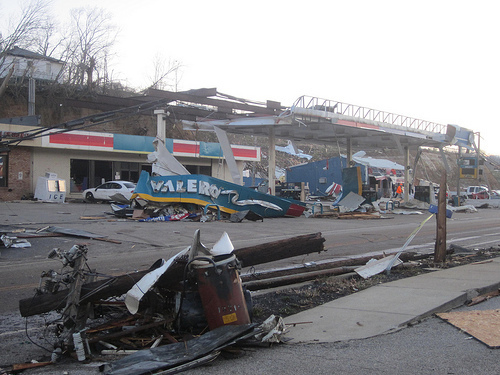
On March 2, 2012, the town of West Liberty, Kentucky, was literally destroyed by a major tornado but the Court House Annex withstood the blast which killed six people in the county and destroyed nearly every other major public building within the city limits.  I am adding two photos from the aftermath of the tornado to show just how clearly the town was destroyed around this magnificent building.  But the WPA stonework withstood the tornado with some damage to roof and windows which was easily repaired as the effort to rebuild the town began.

Downtown West Liberty After The Tornado Photo by CNN

Gas Station Across Street From Courthouse Annex After Tornado Photo by Flickr

The two photos immediately above were taken by professional photographers in the next few days after the West Liberty Tornado in early March 2012.  So far, I have been unable to locate a photo of the Court House Annex taken immediately after the tornado and will continue to search for one and post it when I can. It appears that since the building withstood the tornado with little damage the professionals were looking for "real disaster" photos and did not focus on the Court House Annex But the first photo immediately above of the gas station directly across the street from the Court House Annex shows some of the damage in the immediate area.  The sidewalk visible in the foreground of the photo is directly in front of the Court House Annex.  The photographer would have been standing in the edge of the small parking lot beside the Court House Annex.  The old wood sided Morgan County Board of Education building which stood directly to the south of the Court House Annex was immediately destroyed as was the John F. Kennedy Public Library which stood directly to the north side of the parking lot from which the photograph above was shot.  Diagonally across the street to the northeast, the building in which a physical therapy facility was operated and had originally been an automobile dealership was also completely destroyed.  Diagonally across the street to the southeast, a Dollar General store was totally destroyed.  Without the high quality stonework of the WPA, the Court House Annex would not exist today.   


Morgan County Courthouse Annex (North View) Photo By Roger D. Hicks


This historic WPA building still functions perfectly well as the primary site of Morgan County Kentucky government operations and is likely to continue to do so for many years in the future. It deserves to be added to the National Register of Historic Places and I will begin to work in the near future to see if I can facilitate that along with help from as many citizens of Morgan County and the general public as can make a phone call, sign a petition, write a letter, or send an e-mail to the appropriate agencies and people to support the effort.  Placement on the National Register would further guarantee for the foreseeable future that this wonderful, iconic, and historic WPA project would be protected, honored, and preserved as it should. 
Morgan County Courthouse Annex (Northwest Corner View) Photo By Roger D. Hicks


Morgan County Courthouse Annex (West/Rear View) Photo by Roger D. Hicks


Morgan County Courthouse Annex (South West Corner View) Photo by Roger D. Hicks

Morgan County Courthouse Annex (South View) Photo by Roger D. Hicks

Morgan County Courthouse Annex (Southeast Corner View) Photo by Roger D. Hicks

Morgan County Courthouse Annex (East/Front View) Photo by Roger D. Hicks

Sunday, May 27, 2018

Republicans And Brown Headed Cowbirds

I frequently sit at my computer located in our family room window and read Internet news stories, work on research for both my own writing and my personal interests, and watch the birds which my wife and I feed outside our window on the pavement of our driveway.  Like every one who feeds birds regularly, we sometimes encounter nuisances such as squirrels, rabbits, crows, and, worst of all, brown headed cowbirds.  Recently, I was taking my daily walk at our local park, Old Mill Park, in our hometown of West Liberty, KY, and encountered a small family group having a Memorial Weekend picnic at one of the picnic tables near the Licking River which borders the park.  As I walked past on the walking path, one of the women who was sitting at a picnic table under a tree commented that a bird egg was on the ground under the tree.  I asked them if they knew the habits of brown headed cowbirds in nesting and laying their eggs.  None of the people had heard of the species and their habits.  But as I was explaining the life cycle of brown headed cowbirds, it suddenly dawned on me that brown headed cowbirds are exactly like Republicans and vice versa.  Let me explain.  

Old Mill Park Amphitheater Photo by West Liberty Tourism Commission

  
According to the Audubon website Guide To Birds page about the brown headed cowbird we can learn several things about the species and its striking similarity to Republicans both singularly and plurally.  Without a doubt, the brown headed cowbird is the most Republican of birds.   As the naturalists and writers at Audubon say, "Cowbirds lay their eggs in nests of other birds. Heavy parasitism by cowbirds has pushed some species to the status of "endangered" and has probably hurt populations of some others."  Republicans, both individually and in groups have for many years and currently endangered many kinds of people and animals species in the world.  As of today, TRAITOR & International Terrorist Trump has endangered the lives of 800,000 Immigrant Dreamers by bringing an end to the federal program which allows these people who came to America as children to remain in the country and eventually to gain citizenship.  He has endangered the lives of hundreds of thousands of Syrian citizens of all ages who are suffering under a dictatorship which is bombing them with poisonous gases which have been banned from use in war for many years.  His decision to give advance warning to Syrian President Assad and Russian President Putin that he intended to pull all US troops out of Syria gave them the green light to resume bombing with poisonous gases and resulted in the horrible attack on Syrian rebels and their children in early April 2018.  By living in a nest built by Russian President Vladimir Putin, TRAITOR & International Terrorist Trump has made it highly likely that the Syrian dictator will persist in power and murder thousands more Syrian patriots and their children.  More than 3.5 million Puerto Ricans, all United States citizens continue to suffer from a lack of nearly all basic community services because the illegitimate Russian Owned Criminal Syndicate, which occupies the White House on the strength of TREASON, has chosen to refuse to provide disaster relief services to this US owned territory simply because they are Hispanic, did not vote for the TRAITOR & International Terrorist Trump, and do not support him today.  How much more like a brown headed cowbird can you be? 

The Audubon website goes on to say this about the brown headed cowbird: "Female may lay nearly one egg per day for several weeks, up to 40 in a season, exceptionally 70 or more. Female often removes an egg from "host" nest before laying one of her own. Known to have laid eggs in nests of over 220 species of birds, and over 140 of those are known to have raised young cowbirds. Young: Fed by "host" parents. Develop rapidly, and leave nest usually after 10-11 days."  Republicans, especially those of higher wealth levels, frequently send their own children to finishing schools, residential schools, and other private schools in order to free themselves of the presence of their own offspring until they are old enough to function minimally successfully on their own.  Oakcrest School, a favorite of parents of girls who describe themselves as "conservative", has an annual tuition of nearly $30,000.  The Heights in Maryland, a conservative school for boys has a similar annual tuition.  While attending such a school for several years might not be exactly like being a bird of a different feather growing up fast in the nest of a robin, cardinal, or oriole, these children of moneyed Republican parents are being nurtured, fed, clothed, and housed by relative strangers.  

The Audubon website also delivers highly interesting information about the mating habits of brown headed cowbirds.  "In breeding season, male displays by fluffing up body feathers, partly spreading wings and tail, and bowing deeply while singing. Groups of males sometimes perch together, singing and displaying."  Now doesn't that sound an awfully lot like a Republican Congress in their continuing effort to minimize, deny, and support the ongoing damage which TRAITOR & International Terrorist Trump is doing to America, Democracy, and the world at large?  Of course we must address the opening reference to that sentence about "breeding season".  At this link, you will find a list of ten of the most egregious sexual scandals among Republican politicians who might have been "...fluffing up body feathers...singing and displaying" during the illicit encounters which brought about their public embarrassments.  How much more like a cowbird could they be??? Please note that I did not even mention Stormy Daniels.  The website allaboutbirds.org further describes male brown headed cowbirds in this manner:  "Males gather on lawns to strut and display for mates."  Somehow, that sentence instantly makes me visualize a Rose Garden appearance by the orange headed cowbird himself.