Search This Blog

Showing posts with label WPA. Show all posts

Sunday, June 30, 2019

Martha, Kentucky, WPA School and Downtown Martha

Martha, KY WPA School--Photo by Roger D. Hicks

Today, June 29, 2019, my wife and I took a drive in the country to buy produce from one of our Mennonite friends in Keeton, Kentucky, on the Johnson and Lawrence County line.  A few months ago, I had driven further in that area without  a camera and had made a mental note to return with a camera and shoot some photos of the Works Progress Administration (WPA) school in Martha, Kentucky, which is one of those wonderful cut stone schools which the WPA built all across the country during the Great Depression as Franklin D. Roosevelt, our greatest president, fought to save the nation from the economic disaster of the Hoover Administration.  Between 1938 and 1943, as the nation recovered slowly, the WPA built thousands of projects from sea to shining sea and many of the older schools in Kentucky are WPA schools although most of them are no longer in use, at least not as schools.  Their stonework is phenomenal and worthy of preservation for all time both from a craftsmanship and a historical perspective.  I have written earlier on this blog about the former Morgan County High School in my hometown of West Liberty which has been remodeled, survived a disastrous tornado which demolished much of the town around it, and now functions as our Court House Annex and houses several county offices and a gymnasium.

Ricky Skaggs--Photo by Ricky Skaggs Official Website

The Martha Kentucky WPA school is now privately owned, seriously dilapidated, and in desperate need of restoration and preservation. Many of the windows are broken and the building is being used for hay storage.  I did not enter the building but suspect that the interior is probably not much better than the exterior. I am glad I shot these photos before it can succumb to even worse fates.  It sits on a slight rise above the north side of Kentucky Highway 32 at the junction of Kentucky 32 and Kentucky 469.  The school also has a somewhat interesting place in the history of Bluegrass and Country music since it was the grade school which Ricky Skaggs attended as a child.  I have been told by the current owners of the school that Ricky himself has also shot photographs of the school.  During my visit today I suggested to the current owner, who insists they will never sell the building, that they consider renovating it and turning it into a bed and breakfast.  She seemed only mildly interested in that idea.  But the school is located only 20 miles from Yatesville Lake State Park; 18 miles from Paintsville Lake State Park, the Kentucky Mountain Homeplace, and the US 23 Country Music Highway Museum, all of which are in Paintsville, Kentucky; 40 miles from Jenny Wiley State Park, Dewey Lake, and the Mountain Arts Center, all of which are in Prestonsburg, Kentucky; 50 miles from the Paramount Arts Center in Ashland, Kentucky; and about 50 miles from Greenbo Lake State Park as well.  The school is also only about 25 miles away from US23 which is otherwise known as the Country Music Highway.  This wonderful old WPA school is also only about 25 miles from Van Lear, Kentucky, which is the home of the birthplace of Loretta Lynn.  With this kind of central location to so much country music history, fishing, hunting, and artistic showcases, the school would draw fans of several different forms of entertainment to the bucolic crossroads of Martha. If you ever take a drive to Martha, stop at the combination country store, sporting goods store, and emporium across the highway from the school and reinforce for the owners, who also now own the school, that it would make a wonderful and profitable bed and breakfast.

Abandoned Building At The Intersection of KY 32 and KY 469--Photo by Roger D. Hicks


Martha, Kentucky, and the intersection of Kentucky 32 and Kentucky 469 are not only bucolic.  Martha is tiny.  The store, the school, an abandoned old home or one room store building across the road, and what appears to be an equally abandoned Holiness Church beside the store are all there is in Martha.  It is a quiet, dusty crossroad in the heart of Lawrence County farming land with hay, cattle, and corn cropping up all the way around.  The US post office is located about a half mile south of the intersection on the east side of the road.  If the school were a bed and breakfast, it would be a wonderful place for people seeking country solitude for a weekend or a week within driving distance of entertainment.  I do apologize for the poor quality of my photographs from this particular day.  The sun was beaming down on a cloudless 90% day and I had no sunglasses and could not see the viewfinder.  I will try at some time to return and shoot better photos to update this post.

Abandoned Holiness Church, Martha, Kentucky--Photo by Roger D. Hicks


The abandoned old building at the intersection would be a blast to explore but I chose to not take any chances on vermin or an angry owner.  Judging by the sign nailed to the porch post, I am guessing it was probably the first country store in Martha although it could have been a home.  I love abandoned buildings and this is a fine example of such things in the South and Midwest.

Beside the actual operating store sits what appears to be an equally abandoned Holiness Church.  It does not have a sign with any particular church name but the sign above the door quotes Isaiah 35:8 and reads "And It Shall Be Called The Way Of Holiness".  That is a partial quotation of the verse from the King James Version of The Holy Bible.  The complete verse reads: "And an highway shall be there, and a way, and it shall be called The way of holiness; the unclean shall not pass over it; but it shall be for those: the wayfaring men, though fools, shall not err therein."  In my opinion, the best, most quotable section from that verse for a sign at the Martha intersection would be "It Shall Be For Those, The Wayfaring Men (AND WOMEN)!".  Now wouldn't that be a great quotation to use to advertise a bed and breakfast in the Martha Kentucky WPA School?

Sign On Abandoned Martha Kentucky Holiness Church--Photo by Roger D. Hicks


Monday, November 19, 2018

Morgan County Kentucky Court House Annex--WPA Construction

Morgan County Courthouse Annex Front (East) Photo by Roger D. Hicks

The Morgan County Kentucky Courthouse Annex is for all intents and purposes the actual Morgan County Courthouse since what is known as the courthouse is actually leased to the Appalachian Regional Healthcare System.  It holds the offices of the County Judge Executive, the County Clerk, the Sheriff, the Property Valuation Administrator, and meeting rooms for the Fiscal Court composed of the County Judge Executive and the Magistrates.  There is also a gymnasium on the ground floor and the basement is leased to a day care program.  This building is the most historic building in the county.  It was built by the Works Progress Administration (WPA) in the heart of the Great Depression and originally served as the local high school.  It was dedicated by First Lady Eleanor Roosevelt and Kentucky Governor Happy Chandler.  There is a large bronze plaque in the main hallway discussing this historic building and its history.  I will add photos of the interior and the information on the plaque in a few days.  I shot these exterior photos on Sunday, November 18, 2018, in order to do it at a time when there were not large numbers of cars in the parking lots or heavy passing traffic.  The photos are not perfect and I apologize for that.  When I can locate better photographs by other people and gain permission to use them, I will add those.


Morgan County Courthouse Annex (Northeast Corner View) Photo by Roger D. Hicks

The building is an excellent example of Depression Era stone work by the Works Progress Administration (WPA) which was one of the many New Deal programs instituted by President Franklin D. Roosevelt in order to bring the country out of the Great Depression which had been caused by the economic mismanagement of the Hoover administration.  These WPA stone buildings were built all over the southeastern United States where local stone was available of acceptable quality.  They are rapidly disappearing and all of them which are still in useful condition need to be restored and saved.  Thanks to some interesting circumstances and the high quality of the stone work this wonderful building has survived and remained in productive use almost every day since the day it was opened.  

First Lady Eleanor Roosevelt Photo by Yousuf Karsh


President Roosevelt issued an executive order on May 6, 1935, which established the Works Progress Administration (WPA) at a time when the national unemployment rate was 20%.  The WPA was the greatest infrastructure operation in the history of the country.  It employed several million  previously unemployed people and in the eight years of its existence it built more than 4,000 new school buildings, 130 new hospitals, 9,000 miles of storm drains and sewer lines, 29,000 new bridges, 150 new airfields, paved and repaired more than a quarter million miles of roads and planted 24 million trees.  Many of those schools, hospitals, sewer lines, bridges, airports, and roads were in areas which had not had such infrastructure previously and many of them are still in daily operation today in one capacity or another whether or not they are being used for their original purposes.  The Morgan County High School, now known as the Morgan County Court House Annex was simply one small project among thousands of others nationwide which the WPA was building at the time.  In June of 1943, the WPA was disbanded after national unemployment had  dropped to less than 5% as a result of the economic recovery and the effort to build war time armaments.  But it will always be one of the most important economic and infrastructure programs in the history of the country. 

Photo of Kentucky Governor Albert B. "Happy" Chandler Photo by Murat Shrine

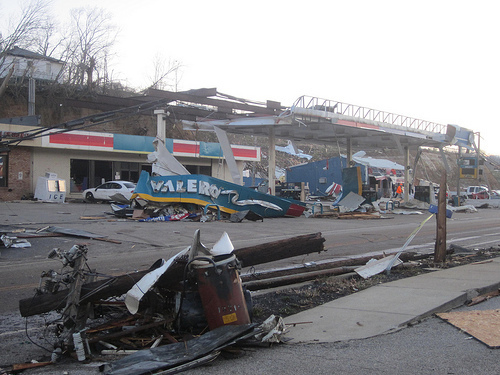
On March 2, 2012, the town of West Liberty, Kentucky, was literally destroyed by a major tornado but the Court House Annex withstood the blast which killed six people in the county and destroyed nearly every other major public building within the city limits.  I am adding two photos from the aftermath of the tornado to show just how clearly the town was destroyed around this magnificent building.  But the WPA stonework withstood the tornado with some damage to roof and windows which was easily repaired as the effort to rebuild the town began.

Downtown West Liberty After The Tornado Photo by CNN

Gas Station Across Street From Courthouse Annex After Tornado Photo by Flickr

The two photos immediately above were taken by professional photographers in the next few days after the West Liberty Tornado in early March 2012.  So far, I have been unable to locate a photo of the Court House Annex taken immediately after the tornado and will continue to search for one and post it when I can. It appears that since the building withstood the tornado with little damage the professionals were looking for "real disaster" photos and did not focus on the Court House Annex But the first photo immediately above of the gas station directly across the street from the Court House Annex shows some of the damage in the immediate area.  The sidewalk visible in the foreground of the photo is directly in front of the Court House Annex.  The photographer would have been standing in the edge of the small parking lot beside the Court House Annex.  The old wood sided Morgan County Board of Education building which stood directly to the south of the Court House Annex was immediately destroyed as was the John F. Kennedy Public Library which stood directly to the north side of the parking lot from which the photograph above was shot.  Diagonally across the street to the northeast, the building in which a physical therapy facility was operated and had originally been an automobile dealership was also completely destroyed.  Diagonally across the street to the southeast, a Dollar General store was totally destroyed.  Without the high quality stonework of the WPA, the Court House Annex would not exist today.   


Morgan County Courthouse Annex (North View) Photo By Roger D. Hicks


This historic WPA building still functions perfectly well as the primary site of Morgan County Kentucky government operations and is likely to continue to do so for many years in the future. It deserves to be added to the National Register of Historic Places and I will begin to work in the near future to see if I can facilitate that along with help from as many citizens of Morgan County and the general public as can make a phone call, sign a petition, write a letter, or send an e-mail to the appropriate agencies and people to support the effort.  Placement on the National Register would further guarantee for the foreseeable future that this wonderful, iconic, and historic WPA project would be protected, honored, and preserved as it should. 
Morgan County Courthouse Annex (Northwest Corner View) Photo By Roger D. Hicks


Morgan County Courthouse Annex (West/Rear View) Photo by Roger D. Hicks


Morgan County Courthouse Annex (South West Corner View) Photo by Roger D. Hicks

Morgan County Courthouse Annex (South View) Photo by Roger D. Hicks

Morgan County Courthouse Annex (Southeast Corner View) Photo by Roger D. Hicks

Morgan County Courthouse Annex (East/Front View) Photo by Roger D. Hicks

Sunday, April 17, 2011

Logan County West Virginia My Favorite Places In Appalachia

Logan County West Virginia

Logan County holds a special place in my heart for a variety of reasons.  I lived and worked there for about 5 years in the 1980's.  I developed a core group of close friends in Logan County as well as several attachments to particular places in the county both for personal reasons and, in some cases, due to the history of those places.  Blair Mountain is the most important place for me in the county.  It is also one of the most historic places in the history of the American labor movement.  That story is told in several books.  Bill Blizzard, a former writer for the Charleston Gazette, wrote "When Miners March" which is based primarily on first person accounts from his father, William Blizzard, Sr., who fought on Blair Mountain with the miners in their struggle for union recognition and reasonable working conditions.  The elder Blizzard and several other miners were actually charged with sedition, treason, murder, and a variety of other charges and tried in a historic trial in Harper's Ferry, West Virginia.  That trial resulted in acquittals. Robert Shogan also wrote "The Battle of Blair Mountain", which is less than perfect but generally accurate. There are also several other books about the incident.  The Battle of Blair Mountain is one of the small number of occasions in American history when the U. S. military was used against citizens.  Several hundred miners marched up Cabin Creek out of Charleston toward Logan and were met by hired gun thugs under the supervision of Sheriff Don Chaffin who was a minion of the coal companies and led their efforts to control coal miners and their families through a variety of techniques ranging from simple intimidation to murder. The company gun thugs had set up fortified positions near the ridge line and the miners fought for several days from behind trees in an attempt to move on to Logan.  No one can be sure today how many miners were killed in that fight and it is often asserted that far more were killed than were ever officially enumerated.  During the battle, most of the fighters on both sides were wearing similar clothes and it was difficult to tell enemy from friend.  The miners tied red bandannas around their necks to differentiate themselves from the gun thugs. That action is the root of the modern epithet of "red neck".  It was not originally a negative name.  It was a proud recognition of men who had placed their lives in danger in order to fight for the UMWA.   Recently at a memorial for Bill Blizzard, Jr. mourners came  to the service wearing red bandannas. 

Until about 20 years ago, there was also a fire tower and fire watchers cabin at the peak of Blair Mountain which had been built by Civilian Conservation Corps members during the Roosevelt Administration.  That cabin burned during a forest fire in the 1980's.  Eventually, when fire prevention and observation services were changed and modernized the fire tower was also torn down.  When I lived in the area, I would often go to the top of the mountain which could be reached by a dirt road off the main highway.  I would climb the tower and look out over the mountain and wonder how many miners still lie undiscovered and unburied on the mountain.  Those men both unburied and buried deserve a memorial fitting to the bravery they exhibited during the battle.  Blair Mountain is now owned by one or more coal companies.  But it would make an ideal park and historic site if the funding and political hurdles could ever be surmounted.  It would make an ideal park and convention center under the auspices of some consortium of organized labor, educational institutions, and private foundations.  I believe it is unlikely that it could ever be established as a part of the state or national park systems.  The political resistance from big business and the coal industry would be intense.  However, if an exploratory group from the above mentioned groups could be formed, the work of putting the issue in the ears and eyes of the general public could begin.  Blair Mountain Memorial Park would be a wonderful idea. 

Logan County is also the site of the Buffalo Creek Flood which resulted in the deaths of more than 130 people when Pittston Coal Company refused to repair a damaged and heavily overloaded coal slag dam in the head of Buffalo Creek. The best book about that incident is "Everything In Its Path" by Kai T. Erikson.  In a more recent book, "A New Species Of Trouble", Erikson writes about man made disasters and once again discusses Buffalo Creek at length. There are also several other books about the incident.  Logan County played a historic role in the labor movement and Buffalo Creek is a classic case of the general public suffering at the hands of big business. 

Logan County is also the site of 22 Holden which was one of the worst coal mine explosions in history.  I will eventually write longer, separate postings about each of these historic events.  Each of them deserves to be written about, discussed, and never forgotten. Throughout and following each of them, the people of Logan County and Southern West Virginia used native Appalachian values to overcome disaster.  The general public deserves to know far more about those incidents. 

Logan County was also the home of Jim Ferrell, the best friend I ever had.  Please read my separate posting about Jim, an Appalachian Hero. 

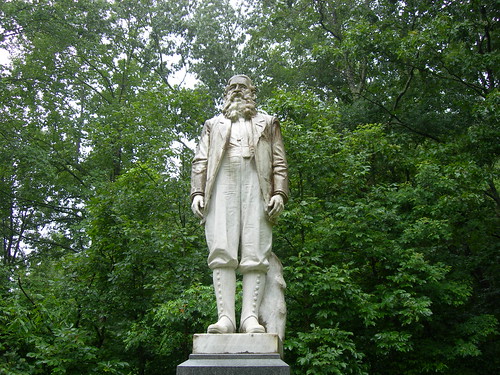
Logan County also played a prominent role in the Hatfield-McCoy Feud which has been used as partial justification of much of the prejudice and discrimination toward Appalachians.  Logan County is also the site of the Hatfield Cemetery which holds the graves of most of the members of the Hatfield family at the time of the feud.  It is worthy of designation as a state historic site.   

Statue of Anderson "Devil Anse" Hatfield In The Hatfield Cemetery