Search This Blog

Showing posts with label union labor. Show all posts

Monday, July 8, 2024

What Is A Scab?

 Recently on a social media group of which I am a member, I saw someone post a photograph of a group of scabs being guarded by Kentucky National Guard soldiers in order for them to cross a picket line in a historical Harlan County strike in order to assist the coal company to break the strike.  This person had described the scabs and their activity in this manner: "1939 Harlan County Kentucky. Miners being escorted to work by the National Guard. This is how the name Bloody Harlan mostly came about among other reasons."  This was obviously an attempt by someone with anti union sentiments to make the scabs appear respectable and normal as if they were ordinary coal miners which is the furthest thing from the truth.  I immediately confronted the anti union nature of the description in this manner: " You are partly correct but you forgot the most important word. Those were not miners. They were SCABS, the lowest form of life in the mining world."  I attached a link to Jack London's famous description of a scab from over a hundred years ago.  Jack London died in 1916, and I have no idea exactly when he initially published that beautiful piece of writing.  But it just as accurate today as it was when Jack London first sat down to write it.  I am including a small portion of London's description so none of you can ever say you haven't known about at least part of it.   

"A scab is a two-legged animal with a corkscrew soul, a waterlogged brain, and a combination backbone made of jelly and glue. Where others have hearts, he carries a tumor of rotten principles.  When a scab comes down the street, men turn their backs and angels weep in heaven, and the devil shuts the gates of hell to keep him out. No man has a right to scab as long as there is a pool of water deep enough to drown his body in, or a rope long enough to hang his carcass with. Judas Iscariot was a gentleman compared with a scab. For betraying his Master, he had character enough to hang himself. A scab hasn't." (Jack London, "Ode To A Scab")


This is a fine little story about a scab from a speech Mother Jones, the great female union organizer, told during a speech to striking miners in 1912.  

"An old Irish woman had two sons who were scabs. The women threw one of them over the fence to his mother. He lay there still. His mother thought he was dead and she ran into the house for a bottle of holy water and shook it over Mike.  “Oh for God’s sake, come back to life,” she hollered.  Come back and join the union.” He opened his eyes and saw our women standing around him. “Sure, I’ll go to hell before I’ll scab again,’ says he." (Mother Jones, "Autobiography", Chapter 11, from the website of The International Workers of The World)


Although John L. Lewis did not specifically use the word "scab' in the quote I am using below, he definitely was talking about scabs, gun thugs, all other forms of vermin which follow on the heels of corporate managers hoping to pick up some small bone or crust which these greater vermin leave behind for doing their bidding all the way up to murder and robbery, and they know in their small, black hearts that they are unfit to sleep in an honest woman's bed, eat a meal at an honest man's table, or father a child capable of becoming a decent, hard working human.  

No tin-hat brigade of goose-stepping vigilantes or bibble-babbling mob of blackguarding and corporation paid scoundrels will prevent the onward march of labor, or divert its purpose to play its natural and rational part in the development of the economic, political and social life of our nation.”  (John L. Lewis) 


I must say here, in the interest of total honesty, that I have never spent one day as a member of  a labor union.  But I grew up in a home and a community where nearly everyone knew the important work that labor unions have done and will always continue to do for the good of all working men and women.  The hundreds of benefits which have been won for the working class have been won by the blood, sweat, and tears of good, fearless union men and women who have faithfully stood their ground against corporations, their officers, and their scabs until all those parties realized the error of their ways and stopped resisting union efforts to improve the world.  Several members of my extended family have spent their lives as union members.  As child by the time I was 9 or 10, I was allowed to read the "United Mine Workers Journal" each month after my uncle Mabry Hicks, an electrician at a tipple in Wheelwright, Kentucky, was done with his copy.  I often spent long winter evenings sitting in my parents' grocery store listening to the union members in our community talk about their efforts to organize, and how much they benefited from union membership.  As an adult, I came to know several men and women who had spent their lives fighting as union organizers all over Central and Southern Appalachia.  They served as my mentors and professors, teaching me on a daily basis just how important trade unions are to the success of America. I came to know at least four people who had been hauled in front of Fascist Senator Joseph McCarthy's committee in the 1950's and who stood their ground against his efforts to destroy their lives.  I attended the funeral of my brother Hewie Hicks who was killed in a nonunion punch mine in Floyd County Kentucky and knew full well that he might have lived a much longer life if he had been working in a union mine.  I know full well the danger that scabs have helped coal operators perpetrate against the working class of  Appalachia and other coal producing states.  I also know that labor unions all across America, in all forms of industry, have saved thousands of lives with the contracts they have won and the laws and government regulations they have brought into existence.  You should recognize these truths also and support unions wherever they are working for the betterment of working conditions for men and women in America.  Union, Yes!  


Sunday, June 30, 2024

"A Union For Appalachian Healthcare Workers, The Radical Roots And Hard Fights Of Local 1199" by John Hennen


The advertising blurb on the back cover of this book states in part:

"The union of hospital workers referred to as the 1199 sits at the intersection of three of the most important topis in US history: organize labor, health care, and civil rights.   John Hennen's book explores the union's history in Appalachia, a region that is generally associated with extractive industries but has seen health care grow as a share of the overall economy."

John Hennen is professor emeritus of history at Morehead State University and this is his third published book.  He is a native West Virginian and was educated at Marshall University and West Virginia University.  This is his third book.  He is an excellent researcher and a damn fine writer.  This book is the history of one of the most unique unions in America, Local 1199, a union which defends the rights of healthcare workers in several states, most of which are in Central and Southern Appalachia.  But the union was actually chartered and did its first organizing work in New York City.  The book provides a scholarly account of the work of original organizer Leon Davis who was an immigrant from Belarus.  It also covers the work of Tom Woodruff, another native West Virginian who was educated at Marshall University, and explores the connection between Tom Woodruff and Don West, the founder of The Appalachian South Folklife Center in Pipestem, West Virginia, and co-founder of the Highlander Research and Education Center in New Market, Tennessee.  Woodruff and West both taught at the Southern Appalachian Circuit of Antioch College in Beckley, West Virginia, during a time when Woodruff was also running Appalachian Movement Press in Huntington, West Virginia, before Woodruff left those two positions to become an organizer for Local 1199 and began what is a storied career as a union organizer and eventual operating officer.  

The book chronicles organizing efforts by 1199 in West Virginia, Kentucky, and Southern Ohio in the 1970's which were both successful and hard fought.  The union and its organizers and members were resisted, red baited, and drug through the court systems of nearly every county they attempted to organize in.  Hospital administrators frequently hired strike breaking companies which were generally billed as "consultants" and which used every means possible including arrest, red baiting, and general harassment to attempt to break 1199.  The union did not win all its organizing effforts but, in the long run, it was more successful in organizing healthcare workers in Appalachia than anyone in the region ever imagined it could be.  Across several small communities and small  hospitals, they won key strikes, benefited from support among the communities which often had been strongholds of the United Mine Workers of America, and made union membership and its benefits a real part of life and the American Dream for workers who had generally been poorly paid, without benefits, and forced to live and work at the whim of hospital administrators many of whom proved to be just as mercenary as the local coal operators had been in earlier times when the United Mine Workers were attempting to organize coal miners in the early twentieth century.  

If you are a student of organized labor, the Appalachian Region, a healthcare worker anywhere in America, or simply a supporter of basic human rights, you should read this book.  It is a fine lesson in how determined organizers and union members can win against long odds.  This union, its officials, and members lived a proud portion of history in the Appalachian coal fields and their story deserves to be heard wherever workers have felt as Ma Joad did in "The Grapes of Wrath" when she said, 

"...it looked as though we was beat. Good and beat. Looked like we didn't have nobody in the whole wide world but enemies. Like nobody was friendly no more. Made me feel kinda bad and scared too, like we was lost and nobody cared... ."

 The organizers, national officials, and members of Local 1199 never gave up, never backed down, and never were willing to accept being in a world where it seemed the whole world was their enemy.  Read this book!  :Union, Yes! 


Thursday, April 1, 2021

"Devil In The Hills", Music About Esau In The Coal Fields by Mary Hott

 For those of you who have already read my previous blog post about Esau in the coal fields, you probably know that the music in this CD is not feel good music in most cases.  Esau in the coal fields was a practice in which women in coal camps whose husbands, fathers, or other custodial male relative was unemployed due to injury, a strike, or other serious event were able to obtain necessary items at coal company stores through a practice similar to scrip but with much more serious consequences if the debts could not be paid.  This practice was first brought to light at the Whipple Company Store in Raleigh County West Virginia.  Mary Hott, who is a singer/songwriter from Paw Paw, West Virginia, learned about Esau during the time when the Whipple Company Store was being operated as a privately owned museum by Joy and Chuck Lynn.  Because she was deeply moved, as any compassionate human being would have been, by the stories of Esau and the sexual abuse and sexual servitude which it resulted in Mary Hott wrote most of the songs on this CD and recorded it with a well known West Virginia band known as The Carpenter Ants.  Her website, "Devil In The Hills", can be found at this link.  The CD is composed of ten songs and an introductory sound bite called "A Miner's Perspective".  Ms. Hott wrote or co-wrote eight of the songs.  the CD ends with Mary Hott's versions of the well known songs "Life's Railway To Heaven" and "Take Me Home Country Roads" both of which have for many years been strongly associated with the Mountain State.  The CD is also shipped with a 24 page booklet which includes several historic photos, lyrics to the songs, and Mary Hott's own powerful writing about both the CD and the practice of Esau which prompted this piece of work.  

Although I have written about music several times on this blog, I do not recall ever choosing to review a CD before.  That should be considered as an indicator of my overall opinion of this CD.  The lyrics are powerful.  Mary Hott's voice is smooth yet strong, trained yet native to West Virginia in such a way that the CD is clearly authentic, and her vocal range makes the CD a pleasure to listen to if it is not a faux pas to call a CD on the subject of Esau in the coal fields by such a word.  Mary Hott and I exchanged internet based messages about this CD and Esau almost immediately after I first learned of the practice of Esau and her information and honesty helped a great deal in the formation of my opinions about Esau.  During those exchanges, Mary Hott had this to say, in part, about the CD and Esau:

"I'm careful to not call the Esau scrip "institutionalized" -- it appears it was more localized, and may have originated in railroad culture, but not necessarily known at the upper ownership levels of coal companies. It appears it was mainly a method for keeping families "in their place" and not attempt unionization (or any betterment of their living conditions). And Esau was only a part of the story of the conditions women lived under during that time. My interest started with Esau but soon turned to the overall abuse of human rights, both women and men, of all cultures. My CD package contains a booklet that interprets the background stories as well as explains the historical context." (Mary Hott- personal message to Roger Hicks March 20, 2021) 

The CD begins with "A Miner's Perspective" which is a recorded reminiscence by a coal miner in the book "Whipple Company Store Vol 1:Coal Camp Voices"  by Joy Lynn.  The second track, "They Built A Railroad" was written by Michael Lipton and Mary Hott about the early development of railroads into West Virginia in support of the rapidly burgeoning coal industry.  These lines from the lyrics are an excellent portrayal of what was happening in the early days of the coal industry both in West Virginia and in Appalachia in general: "They were building empires from a distance. Monied men from the north and east.  They called it progress, taming our wilderness.  They left despair and poverty." The third track, "Annabelle Lee" utilizes the name of Edgar Allen Poe's martyred heroine.  Poe's lines "That the wind came out of the cloud by night, Chilling and killing my Annabel Lee." are echoed in the lyrics of Mary Hott "At twelve years old she was sold to the agents who sought out her kind.  Trafficked by train to the deep, remote coal camp-a comfort girl."  And that is the nature of Esau in the coal fields.  The fourth track on the CD, "Room Of Lost Souls", combines elements of three different stories which have been told by miner's and their survivors about the cruel, often fatal, consequences for miners who opposed the company and it's enforcers.  "Each death a mystery. A warning how it will be.  If we think you're a Union man."  The fifth track on the CD directly addresses the issue of Esau under the title "Take The Esau".  These powerful words by Mary Hott tell the story of Esau in a nutshell:  "Mother took the Esau, had no choice.  Had no other options, had no voice.  Kept us kids from starvin', kept our home.  She faced the consequences all alone."  The next song, track six, "The Spot", was actually written by Mary Hott and Michael Lipton about a bar near her hometown of Paw Paw, West Virginia, but the song, the story, and the bar are emblematic of many towns, numerous bars, hundreds of coal camps all across Appalachia.  "It's anyone's guess at the end of the night. The liquor speaks loud and fuels the fight.  In desp'rate times, reach for your revolver, Load one chamber, watch 'em head for cover."  The coal fields of Appalachia are filled with literally thousands of stories about desperate men, without hope, bereft of alternatives who sought the alleviation of their pain in coal camp bars and found only death among other men who were often even more desperate and sought some semblance of power with a gun or knife in their hand.  The title track of the album, "Devil In The Hills", co-written by Hott and Lipton, returns us directly to the story of Esau in the coal fields: There's a devil in the hills...and he's on the loose.  He's a mean one, those company men have the power to abuse."  That abuse took many forms in the Appalachian coal fields: murder, beatings, unjustified firings, and the worst form of all, Esau, which preyed on the wives and daughters of miners who were unemployed and powerless, even more powerless than when they were still working.  "Rise Up, WV", written by Hott and Lipton, is a call for action, both by the powerless miners, wives, and daughters in the time of Esau and for all West Virginians today in memory of those earlier, unprotected victims and reminds us of the famous words of the West Virginia motto as the personification of that call for justice.  "Gotta take a stand for WV.  Rise Up, be free.  Show the world the way it can be.  Mountaineers are always free."  The ninth track of the CD, "Blair Mountain Ballad" is a traditional song set to music by Mary Hott which reminds us of the connection between Blair Mountain, the most famous occasion in which miners literally fought for their lives in Logan County against coal company gun thugs with machine guns.  Blair Mountain will always stand out as the one occasion in which American citizens were attacked by agents of the US government in support of criminal corporations and an even more criminal sheriff.    The last two track on the CD are the traditional songs "Life's Railway To Heaven" and "Take Me Home, Country Roads" which can also be said to personify traditional cultural life in the West Virginia coal fields.  

If you are familiar with the coal fields of Appalachia and the struggles of the Appalachian coal miners and their families, you will appreciate this music.  If you are unfamiliar with the miners and their struggles, this CD is a good place to start.  The description of the CD and its musical styles on Mary Hott's website says The music ranges from bluesy Americana and roots rock to Celtic and gospel, and the deep groove of the anthemic “Rise Up, WV.”  The album is mostly original songs with two covers, including a unique southern gospel version of West Virginia’s adopted state song, “Take Me Home, Country Roads.”  And therein lies my one objection to this work. I would have appreciated the CD more if it had been recorded in one cohesive style no matter what that style might have been.  Whether it had been in the country and Bluegrass which are so popular in the coalfields or in the popular music played on most radio stations today, it could have been a better, more cohesive product if it had been consistently one style of music.  But do not allow my single objection to this CD prevent you from buying, enjoying, and promoting this CD.  It definitely deserves your undivided attention.  And so does the subject of Esau in the coal fields. 


Saturday, June 22, 2019

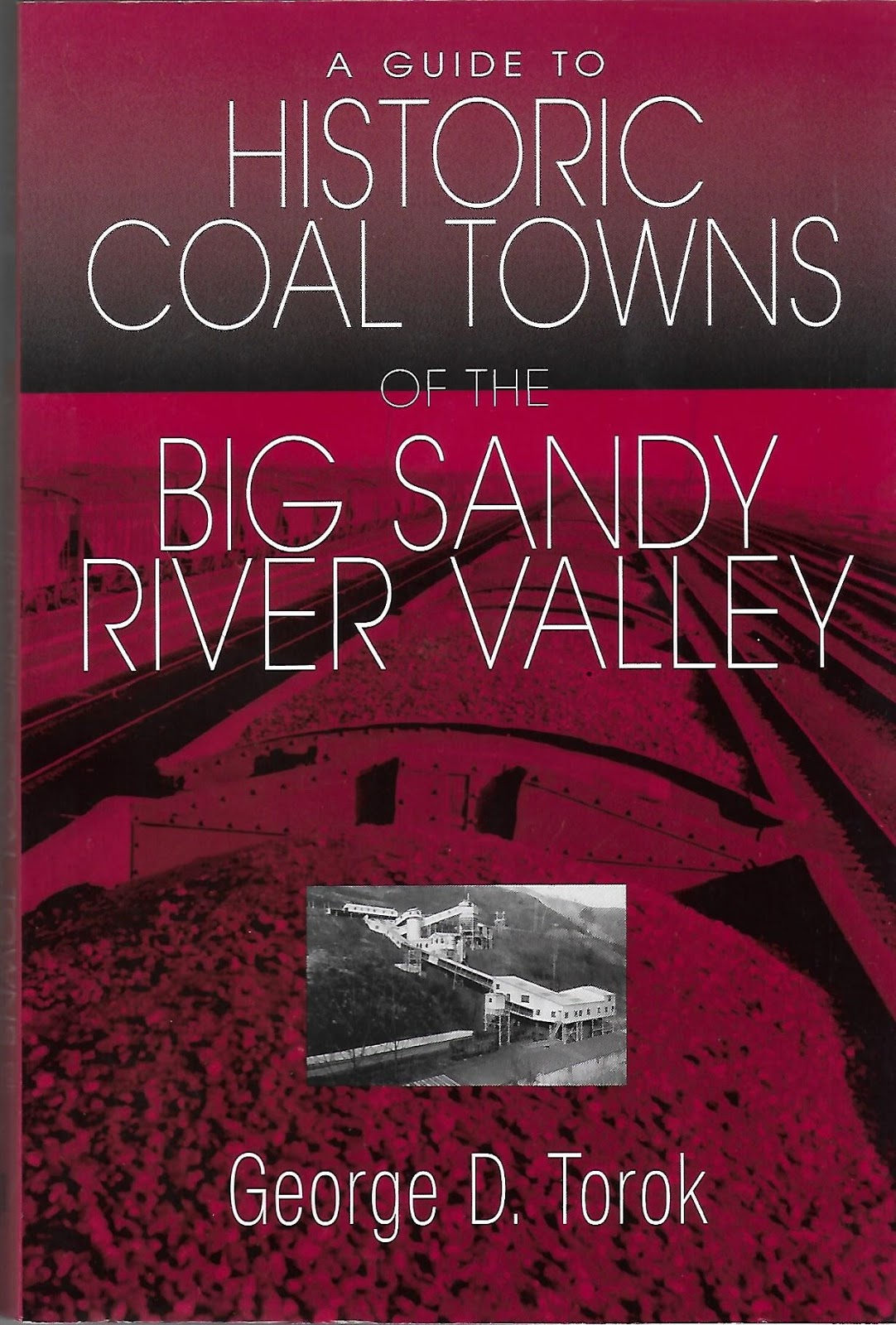
"A Guide To Historic Coal Towns of the Big Sandy River Valley" by George D. Torok--Book Review


While the author only refers to this book as "a guide" both in the title and a few times in the text, it is quite a bit more than a simple guide book.  It is a wonderful and useful piece of work, especially for those who are interested in the coal camp towns along the length of the Big Sandy River and its tributaries.  The author even extended himself a bit beyond his stated geographic region and discusses coal camp towns all the way to Bluefield Virginia/West Virginia and to the towns in Harlan County on the  headwaters of the Cumberland River.  I have no idea how George D. Torok latched onto his decision to write about these coal camp towns but I am very glad he did.  Mr. Torok is a native of Buffalo, New York, and teaches history at El Paso Community College.  But his biography on the cover of this book states that he has "published assorted works on Kentucky history".  I had passed through El Paso twice in October of 2017 but did not know of Mr. Torok or this book at that time.  I would have loved to be able to meet him and discuss this book and his extensive research to produce it.

The book is broken into six chapters, documented with an extensive and well researched bibliography, and supplemented with photographs, documents, and other information from both Mr. Torok himself and several historical sources including  the Eastern Regional Coal Archives, Alice Lloyd College, Elkhorn City Railroad Museum, and Pikeville College Special Collections which I have often used myself for other purposes unconnected to the Big Sandy River or coal camp towns.  It is readily apparent to the experienced researcher that Mr. Torok did a massive amount of work to complete this book including extensive travel in the region which is well documented in the large number of photographs which he personally shot.  He is also able to intelligently write about numerous structures, union locals, individuals, and equipment throughout the course of the book.  

If you consider yourself to be an aficionado of coal camp towns, coal mining or UMWA history, or the geography of the border counties along the West Virginia/Kentucky line, you should read this book.  The bibliography alone is worth buying the book for and will lead the avid reader on a long search for the supporting books, movies, interviews, company documents, and other corroborating information.  This is flatly one of the best pieces of research I have ever seen.  Buy it!  Read it!  Learn from it and use it as the basis for several day trips if you love coal camp towns and their history.  

Friday, March 8, 2019

"Twentieth Anniversary...of Local Union 5895 United Mine Workers Of America 1933-1953" by UMWA Local 5895--Book Review

During a recent research trip to the Wayland Kentucky Historical Society in Wayland, KY, one of the key coal camp towns of the Big Sandy River drainage in Floyd County KY, I was provided a copy of this fifty page book commemorating the first twenty years of UMWA Local Union 5895.  The book was originally written and published by the local union as part of an anniversary celebration in 1953.  It was reprinted by the Historical Society in May 2005.  It is well worth the reading by any student of UMWA history, Floyd County, Wayland, Kentucky, Appalachia, the Big Sandy River, or trade unionism in general.  The book states that "in a regular meeting in May, 1952 ...a motion was passed to instruct the President to appoint a committee and commission them to prepare a history of our local union to be printed in book form...".   The committee was composed of the following members: Nobel Hobbs, Chairman; J. F. Dixon; Lawrence Mount; Charles Burnett; McKinley Parrigin; Robert Hicks; Joe Hicks, Secretary; Pete Mills; E. Hawk Moore; Guy Coleman; Charles Turner; and Roy Lykins.  Let me state for the record that during my childhood and teen years I knew both E. Hawk Moore and McKinley Parrigin.  It is also likely that I am distantly related to Robert Hicks who, along with his brother Joe Hicks, served the local union in a variety of roles for many years.  They were both born at Mousie, KY, the birthplace of my father, Ballard Hicks.  I did not know Guy Coleman but after his death I spent many hours in the home of his widow, Rusha Coleman, because of my friendship with their son Keith Coleman.  Let me also state at the outset of this review of this book that the committee did an excellent job with the book, especially in light of the fact that they were all working full time jobs in the mines, were generally also performing other unpaid duties for the union, and were, in most cases, only educated at the high school level.  The Wayland Historical Society is also to be commended for their efforts to reprint the book and making it available to a larger audience in the second generation copies.  I had never seen a copy of the original text and I am certain that, like many small publishing projects, few copies of the original exist today.  

This book may be only fifty pages but it contains a treasure trove of information for members of all the groups I listed in my opening paragraph.  There are photos and biographies of many of the early officers of Local 5895.  There are nine brief written chapters detailing the first twenty years in the life of the local union.  There are group photos of the local union officers in 1953 and the committee which produced the book.  There is a list of "Some Of Our Firsts" which enumerates more than a dozen key actions and events in the history of the local union.  There is also a brief description of key achievements in the most recent union contract at the time.  There are lists of local union members and their sons who served in WWII and of those members who died in WWII & Korea.  The book also contains a "Public Service Roll" listing members who held elected or appointed positions in the city government of Wayland.  The book is dedicated to a list of 35 "...industrial soldiers who gave their lives in accidents while producing coal..."  in the previous twenty years.  
I found information in this little book which is priceless to me as both a committed believer in organized labor and a writer committed to preserving the history and culture of Central and Southern Appalachia.  I am sure many of my readers will also cherish much of the information which has been preserved in this little masterpiece.  It is a shame that it was not more widely circulated but it has been preserved in the Wayland Historical Society and can be accessed there by contacting the Historical Society.  I am willing to scan and e-mail specific information from the book to my readers who have a genuine and valid interest in reading it.  It is a real tragedy that every union local in the country has not done such a piece of work.  But, as we all know, frequently union members were literally fighting for their lives on a daily basis, working in dangerous occupations for companies which did not care one whit about an individual life of an employee once that person had been replaced.  That brings to mind the old saying in the coal fields of Appalachia that in the early days of coal mining company officials would have rather lost a man than a mule in the mine since another miner could always be hired but a mule had to be bought.  If you ever visit the Wayland Historical Society, try to get a look at this little book, view their wonderful collection of period antiques, and consider giving them a donation to support work like this.  

Monday, July 30, 2018

"Under The Bridge" by Emily Steiner--Book Review

Steiner, Emily. Under The Bridge ( North East, PA, Haines Printing 2018)


Emily Steiner is a young Mennonite woman living in my home county of Morgan County Kentucky,  This is her first book and was printed by Haines Printing in North East, PA, and self-published by Ms. Steiner.  I did not know Ms. Steiner or her family as I do many of the Mennonites in this county until after I had read her book.  Shortly after reading this book, I was walking in Old Mill Park in my hometown of West Liberty, KY, and saw a young Mennonite woman carrying a laptop computer adn dressed in the typical Mennonite fashion of ankle length dress and head covering.  I asked, "Are you Emily Steiner?" which was a good assumption since she matched the photo in the book and it is not customary for Mennonites to work on computers.  She told me she was Emily Steiner and we struck up a conversation which lasted about thirty minutes and was entirely about literature, her writing, her next book now in progress, and many of the writers I have personally known.   Ms. Steiner work briefly as a school teacher in the local Mennonite School.  She has lived most her entire life in Morgan County. She is currently working two part time jobs and working on her third novel, which will be the second book in this series.  This book is the first in that series of books about a young Appalachian woman named Lilly Burchett.  It is labeled on the cover as Historical Christian Fiction.  But in reality, it is presented as a historical novel about a young native Appalachian woman with no connection to the Mennonite religion but does describe her and her family as church goers to a church without mention of the denomination.  

The story is set in Harlan County Kentucky in the period from circa 1918-1922 or so.  The story is also labeled on the cover as "Well researched and rich with detail; the author's first-hand knowledge of life in rural Kentucky shines through in the vivid and sensitive telling of this classic tale of love, loss, hope, and dreams."  It is an attempt to portray the native Appalachians of Harlan County from a period a century distant by a writer who lives a very different lifestyle not only from those natives of the early twentieth century but also quite different from the local native Appalachians of today in this community.  I bought the book at a local bulk food store which is run by another unmarried Mennonite woman whose extended family I know quite well.  Until I saw the book on a counter, I had no idea that any Mennonite in the area was writing fiction. However, Rod & Staff Publishing, one of the largest Mennonite publishers in the country is located in the county in Crockett, KY, and Ms. Steiner's father works there in the editorial department. Since no conservative Mennonite author or publisher uses the internet or modern marketing practices, you cannot find further information about the books of Ms. Steiner on the internet.  The printer, Haines Printing Company, does maintain a minimally informative website about their services but does not directly market this book or any other they might have printed. Their ownership may or may not be Mennonite. Ms. Steiner is directly marketing the book via her personal phone number and address.  I will provide that address at the end of this review.  

Despite the information listed on the back cover claiming first-hand knowledge and positive research, the book misses the facts on numerous occasions in dealing with Appalachian life in the early twentieth century.   However, based on my numerous contacts with the local Mennonite community and my overwhelmingly positive opinion of the Mennonite people in the area, I am willing to say that I do not believe any of these errors were committed with negative intentions. Since that first accidental meeting in the park, Emily Steiner and I have talked face to face three more times, once at the last day of school at the Faith Hills Mennonite Church School and twice at her part time employment in a Mennonite owned fabric and sewing store.  We also converse fairly regularly via e-mail which, due to the Mennonite religious beliefs and mores, is on an e-mail address which actually belongs to her brother who is a local construction contractor.  The book does perpetuate several of the prevalent myths about Appalachian people of the early twentieth century and of Appalachian people and culture in general. However, since Emily Steiner and I have known each other, I have provided her with some guidance about Appalachian Culture and Literature and given her a long list of mainstream Appalachian books which she is reading diligently and working to make the next novel much more culturally accurate. 

The protagonist in the story is Lilly Burchett, a thirteen year old Appalachian girl who is a member of a large family living in "a cabin" in a hollow near a coal camp and a coal mine in which her father, Bernie Burchett, works. Lilly is described as having "...calloused feet that rarely felt shoes" on the first page and so begins the trail of myths and errors about Appalachia and Appalachian life.  The family is composed of the parents, Lilly, and several other of her siblings.  The story begins in early 1918 as World War I is ending and the surviving soldiers are returning from the battlefields.  Lilly is nearing the time when, as she has already been told by her mother, "...'a woman's place is getting married and raising a family'...and then having babies, having them one after another as fast as all the other mountain women."  Lilly is described as a good student in some areas but not in math.  She wants to grow up to leave the mountains and become a writer.  The title of the story arises from the fact that Lilly frequently stops to think, write, and hide her writings under a bridge over the creek on her way home from school where she dreams about the future. I suspect that several aspects of the character are fictionalized versions of thoughts which Ms. Steiner has had growing up as a young, intelligent woman in a strictly conservative Mennonite family and community. To some degree, she has corroborated that belief and disputed it in others.  Another former Mennonite school teacher in the community who actually taught the same year Ms. Steiner did, whom I have known since childhood, has also stated that he agrees with my assessment that many of the cultural errors in the story are rooted not in any prejudice on the part of Emily Steiner but in the fact that the average young Mennonite woman has little contact with the greater non-Mennonite community.  The character of Lilly is much more fully developed than the other characters in the story.  The writing is above average for a first book but not exceptional by any means. But it shows a great deal of talent and is good enough that I am willing to spend time helping Emily Steiner improve both her knowledge of Appalachian Culture and her base of knowledge about writing and literature in general.  The book is readable and for the naive individual who knows little or nothing about Appalachia of the early twentieth century it could be assumed to be accurate in its depictions of the area and its people.  Therein lies the potential damage to be done by this book and all other books like it which are written about Appalachia without sufficient knowledge of the people and culture. 

The errors in depiction of Appalachian Culture, life, and language continue throughout the book and range from simple errors in language to full blown but unintentional misrepresentations.  Later in that first chapter in a description of the local school teacher's opposition to the coal mining companies she has a minor character state "He don't like the mines because he had two brothers killed in a collapse."  No one in Eastern Kentucky would have used the word "collapse" to describe a roof fall.  The generally used word all over Appalachian coal mining country was then and still remains "roof fall" or could have been a use of the word "kettle bottom" to describe a particular type of roof fall.  It is also interesting that in a book about a coal mining town in Harlan County in 1918 there is no mention of the ongoing effort to unionize the mines.  The United Mine Workers of America was organized in 1890.  Kentucky coal production reached a million tons in 1879 and a major producer at that time was already Harlan County and both the United Mine Workers of America and the International Workers of The World (The Wobblies) were attempting to organize miners in Harlan County by about 1905 or 1910.  Ms. Steiner is currently working on the second book of the series with a working title of "Under Fire", the manuscript of which I have read and offered suggestions about improving it both from a cultural and a writing viewpoint.  Ms. Steniner's intentions are to write a book which does address the union efforts in Harlan County Kentucky but to promote the Mennonite views of non-violence and, therefore, to not promote unionism.  She and I have mutually agreed to amicably disagree on that position and to remain friends. 

Chapter Five of "Under The Bridge" begins with a particularly telling paragraph in terms of its depiction of life in Eastern Kentucky in 1918 as Lilly begins working as a housekeeper for the wife of the local mine manager.  "...Lilly grew accustomed to turning a knob for water, dragging heavy rugs up and down stairs, and cooking multitudes of things beyond cornbread, beans, and fried potatoes."  It is quite interesting that this was written by a young woman who grew up in a family, religious community, and subculture which depends strongly on gardening as a major means of sustenance and who knows quite well that anyone who raises a garden in Appalachia eats far more than "cornbread, beans, and fried potatoes".

Later in the book as Lilly is working as a housekeeper in the home of the mine superintendent and meets a couple who are friends of her employer and his wife and is offered the opportunity to return with them to Louisville to live in their home and further her education.  Because of her father Bernie's objections, Lilly turns down that opportunity and begins anticipating life as a young married woman in the footsteps of all the other women in her life.  It is interesting that across many areas in Appalachia such as Knott, Jackson, and surrounding counties in Kentucky,  and several counties in North Carolina schools were being founded such as The Caney Creek Community Center and the Annville Institute which were assisting numerous students in admission to and attendance at colleges outside the region.  Ms. Steiner seems to have not known about any of this history at the time she wrote "Under The Bridge".  But she is working diligently to remedy the shortcomings in her knowledge of Appalachia and Appalachian Culture and Literature.  "Under The Bridge" can be bought directly from Emily Steiner by calling or writing her at Emil Steiner, 155 Memorial Gardens Road, West Liberty, KY, 41472, or by calling her at 606-495-8090.  The price is $10.00.  The book can also be found at Caney Grocery in Cannel City, KY, at the intersection of KY 1000 and KY 191 between Cannel City and West Liberty.  Despite the negative comments in this review, the book is worth reading and buying.  Her second book, "What Money Can't Buy", a purely Mennonite novel is now released and available at Rod and Staff Publishing in Crockett, KY. 


Saturday, March 31, 2018

Kentucky Teachers Get Screwed By Carpet Bagger Bevin

Here is how every state legislator in Kentucky voted on the bill to destroy the Kentucky Teachers Pension Plan. (Chart by Lexington Herald-Leader March 30, 2018)   Every legislator who voted for this criminal, back room robbery should be voted out of office and never allowed to gain another toehold in Kentucky Politics.  This is blog post in progress.  Please return to read the full written opinion which will be completed within the next three days due to current time constraints on the blogger. 

VoteSenatorDistrictPartyCounties
ANayAdams, Julie Raque36(R)Jefferson

YeaAlvarado, Ralph28(R)Clark, Fayette, Montgomery
BYeaBowen, Joe8(R)Daviess, Hancock, McLean

NayBuford, Tom22(R)Fayette, Garrard, Jessamine, Mercer, Washington
CYeaCarpenter, Jared34(R)Fayette, Madison, Rockcastle

YeaCarroll, Danny2(R)Ballard, Carlisle, Marshall, McCracken

NayCarroll, Julian M.7(D)Anderson, Franklin, Gallatin, Owen, Woodford

NVClark, Perry B.37(D)Jefferson
ENayEmbry Jr., C.B.6(R)Butler, Hopkins, Muhlenberg, Ohio
GYeaGirdler, Rick15(R)Boyle, Lincoln, Pulaski

YeaGivens, David P.9(R)Allen, Barren, Green, Metcalfe, Monroe, Simpson
HNayHarper Angel, Denise35(D)Jefferson

YeaHarris, Ernie26(R)Jefferson, Oldham

YeaHigdon, Jimmy14(R)Casey, Jefferson, Marion, Nelson, Spencer

YeaHornback, Paul20(R)Carroll, Henry, Jefferson, Shelby, Trimble

YeaHumphries, Stan1(R)Calloway, Fulton, Graves, Hickman, Lyon, Trigg
JNayJones II, Ray S.31(D)Elliott, Lawrence, Martin, Morgan, Pike
KNayKerr, Alice Forgy12(R)Fayette
MYeaMcDaniel, Christian23(R)Kenton

NayMcGarvey, Morgan19(D)Jefferson

YeaMeredith, Stephen5(R)Breckinridge, Edmonson, Grayson, Hart, LaRue, Meade
NNayNeal, Gerald A.33(D)Jefferson
PNayParrett, Dennis10(D)Hardin, Jefferson
RNayRidley, Dorsey4(D)Caldwell, Crittenden, Henderson, Livingston, Union, Webster

YeaRobinson, Albert21(R)Bath, Estill, Jackson, Laurel, Menifee, Powell
SYeaSchickel, John11(R)Boone

YeaSchroder, Wil24(R)Bracken, Campbell, Pendleton

YeaSeum, Dan "Malano"38(R)Bullitt, Jefferson

NaySmith, Brandon30(R)Bell, Breathitt, Johnson, Leslie, Magoffin, Perry

YeaStivers II, Robert25(R)Clay, Knox, Lee, Owsley, Whitley, Wolfe
TYeaThayer, Damon17(R)Grant, Kenton, Scott

NayThomas, Reginald13(D)Fayette

NayTurner, Johnny Ray29(D)Floyd, Harlan, Knott, Letcher
WNayWebb, Robin L.18(D)Boyd, Carter, Greenup

YeaWest, Stephen27(R)Bourbon, Fleming, Harrison, Lewis, Mason, Nicholas, Robertson, Rowan

YeaWesterfield, Whitney3(R)Christian, Logan, Todd

YeaWilson, Mike32(R)Warren

YeaWise, Max16(R)Adair, Clinton, Cumberland, McCreary, Russell, Taylor, Wayne

H


VoteRepresentativeDistrictPartyCounties
ANayAdkins, Rocky99(D)Elliott, Lewis, Rowan
BNVBechler, Lynn4(R)Caldwell, Christian, Crittenden, Livingston

NayBelcher, Linda49(D)Bullitt

YeaBentley, Danny 98(R)Boyd, Greenup

YeaBenvenuti III, Robert88(R)Fayette

NayBlanton, John92(R)Knott, Magoffin, Pike

YeaBratcher, Kevin D.29(R)Jefferson

NayBrown, Larry95(R)Floyd, Pike

NayBrown Jr, George77(D)Fayette

NayBurch, Tom30(D)Jefferson
CNayCantrell, McKenzie38(D)Jefferson

YeaCarney, John 51(R)Adair, Taylor

YeaCastlen, Matt14(R)Daviess, Ohio

NayCouch, Tim90(R)Clay, Laurel, Leslie

NayCoursey, Will6(D)Lyon, Marshall, McCracken
DYeaDeCesare, Jim17(R)Butler, Warren

NayDonohue, Jeffery37(D)Jefferson

YeaDossett, Myron9(R)Christian, Hopkins

YeaDuPlessis, Jim25(R)Hardin
EYeaElliott, Daniel 54(R)Boyle, Casey
FYeaFischer, Joseph M.68(R)Campbell

YeaFleming , Ken48(R)Jefferson, Oldham

NayFlood, Kelly75(D)Fayette

YeaFugate, Chris84(R)Harlan, Perry
GNayGentry, Al46(D)Jefferson

NayGoforth, Robert89(R)Jackson, Laurel, Madison

YeaGooch Jr., Jim12(R)Daviess, Hopkins, McLean, Webster

NayGraham, Derrick57(D)Franklin

NayGreer, Jeff27(D)Hardin, Meade
HYeaHale, David74(R)Menifee, Montgomery, Powell

NayHarris, Chris93(D)Martin, Pike

YeaHart, Mark78(R)Harrison, Pendleton, Scott

NayHatton, Angie94(D)Letcher, Pike

YeaHeath, Richard2(R)Graves, McCracken

YeaHerald, Toby91(R)Breathitt, Estill, Lee, Madison, Owsley

NVHoover, Jeff83(R)Clinton, Cumberland, Pulaski, Russell

NVHorlander, Dennis40(D)Jefferson

NayHuff, Regina 82(R)Laurel, Whitley
IYeaImes, Kenny5(R)Calloway, Trigg
JNayJenkins, Joni L.44(D)Jefferson

YeaJohnson, DJ13(R)Daviess
KNayKay, James56(D)Fayette, Franklin, Woodford

NayKeene, Dennis67(D)Campbell

NayKing, Kim55(R)Jessamine, Mercer, Washington

YeaKoenig, Adam69(R)Boone, Kenton
LNVLee, Stan45(R)Fayette

YeaLinder, Brian61(R)Boone, Grant, Kenton, Scott
MNVMarzian, Mary Lou34(D)Jefferson

YeaMayfield, Donna73(R)Clark, Madison

YeaMcCoy, Chad50(R)Nelson

YeaMeade , David80(R)Lincoln, Pulaski

NayMeeks, Reginald42(D)Jefferson

YeaMeredith, Michael19(R)Edmonson, Warren

NayMeyer, Russ A.39(D)Fayette, Jessamine

YeaMiles, Suzanne7(R)Daviess, Henderson, Union

NayMiller, Charles28(D)Jefferson

YeaMiller, Jerry T.36(R)Jefferson, Oldham

YeaMills, Robby11(R)Daviess, Henderson

NayMoffett, Phil32(R)Jefferson

YeaMoore, Tim18(R)Grayson, Hardin

NayMorgan, C. Wesley81(R)Madison

YeaMoser, Kimberly Poore64(R)Campbell, Kenton
NNayNelson, Rick G.87(D)Bell, Harlan

YeaNemes, Jason33(R)Jefferson, Oldham
OYeaOsborne, David59(R)Oldham

NayOverly, Sannie72(D)Bath, Bourbon, Fayette, Nicholas

NayOwens, Darryl T.43(D)Jefferson
PNayPalumbo, Ruth Ann76(D)Fayette

YeaPetrie, Jason 16(R)Logan, Todd, Warren

YeaPratt, Phillip62(R)Fayette, Owen, Scott

YeaPrunty, Melinda Gibbons15(R)Hopkins, Muhlenberg
RNayRand, Rick 47(D)Carroll, Gallatin, Henry, Trimble

YeaReed, Brandon24(R)Green, LaRue, Marion

NayRichards, Jody20(D)Warren

NayRiggs, Steve31(D)Jefferson

NayRiley, Steve23(R)Barren, Warren

YeaRothenburger, Rob58(R)Shelby

YeaRowland, Bart21(R)Hardin, Hart, Metcalfe, Monroe

YeaRudy, Steven1(R)Ballard, Carlisle, Fulton, Hickman, McCracken
SYeaSantoro, Sal60(R)Boone

NaySchamore, Dean10(D)Breckinridge, Hancock, Hardin

NayScott, Attica41(D)Jefferson

YeaShell, Jonathan71(R)Garrard, Madison, Rockcastle

NaySimpson, Arnold65(D)Kenton

NaySims Jr, John70(D)Bracken, Fleming, Mason, Robertson

NaySinnette, Kevin100(D)Boyd

YeaSt. Onge, Diane63(R)Boone, Kenton

NayStewart III, Jim86(R)Knox, Laurel

NayStone, Wilson22(D)Allen, Simpson, Warren
TYeaThomas, Walker8(R)Christian, Trigg

YeaTipton, James53(R)Anderson, Bullitt, Spencer

YeaTurner, Tommy85(R)Laurel, Pulaski
UYeaUpchurch, Ken52(R)McCreary, Pulaski, Wayne
WNayWatkins, Gerald3(D)McCracken

NayWayne, Jim35(D)Jefferson

YeaWebber, Russell26(R)Bullitt, Hardin

YeaWells, Scott97(R)Johnson, Morgan, Wolfe

NayWestrom, Susan79(D)Fayette

YeaWuchner, Addia66(R)Boone
YNayYork, Jill96(R)Carter, Lawrence