When I was growing up we raised large gardens, kept small herds of livestock of most varieties, and hunted and fished especially in an opportunistic manner which was intended to maximize our utilization of the resources which were available within several miles of our homes. My father and maternal grandfather, Ballard and Woots Hicks both told me of having hunted wild hogs as boys and young men. They also had worn clothes which were partially or wholly made from the hides, pelts, and wool of domestic and wild animals until the paved highways and railroads began to bring store bought food and clothing to the mountains. Today, although I might not ever be considered a likely candidate to participate in such a thing, I sometimes see episodes of the popular "reality" television shows which put cast members in situations requiring self sufficiency and survival skills and find myself critiquing their performances and making negative comments about how poorly they hunt, fish, build fires, or find enough food to survive.
I will discuss each method of food preservation with which I was familiar in childhood and I am betting that many of my readers of a similar age and time will know some of the same techniques I was taught. I also hope these same people will still be practicing many of these techniques. First I will discuss skinning, scaling, gutting, and preparing meat from a variety of animals both wild and domesticated. We fished and hunted small game on a regular basis in my childhood and fresh fish, turtles, squirrels, rabbits, ground hogs, raccoons, and other game animals, as they became available to us, were regularly seen on our tables. When we were fortunate enough to catch or kill more than we could eat at one or two meals, we preserved that meat for leaner times. Most fish were cleaned the same way by scaling, gutting, beheading, and frying within as short a time as possible. Today, I never eat fried foods and do not recommend that method to anyone due to the high levels of cholesterol it contains. We generally skinned catfish. There were times when we might be able to catch more fish than we could eat and when this happened we usually froze the extras since I was born in the 1950's when freezers were already popular. Extremely large amounts, such as fish caught by gigging, on a trot line or in a trap, might be canned at times. Canning is a particularly favorable method for dealing with bony fish such as suckers, which we usually caught by either gigging or snagging, since the double cooking of hot pack canning and later preparation tends to reduce small bones to an unnoticeable state. These types of fish would be scaled, gutted, beheaded, and cut into sections before being placed in half gallon or gallon large mouth jars. They were then cooked in a hot water bath process which would kill bacteria and preserve the partially cooked food for later complete preparation. At times, we might also use gigging, graveling, or trot line fishing which could produce large quantities and varieties of fish, turtles, and frogs. In my youth in Eastern Kentucky, it was also not uncommon to know of people who were "dynamiting" fish with about a quarter stick of dynamite tied to a rock and thrown in a hole of water known to be heavily populated. I have also known of a few people who used old Army field telephones in small holes of water to obtain fish. By dropping the wires from the telephone into the water and cranking it vigorously, you could sometimes generate enough electrical charge to obtain fish from a small hole of water. Also, I have seen a practice used at times for fish that I would never advise anyone to use, poisoning a hole of water with either commercial bagged and powdered garden insecticides such as Sevin Dust or crushed walnut hulls placed in the water at the top of small hole of water. The possibility of poisoning yourself is far too great to ever do such a thing even in desperation. I am not condoning, approving, or admitting to these practices since all of them are illegal. I am simply stating a fact that they were common in Eastern Kentucky in the 1950's and 1960's.
 |
| Canning Jars Photo by "Make It Do" |
We rarely got enough frogs, even by gigging, to need to preserve them. But, on the rare occasions when we did, they would be skinned, cut up and frozen. In an earlier time, they might have been smoked although I have never eaten smoked frogs. We would also skin and save the front quarters of larger frogs which most people do not do today. Turtles, especially by graveling or hand fishing, were more likely to be caught in large quantities and saved for later. I have never liked cleaning turtles although I love to eat them. There are several ways to clean turtles and while some of them might be easier than some of the others in my mind there is no really easy way to clean a turtle. The way we liked best, and to my mind the easiest, is to boil a large container of water such as a five gallon bucket and simply drop the live turtle into the boiling water which kills it instantly and simultaneously loosens and cleans the skin and shell. I realize full well that this method will cause the squeamish to become somewhat uncomfortable just as will the wringing of a chicken's neck or the breaking of a rabbit's neck by hand with the creature suspended by the hind feet. But survival fishing and hunting is never for the squeamish anyway. But the end result of putting a turtle in boiling water is a simpler, faster, easier cleaning process. The dead turtle is then slit along the joint between the two halves of the shell and the guts are removed. Due to the placement of turtles at the bottom of the food chain, we never ate turtle hearts or livers as we did with most other animals. The head is also removed although I did work for several years with a man who also cooked and ate turtle heads. I will never forget the time I walked into his house and saw a large aluminum pot full of turtle boiling merrily along with a large snapping turtle head floating to the top just as I walked by. After the two halves of the shell are separated and the turtle is gutted, the four legs and tail are detached from the shell and skinned. Along with the neck, these are the bulk of the meat of a turtle but there are also several tasty, meaty chunks of muscle which attach the individual parts of a turtle to its shell. These must be removed with a sharp knife one piece at a time. When I was young, we usually fried turtle, but it is also quite good in soups, stews, and stir fries. One of my favorite seasonal meals is the annual Wild Game Night at
Natural Bridge State Park in Slade, KY, where they usually serve an excellent snapping turtle soup which they prepare in a manner very similar to New England Clam Chowder. I cannot vouch for the soup actually being prepared from scratch in their kitchen. The park could be buying it frozen in bulk from a restaurant wholesaler. But it is good turtle soup. Another more modern method of cleaning turtles involves cutting off the head and placing the nozzle of an air compressor in a hole in the skin and inflating the turtle until it separates from the shell. But no matter how you kill the animal and separate the two halves of the shell, removing the meat from a large turtle is always a slow, time consuming process. But the bright side of it all is that no matter how you dispatch and clean the animal, the food involved, with its wonderful and unique taste, is well worth the effort. The most difficult way to clean a turtle is to simply use a very sharp knife to remove the head and separate the shell and is usually the most common method used by the novice. The more turtles you clean the more willing you are going to become to find a faster, easier way to do the job. The meaty, reptilian, and slightly fishy taste of a turtle is wonderful and well worth the work no matter how you clean and cook it. When turtle is properly cooked, you will get both a mild reptilian taste and a reminder of the swamp. As I do every time I discuss eating turtles and frogs, I feel the need to dispel the common myth that they both "taste just like chicken". I have said before in another post that anyone who believes this has either never eaten good turtle or frog which was well prepared, does not have the sense of taste to discriminate between simple, clean flavors, or they have been in the habit of frying everything they eat in the same old, worn out grease. Frogs taste just like frogs and turtle tastes just like turtle. Neither of them tastes remotely like anything else, especially chicken. The same holds true for alligator. If you are frying either of them, use clean, new shortening and bread them with a combination of meal and a bit of flour, salt, and pepper, and perhaps garlic, and you will find the real taste of turtle, frog, or alligator. I have never caught or killed an alligator and don't expect to do so. But more than twenty-five years ago, when I was working on the Vision Quest Wagon Trains, I knew a few Seminoles in South Florida who hunted alligators on the Brighton Reservation.
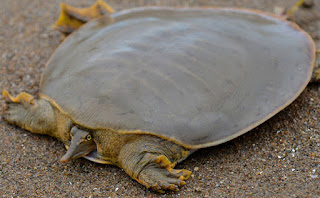 |
| Smooth Soft Shell Turtle Photo By Wichita State University |
Also, let me help you dispel your persistent belief in one of the great myths about turtles, that they are vicious and "will eat you alive". Yes, turtles will bite but if you know how to catch and handle them they are relatively harmless no matter what size they are. First and foremost, grasp a live, conscious turtle only by the tail. When you grasp them by the tail, it is physically impossible for them to bite you. Grab them by the tail, lift them off the ground or out of the water and hold them at arm's length from your body until you have a more permanent place to put them. If you are hand fishing or graveling, when you stick your hand under the creek bank, rock, or sunken object and realize you have a turtle, the first thing you should do is quickly slide your fingers along its spine. The bony projections on the spine of a hard shelled turtle will always point toward the tail. Grab the tail and proceed as above. Also, remember that soft shell turtles are almost never involved in biting. You recognize them by their long, thin, nose, and soft, smooth, leathery shell. They are nearly harmless. Also, never forget that Alligator Snapping Turtles are on the endangered species list and should never be caught, harassed, harmed, killed, or eaten. Go to a good wildlife identification guide in your state and learn whether Alligator Snapping Turtles are native to your waters, learn to recognize them and differentiate them from other species in your area, and NEVER harm an Alligator Snapping Turtle in any way. Also be aware that the Spiny Soft Shell Turtle is also endangered and should never be harmed either. Follow the same precautions about them that you do for the Alligator Snapping Turtle.
 |
| Common Snapping Turtle Photo By State Of Michigan |
I also have little tolerance for those people who discuss eating some form of wild game and then provide a way "to get the wild taste out" such as smoking, soaking in salt water, or making jerky or summer sausage. In my mind, this is just a way for people who don't like wild game to still claim they eat wild game. For me, the entire point of eating wild game is to find the unique wild game taste which is natural for each species, learn to enjoy it, and justify killing the animal without basically wasting its meat and life in order to appease a desire to appear to be "doing the wild thing".
Frogs are one of the easiest animals in the entire world to clean. You simply pick up the frog and using your left hand fold it over so that the point where the hind legs join the back is up in the air. Then you cut the hind legs off and find a point at the pelvis where you can slip a finger between the skin and flesh. Then the skin will slide off the legs nearly as easy as popping a grape. Cut off the feet and you are done. For larger frogs, we usually also skinned and ate the front quarters which takes only a bit more work. You cut off the head, remove the front legs and shoulders from the spine, skin it, and you are done. There is less flesh on the front legs but on a large bullfrog there is far too much to waste. I prefer my frogs fried much as I would a turtle. But I repeat I no eat fried foods due to the excessive amounts of cholesterol frying produces. Frogs are also good broiled, and cooked in soups. stir fries, and stews. And, to repeat myself, they do not "taste just like chicken". At times, I have also eaten frogs freshly caught, skinned, and simply broiled on a stick over an open fire within a few feet of the water in which they were caught. There is nothing better than a broiled frog which was alive ten minutes before it was eaten.
 |
| American Bullfrog Photo By MDC Discover Nature |
Nearly all small game animals are cleaned the same way but might not be cooked exactly alike. In nearly all cases, you skin the animal by beginning with a slit in the abdomen, peel off the skin while losing as little flesh as possible, cut off the feet and head, remove the viscera, retain the heart, liver, and perhaps the lungs if you are not too squeamish, and prepare the animal in the style you like best. But there are a couple of exceptions to this general rule. With squirrels, you never throw away the head. It is the best part of the squirrel with the unique taste of the tongue and brain. Just skin the animal and cut off the ears and nose, remove the eyes and cook the head with the rest of the animal. Some people even eat squirrel heads with the eyes intact but I have never done it. I have generally not eaten heads from other small game animals but I am sure they are nearly as good as squirrel heads based on how many I have seen Andrew Zimmern eat on television. Squirrels are also sometimes cleaned in a faster, simpler way than other small game. It is possible to cut the tail from the spine without removing it entirely. You then place a foot on the tail, grasp the squirrel by the hind legs and pull. This will generally result in removing the skin along the entire back and part of the sides. The remaining skin can just be slid neatly off the belly and legs with a small cut here and there. I prefer squirrels cooked in a pressure cooker since they have little to no fat and can become tough if they are not cooked properly. Then I like to make cream gravy over them and serve them with fresh new peas and biscuits which is a wonderful meal.
 |
| Grey Squirrel Photo By Geneblitz |
Ground hogs have musky glands under their armpits which need to be removed which will give the meat a strong, musky taste if they are left intact. I prefer ground hog baked with salt, pepper, and a bit of sage. But younger ones can be fried with success. Another beauty of ground hogs is that they are purely vegetarian and the meat is exceptionally clean in comparison to other animals which sometimes scavenge or even kill smaller animals for food. My mother, when my father had stopped hunting and I was too young to hunt, used to actually pay other older local boys for ground hogs because she loved them so well. It is also interesting that her parents for several years had a pet ground hog in their home on Rock Fork. He actually stayed with them for several years and would leave in the fall to go a short distance to hibernate and would suddenly reappear when the ground began to warm up in the spring.
 |
| Groundhog Photo by Pestworld.org |
Opossums should not be killed immediately upon capture if possible. Since they are a bottom tier scavenger and will eat carrion they should be caged and fed fresh fruit, preferably persimmons, for a few days to clean out their system before killing, skinning, and eating. But if you do not have persimmons handy, you can use apples, pears, or any fruit available. Sweet potatoes also work well for cleaning out an opossum. This will result in much better tasting meat. Most opossums are also quite fatty and greasy. They are best baked over a rack to allow drainage of as much of the fat as possible. Most of the people I knew as a child baked opossum seasoned with salt, pepper, and sage and baked it alongside sweet potatoes which they say improved the meal. Raccoons are often the largest small game animal available in Appalachia and a good sized raccoon can sometimes weigh thirty pounds or more. This means you might have enough meat to freeze half for later. They are also wonderful baked, barbecued, or stewed. Rabbits are generally the easiest of the small game animals to clean. You can simply pick the animal up in one hand along the skin of the back, cut a hole in the skin large enough to insert a couple of fingers, and pull in each direction toward the head and tail. The entire skin will slide off as easy as pie. Remove the head, feet, tail, and guts and bingo, the rabbit is ready to wash and prepare. Rabbit hearts and livers are also quite tasty. I love the iron rich taste of nearly all organ meats. Rabbit is probably the cleanest tasting, least gamey meat in the woods and many people who will not touch raccoon, muskrat, or opossum love rabbit. It can be prepared fried, broiled, boiled, used in soups, stews, or nearly any way you might cook chicken. But please remember, it does not "taste just like chicken". With rabbits and squirrels, it is also often possible to get more than you can eat depending on the bag limits in your state. In that case, clean, quarter, wash, and freeze the extra in meal sized quantities. You can do the same with any other small game animal if you have more than you can eat on the day you kill them. Muskrat is wonderful food and my family never ate them. In my late twenties, I was a Thoroughbred horse farm foreman in Lexington and worked with a maintenance foreman named Harvey "Bull" Jackson who finally exposed me to muskrat. It can be prepared in most ways you would prepare groundhog or raccoon and it is wonderfully clean, tasty meat. Muskrats are pure vegetarians and this contributes to the clean taste of the meat. One of my most treasured memories is of the Sunday morning Harvey Jackson and I were working and he brought in muskrat he had killed the night before and had his wife, Ruth, prepare for our breakfast in a tack room before we went out to work. Always remember that muskrats must be cleaned without breaking the musk glands near the anus. They must be removed without puncturing and will seriously ruin the flavor if left on the animal. I have seen recipes from Michigan in which muskrats are baked with sauerkraut. It is not appetizing to me at all even though I like sauerkraut in other ways, but you might try that if you do not like them baked, fried, boiled, or stewed.
I have never eaten guinea, goose, porcupine, or armadillo but I have been told by others that all three are good eating. I live in an area where a few people keep guineas and sooner or later I will buy one and try it. It might be a little more difficult to find goose but I will get there. As for porcupine and armadillo, the finding might be even more difficult since neither of them is available in Eastern Kentucky. I have seen armadillos on a regular basis in the deep south in Georgia, Alabama, Texas, and Florida but I never met anyone who regularly ate them. It is also wise to remember that the armadillo is the only animal species that can transmit leprosy to humans. But modern scientific advances have made leprosy easily curable. So enjoy your armadillo at the next opportunity. The only porcupine I have ever seen in the woods was in Pennsylvania at a state park called
Pit Hole City.
Pit Hole City, a former oil drilling boom town which had completely disappeared over time, was being developed into a park at the time I saw the porcupine. Candice and I had not been dating very long at that time and we went there to hike and have a picnic. The woods were quiet and peaceful and we both lay down in the leaves and went to sleep. Suddenly we were awakened by a rather heavy rustling in the leaves behind our heads. We had gone to sleep within three feet of a game trail and a large porcupine came sauntering through within a couple of feet of our head. It ran up a nearby tree when we awoke and jumped up. I have always thought we were lucky that neither of us made physical contact with the animal when we awoke. Someday, I hope to find a porcupine in a situation where I can eat it since I have read in numerous places that they are very good eating.
I have also never eaten beaver but they have returned to Eastern Kentucky over the last few years and I have a friend who traps them regularly during trapping season. He has promised to save a carcass for me after he has salvaged the hide which he sells as a source of income. I have read that old trappers loved the beaver tail and often lived primarily on those during trapping seasons. I can't wait to try beaver. Another word to the wise, if you do decide to eat beaver, remember they also have large musk glands near the anus and those should never be broken during the skinning process.
These are a few of the wild foods I love best and I hope you love them too. Always obey the game laws, respect bag limits and seasons, never kill anything you don't intend to eat, and never allow yourself to refuse to try a new food source just because you have never had it. Bon appetit!


