Search This Blog

Showing posts with label theology. Show all posts

Thursday, May 27, 2021

The Indian Bottom Association of Old Regular Baptists--Trends In Membership Over The Last 80 Years

This blog post has been prompted by what I have observed over the last thirty or so years to be a steady, but slight, decrease in the numbers of both members and member churches of the various associations of churches which refer to themselves as "Old Regular Baptist".  My mother was a member of the Steele's Creek Church of the Old Regular Baptists from some time about 1950 until her death in 1970.  Since her death and the death of the long term moderator of that church, E. Hawk Moore, along with other members and regular attendees at that church, there was a steady decrease in members until finally the church was dissolved by the New Salem Association of which it was a member church and the church property was sold to a private owner who now leases the building to a private corporation which uses it as a day treatment center for the mentally ill or mentally disabled.  Quite fortuitously, I was able to meet that owner and he graciously gave me the sign from the front of the church which had never been removed at the time the church was dissolved.  Let me state for the record that the Steele's Creek Church was not a member of the Indian Bottom Association and I know of no connection between that church and the Indian Bottom Association other than the possibility that some minister who might have been connected to the Steele's Creek Church could have been a delegate to the Indian Bottom Association meeting at some time since several associations which refer to themselves as Old Regular Baptist do have some form of limited fellowship between associations and often send delegates to the association meetings of corresponding associations.  I should also note for the record that I am not and have never been a member of any Old Regular Baptist Church and I should never be confused with the Old Regular Baptist preacher Roger Hicks.  I am simply interested in their history, as I am in nearly every other aspect of the history of Central and Southern Appalachia, since they were a part of my family's life and I have known of them all my life.  

Among the many associations in Central and Southern Appalachia which refer to themselves as Old Regular Baptists are The New Salem Association, The Northern New Salem Association, The Burning Springs Association (1813), Red Bird Association (1823), Mountain Association (1856), Red River Association (1876) The Mud River Association (1888), Twin Creek Association, Spencer Association (1898), Sandy Creek Association, Washington Association, Three Forks of Powell Valley Association, The Philadelphia Association, Ketocton Association, Yadkin, Holston, Kehukee and Roaring River. Associations. This list is likely to be somewhat incomplete and I would recommend anyone who is interested in learning more about the Old Regular Baptist churches and their numerous independent associations to read Howard Dorgan's excellent, but somewhat aged, book "The Old Regular Baptists of Central Appalachia: Brothers and Sisters in Hope".  Any attempt to study all of the various associations is a complex and time consuming effort and I suspect that is a major factor in the fact that so few academic books have been published about any of these associations.  Thankfully, the Old Regular Baptists have historically produced an annual report of vital statistics, obituaries, and circular letters which is the best source of information about any particular association. These annual reports are referred to as the "Minutes" of each particular association and have always been a rarity among the majority of small Appalachian churches most of which maintain very few written records.  But the major drawback to that route of research is that no central depository exists for the Minutes of all the associations.  The University of Pikeville has the best collection I know of but even that one is markedly incomplete.  Thankfully, the Indian Bottom Association made a decision with the advent of the internet to place all their "Minutes" online.  I would have loved this writing to have been able to compare membership and total church numbers for at least two or three associations over the same time period but I do not have adequate access to a sufficient number of Minutes over such an extended period of time.  For that reason, this blog post can only effectively examine the membership trends in the Indian Bottom Association.  But it is likely that the other associations will have had similar trends in membership and church numbers to the Indian Bottom Association. 

I will be comparing total membership numbers and total church numbers in the Indian Bottom Association from 1939 to 2019 in ten year increments since it would be a task of book length to compare those numbers year by  year for even fifty years.  I want to begin in a year prior to World War II for two reasons, firstly, because that war changed the face of much of rural America since it sent hundreds of thousands of rural men, and quite a few women in supportive services, to Europe and Asia and exposed them to a vastly different world than the one in which they grew up.  Secondly, I would like to be able to make an educated conclusion as to whether or not a sizeable number of those young Appalachian men and women who returned alive from World War II had been affected by the war in a manner which would have caused them to have what are commonly called "salvation experiences" and to join the churches of their parents after their return.  

In 1939, there were 27 documented churches in the Indian Bottom Association which had recorded a total of 1328 members.   Three churches had more than 100 members with two more having membership in the high 90's.  The largest church was the Big Cowan Church with 138 members.  Big Cowan Church was located in Whitesburg in Letcher County Kentucky.  Carr's Fork and Poor Fork were the other two churches with 100 or more member at that time.  Carr's Fork was located on Carr Creek in Knott County Kentucky and Poor Fork was located near Cumberland, Kentucky, in Harlan County. 

When we go to the 1949 "Minutes", we see that there were then 30 churches in the Indian Bottom Association which represents an increase of 3 member churches over the ten year period which is an 11% increase over the 1939 statistics.  The total membership in those 30 churches was 1634 which represents a sizeable increase of 306 members which is an increase of slightly more than 23% in total membership in the association over the ten year period following World War II.  There is no available way to determine how many of those 306 new members might have been returning veterans but it is likely that a significant number of them were such men and perhaps a few women who were also veterans of some war related service such as nursing, hospital work, or office work at established military bases.  There were then, in 1949, five churches in the association which had more than 100 members each with the Big Cowan Church remaining the largest with 167 members.  That reflects an increase of 29 members in the Big Cowan Church which is slightly more than a 21% increase in membership over the ten year period.  Poor Fork, Oven Fork, Big Cowan, Doty Creek, and Little Home were the five churches with at least 100 members.  Carr's Fork had dropped out of the list of churches with at least 100 members and was down to 95.  Big Cowan still led the numbers with the aforestated 167 members, an increase of 29 members over the ten year period which represented an increase of 21% in membership. 

In the 1959 "Minutes", we find that total membership in the association had dropped to 1377 members which is a significant decrease over the ten year period and is very close to the numbers at the beginning of this research in 1939.  The total loss in membership is 257 members for a percentage of 15.7% over that  ten year period from 1949 to 1959.  The total number of churches in 1959 remained stable at 30.  

The 1969 "Minutes" showed a total membership of 785 members which is very significant drop in membership from 1959 when the total was 1377 members.  The total membership loss was 592 members for a 42.9% drop in membership which would be shocking in any respected institution in a stable community.  The Statistical Table only shows a total of 21 churches in the association which seems to indicate that 9 of the member churches had chosen to leave the association over the preceding ten years.  The most logical reason for such a departure in members and member churches would be that there had been some major dispute of doctrine which led the 9 churches and most of their members to leave the association.  It is also significant that no church in the association reported having a hundred members.  The largest was now New Home Church with 82 members.  A handful of the churches were now reporting less than 20 members.  

The 1979 "Minutes", as entered into the internet website does not contain a Statistical Table page which appears to be an error of some sort since no association of which I have ever known failed to include the Statistical Table in their annual "Minutes".  Because of that error, I have chosen to revert for this time period to the 1978 "Minutes" which will make this period of examination 9 years instead of 10.  For the next reporting period, I will revert back to what would have been the normal year to examine, 1989,which will make that period of examination 11 years.  The 1978 "Minutes" shows 916 total members which is a significant increase over the 785 members reported 9 years before in 1969. That represents a 16.6% increase in total membership over the 9 year period.  But the 1979 "Minutes" shows only 20 member churches which represents a loss of 1 member church during that 9 year period.  The usual reasons still hold true for the loss of a member church and would usually be due to either a loss of membership which caused a church to be dissolved or that the missing church left the association to either become an independent church or to join another Old Regular Baptist Association.  It is most likely that a church's departure with active members would have been due to doctrinal disputes.  It should also be noted that the church structure in Old Regular Baptist churches does not utilize a system of pastors or paid ministers of any kind.  Each church has a Moderator, Assistant  Moderator, and Church Clerk.  The Moderator is not a complete example of a "pastor" and that word would never be used in an ORB church.  The Moderator is responsible for running the monthly weekend of meetings, supervising care of the building, preaching or at least "opening" the services but does not function in a truly "pastoral" capacity. 

The 1989 "Minutes" shows a total of 1323 members and a total of 26 churches which is a significant increase in both membership and member churches.   That is a total of 407 new members over the 11 year period and an increase of 6 member churches.  The percentage of increase in membership is 44.4%.  The 5 new churches represents an increase in member churches of 25 percent.  I suspect that some of those member churches arose out of the Great Migration of Appalachian mountain people who moved to the industrial north to work and took their particular form of religion with them.  The church clerks list shows one in Ohio and one in Indiana which has been a common theme with the New Salem Association also and actually brought about the creation of the Northern New Salem Association in Ohio, Indiana, Michigan, and one or two other industrial Midwestern states.  But  I also suspect there could be other sociological reasons for such an increase in both the church members and the member churches.  Once again, I have arrived at a question which cannot be completely answered in the time I have to devote to this research and it is exacerbated by the lack of comparative data from the other associations.  

The 1999 "Minutes" reports a total membership of 1893 total members and a total of 42 member churches.  Both these increases over the 10 year period are remarkable.  They could be due to further movement of members and their families to the industrial north but that is unlikely.  It seems to me that the more likely answer would be that another small association may have disbanded and those churches decided to join the Indian Bottom.  An increase of 16 new churches in such a small association over that time period is unlikely.  The 16 churches represent a 61% increase in member churches.  The total increase in members is 570 members which represents a 43% increase in total membership and the total membership in the association had doubled over the previous 20 years.  That is truly astounding and it shatters my original supposition that the association would have had significant losses in membership over the time period.  

The 2009 "Minutes" reported 1876 total members is virtually identical to the 1893 members 10 years before.  The drop in membership of only 17 members in a total population of nearly 2,000 is statistically insignificant at .00898%.  A total of 47 member churches were reported in 2009 which indicates that average membership per individual church is dropping.  The new churches, 5 in total, represent an increase of 11.9% in total churches.  Although I had not been computing average membership in the churches over the entire examination, let's look at that for this two reports.  In 1999, the average membership per single church was slightly more than 45 members.  In 2009, the average membership per single church was down to 39 average members a drop of 6 members per congregation which represents a drop of 13.3% per individual congregation.  

The 2019 "Minutes" only two  years ago reported total membership in the association of 1595 members for a drop in membership of 281 members which represents a drop in membership of 14,9% and is also significantly less than it was 20 years before.  There are only 43 total member churches reported in 2019 for a drop of 4 member churches which is a drop of 8.5%.  The total average membership per local congregation has also dropped to 37members which is another drop of 2 members per congregation.  While everything I suspected to learn by examining these membership data in the Indian Bottom Association did not hold true, I did learn the total membership in the congregation had a significant increase in membership following World War II which was followed by a slow decline in membership which was temporarily reversed in the ten years between 1989 and 1999.  I still suspect that sizeable increase was probably due to other churches and their entire congregations deciding to join the association.  But after that increase, the next 20 years shows a reversion to the slow, steady decrease in membership while at the same time showing an increase in member churches which is offset by a drop in total average membership per congregation.  I am too overloaded with other projects to attempt a full year by year analysis of the numbers.  But it would be very educational to see some good statistician and researcher do that very project with a book in mind about that and other aspects of the various associations of Old Regular Baptist churches.  Howard Dorgan's excellent book was published 20 years ago and a follow up is long overdue. 

Sunday, February 7, 2021

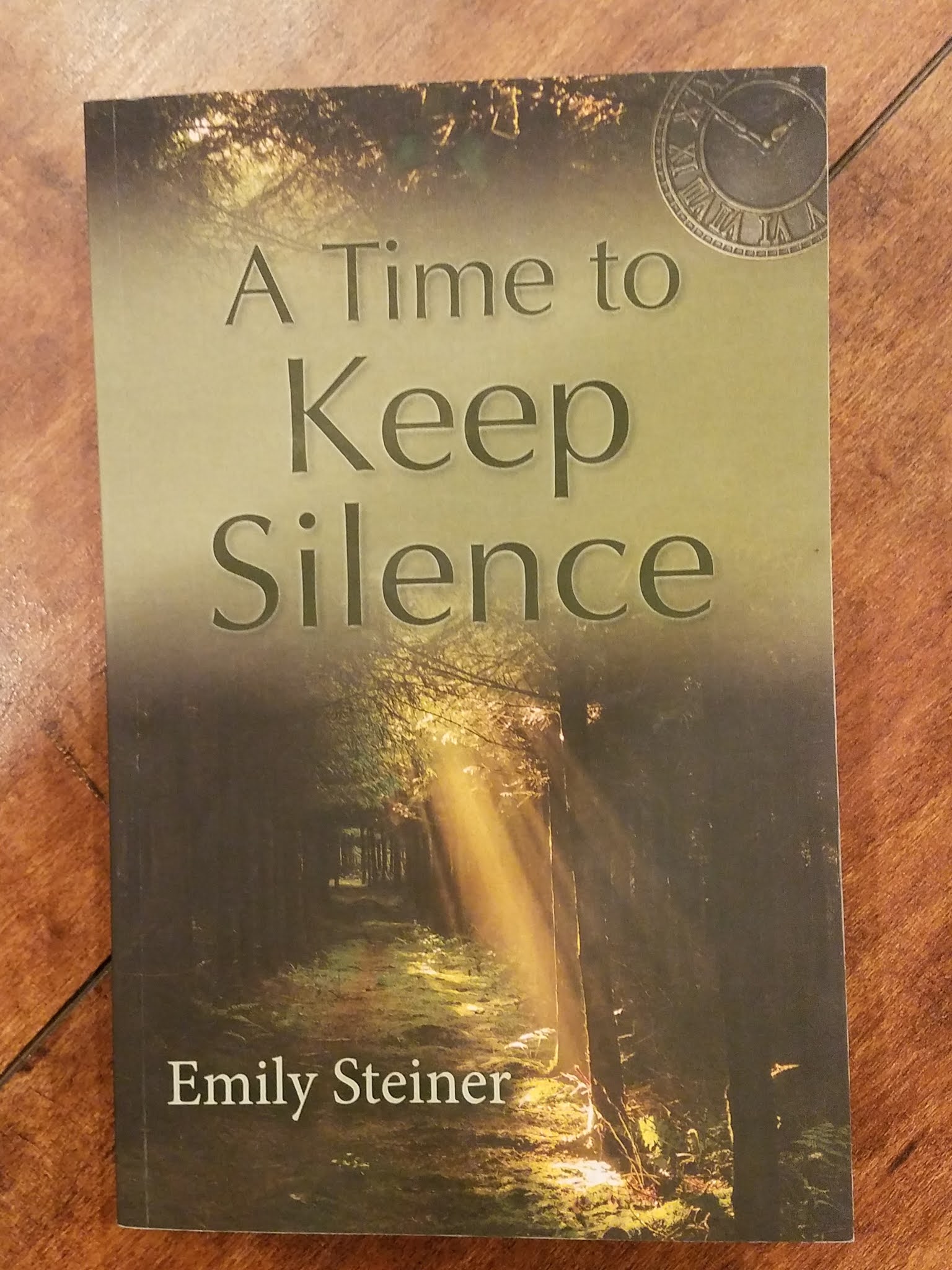
"A Time To Keep Silence" by Emily Steiner--Book Review


 I always enjoy reading books and posting about them on these reviews on my blog post and, in general that is especially true when I write about books which were written by my numerous friends who are authors.  This is not one of those times because I have just read and am now writing about a new book by one of my friends whom I like especially well and I do not like this book nearly as much as I have three others she has written and which I have also reviewed on this blog.  The friend and author to whom I refer is Emily Steiner, a young conservative Mennonite woman whom I have known for about three years.  I respect her talent, her intelligence, her writing, her books, and her commitment to her religion.  I value our friendship and we correspond these days by e-mail since she is teaching in a small Mennonite school in Central Michigan.  We met accidentally, or serendipitously as I prefer to believe, in Old Mill Park near my home in West Liberty, Kentucky, and slightly farther away from her childhood home in Crockett, Kentucky. She was dressed in a traditional Mennonite long dress and head covering and carrying a lap top which is odd among Mennonites.  I had already read her book, "Under The Bridge", which is linked above and which is the first book in her triumvirate of books about a coal mining family in Harlan County Kentucky in the union organizing efforts of the 1920's.  While I disagreed with the book's position that Christianity and trade unionism are not necessarily compatible, I liked the book and her writing quite well overall.  I struck up a conversation with her by asking these exact words, "I don't mean to bother you, but are you Emily Steiner?"  She responded "Yes!" and I told her about having read her book and we had about a half hour conversation about her book, writing on both our parts, Appalachia, and writers I knew.  We established what has been a good, honest, communicative, and respectful friendship beginning that day despite the difficulty of an older, married, non-Mennonite man and a younger, single, Mennonite woman having a friendship which respects the social barriers her religion requires in such cases.  We sometimes read each other's writing, sometimes e-mail, and, if a community occasion makes a face to face meeting possible in her community of origin, we sometimes talk a while in plain view of other Mennonite observers.  It has helped that I am fairly well known by numerous members of her congregation because I have done business with them for quite a few years and have always respected and honored the constraints and barriers their religion places on contacts with outsiders.  

So, to repeat myself, this is a difficult review to write since I like and respect the author a great deal and am not particularly fond of the book.   But please do not assume that I am saying you, dear reader, will not like the book.  It has merit as does all the work I have ever read by Emily Steiner.  So, in order to be absolutely fair to my friend, Emily Steiner, I searched out two other reviews on the internet from other sources who have read the book to see what they thought about it.  An anonymous reviewer on the Goodreads website has this to say about the book: ...A Time to Keep Silence shows the loneliness and misunderstanding that singles can face in a tight-knit Mennonite community. This is a book that an older single may relate to, and those who are married can read to understand the challenges of singles.  I agree wholeheartedly with this reviewers statement that the book "shows the loneliness and misunderstanding that singles can face in a tight-knit Mennonite community". From my point of view, the most valuable thing I got from reading the book is that it gave me an improved understanding of the religious based social customs which govern dating and consideration of marriage among young conservative Mennonites.  But, having lived my life in the greater non-Mennonite community, I tend to believe that the social customs in question place undue burdens on those young church members.  I was left with the impression that, in most cases, young Mennonite women are almost required to accept the first young Mennonite man whom they agree to date as the person they will marry even before their first date.  That is a bit too restrictive for my blood.  

The second review I chose to read about "A Time For Silence" is by a relatively young Mennonite widow who describes herself on her blog as follows: I am Gina, a Mennonite mom who writes about books, broccoli, and baking bread. In May, 2017 my husband was diagnosed with glioblastoma, an aggressive brain cancer, which took his life two years later in May, 2019. These pages share my journey of searching for joy with cancer and widowhood."  I know nothing about Gina other than what I have read on her blog and the fact that Emily Steiner has told me she knows Gina. As it turns out, I have just discovered that Gina was the person whose writing was used in part on the Goodreads website for the first quotation I used about the book since the language is identical on that website to part of Gina's review on her blog which I recommend for anyone who wants to learn more about Mennonites, their religion, and the self-sufficient lifestyle of gardening, canning, freezing, cooking, and other things such as homeschooling and church based childhood education.  I should also say that the photo of "A Time To Keep Silence" which I have used above is taken from Gina's blog, "HomeJoys" as linked above.  I have been unable to locate other independent reviews of the book at this time and will attempt to use quotations in others I might locate in the future to update this review.  

Now to more adequately address my personal issues with this book which Emily Steiner has told me is selling better than any of her previous books.  In fact, she and I had one e-mail exchange when she was actually at her printer, Haines Printing, watching the presses run so she could pick up several hundred more copies of this book.  That could be an indication that I am wrong about the book.  But, the first critique I have of the book is that it is a story which is told in 341 pages and could, I believe, have been told in a more literary manner in 200 or 250 pages at the most.  I have told Emily in an e-mail that I think that a lot of dialogue does little to advance the plot and I stick to that assessment.  The book is broken into 60 relatively short chapters, the longest of which is about 10 pages and several are 1 page.  Emily has explained this to me as a choice she made "to keep people turning pages".  I did keep reading to the end and I will buy and read the other two books which are to follow in this series about the main characters, Justin and Monica, whom I expect to be married by the end of the third book.  I was also put off mildly by one section in the book in which the protagonist, Monica, who is working in a coffee shop she and a friend, Ida Belle, have recently bought and are operating as single Mennonite women. Monica becomes scared of a rough looking non-Mennonite man who is staying in the coffee shop too long, asking a few too many questions and is dressed somewhat inappropriately by Mennonite standards.  To see single Mennonite women operating a business as Monica and Ida Belle do in the book is uncommon but not totally rare.  I regularly do business in a bulk food store which is owned by a woman in Emily Steiner's community of origin.  I also know of a bakery business in that same community which was operated for a time by the former Mennonite divorcee daughter of a devout Mennonite friend of mine.  But I have never known of a Mennonite who pre-judged a person to the degree I perceived in that section of the book.  Monica fears are used as a tension builder before the male in whom she is interested, Justin, enters the shop to buy coffee for himself and his employees.  Monica fights the desire to ask Justin to rescue her from the perceived danger of the rough look man and allows Justin to leave before making the request.  The book also winds to a conclusion without either Monica or Justin taking any action to move their relationship to another level.  It simply ends with the two of them still thinking about the possibility of dating each other but doing nothing to bring it about.  Both are afraid of entering a dating relationship because they have both been unsuccessful in one prior dating relationship.  Both fear the disapproval of the community if they enter a relationship which does not end in marriage.  In the real world, almost no one, except Mennonites apparently, gets married to the first person they date.  In my opinion, no one, not even young Mennonites, should feel compelled to marry the first person who asks them to consider a dating relationship.  I sincerely hope the next two books in this series are better than this one.  But use your own judgment about whether or not you want to read this book, especially if you have read other books by Emily Steiner and enjoyed them.  This could turn out to be the very book you have been hoping you would find.

"A Time To Keep Silence" is available directly from the author, Emily Steiner, for $12.50 plus $3.00 shipping for a total price of $15.50 by check or money order from: Emily Steiner, 5532 N. Shepherd Road, Rosebush, Michigan 48878.  If you have questions, Emily will answer her cell phone in person or return your call if you need to leave a message at 606-495-8090.  But, if you call, please keep in mind that she is a school teacher.  Call after 4pm on weekdays, never on Sunday. 

Thursday, September 21, 2017

"The Original Wisdom Of The Dao De Jing A New Translation And Commentary" by P. J. Laska--Book Review

Laska, P. J.: The Original Wisdom Of The Dao De Jing A New Translation And Commentary (Green Valley, AZ. ECCS Books, 2012)

P. J. Laska Photo by Warene Hobson


Please allow me to preface this review and/or commentary by saying that what I know about the Dao De Jing would not fill a thimble.  This is the first time I have ever read any translation of the Dao De Jing other than whatever small sections of it which might have been included in an old classic called "The Bible Of The World" edited by Robert O. Ballou and published in 1939.  That little classic and its subsequent replacement, "The Portable World Bible" also edited by Mr. Ballou and published in 1976, are both classic texts for the students of both religion and history who want to understand the complexity and diversity of the world's religions and their effects on world history without doing a full fledged doctoral level piece of research.  I was first introduced to "The Bible Of The World" by Dr. Billy Rojas, Ph.D., who taught history at Alice Lloyd College for a few years in the 1960's and 1970's.  Later in about 1974, I met my friend, professor, and mentor, P. J. Laska, who wrote the particular version of the Dao De Jing which I am attempting to address in this review, and he further broadened whatever understanding I have of the world's religions.  Laska published this version of the Dao De Jing in 2012 after having studied the Dao and Daoism for more than forty years.  It is also relevant to this discussion that P. J. Laska holds a doctorate in philosophy.

P. J. Laska Photo By Roger D. Hicks

The Dao De Jing is generally defined as "...a famous Chinese philosophical text attributed to the authorship of Laozi (Lao Tzu) (sixth century B.C.E.), and highly influential in the religion of Daoism."  Like most major religious texts of the world, the Dao De Jing must be studied regularly and frequently in order to be understood.  I do not presume to understand it. Laska has told me in our personal communications that:

"...I'm not interested in Daoism (the religion), which is what most of western writing is about.  I found the older wisdom tradition conveyed by the Dao De Jing to have a lot in common with the naturalism that evolved in early Greek philosophy.  Then I was puzzled by the phrase "wei wu wei" (ddj 3 &  63) and spent a lot of time trying to make sense of other translations before I realized they were passing off "act without action" and other contradictory nonsense as something subtle and mysterious.
I started exploring this phrase which asks the reader to bring opposites together.  Then it struck me that the opposites are "wei"=human action, and "wu wei" =non-human activity, or natural process, and it fell into place.  The ancient wisdom is about balancing these two, to achieve sustainability.  

The main difference between human activity and natural process is the intellectual and artistic design that's present in human action, whether it is called thought or idea,  or consciousness that gives our action its end or goal.  I call it 'desiging (sp) action' to set it apart [from] the processes of nature that go on without this conscious design.  This is the key to the ecological reading that guides the commentary -that and the anti-imperialist thread, which you will see in ddj 80 the paradigm for a sustainable community is a small state with few people." Personal Communication from P. J. Laska to Roger D. Hicks 2017.

As I understand our prior and subsequent communications about this book, P. J. Laska's intention was  to produce an ecologically based translation of the Dao De Jing.  I do not wish to further speculate as to whether or not I believe that Laska achieved his goal.  Or as they used to say on Beaver Creek when I was growing up "I reckon I jist don't know nothin' about that there stuff."  I did find the Dao De Jing sufficiently interesting that I might go so far as to reread Laska's translation in a more studious manner by following all cross referenced sections which appear in his notes and commentary which will be an even more time consuming task.  I read it this first time in what some might consider a fairly close effort and actually read every note or commentary section throughout the entire text.  I did find it somewhat disconcerting that there are notes at the end of most of the verses, stanzas, chapters, or sections and there are also commentaries in a separate section at the back of the book each of which is designated by an asterisk at the end of the particular stanza or chapter.  I would have found it personally more effective if both the notes and commentaries had been combined in a single note at the bottom of each stanza or chapter.

Roger D. Hicks & P. J. Laska Photo By Candice Hicks

I must also say that certain small sections of the text struck me as particularly pertinent to life and world politics in the highly dangerous world in which we live today.  I refer the reader to stanza or chapter 30, found on page 37 of the book, states in part: 
"Those using [the Wisdom of] the Way to assist a sovereign in governing do not employ force of arms. This will likely provoke the use of arms in return.  Where troops set up camp, thistles and thorns grow.  Where great battles are fought, years of hardship will follow.  Those adept [in the use of the Way] do not risk using force.  They succeed without vanity and without aggression, and get results without arrogance, gain, or use of force." 
This language is more pertinent today than it could have been at nearly any other time in world history.  I am writing this review on the day after the particularly ignorant, inflammatory, and ill advised speech before the United Nations by the TRAITOR and International TERRORIST Donald Trump.  There are other equally pertinent sections of the text of this book which can be applied to world politics today in general and in particular involving the Russian Owned Criminal Syndicate which is currently illegally occupying the White House.   But, to return to my discussion of P. J. Laska's book:

This is a book worth reading especially for the practicing Daoist or student of Daoism. It is also worth reading for the student of world theology and, perhaps, even for the person who is in that life stage of seeking peace of mind and a personal spiritual world view.  I would not presume, and I do not believe that Laska does either, that this edition of the Dao De Jing is a be all end all edition that will give the reader release from the need or desire to read other editions.  In fact, if I ever finish all the other projects I am working on to which I assign higher levels of importance I just might read another more commonly used edition myself.  Maybe, to that degree, P. J. Laska might have achieved one of his unstated goals, to initiate the reader into a further study of the Dao De Jing.  However, let me end this piece the same way I began.  What I know about the Dao De Jing would not fill a thimble.