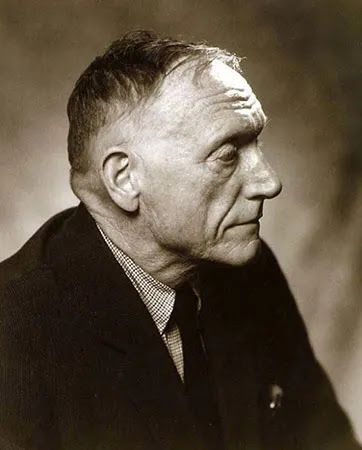


My wife Candice and I just finished reading this fine little book by Jean-Dominique Bauby in the manner in which we have been reading books regularly for several years now. While Candice washes our breakfast dishes, I read aloud from whatever book we are reading at the time. When she finishes washing the dishes, I stop reading and rinse them. I put them away later. We alternate who chooses the next book we read, and this one was her choice. Our previous book which I chose was "Band Of Angels", a novel by Robert Penn Warren which I wrote about at this link. For us, this book is personal. Bauby was the editor of "Elle", the French fashion magazine, when he suddenly, and apparently without any warning, suffered a severe stroke in his early forties which left him with "Locked In Syndrome". Locked In Syndrome is a condition due to a stroke or other form of brain damage which leaves the patient completely paralyzed, unable to move or speak, and without any realistic hope of recovery. Usually, the patients mind is working perfectly well inside a completely dysfunctional body. Sometimes, as in Bauby's case, the patient is able to blink one or both eyes which is utilized to facilitate a form of communication. Bauby, his friends, family, and providers were trained to use an alphabet system with the letters of the alphabet arranged in order according to their frequency of use in French, his native language. The person communicating with such a patient is required to read the letters one at a time, wait until the patient blinks in response to a letter, write that letter down, and repeat the process until a word is spelled. Then a sentence, and thus a conversation. Bauby and a young female employee of his publisher utilized the system for him to write this book which is, understandably, only 132 short pages of about 175 words each for a total of approximately 23,000 words. Admittedly, that is a small word total for most adult non-fiction books. But for a book which was produced using the method described above, it is a phenomenal piece of work for both Bauby and his publisher's employee.

For my wife and I, the book is a personal matter for two reasons: 1) my wife has been in a wheelchair for about 26 years, and in a power chair for about 5 years due to a rare genetic disorder; 2) when I was an undergraduate at Morehead State University, I had a professor whose husband, a retired psychiatrist, suffered a massive stroke which left him with "Locked In Syndrome". On one occasion, my former professor told me the story of her husband's stroke and eventual death. They utilized some such system of eye blinking to discuss his condition, absolutely devastating prognosis, and their possible options in the matter. Admittedly, they were a couple who were unusually prepared by their professional lives to deal with such an issue in their private lives. Her husband was a retired medical doctor and psychiatrist who had run a large state operated mental health treatment system. His wife was a doctoral level professor of social work who had also worked in mental health setting in the past. But, as she told me the story, it was obvious that she was still totally devastated by the decision they had reached in his case. They had discussed their problem and their options, as I described above, and her husband chose to be disconnected from life support and to die rather than to linger for whatever time the health care system could have kept him alive. Admittedly, my wife and I have a very unique perspective from which to assess Bauby's incredible little book.

The book is written in very short chapters, very little pages, and is an incredible read both for its brevity and its breadth in how much information it contains. Bauby says little until almost the end of the book about the actual event of his stroke. It moves from short segments about his life in a state government operated system for very difficult neurological cases in France to segments about his life before his stroke to other segments about how he spends his time when he is alone in his hospital bed. He discusses his creation of fantasies about what had previously been his goals and dreams, his life with his young children and wife, and his professional life as the editor of a major French fashion magazine. This is a book which a good reader can finish in a single sitting. But it is also a book which can require some time between sittings for the reader to absorb and process the information it contains. This is an incredible book and well worth reading by every reader

On November 30, 2023, I took one of the most painful actions I have had to take in years. Our wonderful tom cat Nikki Sixx, otherwise known as Bubby, had progressed into the final stage of kidney failure after 13 years, all of which except the first 6 months or so of his life, he had spent in our house. One summer day in 2010, he had wandered into our yard about half grown and nearly starved to death. He might not have weighed 2 pounds that day and in his adult prime he reached 16 pounds. As I have always said about him, you could have held him up to a light and candled him like an egg. At the time our awesome dachshund Giggles was in her prime and immediately began to bark at him, harass him, and try to drive him away. I was amazed when I saw him just walk up to her, purr loudly, and rub against her. He was completely unfazed by her.

We decided to take him in and keep him, had him vaccinated, neutered, etc. and he quickly began to work his way into our hearts. He was a handsome devil with his Siamese Cross good looks and beautiful blue eyes. He had a perfect disposition, was always loving and quickly became deeply attached to my wife Candice. Like Giggles, he spent a great deal of his time in her lap in her wheelchair. It was one of his favorite places to be whether she was in it or not as the photo below shows. He was totally devoted to Candice and the feeling was mutual. I loved him too but he was never as close to me as to Candice. He had about 12 great years with us without any kind of health problems or problem behaviors but as he aged he developed kidney failure which I am told is the most common cause of death in elderly cats. We took him to the local veterinarian, had him tested, got the results, and realized that his time with us was going to be limited. He was flushed out with saline and perhaps some medications and placed on a special cat food for kidney failure. The good times lasted for a few more months and he had another episode of deterioration with another episode of the same treatment. That episode gave him a little more time but he quickly got to the point that he couldn't even make it into the cat box and we realized that he needed to be let go. It was time to have him euthanized and end his suffering. That was a tough decision.
.JPG)

When we took him to the veterinarian on November 30, 2023, to be euthanized, Candice couldn't go inside with me and Bubby for the end. I took him in and was eventually taken back to a treatment room. The veterinarian and her vet tech were both great in how they dealt with us. The vet tech took him back to another room to insert a catheter and give him a mild sedative to help him relax. Then she brought him back to the room and left us alone for at least 15 minutes. I held him on my lap, talked to him, told him I loved him and that he was going to Kitty Kat Heaven. When the veterinarian and vet tech came back in they asked me if I was ready, and did the necessary work as he lay on a table. We all petted him as he fell off to a peaceful sleep and the end came. I had been present on many occasions in the Thoroughbred horse business in which I worked for several years when we euthanized horses, some of them very successful and famous race horses. But I had never had an animal euthanized before with whom I had such a deep and loving connection. I managed not to cry in the office but I have cried many times since. He was one of the best cats I have ever known and I have known many good cats. He was more like a child and the other nickname I had often used with him was "Son". He had been a major part of our lives for 13 years and had been a very important part of Candice's support system with her life in a wheelchair. We brought him home, placed him in his favorite Cat Napper wrapped in a blanket and I buried him in the front yard near the edge of our porch beside Giggles who had died in 2015. We still haven't ordered his tombstone like hers but will do so in spring. He will be forever missed in our hearts and minds. He was a fine cat and, as I have said many time, we had him for 13 year and he never lied to me, never stole anything from me, never asked me to borrow money, and never voted a Republican vote in his life. You can't ask anything more from a cat!
.JPG)
I wrote this about four years ago as a potential submission to an online magazine which is focused on the disability community and it was not published there. I've never done anything with it otherwise and finally decided to post it here since I do think it is worth reading and someone might actually get something positive from it. I have also added a small addendum at the bottom about one related recent event.
Life With A Rare Genetic Disorder
On a bright, sunshiny day in June 1992, my wife Candice walked down an irregular stone path to the main overlook of New River Gorge National Park on her father’s arm and we were married. At the time, she was in her early twenties, seventeen years younger than me, and so far as we knew she was perfectly healthy. She had been running college track just a couple of years before at the University of Wisconsin-Platteville. She quickly obtained a job as a state social worker in Eastern Kentucky where I had been raised and quickly adapted to life in Appalachia although she had never been in the region before we met.
Four or five years later, she began having difficulty with walking over irregular terrain and the thing I remember most vividly is that sometimes she would simply lock up in the soft dirt of our garden. We began a series of encounters with neurologists and tests for every neurological disease known to the medical world. All the tests results were negative and one doctor even told us Candice’s symptoms were psychosomatic. This cycle eventually brought us to Dr. Joseph Berger, M. D., at the University of Kentucky Hospital in Lexington where he was the department chair and a professor of both neurology and psychiatry. Dr. Berger is one of the most intelligent, professional, and dedicated humans I have ever known. After several visits and a repeat of the tests for ALS, MS, MD, and other diseases, all of which were still negative, Dr. Berger sat down with us one day and said, “I don’t know.” for about a half hour which is still one of the strangest experiences I have ever had. He suggested that we consider going to the National Institutes of Health in Bethesda, Maryland, which Candice agreed to do.
At NIH, we met Dr. Elif Arioglu, M. D., an equally brilliant, caring, and dedicated young Turkish Muslim woman who was on a fellowship at NIH. She became Candice’s regular primary physician during the five years or so we traveled to Bethesda. Candice’s initial health history at NIH was done by the Director of the National Institute of Diabetes and Digestive and Kidney Diseases Dr. Simeon Taylor. When he walked into the room and introduced himself along with his job title, I realized even more than I had when Dr. Berger said “I don’t know” that we were in truly deep water. I knew that if the president had been ill with similar problems Dr. Taylor and his associates would have been on the job.
The Human Genome Project was in full swing during the time we were traveling to NIH and we learned about it and got some hope that when the human genome was fully understood we might have a solution to Candice’s problems. Candice was enrolled in some research protocols, tested in every way known to modern medical science, and provided maintenance medications and some adaptive equipment as her disease continued to progress. We met some of the most brilliant medical practitioners and researchers in the world along with a growing group of the most exotic patients and diseases we could imagine. NIH was a highly educational and sometimes inspiring place to spend four or five days every three to six months. But five years rolled by with no easy answers. Dr. Berger and Dr. Arioglu eventually co-authored two journal articles about Candice’s condition and her father who had a similar body type and other mild symptoms was also brought into the NIH programs for a few years.
But nobody came up with any ready answers and eventually Candice grew tired of the endless poking, prodding, tests, and the endless parade of brilliant medical students who repeatedly asked the same questions for their own education. After five years, she withdrew from NIH but had continued to work for the state of Kentucky the entire time. She found it necessary to transfer from the Department for Social Services as an investigative worker after she progressed from a cane to a walker to a wheelchair. But for ten years, she continued as a food stamp worker, and eventually secretary, at the local food stamp office before she finally retired on disability after having worked in that office for ten years after she had progressed into a manual wheelchair. During this period of slow steps backward, she also began to drive with hand controls and eventually took her state pension and Social Security. We remodeled our house with an accessible bathroom and ramps. We learned to adjust to life with a wheelchair and a ramp van. But answers were not forthcoming other than knowing that she had a rare inherited genetic condition which was linked to both spinocerebellar degeneration and lipodystrophy. Finally, a researcher in the Toronto area who was working on diabetes research, was able to use NIH generated data along with the data from her one visit years before to the Cincinnati Children's Hospital and isolate the particular genetic flaw which caused Candice’s problems. Dr. Berger finally told us a few years into the problems that the flaw had been found in only two other patients in all of North America and that he believed all three had a common ancestor. But there were no further answers.
No one ever believes they, or someone they love, will become a patient with a disease for the medical journals. Those things don’t happen to ordinary people. But it happened to Candice and me. By the time Candice had decided she could no longer work in an office setting, the medical records we mailed to the Social Security Administration were shipped in a medium sized cardboard container with the first piece of paper in the box being a letter from Dr. Berger stating that in his professional opinion Candice was totally disabled. We have no idea if any worker at Social Security ever read that entire box of records and we suspect that the collective weight of Dr. Berger’s letter and the weight of the box settled the disability case whether the records were ever read or not.
Over the past twenty years, Candice and I have adjusted to our lives together as well as any two people could. We have traveled to both Canada and Mexico. We attend concerts regularly and love to find new things to see, do, and experience. But we still wonder how life might have been different if NIH had truly been the magical place we thought it might be the first time we entered those doors. Dr. Arioglu has taught medicine at the University of Michigan for most of the last twenty years. Dr. Berger has retired from the University of Kentucky and works with the same dedication as always as the Chief of the Multiple Sclerosis Division at the University of Pennsylvania. Candice and I still live in the same modified home in Eastern Kentucky and work to accept our lives together without any answers.
Copyright 2019 by Roger D. Hicks
ADDENDUM
This addendum is being written on New Year's Eve 2023 and about two weeks ago our phone rang for the second time over the last twenty years with Dr. Elif Arioglu (Oral), now married about twenty years with two grown sons, seeking the latest news about Candice and her health and also asking if she might be interested in participating in some of Dr. Arioglu (Oral's) ongoing research at the University of Michigan. We have always both respected and appreciated this woman who, despite her intense work schedule as a doctor, medical researcher, educator, and director of two research programs at the university, has never forgotten us and has found time to become more a friend than a doctor we once knew. If you have to be saddled with such a rare medical condition, it is an incredible blessing to also be gifted with knowing such a brilliant and caring doctor.
Recently, I scrolled through the rather long list of blogs on my "Reading List" on this website and found that many of the blogs on that list had not had a new post in quite some time, some of them for even a few years. When a blog and blogger go that long without any new content it is safe to assume the blog is now defunct. But why do they become defunct? I'm not even sure I know all the answers but a lot of possible answers are seemingly obvious. Some of the bloggers simply die. Other bloggers might find new interests which they enjoy more and simply quit blogging. Others could even have found themselves in prison. Who knows? I have published this blog since April 15, 2011, and it has grown steadily both in the amount of posts I have created and in the number of people who have become interested in it. In the nearly 10 years I have written this blog, it has slowly grown from a few dozen followers to more than 150 followers. But, I have no way of knowing how many of those followers actually actively follow the blog to the degree that they read most of my posts, read some of my posts when they are bored, or simply return at irregular times to see if I have posted anything in which they are interested.
Over the last couple or three years though, this blog has ballooned from about 50 followers to more than 150. This blog averages about 3,000 page views a month and has had a little over 362,000 page views in the ten years it has been active. But, interestingly, the two highest months in page views came in September 2014 and March 2015 when it received 18,917 page views and 20,917 page views respectively. At that time, I probably had less than 30 followers. I have no idea why the blog received such high numbers in those two months. The roughly one year period from February 2014 to March 2015 had consistently higher numbers than the blog average. January 2015 was the lowest month in that period with 5,262 page views. I repeat that I have no idea why the numbers ran so high for that period and why now, with at least three times as many followers, I usually get lower page views. If any of you readers can explain why, I would love to hear it.
Now, to discuss the reason which prompted me to write about this in the first place. Over the years, I have added 32 blogs of fairly varied subject matter to my reading list and have not ever deleted one from that list. My primary areas of interest have consistently been Appalachian Studies, Auctioneering, Travel, and Disability Issues since my wife, Candice has been in a wheelchair for more than twenty years. Of the blogs on my list, I clearly know less than half a dozen of the creators and have only ever met one of them in person. I have probably corresponded with a dozen or so either via e-mail or the comments sections on either my blog or theirs. The one person I know, have met, correspond with regularly, and expect to see again in the future is Mike Brandly who is an auctioneer, real estate broker, auctioneer trainer, and expert witness in matters of auction law. His blog is called Mike Brandly, Auctioneer Blog, and has had more then 1.4million page views due to his national prominence as a multi-faceted auctioneer. I have actually taken my required continuing education for my auctioneer license from Mike and we are Facebook friends. We have a couple of Facebook groups in common, two of which Mike runs and one run by a friend of mine to which I referred Mike.
I also know, in a less personal way without any face to face contact, a woman named Heather Johnson who writes a wonderful blog called Paralyzed With Joy and has done so since November 2009. Heather is a full quadriplegic due to a horrible car accident, not her fault, when she was 17 years old. If she can maintain a blog for 12 years, anybody can. And her is one of the most interesting blogs I read. Heather, one of her sisters, and I are all Facebook friends.
Another blogger with whom I have had extensive contact beyond his blog is known to the world as either Greenbrier Jim or Wayfarin' Stranger which is also the name of his blog which he operated regularly from February 2011, to March 2014, and then ceased to produce it which is a damn shame since it is a wonderful blog of both his own high quality photography and Appalachian History. Jim grew up in Morehead, Kentucky, where I attended Morehead State University years after he left town. I suspect that Jim may be having health issues which have kept him from continuing. But his blog is still worth exploring for the quality of his work in both areas.
Another blog and blogger which I appreciated a great deal was called Dave's Cupboard and focused on unusual foods. Dave, who I do not know from Adam, ran his blog consistently from January 2, 2006, until June 26, 2015. I suspect that Dave might have either passed away or suddenly suffered a major health crisis. His daughter was listed as a co-author on the blog and I sent a message of inquiry but never got an answer. I love odd, unusual, even strange foods, and I miss Dave's blog a lot. It is also worth visiting for the past reflections on many things a lot of people claim they never eat.
Only two or three blogs on my Reading List can be said to still be active with posts having been created in the last few months at the latest. I miss the work of every one of the authors who created those blogs and wish they were still active. And I have to repeat, I have no idea why some of them stopped.
 |
| Cratis D. Williams--Photo by the Williams Family |

