Search This Blog

Friday, September 20, 2019

New Book, "True Christmas Stories From The Heart Of Appalachia", From The Jesse Stuart Foundation

The Jesse Stuart Foundation has just released a new book entitled "True Christmas Stories From the Heart of Appalachia".  The book has 43 Christmas stories from 39 authors. It has stories from my friends, Edwina Pendarvis and Emily Steiner, as well as the well known authors Jesse Stuart, Thomas D. Clark, Cratis Williams, Bill Best, and Billy C. Clark. Including my story, "Christmas On Beaver Creek", there are three stories which are set in Knott County.  Two of those stories are set at Pippa Passes and the Caney Creek Community Center. This book is a wonderful addition to your collections of Christmas books or Appalachian books. It is also a wonderful Christmas gift for those who love to remember and work to preserve the Appalachia of their childhood.  It is well worth reading and will take nearly every reader back to some wonderful memory from your growing up years. I have a limited number of copies available with my autograph at the price of $25.00 plus $3.00 shipping (28.00 total) which is the price set by the publisher. The book will cost you the same amount of money without any autographs from the Jesse Stuart Foundation.   I will accept PayPal at rchicks@mrtc.com. I will also accept orders with a check or US Postal Money Order at:

Roger D. Hicks
65 Highway 1081
West Liberty, KY 41472
Send me an e-mail there with your name, address, and the name of the person to which you want each copy dedicated.
Here is an excerpt from my story: "Late in the evenings when the fire was warm and business slow, the older men would stop by the store to tell stories about old Christmas with the cattle kneeling in the fields...and how some old preacher talked about three men who rode on camels across a big desert following a star to take some fancy presents to a baby who was just like us, too poor to be born in a hospital." 

Tuesday, September 17, 2019

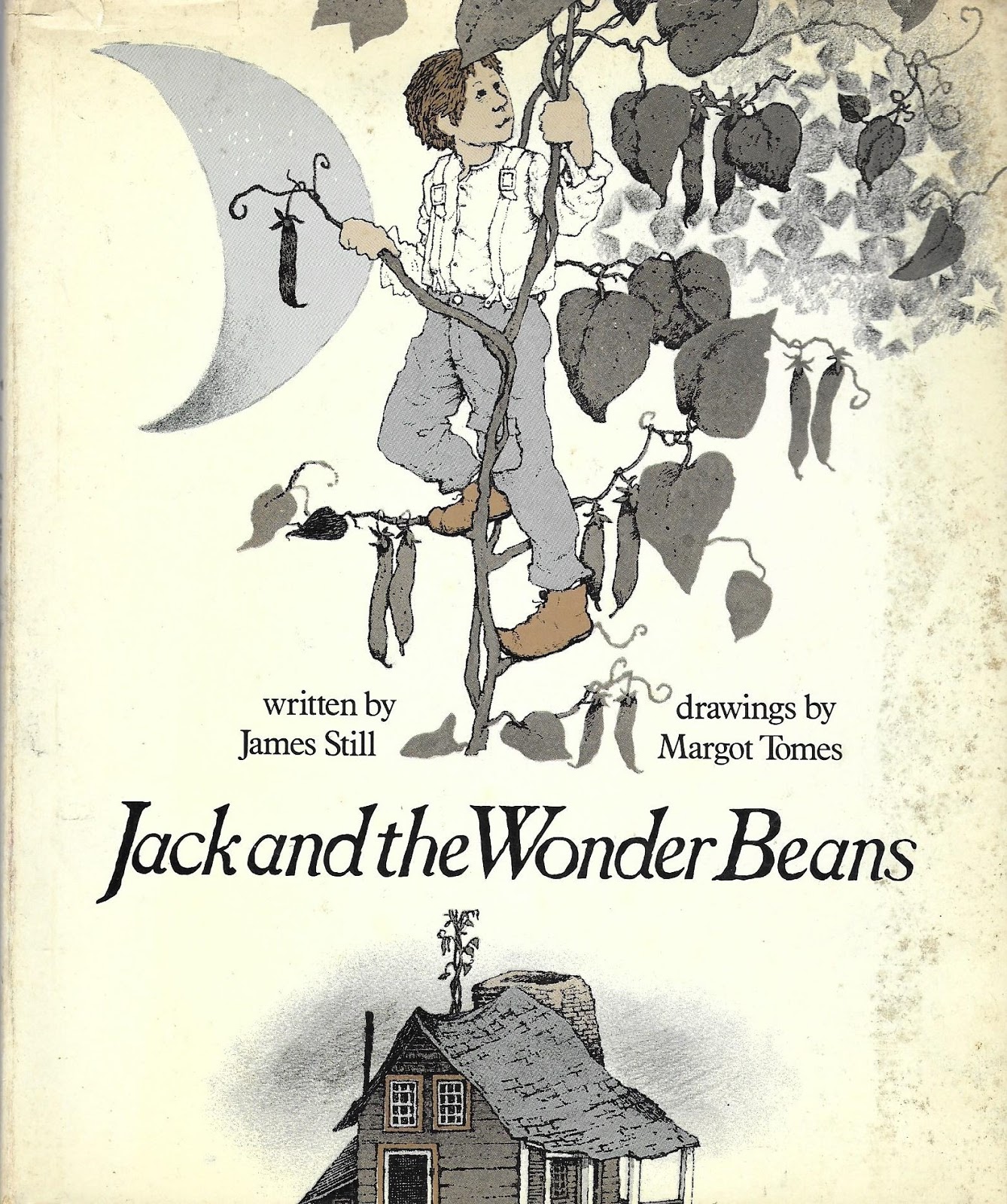
"Jack And The Wonder Beans" by James Still--Book Review

James Still--Photo by University Of Kentucky

Still, James & Illustrated by Margot Tomes. Jack and the Wonder Beans. (New York, G. P. Putnam's Sons, 1977)

This is James Still's Appalachian adaptation of the classic fairy tale "Jack and the Bean Stalk".  It is somewhat heavy on dialect and humor and yet it is probably better for your children than a simple fairy tale.  As for children and fairy tales, I would be a lot better satisfied if the majority of American and Appalachian children were being raised on fairy tales than computer based games of mass destruction.  We never seemed to have nearly as many problems with our children when their parents were sitting by their beds reading them stories about woodcutters chopping up criminal wolves in order to save little red haired girls than we are now when we hand each child some form of electronic device and leave them to their own devices with games in which weapons of mass destruction are used against the general public.  This book is one of at least three little books which G. P. Putnam's Sons published for James Still at the height of his national popularity which was rooted in the success of "River of Earth".  Two of the others are "Way Down Yonder On Troublesome Creek" and "The Wolf Pen Rusties Appalachian Riddles & Gee-Haw Whimmy Diddles".  For all three of these books, Putnam used New York illustrators which I suspect was a convenience to the publisher.  I also suspect the books might have been more authentically Appalachian if they had been illustrated by genuine Appalachian artists.  


"Jack and the Wonder Beans" makes a legitimate attempt to utilize Appalachian dialect, at which James Still was an acknowledged expert, while also attempting to not make the language unreadable for the general public.  I suspect that the original text, as Still would have sent it to the publisher, was considerably more rooted in dialect.   The dialect in the book seems "cleaned up" at times especially when you compare it to the dialect in "River of Earth" or his short stories.  The art work also seems at times to be much more generically "Southern" than truly Appalachian.  But the book is loaded with expressions I heard as a child in Knott County such as "a hog on ice" and "feet as big as corn sleds".  Any reference to a corn sled can generally be assumed to be Appalachian or Southern.  In all my travels over half of America and a bit of Mexico and Canada, I have never heard anyone outside Appalachia refer to the family corn sled and I have to admit that I have recently used a reference to "that fancy corn sled" which Old Saint Nick drove "behind them funny looking deer". Corn sleds have always been handy both on the farm and in a bit of writing intended to educate the outside world about Appalachia.  I commend James Still for having reverted to the use of a corn sled in this book. 

While this book is a bit dated, which is not unusual in the many books I have read and written about on this blog.  But it is well worth reading both for children and adults.  I often read children's literature when I want a break from more academic reading.  This book is also widely sold on used book websites and should be easy to locate.  If you want a reminder of the old Appalachian dialect of your ancestors, this is a good place to start.  

Monday, September 16, 2019

Elk Night And A Good Hike At Jenny Wiley State Park Lodge, September 14, 2019

This past Saturday night, my wife Candice and I went to Jenny Wiley State Park Lodge for Elk Night in the lodge dining room.  We got there about an hour or so early so I could take a hike on one of the trails I had never been on, the Moss Ridge Trail which starts up the hill above the lodge and just below one of the rental cottages.  It runs for about 1.3 miles total.  It begins in the general direction of the amphitheater and then doubles back along the ridge to the lodge.  It is labeled as "Strenuous" in their little flyer about the trails.  I agree that it is a bit tough and should not be attempted by anyone who is not used to hiking some in the mountains but I think it falls a bit short of "Strenuous".  The staff description states that it has steep uphills and steep down hills and that is accurate.  It begins with a short hundred yards of pretty level hiking and then has some treated wooden baffles across the trail to prevent erosion which are not remotely steps but purely water baffles which are too far apart to be considered steps on the first uphill.  It is in timber all the way and well shaded.  But for me the worst part of the entire deal is that it and the linked Steve Brackett Memorial Trail were both primarily bushwhacked out of the woods with a small bulldozer and it will show for many more years that it was accomplished in that way.  The trail itself is level in large sections but does have some steep uphills and, on the return loop, some steep downhills which are over some sections of exposed rock and gravel which tends to make it a bit risky about falls due to small, rolling rocks. The other drawback to the trail is that it has several large down trees which have not been dealt with and a few are in full blown widow maker mode.  But they are nice trails with the two or three objections stated above and they appear to be somewhat better maintained than the Jenny Wiley Trail which I hiked part of about a month ago and wrote about on this blog. The area of the Moss Ridge Trail that runs along the ridge is nice and flat and was not damaged so much with the bulldozer.  It apparently runs along the property line of the park on the ridge because there are several three foot tall steel markers in the ground which are painted bright red and labeled "Boundary Line".  The land on the opposite side of the markers is also timber land and brings up another idea I have about the need for the state park system to be funded to increase the acreage and uses of  nearly all the state parks.  I also realize that this idea is not one that would get very far at this point in Kentucky politics. I spent an hour on the trails which included probably a half mile of the Steve Brackett Memorial Trail until I reached a point where it starts to drop off rapidly toward the level of the lake.  Candice was waiting on me near the lodge reading a book in a shaded parking spot so I turned around and doubled back.   

We attended the Elk Night Dinner a the lodge after my hike and have also eaten there on other occasions.   I have never been shy to say that the kitchen staff and food are much better at Natural Bridge State Park Lodge where we also eat fairly frequently and usually attend their Elk or Wild Game Night Dinners.  The food at Natural Bridge is always better prepared and the staff do an overall better job of presenting and servicing the entire affair of a well-attended special dinner.  But on this occasion at Jenny Wiley they did have one food which I had never had and found somewhat pleasing.  They served smoked elk in reasonably sized slices which were well prepared and pleasing although, for my personal taste, the smoked elk was a bit too lightly smoked.  I love a good, somewhat strong smoky taste similar to what you find in good smoked pork chops.  The elk roast on this night was overcooked and served in a somewhat stingy manner by the person serving it on the buffet line.  The deserts which Jenny Wiley describes as "Appalachian deserts" are not remotely regional or Appalachian.  There was peach and blackberry cobbler.  The peach was somewhat odd tasting as if it had been too heavily laden with margarine but the blackberry was better and well received by our group.  The other deserts were nothing that could not have been expected on a normal menu in any sit down restaurant in the eastern half of the country.  Our waitress whose job only involved serving drinks and paying attention was hard working, funny, attentive, and a welcome sight in the place.  But we did notice that a waitress who had served us competently and well only a month ago was not present on a night when such a restaurant would have called all hands on deck which leads me to suspect high turnover in the kitchen staff. 

My primary reason for returning to the Jenny Wiley Lodge for an Elk Night Dinner was primarily to eat out with my cousins and their spouses because they live in the area and like the lodge.  But I much prefer Natural Bridge.  But you should try them both and make up your own mind. 

Monday, September 9, 2019

"River Of Earth" by James Still--Book Review

James Still--Photo by University Of Kentucky

This novel by James Still is frequently referred to as "the quintessential Appalachian novel" and at times even as "the best Appalachian novel ever written".  I agree that it is a wonderful novel with beautiful use of dialect which is very difficult to produce accurately without becoming maudlin.  Still did an excellent job of dealing with the classic Appalachian dialect of my native and his adopted Knott County Kentucky.  The novel is narrated by a young boy of about 8 or 10 whose family is overburdened with poverty, illness, death, and deprivation.  They move back and forth from the hillside farm on which the story begins and the coal camp nearby where the father works whenever he is able.  The mother is devoted to her family and the family farm where she eventually buries her most recent child who dies of poverty and malnutrition.  Another son loses some fingers from playing with a blasting camp during their stay in the coal camp.  Three worthless relatives of the weak father move in on the family anytime they begin to do well and have an extra meal or two available.  They contribute nothing to the family and generate strife between the father and mother.  In this book (The Hills Remember: The Complete Short Stories Of James Still), Still writes in (his version of) the dialect which my parents, grandparents, aunts, uncles, cousins, and the customers in our country store spoke during my childhood.  Other than Mildred Haun, Still may well be the best writer in Appalachian dialect.  But one word used by Still always sticks in my craw as a native Knott Countian.  That word is "chaps" to refer to children and I never heard any of the native speakers around whom I spent my childhood use that word to refer to children.  I suspect the word "chaps" was imported by James Still into his novel subconsciously from his native Eastern Alabama.

" When I wrote about "The Hills Remember: The Complete Short Stories Of James Still", I discussed his dialect writing in comparison to that of Mildred Haun and I append that discussion here: Still is also frequently referred to as one of the better, if not the best, writers in Appalachian dialect.  I do not dispute that he is a fine writer in Appalachian dialect.  But I will always believe that Mildred Haun is a far superior writer of Appalachian dialect.  Her classic work "The Hawk's Done Gone" is far and away the best dialect writing ever done in Appalachian Literature.  As I said earlier, I spent the first twenty years of my life in Knott County Kentucky, was educated there through high school and began my college education at Alice Lloyd College.  I was also reared by my parents, maternal grandparents, and an extended family of aunts and uncles who all grew up in Knott County early in, and in some cases before the turn of the twentieth century.  I know Knott County Appalachian dialect as well as any human on earth and I must insist that there are times when I see that  James Still wrote linguistic expressions which I never heard from my parents, grandparents, aunts, uncles, farmers at the livestock sales or jockey grounds, or the elderly customers at my parents' country store.  The one word which he used frequently, especially in "River Of Earth" and his short stories and which I never once heard in Knott County is "chaps" in reference to small children.  In my childhood, small children were "young'uns", "chillun", "yard apes", "curtain climbers", and several more conventional, less colloquial terms.  But they were never "chaps".  I suspect that is an expression from Still's youth in Alabama.  Getting back to the comparison between Still and Haun, I will defend Still to the degree that the two of them were writing dialect based on two different subregions of Central Appalachia.  I have also traveled extensively in the Cocke County, TN, area where Haun spent her life and did extensive research among Appalachian serpent handlers there.  The two subdialects have significant differences.  But Haun's consistency and accuracy in writing dialect is superior to James Still's.  It is also worth noting that it is only 63 miles from Harrogate, TN, where Still attended college to Newport, TN, where Haun lived her life.  I do not know that Still ever spent time in Newport but since he and Haun both attended Vanderbilt University it is possible that he did know her and might have even visited the area which would have also exposed him to the dialect which she wrote so admirably.  It is also possible that Still's travels from Chambers County Alabama to Claiborne County Tennessee to Davidson County Tennessee to Knott County Kentucky could have provided a plethora to opportunity for Still to blend the dialects of the four to a degree that not even he recognized."

I do not mean to disparage James Still as an Appalachian writer.  He is a wonderful writer and his work, especially "The River Of Earth", has been taught in classes in colleges and universities all across America and several foreign countries.  But after 68 years of life arising in and being deeply influenced by Knott County, I am firmly convinced that I understand the local dialect as well as anyone on earth.  And, if I am allowed to move on from the discussion of his dialect writing to a simple discussion of the novel as an example of outstanding literature, I firmly believe that it borders on being a masterpiece.  But there are other writers who have lived and written in, of, and about their native Appalachia whose work rivals Still's and I would never go so far as to say any of them have written "the best Appalachian novel".   I believe that appellation is still up for grabs.  I believe that supporters of Harriett Simpson Arnow, Denise Giardina, Gurney Norman, Wilma Dykeman, and Thomas Wolfe can all make rational arguments that each of these authors has written "the best Appalachian novel".   

But let me close by saying that James Still was a wonderful novelist.  In my opinion, he was a far better novelist than a poet for which he actually is often praised more highly.  This novel is arguably a masterpiece and will always be worth reading because of the strong characterizations, the building and resolution of conflicts throughout, and the stark, simple, powerful language which draws the reader into this book and leaves her wanting more and also wanting to help this family fight against their unending struggle to survive.  It is wonderful writing. 

Sunday, September 8, 2019

"Jenny Wiley Pioneer Mother and Borderland Heroine" by Henry P. Scalf--Book Review

Scalf, Henry P. Jenny Wiley Pioneer Mother and Borderland Heroine (Prestonsburg, Kentucky. Prestonsburg Publishing Company Press, 1964)


The story of Jenny Wiley and her capture by and escape from Native Americans on about October 1, 1789, in what is now Johnson County Kentucky has been told, retold, exaggerated, blown all out of proportion, and moved from fact to legend to myth over the intervening 220 years.  It has resulted in at least one musical theater production which has been a regular and now intermittent production of the  summer musical theater named after her along with the state park in Prestonsburg, Kentucky, where this little 16 page pamphlet was produced by Henry P. Scalf in 1964.  Scalf was a newspaper writer, author of several such pamphlets and about a half dozen genealogical books during his lifetime.  Much of his writing, documents, and books are in the Special Collections Department at the University Of Pikeville Library which I have used more than once in my research. I own one of his dozen or so self-published genealogical books about the Stepp-Stapp Families of America.  His best work was done in the fields of newspaper writing and genealogy.  This Jenny Wiley pamphlet was produced about 10 years after the formation of the Jenny Wiley State Park The date of this pamphlet coincides with the formation of the Jenny Wiley Summer Music Theater in 1964 and was likely an attempt by Scalf to capitalize on that event or, perhaps, to help support the push to form the theater.

Late in this work, Scalf states that "Ever with the Wiley story have been stories of the unusual, the strange and fanciful.  Some of these were added by descendants and other mountain folk for the tale of her captivity penetrated deeply into the consciousness of a people, becoming after the lapse of many decades an important element of their folklore."  Scalf was absolutely correct to make that statement and much of the general public opinion about the Jenny Wiley story today in Eastern Kentucky, Western Virginia, and Southern West Virginia is nothing more or less than folklore.  While it is a fact that Jenny Wiley was captured by and successfully escaped from her Native American captors after witnessing the deaths of her brother and children, much of what is frequently accepted as fact in the region today is nothing more than myth, legend, puffery, and prevarication.  It has long been impossible to differentiate the truth from the fiction.  But this woman has become a solid and permanent part of the historical beliefs in the region.  Harry Caudill wrote a terrible novel, "Dark Hills To Westward",  about the Jenny Wiley story and there have been nearly a half dozen other highly fictionalized books about her.   A highly fictionalized, but enjoyable musical play was written about her and performed to rave reviews hundreds of times in the theater at Jenny Wiley State Park.  Her grave on a ridge near River, Kentucky, is frequently visited by her descendants and total strangers who are enamored of the tales of her privation, grief at the deaths of her children, and her miraculous escape. I have to admit that I have visited her grave once myself.  This is an interesting little pamphlet to read if you can find a copy.  It will hold your interest.  But do not automatically assume that every word in it is a fact.  It contains no references to any historical documents and no professional method of crediting sources was used. At the time of the events not a great deal of documentation took place due to a variety of factors including the harsh conditions under which the people lived in the area, the high rate of illiteracy at the time, the persistent need for everyone to devote nearly all their time to survival and self-preservation, and the simple fact that paperwork was not a daily task of anyone.  The story was told by the people who were parties to it, passed down over more than 200 years through the oral story telling tradition, and has grown out of all proportion to the bare truth at the time the events happened.

Jenny Wiley lived until 1831 and died at the age of 71 more than 40 years after her capture.  The area at the time was genuinely on the edges of white civilization in America.  My own third-great-grandfather, Aulse Hicks traveled to Prestonsburg, Kentucky, sometime between 1790 and 1810 and we do not have a single historical document about his life.  I wonder if he might have known the Wiley family.  I have always admired the courage and fortitude of anyone who would pick up what little they could pack onto a horse or mule and a draft ox which might have also doubled as a milk cow, and stride off westward into Eastern Kentucky from the relative safety of much more heavily settled Western Virginia in the time of Daniel Boone and Jenny Wiley. 

I would also say that if you are doing genealogical research related to the Big Sandy and Tug River valleys the Scalf papers at the University of Pikeville Library are well worth a visit but you should contact the library archivist first to schedule a visit and access to those papers. 

Friday, September 6, 2019

Cemetery Traipsin' With Alexander Allen--September 5, 2019

Roger D. Hicks At Collins Cemetery--Photo by Alexander Allen

Yesterday, September 5, 2019, I spent a large part of the day doing what I like to call cemetery traipsin' with Alexander Allen in Floyd and Knott Counties in Eastern Kentucky.  Alex is a distant cousin on the Allen side of my family, only in his early twenties, and actually very interested in and actively involved in local history, family history, and genealogy.  It is highly encouraging and positive to see anyone Alex's age who is this interested in these issues of genealogy and historic preservation.  I think I know a lot about the cemeteries of Eastern Kentucky, some in Southern West Virginia, and a few others scattered over a few other states.  I have personally added more than 3,000 memorials to Find A Grave and photographed more than 650 graves for the website.  As my Find A Grave profile states, I have wandered through cemeteries in a great deal of the country and grew up within sight of three in Knott County. But I have to admit that Alex, especially for his age, has a large store of knowledge about cemeteries in Eastern Kentucky. Alex and I were going to some cemeteries each of us know well but neither of us knew all of them or all of the necessary information about them. We intended to take each other to a few which were important to both of us and share some information about them and the people buried there.  We started at the Manns-Allen Cemetery on Steele's Creek near Wayland in Floyd County.  This cemetery is located on a fairy high point on the left side of Steele's Creek about a mile and a half up the creek from Wayland and less than a half mile from the place where my parents operated a country store from 1945 to 1957 before moving to a new store at Dema on Beaver Creek in Knott County. It is at the mouth of a little hollow, which so far as I know has no name, and is the location where a couple named Bill and Goldie Stegall lived for many years.  I lived the first six years of my life on Steele's Creek and I had never been on that cemetery.  I do not remember ever being told that several members of our extended family were buried there.  What is a real shame about it is the fact that my maternal great-grandmother Hester Allen is buried there.  For the first time in my life, I visited the grave of my great-grandmother.  That cemetery is becoming badly overgrown and one section of it does not appear to have been mowed or cleaned up in many years.  At least one tree has fallen over a couple of graves. Another grave has a grape vine growing out of it and the base of the vine is nearly as big as my wrist.  Alex says he has dealt with the Floyd County Judge Executive recently about another cemetery and that official will sometimes send county inmates to clean up cemeteries.  Alex also states that each cemetery has to be placed on a list and they are done on a first come, first served basis which is the appropriate policy for such work.  Another friend has also told me recently that Floyd County inmates are also used sometimes to dig graves for families which cannot afford to pay for graves to be dug and I witnessed that practice not long ago when the nephew of some friends died whose parents were quite poor.  That issue of paying to dig graves irks me and always will.  I was an adult before I ever saw anybody paid to dig a grave in Eastern Kentucky.  When I was growing up, the family, friends, and neighbors always dug graves and nearly everyone would have considered it to be a travesty for anyone to accept money for such work. I would go so far as to say that most of the adults I knew in my childhood would have assisted in digging a grave for their avowed enemies if the need arose.  In that time and place, they would have done the work and never uttered one negative word about the person with whom they had disagreed in life.  

Ella Hicks Tombstone, Collins Cemetery--Photo by Alexander Allen
We traveled further up Beaver Creek beyond Wayland to the Collins Cemetery #1 which is located on the west side of Beaver Creek about a mile below the Knott County line.  I have known about this cemetery all my life and can remember a time when it was clearly visible from the highway nearly an eighth of a mile away on the other side of the creek.  But neither Alex or I had ever been on this cemetery despite the fact that both of us have family members and others we have known about buried in this spot.  It is a large cemetery with more than a hundred graves on it.  One hundred and thirty six graves on this cemetery have actually been documented on Find A Grave but I suspect that there are probably several more which were missed by the person who did most of those memorials.  This cemetery sits well up on the hillside and, if it were in good shape, commands an incredible view of a sizeable section of Right Beaver Creek with large mountains in every direction, no visible strip mine damage, obvious evidence of elk in the area which also means there has to be other wild game population, and the scene is generally quiet and peaceful without a great deal of noise from the visible highway.  When I say that the Manns-Allen Cemetery is "badly overgrown", that statement does not hold a light to the deplorable condition of the Collins Cemetery.  At one time, it was considered a major non-commercial public cemetery along the Beaver Creek, Floyd and Knott county border area and many outstanding members of the community have been buried there over the last one hundred years or more.  But today the cemetery is at best a briar patch with trees growing randomly all over the area and jungle might be a more apt descriptor.  The cemetery has a still functional chain link fence around it which is in good condition.  But elk are bedding down in the brush all over the cemetery. There are several monuments which have been turned over and one or two are broken.  I suspect that elk may have caused most of this damage since all livestock and wild animals will sometimes need to scratch themselves on the first available solid object.  A tall grave marker is no fitting scratching post for an elk weighing more than 500 pounds. It also appears that at one time someone had installed an electric fence charger in the vain hope that it would deter the elk from entering the cemetery.  But even if the electric was functional, the elk would simply raise their front ends and launch themselves over the fence. I actually stepped into a grave that was sunken to about knee depth because I was working my way around the cemetery and wending my way through briars, weeds, grapevines, and other brush which was over my head in many places.  I was pushing and weaving my way through a large mat of vegetation and literally pushed through and before I could see where I was I had stepped into the sunken grave up to my knees.  That one grave was the only one we found which was noticeably sunken although more could be hidden in the brush patches into which we never waded. 


Edgar Hicks Tombstone--Photo by Alexander Allen
Alex and I slowly worked our way through the majority of the cemetery and found probably most of the graves which are marked with formal granite or marble markers.  But we also frequently stumbled over semi-sunken sandstone markers for graves which might or might not be susceptible to rubbing in order to learn who is buried in them. Most of these sandstone markers have slowly sunk into the earth and little is visible of many of them. I have never done rubbing on grave markers and I realize that I should attempt to learn.  But, in spite of all these problems with brush, briars, and trees, both Alex and I were able to find some graves which were important to us.  I was able to locate the graves of my maternal aunt and uncle, Ella and Edgar Hicks, who had died tragically as children.  Just a few days before she would have turned three, my aunt Ella woke up one frosty October morning in 1922, just 11 days before what would have been her third birthday, and backed up against the hearth catching her nightgown on fire.  She died as a result of severe burns.  I had heard the story dozens of times as a child but I do not remember ever being told where she and my uncle Edgar were buried.   My uncle Edgar died at the age of ten in 1936 of what I always heard described as "a fever".  He had apparently been perfectly healthy until just a few days before his death.  My mother, the firstborn of my grandparents' children, was 22 years old when her brother Edgar died. She had been 8 when her little sister Ella died.  I am glad to say that I have finally been able to visit their graves.

Roger D. Hicks at the graves of Ella and Edgar Hicks--Photo by Alexander Allen
After we left the Collins Cemetery, Alex and I traveled further up Beaver Creek to Dema to visit the Turner Cemetery where both of us have several members of our extended family buried.  I grew up within sight of this cemetery, played on it with my friends as a child, attended traditional Old Regular Baptist Memorial Meetings there, and was first exposed there to the fine old Appalachian tradition of digging graves without pay for family, friends, neighbors, and total strangers.  I often refer to one old man, Alonzo "Lonzo" Bradley, I knew who lived his entire life on a hillside farm between the Turner Cemetery, the Pigman and Slone Cemetery, and the Collins Cemetery and always appeared in front of a deceased person's house the morning after they died with his tools in his hands ready to help dig the grave.  I often say that I have seen that old man insist that a grave be perfect, absolutely vertical and rectangular, without odd projections or holes in its walls, and dug with respect for the dead.  He firmly believed that the last decent and respectful thing we the living can do for the dead is to provide them with a perfectly dug grave which has been rendered with love and respect. I have seen that old man use his drinking water and dirt from the grave to make mud balls to fill holes in the sides of a grave where a rock had fallen out or been removed.  I will always remember him in his bib overalls with an old crumpled hat on his head climbing in and out of a grave until it perfectly suited his expectations. If good works and charity can get anyone into Heaven, you can rest assured that Lonzo Bradley is there resting from digging hundreds of graves for his neighbors and friends over his 76 years.

Alex had visited the Turner Cemetery but did not have much of the personal information I have about the individuals who are buried there.  I had personally known the majority of people who have been buried there over the last sixty years.  Alex and I started at the gate and walked the entire cemetery and I told him the stories I know about the people buried there.  The cemetery contains the graves of three very significant preachers in the Old Regular Baptist Church: E. Hawk Moore whom I have written about on this blog; Clabe Mosley, who lived to be 102 whom I have also written about, and who is perhaps the most famous Old Regular Baptist preacher in the history of the denomination; and, Hawley Warrens who lived within sight of the cemetery and was also a significant preacher in the denomination.  I suspect I will also eventually write a blog post about what I remember of Hawley Warrens. 
Turner Cemetery Sign--Photo by kestryll on Find A Grave 
As we were leaving the cemetery, we encountered Roy Huff and his wife, Priscilla Gail "Dockey" Huff, who do the lawn mowing and care of the cemetery and have done so for about twenty years.  Let me state for the record that this cemetery is always in excellent condition compared to most non-commercial cemeteries in Appalachia.  Roy does an excellent job despite the fact that he is nearly 80 and has had coronary bypass surgery.  Roy and Dockie do this work year in and year out, receiving only donations, and completing the work regardless of the income they may or may not receive for it. In many ways, Roy Huff has stepped into the empty shoes of Lonzo Bradley.  They say they mow the cemetery roughly a half dozen times a year.  And if you have read about the previous two cemeteries we visited on this day, you know that this is an exception.  If you know this cemetery, have loved ones buried there, or simply want to do a good deed, send them a check at the address on the sign in the photo below.  I can assure you the money will be used for the good of the cemetery and Roy and Dockie are completely honest.  I have known them since 1957.  We talked outside the cemetery near my truck for probably fifteen minutes before we left them to do their work.

One interesting portion of the talk which Alex and I had with Roy and Dockie was an almost verbatim repeat of a conversation which I had with Alex only minutes before.  I had been telling Alex about an incredible, perhaps two hundred year old oak tree which used to grow in the center of the cemetery and eventually died and was cut down.  It grew near four graves at the highest point of the cemetery which are only marked with rocks.  One of those graves is outlined with cut stones which are very similar in size, shape, and cut to the classic hand cut stone steps we often see at old mountain homes.  The other three have only large sandstone rocks on them.   When I was growing up, the prevalent tale in the area was that this grave with the cut rocks was "the grave of an old Indian".  Today I know better.  Native Americans did not bury their dead in that fashion.  What I had been telling Alex was that no one in my lifetime had ever been able to make a statement about who the four people buried in those graves might have been.  During our discussion with Roy and Dockie, Roy suddenly and spontaneously brought up that magnificent old oak tree and the four graves near it.  He went on to tell Alex virtually the same story I had only minutes earlier.  He also holds a view similar to mine that those people must actually be some of the first white settlers in the area of Dema and were probably the first people ever buried in the Turner Cemetery.

After we left the cemetery, we traveled to Garrett, Kentucky, and had lunch at the Garrett Fountain which serves mostly sandwiches, fries, and onion rings. The food is acceptable but not outstanding.  Then we went back to Glo and I visited with Alex's maternal grandfather Sam Bradley for awhile before heading back home.   

Tuesday, September 3, 2019

"Mantrip" Magazine, Wheelwright High School, 1986 to 1996


"Mantrip" vol. 1 no. 1
From 1986 to 1996, staff and students at Wheelwright High School in Wheelwright Kentucky published a wonderful little magazine called "Mantrip" which published primarily oral history interviews but also included some fiction and poetry along with wonderful photographs and some local art work. At times, the magazine would include interviews with Kentucky and/or Appalachian writers of some significance. I only own five editions of "Mantrip" which includes Volume 1, Numbers 1 & 2; Volume 2, Number 1; Volume 3, Numbers 1 & 2.  I would love to be able to add all the missing volumes to my collection and I am willing to pay reasonable prices if you have them and are willing to sell.  They are generally very difficult to locate on used book sites on the Internet. This, I suspect, is primarily due to the fact that they were printed in small editions of only a thousand or two.  The few copies I own were generously given to me by one of my best friends, a relatively uneducated man who loved books, writing, and history and decided to pass them on before he died.  Interestingly, the first edition, Volume 1, Number 1, has the header "a ride on the Mantrip" printed on the cover instead of simply "Mantrip" as all the others do.  But on the contents page and in the opening essay, "About Mantrip", it is labeled only "Mantrip".  All the subsequent editions which I own are always simply labeled "Mantrip".  The contents page always states that the magazine is produced by The Oral History Project, Wheelwright High School, and Volume 1, Number 1, also states that the magazine, or at least that initial volume, was funded by a grant from The Kentucky Educational Foundation.  All the volumes I own list Carol Stumbo and Delores Woody as the faculty sponsors.  They also list Knott County Kentucky poet, professor, and lifelong literary mentor Albert Stewart as an editorial advisor. Stewart was also the founder of Appalachian Heritage Magazine during his time at Alice Lloyd College and acted as a mentor to dozens of aspiring writers in Appalachia including this writer. But Robert "Bob" Hall, who was a guidance counselor and former alumnus of Wheelwright High School, was also apparently involved in the work of the project since it contains his poetry from time to time along with interviews with his parents who owned a grocery store in Hall Hollow which they eventually passed on to Bob and his wife Shirley. The importance of the Hall family and Hall Hollow in the life of Wheelwright are chronicled quite well in George D. Torok's wonderful book, "A Guide To Historic Coal Towns Of The Big Sandy River Valley". In the early days of Wheelwright, the Hall family store was one of the few privately owned stores located within the incorporated environs of a coal company owned town.

So far as I know, everyone who was involved as an advisor or faculty member to the project is now deceased.  I personally knew Carol Stumbo, Robert "Bob" Hall, and Albert Stewart.  They had all met at Alice Lloyd College where they all worked as faculty or staff in the late 1960's and beyond.  Stewart and Stumbo were both professors there and Bob Hall was the guidance counselor.  There is no doubt that the three knew and worked with each other at Alice Lloyd College.  But it is also possible that Hall and Stumbo had known each other even before their employment at the college since they grew up in Wheelwright and McDowell located only 13 miles apart on Left Beaver Creek in Floyd County. However, Bob Hall was about 6 years older than Carol Stumbo so it is not likely they knew each other through school activities.  But since Bob's parents operated a well known grocery store in the area and both would have been outstanding students, they could well have known each other even before their tenure at Alice Lloyd College. In time, Albert Stewart retired from Alice Lloyd College and Hall and Stumbo both moved on to Wheelwright High School. Carol Stumbo also served several  years as a member of the Floyd County Kentucky School Board. I did not know or know of Delores Woody although I believe the link I am providing here is her memorial on Find A Grave.

It is somewhat unusual that a small high school in the heart of Appalachia could have produced such a high quality magazine over a period as long as ten years and that fact is a monument to the four individuals who supervised the students who performed most of the work.  Apparently, the Kentucky Historical Society (Volume 35, Number 3, Summer 2007) has managed to preserve a significant collection of the audiotapes from those oral history interviews.   Carol Stumbo also published at least one article in Appalachian Heritage magazine about the involvement of Albert Stewart in the project.  She also published one other article in that magazine on the subject of Appalachian agriculture Volume 14, Number 1, Winter 1986 which may well have arisen from the work on "Mantrip".  In some ways, this entire project might have been modeled after the famous and infamous work of Elliott Wigginton on "Foxfire" at his north Georgia high school.  But over the course of several decades "Foxfire" has survived with the work of other leaders than Wigginton and Wheelwright High School was consolidated out of existence and "Mantrip" died out as well after ten years of important work.

In just the handful of issues of "Mantrip" which I own, the magazine published written or artistic works by Appalachian authors and artists Gurney Norman, Russell May, Tom Whitaker, Albert Stewart, and interviews with Tom Whitaker, Albert Stewart, Billy C. Clark, Gurney Norman, Russell May, and famous newspaperman and genealogist Henry P. Scalf.  That is a phenomenal amount of historical, literary, and artistic preservation for a small magazine being produced by a tiny high school in a coal camp in Eastern Kentucky.  Every issue, every single copy of this little magazine is worthy of being preserved.  If you own copies either keep them, sell them to me and I assure I will keep them to be passed on along with my entire collection to a worthy university for permanent preservation, or pass them on to another person you are absolutely convinced will arrange for their preservation in an appropriate institution.  If you have never read a copy of "Mantrip" and can find one anywhere buy it and read it.  If you cannot find one for sale, search the online collections of college and university libraries in Appalachia and make a trip to read their collection.  If you are a native Appalachian and a student of Appalachian history, culture, literature, art, and oral history, you will love this little magazine and gain valuable information.  Some of the oral history interviews with lesser known residents of the Wheelwright area can also be highly useful to those in search of genealogical information about ancestors who might have lived in Floyd County, Left Beaver, and Wheelwright.