Search This Blog

Monday, September 27, 2021

Aphorisms, Quips, and Non-sequiturs From Roger Hicks

 I have contemplated for quite some time to post a list of some of my favorite aphorisms, quips, and pithy statements as aphorism is sometimes defined.  You will be likely to like a few of these, hate others, and possibly even accuse me of being unfairly prejudiced against one or several groups of people, but very unlikely to accuse me of being prejudiced against any race or ethnicity.  Here we go!

  1. No Republican in the country is fit to hold any position of public trust unless they first and foremost call for the indictment, prosecution, and conviction of the TRAITOR Donald Trump for all of his many crimes up to and including TREASON!  Now that about half of you are awake and unjustifiably angry let's go on.
  2. The most frequently used word in the English language is "Lady"!  As my dear old Daddy used to say, "Not everyone who squats to pee is a lady!  For hundreds of years, the primary definition of "Lady" was "a woman who is polite and well educated, has excellent manners, and always behaves well".  That should still be the primary definition of the word.  
  3. The second most frequently misused word in the English language is "fiancee".  For hundreds of  years, the primary definition of the word "fiancee" was "the woman that somebody is engaged to".  That should still be the primary definition.  Nowadays, the word "fiancee" is generally used to mean "the person with whom I cohabit" or "the person with whom I am publicly known be having sex regularly."  The prevalent current usages of the word are generally a very weak defense against anyone whose morals are offended by sex outside of marriage, cohabitation, or any form of casual sex.  If you want to test my theory about the current use of the word "fiancee" and see two people grimace openly, the next time anyone introduces their current sex partner to you as their "fiancee", smile broadly, say "Congratulations, when is the wedding?"  
  4. The third most frequently, misused word in the English language is "gentleman".  For hundreds of years, the primary definition of the word "gentleman" was "a chivalrous, courteous, or honorable man".  That should still be the primary definition and usage. You will actually see and hear witnesses or victims of crimes such as robbery or assault say into a television camera or radio microphone "the gentleman stuck a gun in my face" or "the gentleman was beating his wife when I began recording".  You can rest assured such people are not gentlemen.  You can also rest assured that I can not now be accused of being unfair to either women or men as a group since I have now written about the misuse of both words of reference to the genders. 
  5. No one should be able to gain and hold a job in any white collar setting who cannot write in cursive, do math in their head without any form of electronic device or pencil and paper, or who cannot tell the difference between all the words on a list of the most frequently misused homonyms.  Just this week, I saw on a news graphic on a CBS station in my area, "they're" being used as "their" on the 6pm evening news in a city of 300,000 people.  In a metropolitan area with something in the neighborhood of a quarter to a half million people, a major network television affiliate should be able to hire someone with a college education who can write, spell, and add.  I have said for many years now that if  I were still hiring people I would have the secretary in my office give each applicant who came in for an interview a yellow legal pad and a ball point pen with these instructions: "Please leave all your electronic devices on the corner of my desk, take a seat at the desk on the other side of the room and write in cursive a complete paragraph, composed of complete sentences with correct spelling, grammar, syntax, and sentence structure to explain why you are the best candidate for this job.  The interviewer will be with you in about fifteen minutes."  
  6. No well constructed sentence begins or ends with the word "So".  Today, it is far too common to hear people begin every sentence with "So..." as if they believe it is necessary for them to explain what they are saying in advance.  And no well constructed sentence ever ends with "So..." which is the word "So" followed by an ellipsis as if the person either believed they really had more to say or that they finally realized they had nothing more they could think of to add.  
  7. If you cannot carry on a conversation without using "Like" in the middle of every description without every saying which two things you believe are alike you have no business using the word ever.  "Like" is intended to be an indicator of a comparison between two similar things and is never an appropriate filler word.  When you use it in that manner, what you are actually saying is "I don't know what else to say."
  8. The frequent use of the phrase "You know" in the middle of sentences is just as bad, if not worse, than the aforementioned use of the words "Like" and "So".  I can assure if I actually knew what you are trying to tell me I would not need you to tell me, "you know".  
  9. Never trust a church or a funeral home which uses a neon sign to attract business.
  10. Never trust a church with the words "community", "independent", or "non-denominational" in their name.  The use of such words to deliver the message that the church stands alone also deliver the message to me that the founders of that church did not choose to bound by any denominational oversight or constraints.  It also tells me that the leadership mistakenly consider themselves to be somewhat flawless in their doctrine and judgment since they will not allow the leadership of other churches and/or denominations the right to inspect, oversee, or criticize them.
  11. A Drug Is A Drug Is A Drug!  No drug of abuse should ever be legalized and marijuana is a drug of abuse and a classic gateway drug just as is alcohol.  
  12. Never listen to a preacher who tells you how to vote or a politician who tells you how to pray!
  13. Puerto Rico should be a US state.  Washington, D. C., should not be a US state.  If you don't understand that, study the history of how all native Puero Ricans, born as US citizens, are deprived of many of the rights and governmental services afforded to all other US citizens and also read the history of how and why the District of Columbia was created. 
  14. Every American citizen should be afforded a free public education either for a four year college degree or a two  year vocational degree whichever is most appropriate to the individual. 
  15. All students in every public school in America should be denied access to all electronic devices until they prove they can read, write, and do basic math at the first grade level.  
  16. Every American citizen should be eligible to receive all necessary medical care under a nationwide government run health care system such as those used in the most civilized countries in the world.  This system, along with all government expenses should be paid by a graduated income tax with the richest individuals and corporations paying taxes proportionate to the income they receive. 
  17. No doctor or other prescriptive level medical professional and no member of their immediate family should ever be allowed to own any interest in a pharmacy. 
  18. Physical Education should be a requirement for one hour each day in every grade in every public school in America all the way from K to 12.  You would be amazed at how much lower the negative disciplinary and behavioral problems would be and how much obesity would drop.   
  19. Civics should be taught in every American school at the 4th and 9th grade levels.
  20.   Always Vote Democratic!  If you don't understand that one, go back and closely read a good college freshman level American history book.
   Now that I have pissed a few of you off, think about all I have said here and you probably won't be nearly as pissed off in the long run.  Come back in a few days because I will probably add a few more to this list. 

Tuesday, August 24, 2021

"Duets" by Edwina Pendarvis & Harry Geig--Poetry


This is a little, self-published, 24 page book of poetry by the Huntington, West Virginia poets Edwina "Eddy" Pendarvis and Harry Geig.  Eddy is a professor emeritus from Marshall University and her partner, the late Harry Geig, retired from the U. S. Army Corps of Engineers.  Eddy and I have been friends for several  years and, sadly, I never knew Harry.  Both were widely known, at least in Appalachian and West Virginia poetry circles for the quality of their writing.  While I would not clearly classify everything in this little book as love poems it is constructed and published with love and strong emotions based in a relationship which lasted literally to the day of Harry's death.  My one objection to the book, and one  I  have had with other multi-authored books of poetry is that the individual poems are not labeled as to specific author.  But this is a really nice little book of which I had known for several years but had never been able to locate a copy until recently.  The book was published under the company name Shoestring Publications, Lavalette, West Virginia, and was no doubt done in a very small press run of no more than a thousand copies based on how rarely it ever appears for sale on used book websites.  Since the only Shoestring Publications I can locate on the internet has a Maine land line number, I suspect this book was not done by that company and was, instead, a single effort with a private printer and the authors.  

As I said in my first few sentences, both Edwina Pendarvis and Harry Geig have been recognized as serious and high quality poets in Appalachia and West Virginia for quite a few years.  The book is filled to overflowing with high quality poetry and is remarkably consistent in tone and flow for a book with multiple authors. I have previously read works by both authors and each has always had a unique style in my opinion.  I believe I can sometimes discern which of the two wrote a particular poem but not always.  Harry's poetry tends to flow like scat music, street talk, and is usually about human interactions in an urban environment.  Eddy Pendarvis' poetry often has a more rural, less edgy quality to it.  But I won't bother you my guesses as to which author wrote which poems in the book.  Instead, let's talk about some of my favorite poems and lines in this little jewel.  

The poem "Come and See" opens and closes with some finely chosen words which clearly show the love with which they were written: 

When a long-dead comet    un-named

showered us with an after-image    of meteors 

I went with you   to a hilltop

to watch   you

.....

Whenever   wherever

eye-bright fireworks rise   and die

in a black

                      and purple night    it's you

it's you I want to see  

That opening and closing pair of stanzas is what a well-written love poem is all about.  

The poem "Soldier" is longer than most in the book and chronicles a sad, end of life story about a strong, effective soldier in his "shiny black Pony-ac Ventura...during the strike (but the assailants are still unidentified)".  These couple of lines paint a picture of a strong, effective man in a bad situation who is able to hold his own.  But because the poem is an end of life story, we come to the closing lines and find a seventy-two year old man who speaks out about about being robbed "...three kids callin' me pops..."  and he "...couldn't do nothin' about it...not a fuckin' thing."  That is a strong story about an old man, near death, complaining about his weakness and inability to defend himself.  

The next to last poem in the book, "Christmas or Anytime, Honey" is one of the real, heart string tugging love poems which make the book the little jewel it is: 

"But listen, If you were dying, I'd save you.  I'd stand

at the foot of the bed, challenge Death to his old game, and, 

lousy player that I am, 

I'd win anyway."  

That is just about as strongly poetic a statement of love as I have ever read.  

If you can locate a copy of this little jewel somewhere in a used book store, yard sale, online book seller, grab it up, read it, and enjoy it to your heart's content just as I have. 

Wednesday, August 4, 2021

"My Curious and Jocular Heroes: Tales and Tale-Spinners from Appalachia" by Loyal Jones--Book Review


For many years, Loyal Jones has been the dean of Appalachian scholars and is one of the founding fathers of the field of Appalachian Studies.  But like most other people who earn a preeminent position in any field, he also had mentors, teachers, professors, and a wide collection of others who helped shape him into the scholar and writer he is.  Loyal Jones is now fully retired at age 93 after a long career as a professor, writer, and creator of the Loyal Jones Appalachian Center at Berea College.  I have been influenced greatly by Loyal Jones and his work and have written about him extensively on this blog.  He wrote at least two of the most important books in the field of Appalachian Studies, "Appalachian Values" and "Faith and Meaning in the Southern Uplands".  He also wrote several books of Appalachian humor with his co-author, Billy Edd Wheeler, who is sometimes better known as a song writer. 

This book, which was published in 2017 by The University of Illiniois Press may well be Loyal Jones' last book since he is now 93 and no longer living in Berea, Kentucky, near the college where he spent his academic career.  This book pays homage, both in biographical essays and the inclusion of selected works, to four of his professional heroes, three of whom he knew personally: Cratis D. Williams; Bascom Lamar Lunsford; Leonard Roberts; and Josiah H. Combs.  These men were all experts in the field of Appalachian Folk Music and Appalachian Humor which includes the world famous Jack Tales.  The book, as mentioned above, is composed of biographical chapters about each man and an immediately following section of folk songs, folk tales, or jokes each man is credited with documenting and publishing in their work.  This book is a wonderful assessment of the lives and academic careers of each of these men and a tribute to the extensive work they performed in collecting these songs, stories, jokes, and riddles which have been passed from person to person in an oral tradition which predates the English settlements in the Tidewater region.  Each of these men were also well educated and worked professionally but the book also makes apparent that each of them was most likely happiest when he was sitting in a hickory bottom chair on a porch in some isolated hollow in Appalachia listening to songs and stories being told by a local resident who often had no formal education but had spent their lives hearing, remembering, and retelling these stories, singing these ancient folk songs, and passing them on once again so they would be preserved in the record over time.  

Josiah H. Combs was the first graduate of the Hindman Settlement School and obtained a doctorate from the Sorbonne in Paris.  He worked as a professor of languages in several major universities and published several collections of these stories and songs in his lifetime.  Cratis D. Williams rose from a one-room school in Lawrence County Kentucky to become the dean of the graduate school at Appalachian State University and wrote a master piece doctoral dissertation about the literature of Appalachia.  He was also, like Loyal Jones, one of the founding fathers of the field of Appalachian Studies.  Bascom Lamar Lunsford was both a collector of these historic tales and songs and a performer as well.  He also happened to be an attorney and founder of the eponymous folk festival which still exists today at Mars Hill University in Mars Hill, North Carolina.  

Leonard Roberts grew up in Pike and Floyd Counties in Eastern Kentucky and was a multi-instrumental performer and college professor at both Berea and the University of Pikeville.  He is known as one of the greatest collectors of Appalachian folk songs and folk tales. He founded the University of Pikeville Press which published some of his work.  His two best known books, "Up Cutshin and Down Greasy" and "Sang Branch Settlers", are both required reading for anyone who wants to learn about Appalachian folk tales and folk songs.  He died far too young in a wreck with a coal truck near his home in Betsy Layne, Kentucky.  

Loyal Jones did a masterful and loving job of writing about the lives of each of these men whom he refers to as "my curious and jocular heroes" in the title of the book. He explains in the book his use of the multi-definitional word "curious" to describe these men.  Curious can mean both inquisitive, inquiring, and odd or strange.  Each of these men fits that definition in the most positive manner.  They were odd in that they chose to spend their lives collecting, recording, and passing on these stories and tales which most of their neighbors never bothered to remember.  And each of them was deeply curious about their native world in Appalachia and wanted to learn all they could about it in order to preserve and propagate that knowledge.  If you love Appalachia and Appalachian Studies, you need to come to know these five wonderful men with Loyal Jones included as their equal and biographer.  If you love a good folk tale, often leaning to the ribald, you will love these men and this book.  Read it and enjoy it, and learn some of these songs and stories to pass on along your way. 

Monday, August 2, 2021

Hiking At Paintsville Lake State Park!


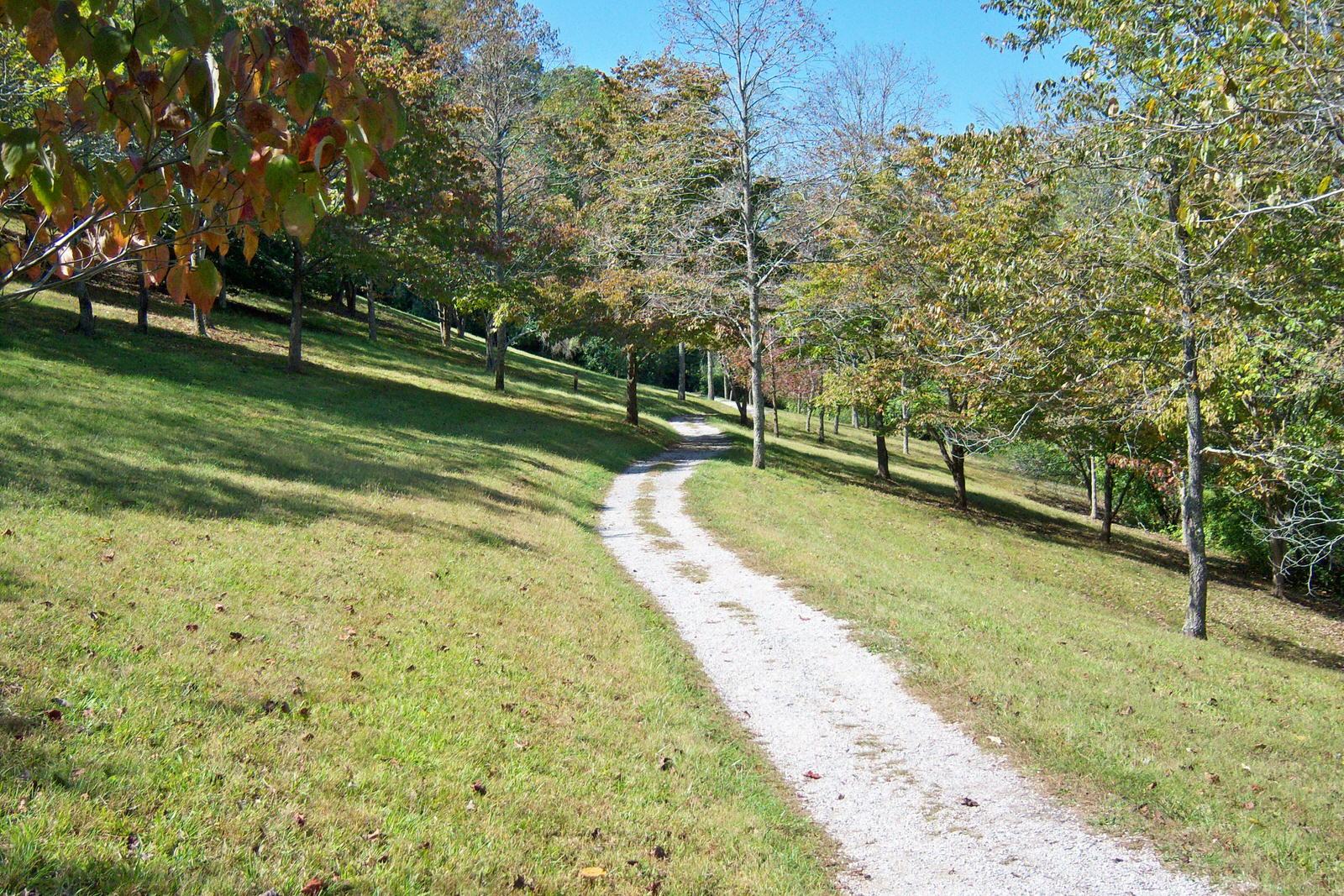
The photo above is a stock photo of the prettiest portion of what is known as the Kiwanis Hiking Trail at Paintsville Lake State Park which is a trail I hike regularly and just hiked today, in fact.  The trail actually begins near the Kentucky Mountain Homeplace which is also well worth a visit.  You can park in their parking lot, and out of courtesy, as far from their headquarters building as possible and start your hike at either end of the trail which makes a loop around the Army Corps of Engineers headquarters and the Kentucky Mountain Homeplace.  The trail has a couple of slight uphills or downhills but is actually rated, in my mind, as easy.  The section in the photo is just east of and below the Corps of Engineers headquarters and a few hundred yards from the beginning on the highway near KMH.  Paintsville Lake and the marina area are below the trail at this point and just east of it.  A small section of the lake is visible from the trail along with part of the marina area.  Then the trail goes away from the lake, crosses the emergency spillway (or gives you the option of shortening your hike a little by taking the emergency spillway until you rejoin the loop of the main trail near the SW corner of the KMH property.  I actually took that option today although I usually hike the entire loop of the trail with an extra twist or two thrown in.  The main loop is more tree shaded, feels a bit more isolated, and has a generally prettier look than the emergency spillway which is actually a cut through in the hillside which leaves a flat grassy area maybe 100 yards wide which functions as the emergency spillway.  

When I say that I throw in an extra twist or two to my hikes here,  what I mean is that I usually park at the spillway near the public restrooms and public trout stocking area, maybe take one full loop around the spillway area and then hit the face of the dam, go straight up the dam to the highway which crosses there to access the Corps of Engineers office and KMH.  I hike straight up several of the flood control lake dams in Eastern Kentucky and I recommend it if you are a strong hiker with a good heart and lungs, strong legs, and a good back.  But all these dams are steep, high, and tough.  The Paintsville dam is especially tough since it has a large area of boulders about 100 feet from bottom to top all across the dam due most probably to some past seepage problem.  Do not attempt this dam unless you are pretty tough and nimble.  The second twist I throw in my hikes here is that when I have hiked about 90% of the entire loop and I am back in the area overlooking the spillway where I park,  I hit the woods downhill toward the spillway.  It is typical Eastern Kentucky woodland, steep, and rocky.  It also has a couple of places where you could fall 30 feet or so.  But in this area, there is an ancient rock shelter, not a cave, but a rock shelter, overhang, whatever you want to call it which I am sure was used historically by both early native peoples and some of the first settlers in the Paint Creek area as temporary shelter.  It would sleep about a half dozen people and IT IS NOT LEGAL TO CAMP IN IT but it is a nice spot to stop for a few minutes at the end of a hike, cool off, and consider how it might have been used historically.  Paintsville Lake and the Kiwanis Trail is a nice hike whether you are looking for a relatively easy loop or if you want to make the loop more difficult as I do.

Sunday, August 1, 2021

Putting Up Peaches! Freezing.


For the past several years, I have bought fresh peaches from a Mennonite friend I know who travels with a truck and trailer to peach orchards in several states and sells peaches from his home in Crockett, Kentucky, in the Mennonite community in which I have so many friends and connections.  We freeze the peaches and use them during the winters for cobblers which are wonderful in cold weather.  We have also begun in the last year to fry peaches just as you would fried apples and they are also a great addition to a country breakfast and a nice flavor break from always eating apples.  Due to both the loss of quite a bit of food value and the extra labor involved, this year we decided to try freezing one half bushel box of peaches with the skins on instead of peeling them.  As a test, we made one cobbler with the first box of peaches we bought a few weeks ago without peeling them and it worked quite well.  I have always eaten fresh peaches skin and all and the idea of eating the skin has absolutely no negative connotations for me.   So yesterday, July 31, 2021, we decided to freeze our second half bushel of peaches with the skin intact.  The amount of waste, especially without hogs or chickens to eat the peelings, is incredibly smaller.  Where we usually have gotten seven bags of peaches, minus the few we eat, cook into a fresh cobbler, and a few to give to an elderly neighbor.  Without peeling the peaches, we got the same amount of eating, fresh cobbler peaches, and give away peaches, but had nine bags for the freezer.  That math makes a lot of sense.  I have to admit that we did not do any research about freezing peaches with the skin on before we attempted this which is not usually our first action.  This morning, after having already frozen the peaches, I have read a few articles on the internet from people who have regularly frozen them with the skin on and they all agree that they like it that way.  But one person said that peaches frozen with the skin on will shed the skin when they are thawed.  We will have to see how that turns out in a month or so when we eat our first bag of frozen peaches.  My niece in Kendallville, Indiana, who has frozen, dried, canned, and preserved food for many years in any way possible says that she uses a hot water bath with peaches to cause them to shed the skins before she freezes them.  We considered doing it that way but decided the extra labor with the hot water made it more attractive to just remove the pits, slice them, and freeze them.  Plus, there were two jobs when I was growing up which I hated with a passion and they were helping can beets and tomatoes because my mother used the hot water bath method to get the skins off the beets and tomatoes and that hot water in a three bushel tub was something that I never came to accept willingly.  I just did not want to repeat the experience with peaches.  

I can't wait until that first fall morning when we have fried peaches as a part of our breakfast. 

Saturday, July 31, 2021

Eating Pickled and Jellied Foods!


I have to thank my Facebook friend Susan Maslowski, for the motivation for this blog post.  Susan insists that she is not a food expert but knows an awful lot about food and food writing. She describes her experience in this way: "I participated in a one-week cooking school at The Greenbrier in the 70s. I no longer write for the Sunday Gazette Mail, but I do a weekly column for their Kanawha and Putnam supplements". The comments on Facebook of one other person, Satine Bonet, who commented on Susan's post about Zeimni Nogi also brought some motivation to the topic.  Zeimni Nogi  is described as "a traditional Polish dish eaten during the cooler months, topped with a squeeze of lemon juice or served with some tasty horseradish". I suspect that in much of Eastern Europe, where rural poverty is widespread, this dish is eaten with far more horseradish than lemon juice since horseradish can be raised at home and lemons would have to imported at a price. I would be willing to try the dish both ways since I love both horserdish and lemons. Here are the succinct directions for making Zeimni Nogi according to Polish Foodies Traditional Recipes: "Polish pigs’ feet jelly is a type of aspic made by cooking root vegetables such as carrots, celery, and parsley with pork legs till it forms a jelly. This jelly is then refrigerated till it sets and is always served cold!"  I have to admit that I have never eaten Zeimni Nogi or even heard of it until today, July 31, 2021.  But I would love to try it.  It looks and sounds fantastic if you like pickled, jellied, or unusual pork based dishes.  Thank God, I grew up in a family where we "ate anything that creeped, crawled, or flew too low over the supper table".  I also grew up in a country store and was literally carried home from the hospital through the door of the country store since we lived in the same building.  I like to say that my parents carried me home from the hospital at three days old, set me on the counter, and told me to greet customers until I was big enough to do something more.  Growing up in the store and, later, being allowed to travel quite a bit, attend Upward Bound, and expose myself to many things, I learned to like a lot of foods and other experiences which many people avoid.  

We sold, frequently ate, and sometimes made a variety of either  pickled or jellied products including souse, pickled pigs feet, pickled bologna, pickled eggs,and pickled wieners. Let me also say here for the record that I know full well that Zeimni Nogi is not pickled.  It is jellied.  But several of the other foods, both pickled and not, which I am about to discuss are jellied. All these foods were brought to mind by my learning about Zeimni Nogi.  I still love all the pickled and jellied foods I was raised on to this day but rarely eat them anymore because of a well managed history of high blood pressure.  I also love to eat organ meats from hogs, especially what we call "lights" better known to the general public as pork lungs.  I used to love souse so much that for a year while I was working for a company called Vision Quest and stationed in Franklin, Pennsylvania, I had a souse sandwich once a week for lunch.  One of my assignments at that time was that one day a week I supervised a crew of juvenile offenders who were doing community service by helping the city maintenance foreman to pick up recyclables all over town.  The offenders' reward for their work was that they got taken, along with me, to the local grocery store deli for lunch.  I ate so many souse sandwiches there that I could walk into the store, head toward the deli, and one of the deli workers would open the door to the cold cut cooler and begin to slice souse.  I remember the best homemade souse I ever had which, sadly, was not made by my mother.  I was working as a salesman in Logan, West Virginia, and worked with a female friend whose best friend and surrogate mother was an 80+ year old African American woman who lived in Main Holden, an old coal camp near 22 Holden which was the scene of  a famous coal mine disaster.  This old woman agreed to make and share the souse if I would buy the hog heads which I did.  This old woman made incredible souse which I still remember nearly 30  years later and I only got to eat her souse once in my life.  I was also raised on pickled eggs which are best pickled in beet juice as are pickled bologna or pickled wieners. You add the boiled eggs, wieners or bologna to the pickled beet juice in a big mouth gallon jar and wait at least a week before you sample them.  They are awesome done that way and the longer you pickle them the better they taste.  But getting back to pork organ meats, they are all great but nothing is better than pork lungs, "lights", boiled with some kidneys, spleens or "melts", hearts, livers, and potatoes in a great big stock pot.   They are incredible. Then you throw in some fresh green onions, sliced tomatoes and cucumbers, and cornbread and you have a feast. 

 In Western North Carolina, they  make an organ meat based food which they love and even have festivals for called Liver Mush which is made with pork livers and other organ meats along with spices and cornmeal.  Here is a simple recipe for Liver Mush:  "pig liver, pig head parts such as snouts and ears, cornmeal and seasonings". It is commonly spiced with pepper and sage. The meat ingredients are all cooked and then ground, after which the cornmeal and seasoning is added.  Then, as I understand it, the Liver Mush is placed in loaf pans to congeal, sliced, and later recooked on a grill.  The truly fascinating aspect to eating Liver Mush is that it is generally eaten in two ways, usually as sandwiches: 1) with mustard; and, 2) with grape jelly.  Now that is an interesting contrast and as, I understand it, just like Alabama and Auburn football there are devoted fans on both sides. It is also my understanding that North Carolina state law actually regulates the minimum percentage of pork liver which must be in Liver Mush in order for it to be legal to sell. By law in North Carolina, the product must consist of at least 30% pig liver. I can't wait to eat some good homemade Liver Mush and Zeimni Nogi. 

Friday, July 30, 2021

Hiking In Greenbo Lake State Park

 A few days ago on my birthday, one of the big ones, my wife, Candice, wanted to take me somewhere so I could hike in the woods and we could eat out which we haven't done much of in the last fifteen or eighteen months due to the Covid 19 pandemic.  The numbers in Kentucky hadn't quite fully turned the corner as they have now and we decided to take a chance since we are both fully vaccinated.  We had been to Greenbo Lake State Park once before and enjoyed that trip a great deal.  Greenbo Lake is one of the smaller man made flood control lakes in Kentucky.  The largest, Kentucky Lake has over 160,000 surface acres.  Greenbo Lake, at 225 acres, is not much more than a pond compared to the largest lakes which all have over 100,000 acres.  But it is a very pretty little lake with some really good hiking trails in the state park which contains it.  


Greenbo Lake State Park also has some historically important coke ovens, a restored one room school, and two unmolested small cemeteries which is unusual in the Kentucky State Park System.  I have written in other places on this blog about the relocation of graves during the construction of lakes and highways in the state.  I have hiked in numerous Kentucky state parks situated around lakes and nearly everyone I have ever hiked in has relocated cemeteries in them which usually were placed in a common government cemetery near or in the park.  I have also published a short story about the relocation of family cemeteries for the construction of a lake this past spring in Seeds 2021, the literary magazine from Northeastern Illinois State University.  My short story is entitled "Damn!" and can be found at numbered page 74 in the online journal at the previous link.  However, the page numbers in the online version do not synch with the page numbers in the table of contents.  That story is actually located at page 85 according to the internet counter.  


 But, let's get back to the hike at Greenbo Lake.  The park has three marked trails which come to a total of 32.8 miles of possible hiking without leaving marked trails and striking off into the woods with a compass or GPS.  I chose the trail which begins near the handicapped fishing pier not far from the boat launching and storage area because Candice has been in a wheelchair for over twenty years and wanted to read near the pier while I hiked for an hour.  I  rarely hike an entire trail anywhere but instead hike out for a little over a half hour and double back to wherever Candice is waiting for me and we always choose a safe location for her to stay.  This particular trail, so far as I hiked it for about 1.5 miles is within sight of the lake in the woods with a few relatively easy uphills and downhills.  I would rate that portion of this trail as easy.  I never saw another human on the trail except for one fisherman in a pontoon boat who happened to be fishing alone within sight of the trail.  He and I had a friendly conversation as he fished for a couple of minutes which was a unique experience for me while hiking to be able to talk to someone actively fishing although I have done it at Eagle Lake on the campus of my alma mater, Morehead State University.  I hiked outward for about 40 minutes and turned around which brought me out of the woods exactly on the one hour mark.  Early in the hike, I encountered the only interesting wildlife of the hike, a small black racer about two to two and a half feet long.  It froze when it saw me on the trail about ten feet above it.  I started to bend over to pick up a small peeble to toss near it to see how it reacted and it instantly turned and disappeared into the leaf mold below me even before I could grasp a pebble.  It was about 85 degrees at the time and any cold blooded animal such as a snake was in firm fettle for traveling on such a day.  I did not have a camera with me and do not have a photo of my little friend.  

After my hike, Candice and I returned to Grayson, Kentucky, to search for a place to dine inside which we hadn't done in quite some time.  After driving all over Grayson looking for an open dining room, we wound up at Huddle House which was the only one we could find with indoor seating.  We went in wearing masks, which is my suggestion to anyone in public until the pandemic is over.  The only people in the restaurant in early afternoon were the cook, the manager, and one waitress behind  the counter and one other couple eating in a booth well away from us.  So we took off our masks which is necessary if you intend to chew anyway.  The hired help was friendly and we talked freely about whatever popped up.  The manager said the day before had been his birthday and I mentioned that this particular day was mine.  A bit later an older man and a young boy who appeared to be his middle school aged grandson came in and sat down well away from us and also ate.  No one else came in the place during our meal.  We actually felt safe in the face of  Covid 19 in light of the low population, good social distancing, and our vaccination.  After eating, we drove back home and it was, according to all measurements, a day well spent.