Search This Blog

Showing posts with label women. Show all posts

Sunday, June 23, 2024

Thoughts On Reading "Imperial Woman" by Pearl S. Buck


Over the years, I have read about 10 of Pearl S. Buck's fine novels and written about several of them on this blog.  Recently, in a large purchase of used books from the estate of a former school principal in this community, I obtained several first editions of Buck's novels including a copy of "Imperial Woman" which was published in 1956.  I had never read it and completed it a few weeks ago although I have procrastinated about writing a blog post about it for no good reason.  After having read all three novels in the "Good Earth" trilogy, three novellas which were published under the pseudonym John Sedges, "The Living Reed" which is a Korean novel and, in my opinion, one of her finest other than her masterpiece "The Good Earth".  I love her work and don't believe that she ever allowed herself to write and publish a second rate book.  I had loved "The Living Reed" nearly as much as "The Good Earth", but I have to say that I am now convinced that it must be at most her third best novel running behind "Imperial Woman" and "The Good Earth".
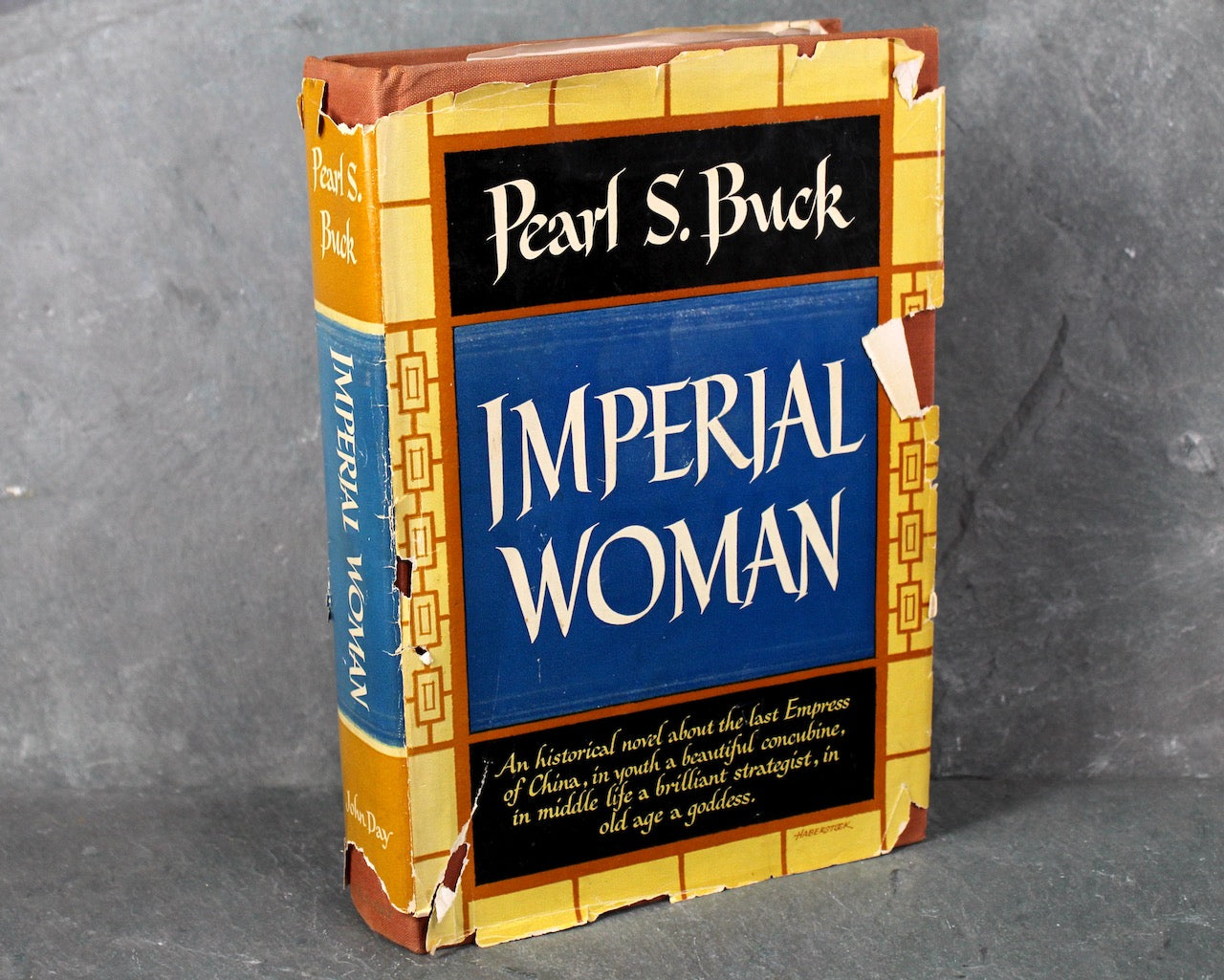
 Pearl S. Buck - Imperial Woman, 1956 FIRST EDITION/Second ...

"Imperial Woman" is a fictionized biography of Tzu Hsi, the last empress of China who was born of low caste and brought into the Forbidden City as a candidate to become a concubine of the sitting emperor at the time.  She is not only chosen to be one of his concubines but manages to bear him a son, the heir to the Dragon Throne, and becomes his most beloved partner and advisor.  She initially devotes her life to helping her son gain and maintain the throne.  But due to the many weaknesses of her son and his early death, she then manages to gain total control of the kingdom through a male heir she has chosen from the family of one of the dead emperor's advisors.  With the help of her cousin Jung Lu to whom she had been betrothed prior to her becoming a royal concubine, she not only managed to hold onto power but increased her power and popularity over the kingdom while living as a  conflicted type of ruler who is loving, devout, and intellectual while also being absolutely ruthless when it becomes necessary.  

It is said that Buck strove to depict both sides of the empress, who is actually only a regent for the child emperor she has chosen. Buck did an excellent job of achieving that goal.  The character of the empress can be loving and devoted to her son and the few people she allows to be closer to her while also being capable of ordering the deaths of those who oppose her.  She is a powerful and powerfully depicted ruler.  She is also dealing with a lifelong conflict between her love for Jung Lu and the inability to allow it to be a public matter in her royal role.  She arranges a loveless marriage for Jung Lu with one of the women who assists her on a daily basis and they both live with the conflict of being in love and unable to allow that love to be manifested fully.  

This is one of Pearl Buck's best efforts in my opinion and well worth reading by any lover of great literature.  It helps prove, along with "The Living Reed", that Pearl Buck's best work was not finished after "The Good Earth".  She was an incredible novelist and knew the China in which he spent much of life as few Americans ever could.  If you haven't read it, find a copy and reward yourself with this wonderful book.  

Thursday, April 18, 2019

"...And Ladies Of The Club" by Helen Hooven Santmeyer--Book Review

When this epic novel was published in 1982, the author Helen Hooven Santmeyer was 87 years old and living in an assisted living facility in her southern Ohio hometown.  The book made Santmeyer an overnight success at a time when most of her childhood friends were long dead. It covers life in a small,fictional Ohio town from 1868 to 1932.  The book rocketed to the top of the New York Times bestseller list and made Santmeyer famous long after her previously published four books had amounted to almost nothing in sales or public acclaim.  One other book was published posthumously and one biography has been written, "Early Promise, Late Reward" by Joyce Crosby Quay. 

Helen Hooven Santmeyer Photo by G.P. Putnam Publishers
I initially bought but never finished a copy of the book in the 1980's after it made the best seller lists.  At the time, I read a few chapters and thought "this is a well-written book but it is just a women's book" which is nowhere near the truth.  I finally read it this time, nearly forty years after it was published, following a conversation with my wife and we read it together.  The book is a sweeping story about the fictional town of Waynesboro, Ohio, and begins shortly after the Civil War.  It follows the lives of the town and its people until the Great Depression.  It is filled with the members of nearly a dozen families who figure prominently in the life of the town and the characters are woven around and into the life of the Waynesboro Womens Club which is formed in the first chapter and continues for the life of the entire novel.  The families live in close proximity in a small Midwestern town and intermingle, intermarry, live, reproduce, die, and generally accomplish admirable lives.  Only one or two characters ever fail to amount to something useful and nearly all of them are striving to become somebody the world would be proud to know.  This is truly an epic novel in every sense of the word and is just as important in the overall story of American Literature as "The Grapes Of Wrath", "East Of Eden", or Frank Norris' Wheat Trilogy of "The Octopus", "The Pit", and "The Wolf".  At the last possible moment, Santmeyer managed to take a well deserved place in that group of American novelists including Frank Norris, Ernest Hemingway, and Pearl S. Buck who have produced great epic novels by grinding on day after day, week after week, year after year in the pursuit of an epic. 


When we ask ourselves "what is an epic novel", we sometimes come up with wide ranging and contradictory opinions of exactly what the term means.  After a diligent search on the Internet, I still wonder exactly what the term means.  One definition I found and like says that "an epic novel [is] one that is epic in scope and theme -- a text that covers a vast expanse of space and time in its quest to uncover answers to the deepest questions of human existence".  In fact, most definitions of epic seem to revolve more around poetry than novels.  It actually appears that even literary people cannot pin down a precise definition of an epic novel.  In my mind, an epic novel must cover a large span of time, let's say at least fifty years, and be centered around the lives of a fairly sizeable group of characters who go about the daily business of living.  Santmeyer's novel definitely fits that definition. 

The primary characters are the members of the Waynesboro Women's Club, their husbands, children, grandchildren, and even a few great-grandchildren.  The two most important families in the novel are the Gordon's, with Anne Gordon as the matriarch, and the Rausch's with Sarah "Sally" Rausch as the matriarch.  By the end of the novel, nearly every major character has lived and died.  Some of the deaths, including one suicide of a minor character, are  notable.  Some are ordinary and as simple of falling dead over an unlit kerosene heater due to a heart attack.  The Rausch patriarch, Ludwig, is a German immigrant and Civil War veteran.  His best friend, John Gordon, is the patriarch of the Gordon family.  If there is a major hero in the story, it is Ludwig Rausch although other characters live somewhat heroic lives, both male and female.  The story flows naturally through marriages, unrequited love affairs, adultery,  childbirth, epidemics, floods, and fires.  There is rarely a dull moment and the novel is well worth the number of hours the average reader will need to commit to completing it.

I tend to believe that many, if not all, of the female characters are partial presentations of Santmeyer herself who never married and worked most of her life as a librarian in a small private college.  Some of these women marry and produce long lines of progeny which Santmeyer never did.  But each of them tends to show some aspect of the life of a well-read, intelligent, self-assured, working woman which Santmeyer was to the very end of her long and productive life.  There is a young female writer working to produce good books.  There are more than a few female librarians and one or two spinsters.  The males are generally well respected and the only real villain is a woman.  At times, the novel does use some archaic terms to depict African Americans and yet one of the few women who survives the entire epic is a black housekeeper who has been totally devoted to her employing family all her life.  Ludwig Rausch is also quite loyal to his black employees just as he is to his white workers. 

This novel is well worth reading and has even led me to believe that, if I ever  find the time, I would like to read more of Santmeyer's books.