Search This Blog

Showing posts with label Pearl Buck. Show all posts

Wednesday, February 12, 2025

"This Proud Heart" by Pearl Buck

On several occasions on this blog, I have written about the works of Pearl S. Buck, one of the small handul of American writers to receive a Nobel Prize in Literature and one of my favorite writers of all time. I have writte3n about "The Good Earth", her most famous novel, which I believe is also one of a very small group of the best novels in all of literature. She followed "The Good Earth" with two other novels in the "Good Earth" trilogy, They are "Sons" and "A House Divided". While either of those novels could have been a career best for many writers, they are not among Buck's best works. I read everything I come across by Buck and still have numerous of her books to be read. Fortunately, a year or so ago, I bought a large collection of books, actually 5 commercial peach boxes full, from the estate of a local school principal. This one we are discussing today I found in a small group of books I bought at a small "junk store" in Rowan county Kentucky which also included a unique first edition of Jack Kerouac's first novel, "The Town And The City", which was published under his legal name John Kerouac, the only one of his books to have been published that way. "This Proud Heart" is one of Buck's lesser known novels which is set in the United States with purely American characters for the most part. The protagnonist is a brilliant woman, Susan Gaylord, and begins when she is a high school student who has shown a great deal of talent in more than one area. She is the daughter of a professor father and a dedicated housewife mother, has one sister, Mary, several years younger and not really close to her older sister. Her father is a somewhat frustrated poet in addition to being a professor in a small college. He has chosen to devote his life to his familiy and his primary profession but does manage to write poetry and publish some of it in small magazines. Susan comes to understand her father's frustration with his life decision and vows to do more to control her own life and its outcomes. She is a talented artist and piano player as the book begins but chooses to marry her high school sweetheart, Mark, who is a totally devoted husband to her and works in the real estate business after they marry. But Susan finds herself interested in sculpture and uses a barn on the old farm they buy to create a piece in wood which is composed of a family of four, a husband, wife, and two children, a son and daughter. That piece is submitted to a contest for a piece to be placed in the lobby of a hospital financed by a very rich man in New York. The piece and her work in general is supported by a famous male sculptor, David Barnes, who has a house in the small New England town in which Susan and her family live. Barnes is a brusque, short spoken man who has strong opinions about Susan's talent and her inablility, as he sees it, to succeed as a sculptor in the United States. He strongly encourages her to come with him to Paris to study under another great sculptor and a man who teaches anatomy to sculptors. She refuses until the untimely death of her husband Mark due to typhoid fever. After his death, she packs up her children and their maid to travel to Paris to actually do what Barnes has suggested. During her time there, she meets another man, Blake Kincaid, who is also a sculptor of much less talent than Susan. They fall in love and she marries Blake which proves to be a less than perfect decision. They return to New York where he lives in considerable wealth and she grows more and more hampered by his efforts to control her, minimize her talent, and disparage her work as a sculptor. She comes to realize these things about Blake and rents a studio in the poor neighborhood near his ostentatious home where she meets and sculpts marble statues of some of the people in the neighborhood. David Barnes returns to the novel from Paris and assists Susan in getting her works into a gallery for an exhibition which confirms her talent and leaves her with a full understanding that she cannot succeed as a sculptor if she remains with Blake. She moves her family back to her hometown after the death of her father and decides to end her relationship with Blake. The novel leaves the whole situation somewhat in midair at the ending but we see that Susan has been able to understand that she must be independent in order to do her best work. The novel is also widely discussed as one of Buck's better works in support of feminism. Susan Gaylord is a strong, successful, competent, talented, and highly motivated woman. For the time in 1938 when the novel was published, she is an amazingly modern woman. I suspect that this novel is somewhat biographical with the sculpting being a substitute for Pearl Buck's writing and Blake being a character based on Buck's missionary first husband whom she divorced to marry her editor and publisher after her early work caused such a stir in the literary world. While I would not say this is one of Buck's best novels such as "The Good Earth", "Imperial Woman", or "The Living Reed", it is a fine novel and well worth reading.

Sunday, June 23, 2024

Thoughts On Reading "Imperial Woman" by Pearl S. Buck


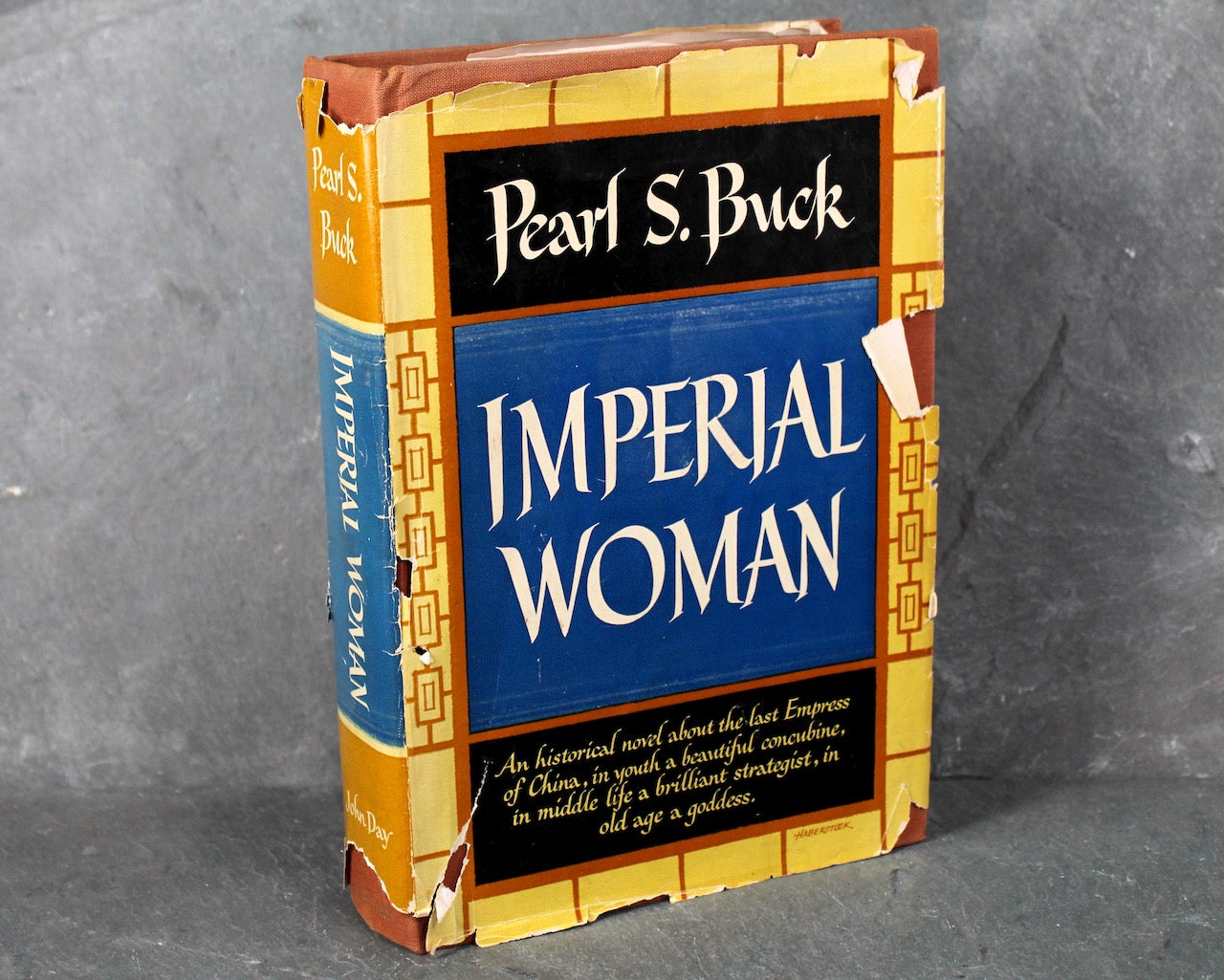
Over the years, I have read about 10 of Pearl S. Buck's fine novels and written about several of them on this blog.  Recently, in a large purchase of used books from the estate of a former school principal in this community, I obtained several first editions of Buck's novels including a copy of "Imperial Woman" which was published in 1956.  I had never read it and completed it a few weeks ago although I have procrastinated about writing a blog post about it for no good reason.  After having read all three novels in the "Good Earth" trilogy, three novellas which were published under the pseudonym John Sedges, "The Living Reed" which is a Korean novel and, in my opinion, one of her finest other than her masterpiece "The Good Earth".  I love her work and don't believe that she ever allowed herself to write and publish a second rate book.  I had loved "The Living Reed" nearly as much as "The Good Earth", but I have to say that I am now convinced that it must be at most her third best novel running behind "Imperial Woman" and "The Good Earth".

 Pearl S. Buck - Imperial Woman, 1956 FIRST EDITION/Second ...

"Imperial Woman" is a fictionized biography of Tzu Hsi, the last empress of China who was born of low caste and brought into the Forbidden City as a candidate to become a concubine of the sitting emperor at the time.  She is not only chosen to be one of his concubines but manages to bear him a son, the heir to the Dragon Throne, and becomes his most beloved partner and advisor.  She initially devotes her life to helping her son gain and maintain the throne.  But due to the many weaknesses of her son and his early death, she then manages to gain total control of the kingdom through a male heir she has chosen from the family of one of the dead emperor's advisors.  With the help of her cousin Jung Lu to whom she had been betrothed prior to her becoming a royal concubine, she not only managed to hold onto power but increased her power and popularity over the kingdom while living as a  conflicted type of ruler who is loving, devout, and intellectual while also being absolutely ruthless when it becomes necessary.  

It is said that Buck strove to depict both sides of the empress, who is actually only a regent for the child emperor she has chosen. Buck did an excellent job of achieving that goal.  The character of the empress can be loving and devoted to her son and the few people she allows to be closer to her while also being capable of ordering the deaths of those who oppose her.  She is a powerful and powerfully depicted ruler.  She is also dealing with a lifelong conflict between her love for Jung Lu and the inability to allow it to be a public matter in her royal role.  She arranges a loveless marriage for Jung Lu with one of the women who assists her on a daily basis and they both live with the conflict of being in love and unable to allow that love to be manifested fully.  

This is one of Pearl Buck's best efforts in my opinion and well worth reading by any lover of great literature.  It helps prove, along with "The Living Reed", that Pearl Buck's best work was not finished after "The Good Earth".  She was an incredible novelist and knew the China in which he spent much of life as few Americans ever could.  If you haven't read it, find a copy and reward yourself with this wonderful book.  

Monday, August 31, 2020

Turkey Craw Beans, Appalachian Language, and Writers Learning About People

Two separate incidents over the last week or so have led me to write this post which I find interesting whether you readers do or not.  On a Letcher County Kentucky Facebook buy, sell, trade group, I saw a person offering to sell what they were calling "Turkey Crawl Beans".  Although I have not seen Turkey Craw Beans to my knowledge, I knew instantly that this person had made a common mistake by either not understanding what they had been told about these beans when they got the seeds or they had just not bothered to learn their real name.  In my childhood, I heard hundreds of older Appalachian people sit in our country store and talk about thousands of different subjects and I learned an awful lot about the native Appalachian dialect.  So I did some research on the internet and found a website called "Local Harvest"  which has a pretty good description of Turkey Craw Beans and some excellent photographs of them. Not only was my first guess substantiated but the story got even better because there is some belief that the person who found the beans in the gizzard of a turkey was also a slave. The photos I have attached to this post are also from that website and, if you use them, you should also give Local Harvest proper photographer credit.   I also sent an e-mail to two of my friends, Bill Best, who is the author of two very good books about heritage Appalachian food crops,  and Frank Barnett, who is also an expert on Appalachian food crops and an expert on Appalachian Heritage beans.  Both responded and both have Turkey Craw Beans in their collections.  Frank has this to say in his response:

Roger,

Yep, we both have the Turkey Crawl (sp) bean. It is not an uncommon bean in the area. 

The seed I got was from Bill and I only raised it one year. However, in Lincoln County, WV the bean goes by the name of Harts Creek which I also raised. Same variety but a much better story about Harts Creek. I was underwhelmed by both.

This is what Bill Best had to say: 
 
Roger, I don’t remember who first gave me the Turkey Craw bean  but I believe it was Eugene Parsons of Lee County, Virginia.  Had he lived he would be a hundred years old this year but a (sic) died of Alzheimer’s several years ago.  There is a story about Eugene in my first book on heirlooms.  What to me is significant about the bean is that it seems to be the dominant bean in all three states of the Cumberland Gap area.  I remember as we walked through his garden Eugene had bean vines running up into nearby trees.  The Lee County ag agent, Harold Jerrell, took me to meet him at his home and in his garden.  Harold is also featured in the first book because of his seed saving and tree grafting.

I do think that turkey craw is the original name of the bean.

As you can see, I still listen to other older Appalachians, especially those who are experts on some narrowly focused subject such as heritage food crops or simply Turkey Craw Beans.  
Turkey Craw Beans, Photo by www.localharvest.org

One of the most common words in the Appalachian dialect is "craw" which is used as a synonym for several words including gizzard, throat, gullet, esophagus, etc.  A common use of the word when the user is upset is to hear them say "that sticks in my craw" which translates to "that upsets me" and is analogous to becoming choked on something which is difficult to swallow.  In fact, some of the very same people who use the previous expression, "that sticks in my craw",  might also use the similar expression "that was a little hard to swaller".  So when I saw the mistaken use of "Turkey Crawl Beans", I knew instantly that the person was actually trying to sell Turkey Craw Beans.  And, without any extensive knowledge of Turkey Craw Beans, I also instantly knew that the original person who recognized and named these beans had either found them the first time in the gizzard of a turkey they had killed or that some portion of the beans, at some time in their development, was shaped a bit like a turkey gizzard.  So I went looking for some answers on the internet and found a website called "Local Harvest" which has an excellent, but brief,description of Turkey Craw Beans.  The story got even better when I learned that Local Harvest believes the person who found and named Turkey Craw Beans was a slave sometime before the Civil War. There are several other seed saver and seed sales sites which carry some version of the same story about a turkey gizzard although all of the sites do not mention the possible connection to slavery.  Bill Best responded to me in a second e-mail regarding the possible slavery connection:


One comment on Turkey Craw beans:  I had never heard about the slave story and I’m wondering how it came to be.  Since the variety is located mostly in the Cumberland Gap area, and since that area was not known for having slaves, I’m wondering how that might have come to be.  I’m also wondering if many slave owners would have trusted their slaves with guns.  As a tiny kid I asked my mother how the Goose Bean came to be.  She told me that her grandfather had shot a wild goose and when she was cleaning it for cooking, she found the seeds in its craw and the bean had been part of our family collection since that time.  I later learned that thousands of children in the Southern Appalachians had been told the same story.  The Goose Bean is also called the Goose Craw Bean in many areas.

Bill's comments about slavery being relatively rare in the Cumberland Gap area is dead on and so is his suspicion that few slave owners would have trusted a slave with a gun.  But it strikes me that on rare occasions with an older, trusted slave a slaveholder might have taught them to use guns and allowed them to hunt at times since one of the primary reasons many people in that area did not own slaves was related to necessity to provide slaves with at least a basic subsistence.  However, it is also possible that some slaves might have hunted with sling shots or even thrown rocks at game which was less flighty two hundred years ago.  There is also the well known fact that slaves performed most of the undesirable jobs on a farm such as cleaning all types of fowl whether wild or domestic and such a slave could have simply found the beans while cleaning a turkey (or goose as Bill Best mentioned) for their slaveholder.  Slaves also frequently did the great majority of work in tending plantation gardens and a slave could well have had sufficient leeway to plant a few seeds they found.   


In the other incident which triggered this post,  my wife and I have been reading a Pearl S. Buck novel called "The Long Love" which I will write about in a few days.  It is one of the five novels which Buck wrote and published under the pseudonym John Sedges.  I have written earlier on this blog about two of those novels, "The Townsman" and "Voices In The House".  I actually like "The Long Love" a bit better than either of the other two although they are also good novels. Also, I recently published a memoir piece called "Christmas On Beaver Creek" in a book from the Jesse Stuart Foundation called True Christmas Stories From The Heart Of Appalachia".  In that memoir piece, I talked about hiding behind a stand up Coca Cola Santa Claus in our store as a child in order to listen to older people talk about subjects like Old Christmas and the Biblical story of Christmas along with any other topics I could hear discussed.  And, to complete the loop back to the Turkey Craw Beans, I had learned enough about Appalachian dialect in those nights in the country store to know that the person trying to sell the beans had not known the actual name of the beans.  In other words, it pays to pay attention especially when you are young.

Turkey Craw Beans, Photo by www.localharvest.org
  The tie in between the Turkey Craw Bean story and "The Long Love" lies in the fact that in one fairly long section of the book Pearl S. Buck has a character who is a novelist who grew up in the town in which her novel is set and he talks at length about all the things he learned about the town and its people by listening to them talk in their homes and other settings during his childhood.  I laughed out loud as I was reading that section because it ties in closely with my previous mention of the memoir piece "Christmas On Beaver Creek" which was published as a chapter in the aforementioned book from the Jesse Stuart Foundation called "True Christmas Stories From The Heart Of Appalachia".  In that memoir piece, I talked about hiding behind a stand up Coca Cola Santa Claus and listening to older Appalachians talk about hundreds of subjects including Old Christmas and the Christmas story from the Bible.  I also learned enough while listening behind that Coca Cola Santa Claus to have sufficient knowledge about Appalachian dialect to know that the person trying to sell the beans did not know what they were talking about.  I realize I repeated the account of  the Coca Cola Santa Claus in two slightly different versions here but I wanted to make absolutely clear the connection between that incident and the Turkey Craw Beans.

This little experience has been educational for me and I hope it has for at least a few of my regular readers. 


Thursday, April 9, 2020

"Voices In The House" by Pearl Buck (John Sedges)--Book Review

This is the second of Pearl S. Buck's five pseudonymous novels which she published under the pen name John Sedges.  This novel is also included in the "American Triptych" edition of three of the John Sedges novels and is best bought that way if you intend to buy and read it.  This is a fascinating novel which is completely uncharacteristic of anything else I have ever read by Buck.  The book is set in Manchester, Vermont, in the home of an attorney and his wife who live in a spacious, multi-wing mansion with three servants.  The novel is a story of several conflicts: the conflict between the classes of the rich and their servants; the conflict between immigrants and natural born citizens; the conflict between the rich and the poor in general; the conflict between attorneys and the criminals they represent; and, most importantly, the conflict between men and women, husbands and wives, about their different expectations, desires, and needs regarding their sexual relationships.  The book is considerably shorter than the first John Sedges novel I read and wrote about on this blog, "The Townsman".  This novel, and the other John Sedges novel I just mentioned are completely different in nature from Buck's better Asian novels such as "The Good Earth Trilogy" and "The Living Reed" which is set in Korea.  But it is well worth reading and its complexity of issues are dealt with really well in the roughly 130 pages which she used to tell the story of the wealthy Asher family and their servants, a mother, daughter, and son-in-law of German immigrants.  

The Asher family is composed of the attorney, William Asher, his wife Elinor, and their three children, two sons and a daughter, along with their spouses and the children of one of the sons.  The servants are composed of Bertha, the German immigrant mother who has been with the family for forty years; her daughter Jessica, who grew up in the Asher home except for the period she spent in a Canadian convent when Bertha shipped her there as a young girl due to conflicts between the two of them which is also a major theme in the novel; and Herbert, who is eventually Jessica's husband and serves as the butler and chauffeur for the family.  Jessica's relationships with everyone in her life are contentious and she lives in a fantasy world in which she is naturally entitled to be a part of the rich family and to live in the palatial house of her own right.  Her conflicts with her mother and the Asher's are rooted in this fantasy.  Her conflict with Herbert is rooted in his belief that he is entitled to "my rights" as a married man to have sex at his whim.  A second cousin of Mrs. Asher, Cousin Emma, is eventually the victim of a horrendous murder by having darning needles driven through her eyes into her brain.  After that disclosure, I don't wish to ruin the book by telling you more.  It is well worth reading.  Try to find a copy of the "American Triptych" edition, which I have been told was originally a book club edition, and read all three of the novels it contains. The "American Triptych" edition can usually be located on the major used book websites at a reasonable price. You will not be disappointed.