Search This Blog

Thursday, May 27, 2021

Watauga County, NC, Has Lost An Important Cultural Asset

The image above is a print of a painting of the 100 plus year old home in which the greatest Appalachian storyteller Ray Hicks spent nearly his entire life.  The original painting was called "Ray's Moon" by Bob Timberlake and depicts the house which was located on Old Mountain Road above Banner Elk, North Carolina and stood for 121 years until the wee hours of the morning of Tuesday, May 25, 2021, when it was burned to the ground in a fire whose origin is so far unknown.  Although Ray Hicks died on April 20, 2003, and his wife Rosie died on January 31, 2014, it was reported by HCPress that the Hicks family still owned the house and the farm on which it was located.  The photograph belows is of Ted Hicks, the son of Ray Hicks, and the old house as it was when the family was living in it.  Ray Hicks' children were at least the third generation to live in the house.  
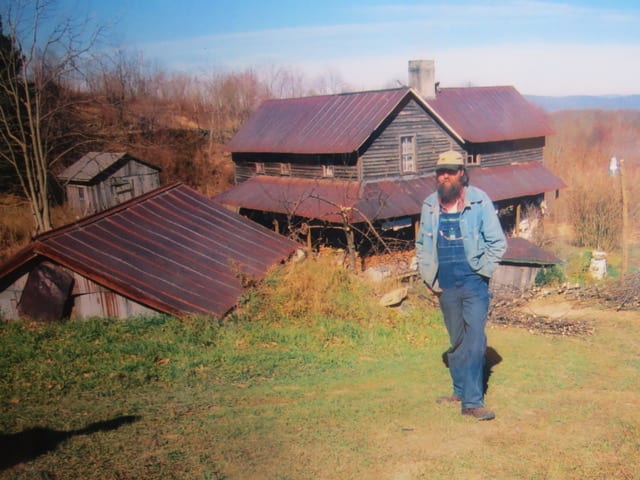

This old house was much more than a house.  It was a symbol of the North Carolina High Country lifestyle of self-sufficiency, farming, herb gathering, instrument making, story telling, and subsistence farming which the Hicks family and their neighbors had practiced for at least 200 years.  The house and its loquacious owner have been immortalized in books by Robert Isbell, Thomas Burton, Shannon Hitchcock, Christine Pavesic, and Owen Smith. It had also been the scene of several video recordings of Ray Hicks practicing the Appalachian storytelling for which he was the acknowledged grand master for the majority of his life. Several of those recorded stories and/or interviews are still available on YouTube. I have been fascinated by the life and story telling of Ray Hicks for less time than I should have been.  I only became interested in his works over the course of the last year or so and began to read books about him and his wife Rosie secondary to having studied the work of Leonard Roberts, who was also a great storyteller, collector, and author in his own right.  But, Ray Hicks was the man other Appalachian story tellers tried to emulate and always came up short in the effort.  

Sherrie Norris of High Country Press wrote the best report of the tragic fire which consumed the Hicks home on the morning of May 25, 2021, and that story can be found on the High Country Press web page.  But their web service is not very conducive to links in other articles or websites and her article is best found with an independent Google Search  using some phrase such as "Ray Hicks Home Burns".  I will quote some from Ms. Norris' excellent, highly personal, and very well written article because her appreciation for and love of Ray Hicks, his stories, and the old house shine through that article in a way which anyone who did not personally benefit from knowing Ray could never equal.  Early in the article, Sherrie Norris says this: 

"Many of us who were “lucky enough” will carry memories for our lifetime of climbing the curves to Old Mountain Road, looking out over the expansive, majestic view of four states, as Hicks often pointed out, and descending the worn pathway down to the place he called home."

Ms. Norris' article also makes it apparent that her love of the place included the house, the farm, the surroundings, and the lifestyle which Ray Hicks and his family had practiced for many years and continued to practice long after many others around them had abandoned that lifestyle.  

"Built by his grandfather, the house stood as a shrine of sorts, welcoming guests for decades from near and far. Whether we sat on the steps of the porch beside the woodpile, on the woodpile, in a ladder-back chair, or inside the house around the old wood stove — in awe of the unique father of Jack Tales himself — visitors were entertained and captivated, all at once. Even after his death, his closest followers gathered at the house in his honor several times in an effort to keep his memory alive.  When he died in 2003 at the age of 80, Hicks left behind a legacy that will not soon be forgotten."

Importantly, Ray Hicks' legacy was built of far more than the old house and that legacy will survive.  But the house was an important part of Ray Hicks and that legacy.  The old house with its ever present woodpile on the porch, the old cane bottom chairs for the frequent visitors who came to sit at Ray's feet and listen to his tales, and that old wood burning stove which Ray had uniquely crafted in the living room to heat the massive, old, poorly insulated house, were all a part of the total picture presented by the lanky 6' 7" Ray Hicks whose favorite way to spend time was passing on the Jack Tales and other stories he had learned and preserved in his 80 years on Beech Mountain.  In addition to preserving the tales he had heard during his formative years, there are also dozens of stories which Ray created in his own right.  

Ray Hicks was a self-made man who never amounted to much in the world when it came to money but he had a great deal of wealth in the thousands who gravitated to him and his tales of common people who overcame uncommon problems; killed giants; escaped witches, ghosts, and goblins; used common sense and everyday objects to always win in the end.  Ray Hicks won in the end and he won every time some new visitor traveled to Beech Mountain to sit on the porch of that old house and listen to this man with little education, a wonderful way of telling the stories of his childhood and his life, and a compassionate, all encompassing love for the common man and woman who always got back up and fought on against long odds to win in the end.  When that old house burned, North Carolina and America lost a cultural icon and a symbol the American pioneers who landed in the Tidewater and traveled deep into the mountains in order to build a new life and a new freedom far away from European plagues, kings, and ironclad class systems.  But the memories of Ray Hicks and that old house will always live on.  


Tuesday, May 25, 2021

"Same Sun Here" by Silas House and Neela Vaswani--Book Review


This is an adolescent book by Silas House and Neela Vaswani which has been widely applauded for several reasons.  It is a cooperative work by Silas House, who is the Director of The Loyal Jones Appalachian Center at Berea College, and Neela Vaswani, who has written several other books in a couple of genres including short stories and memoir.  This is the first book I have read by either author.  I read it primarily because my wife and I bought it to possibly give to our 11 year old nephew in Wisconsin and wanted to review it before sending it to him.  The book is written in the form of pen pal letters between a 12 year old Appalachian coal miner's son, River Dean Justice, and an Indian immigrant girl, Meena Joshi, of the same age in Chinatown in New York City.  Obviously, each of the authors wrote the letters for the child of their own heritage and I am willing to assume the book was produced primarily through e-mail exchanges between the authors.  The two children are both bright, quite emblematic of each of their native cultures, and have grandmothers who are very important parts of their lives.  River's "Mamaw" is his primary caregiver due to health and/or mental health problems of his mother who spends most of her time in bed and, for most of the book, takes little active part in his parenting.  Each of the children is facing and attempting to deal with personal and family problems which are common in their cultures and geographic areas.  River's father is an unemployed coal underground coal miner who has gone to South Alabama to find work and comes home only when he can.  Meena's father works in a catering company in New Jersey and comes home only on his days off and both father's are forced to stay near their work at times instead of returning home.  Meena's parents and older brother have immigrated to New York when she was quite young and left her in the care of her grandmother, Dadi, in India for several years due to problems related to money.  Both children love their grandmother's deeply.  

As the book progresses, a coal company opens a mountain top removal mine on Town Mountain overlooking the town near which River's family lives and also overlooking his school where he is a member of the middle school basketball team.  Meena's family live in an illegally sublet rent controlled apartment in Chinatown and they are very close to the elderly Chinese woman whose son is actually the legal tenant of the apartment in which they live.  They are always in fear of being evicted because landlords can sell such apartments for high dollar if they can get rid of the tenants.  River's grandmother is an active member of an anti-strip mining group and fighting to stop the mountain top removal project.  Eventually, Meena's gradmother dies in India, River becomes more actively opposed to strip mining and mountain top removal, and Meena's family continues to live in fear of eviction and homelessness.  The book is loaded with current hot button political issues in both locations with environmentalism, rent control tenant's rights, immigration, and the economic issues related to the low end working class.  

As the book nears its climax, River's basketball team is practicing in the school gym when a massive rock slide caused by the mountain top removal strikes the school and injures several of the players.  Meena's family and all of the other tenants are evicted and become homeless.  River and his grandmother join a protest in Frankfort, Kentucky, and River accidentally becomes a media darling with a planned trip to New York to appear on television and hopefully to finally meet Meena.  The book is well written, especially in light of the fact that is uses the authorial techniques it does.  The social issues discussed are timely and important in America.  This book has a great deal of merit and is well worth buying for an adolescent reader, especially such a reader in a liberal leaning family.  It says a great deal about inclusivity, environmentalism, immigration, Appalachia, tenant rights, and discrimination against both the Appalachian poor and immigrants.  I would suggest that, for the average adolescent reader, it would be a good idea for a parent or grandparent to read the book either before or with the child and have a structured discussion of the social and political issues it raises.  It is a very unique book and well worth placing in your child's private library. 

Monday, May 24, 2021

"Christmas And The Old House" by Tom T. Hall--Book Review


This is a children's Christmas book by Tom T. Hall.  Yes, THAT Tom T. Hall!  And, before you remember who he is and disappear without reading the rest of this review, you should know that I am talking about Tom T. Hall, the writer; Tom T. Hall, the novelist; Tom T. Hall, the short story author; Tom T. Hall, the non-fiction author; Tom T. Hall from Olive Hill, Kentucky.  Oh, yeah, he wrote a few songs too, eleven Number One songs and about a thousand others all of which are somewhere between good and great.  But you do not know the full Tom T. Hall until you have read his books, about a half dozen books in at least four genres: novels, short stories, autobiography, musical instruction books.  The man can write and I first encountered his short stories about thirty years ago. 

But this book, illustrated by Laura L. Seeley, is a wonderful Christmas books for children in the elementary grades.  Yet, it also has value for nearly every other reader.  It has spots which will make you laugh out loud and spots which will almost make you cry.  Which is what a lot of us have also found in that thousand or so songs the man is most famous for writing.  The book is about two children, six and seven, who live in the country across the road from an abandoned house.  The book is also somewhat religious in nature since it mentions Jesus Christ.  The children live next door to each other, play together daily, and Bobby is the narrator.  The book is written in language most second grade students can read and also in language which accurately depicts the thought processes and language of children in that age group.  Against their parents' rules, they cross the road, after planning their trip at their Planning Rock, and find that the old house has an evergreen tree growing up through the floor.  They decide to decorate the tree as Christmas tree for Jesus and the owner of the property and their parents catch them because the owner has come to visit the house he grew up in one more time before having it torn down.  But the book also has a happy ending and you will love reading it for yourself and for the small children in your life.  If it does nothing else for you, it will give you a new appreciation for the breadth and depth of Tom T. Hall's talent.  That old boy from Olive Hill can write and you should give yourself the gift of experiencing another side of the Tom T. Hall you have probably been hearing on the radio for the last fifty years.  


"A Place To Come To" by Robert Penn Warren--Book Review


When this novel was first released a reviewer in "The Harvard Crimson" had this to say about it: 

"In his latest novel, Robert Penn Warren combines a Southern preoccupation with the past with a typically modern concern with selfhood and alienation. His protagonist literally revels in his aloneness, his rootlessness, his inability to love. Nor is he content with a mere demonstration of his problems; instead, he explains them to us, over and over again, in a style that mixes the lofty literary references of academic--Jed is a medievalist at the University of Chicago--with Faulknerian neologisms and strings of appositives."  (Julia Klein, "Harvard Crimson", April 23, 1977)

In the end, Ms. Klein did not write a positive review of Robert Penn Warren's novel and I firmly believe she erred by doing so.  While this novel is not another "All The King's Men", Warren's best novel, it is a markedly good novel by a great writer and deserves to be read and appreciated just as much as anything else Warren ever wrote.  But, I suppose when you have won three Pulitzer Prizes, one for "All The King's Men" and two for a pair of his books of poetry, you are expected to write stupendously great literature even if your intent was only to produce a grocery list.   It seems to me that simply because Robert Penn Warren was never invited to join the group of American winners of the Nobel Prize for Literature some critics and general readers think he can be forgotten, left by the wayside of mass marketed literature, and ignored.  The list of American Nobel winners which includes Saul Bellow, Isaac Bashevis Singer, Joseph Brodsky, Sinclair Lewis, Eugene O'Neill, Pearl S. Buck, William Faulkner, Ernest Hemingway, John Steinbeck, and now even Bob Dylan, is a prodigious list and I do not mean to belittle or question the credentials of Bob Dylan by adding him to list as the last person.  But I do believe that Robert Penn Warren was just as deserving of a Nobel Prize as any American writer who was ever awarded one and a bit more than a few on that list. When I make a list of the greatest American writers, the names I put on that list are Hemingway, Steinbeck, Faulkner, Buck, Warren, and Flannery O'Connor who also never lived long enough to accumulate a body of literature sufficient to earn the Nobel.  I also find it interesting that three of those writers are southern writers, Warren, Faulkner, and O'Connor.  

And that last statement brings me to one of the most important misconceptions about Robert Penn Warren.  He is sometimes thought of as an Appalachian writer and he definitely was not.  He was indisputably a Southern writer.  He was a self-avowed member of The Fugitives at Vanderbilt and lived much of his life, especially his academic life, at Vanderbilt University and Louisiana State University neither of which is Appalachian.  And his retirement was spent in New England.  Yes, Robert Penn Warren was born in Kentucky, Western Kentucky, which is not in Appalachia, not even in the ever expanding political definition of Appalachia used by the Appalachian Regional Commission and the congress which is a purely political definition based totally in pork barrel politics and not remotely culturally based.  Warren was born and raised in Todd County Kentucky on the Tennessee border in Western Kentucky far outside both the political and cultural boundaries of Appalachia.  He never referred to himself as Appalachian and rightly so.  He never wrote Appalachian Literature.  He wrote Southern Literature and wrote it just as well as Faulkner and O'Connor, even better at times.  

Now that I  have made one more diligent attempt to murder the myth of Robert Penn Warren as an Appalachian writer, let's talk about this book which is a damn fine novel about a southern college professor, raised in Alabama,  living in Nashville and teaching at a college which we can assume is based loosely on Vanderbilt. The writer and professor moves to Chicago to pursue a doctorate, has an affair with a young Jewish woman there, then marries a young woman from the Dakotas who eventualy dies of cancer.  He returns her to her homeland to be buried near her relatives and after her death returns to Tennessee to teach.  The novel is filled with very unique, very human, very well written characters who move in and out of the protagonists life which is often centered around a group of friends which his wealthy lover and her husband have collected on their southern farm.  The protagonist is drifting loosely along in life, attempting to abandon and deny his youth in the deep south and at times filled with ennui.  The death of his wife and her burial in the Dakotas where she grew up is part of the source of that rootlessness but the character is much deeper than one source of ennui.  He is drifting through a group of friends and acquaintances who ride fancy horses, attend fancy parties with their fancy friends, and also seem to drift from moment to moment without aim or purpose.  

But this is a fine novel filled with excellent character development, precise plotting, and tension which must always seek resolution.  It is, admittedly, not "All The King's Men" and it was never intended to be. Warren intended this novel to be "A Place To Come To" and it is.  He intended this protagonist to be Jed Tewksbury whose father died drunk falling from a wagon box while attempting to urinate on the hindquarters of a mule only to be found graveyard dead on a dirt road in Alabama with his penis out of his pants.  That graphic image haunts Jed Tewksbury throughout the novel and a great deal of his ennui can be said to be rooted both in his childhood poverty and his father's ignominious death and drunken lifestyle along with his mother's eventual love for and marriage to a stepfather whom Jed Tewksbury does not really  like and, yet, Jed finds in the end that his little hometown in Alabama is "A Place To Come To".  The novel is filled with the characteristic, powerful writing of Robert Penn Warren.  He moves through the novel like a world champion boxer scattering a combination of literary left hooks, body blows, and precise three and four words jabs into the mind of the astute reader.   If you love good to great literature, southern literature, you need to read this book, and remember as you read it that it was never intended to be "All The King's Men". 

Sunday, May 23, 2021

"The Kentucky Cycle", Pulitzer Prize Winning Drama by Robert Schenkkan


"The Kentucky Cycle" by Robert Schenkkan is a Pulitzer Prize winning dramatic script which won the Pulitzer Prize in 1992.  It is comprised of nine short one act plays which are intended to be produced by the same company of actors in one or two days and has been produced onstage in only a small number of cities.  Yet, it won the Pulitzer over four other finalists including "Two Trains Running" by August Wilson, the great African American playwright whose plays had won two Pulitzer prizes in the previous five years, and whose crafting of drama was so consistently above average that in his lifetime he had five plays nominated for the prize including two which were winners.  In fact, Wilson's "Fences" is generally considered one of the greatest plays ever written.  I am not certain that the Pulitzer committee got it right in 1992.  

"The Kentucky Cycle" is described as a "...sweeping epic of three families in Eastern Kentucky (which) spans 200 years of American history from 1775 to 1975."  The world premier of "The Kentucky Cycle" was held in Seattle and the production opened on Broadway on November 14, 1993, almost 11 months after the Pulitzer Prizes were awarded.  The Broadway production closed on December 12, 1993, less than a month after the opening with a total of only 33 performances which says the play was less than a success in New York.  It averaged less than 57% of capacity during the Broadway run.  

I do not claim to be an expert on drama as literature or on dramatic production but I have acted in numerous one act Christmas plays during my grade school years, played leads in a few college plays, and read drama on a regular basis.  In my estimation, this play or plays, if you prefer, since it is composed of nine one act plays which were intended to be performed in either one day with a lunch break or over two days with five of the plays on one day and four on the other, is of less quality than the average winner of a Pulitzer Prize.  The script is filled with gratuitous violence including a double murder in the opening minutes; one case of patricide; one case of filicide because the child was born a girl; contains numerous negative stereotypes of Appalachian people; frequent use of the cultural and ethnic epithet "hillbilly"; and appears to have been written primarily as an experiment in minimal staging and unique production elements.  I tend to believe that the Pulitzer was awarded for two reasons: 1) the unique staging with minimal sets and little changes during the switches from one play to another made it a unique creature in American drama; 2) August Wilson had just won two Pulitzer Prizes for his plays in the previous five years and the committee had no intentions of being accused of considering him a favored playwright again.  

The script is a unique creature as I have stated above and it does have some redeeming qualities but those qualities and the Pulitzer win were not enough to keep it in frequent staging around the country at outdoor theaters, college and university drama departments, or other venues.  It obviously had to be premiered in Seattle instead of Broadway and had to garner the Pulitzer before a Broadway producer and theater would take a chance on it.  Its use of the cultural and ethnic epithet "hillbilly" is just as reprehensible as the use of any other such epithet about any other such minority group.  Its demands on the stamina and time commitment of an audience make it a production that is more likely to be endured rather than simply enjoyed.  Its use of dialect writing which is often less than perfect also makes it unlikely to be admired by the general American audience and more likely to be perceived by such an audience as another depiction of "those poor, ignorant hillbillies".  I can say that I am glad I read it since it is alleged to depict the history of Eastern Kentucky albeit that depiction is less than perfect.  It is a piece of the greater puzzle of the literature of Appalachia and Eastern Kentucky and it is not the first piece of literature to be well received by some small, perhaps previously prejudiced, portion of the general public and less well by Appalachian audiences.  I would not bet ten cents that it will ever be produced again anywhere in America.  Don't waste your time reading it unless you are a theater buff who loves to read all scripts or an Appalachian scholar who loves to read and study the entire body of Appalachian Literature.  

I would also like to thank Millie Perdue who located this script and gifted it to me because of my expressed interest in reading it.  Thanks, Millie! 

Saturday, May 22, 2021

"A Triumph Of The Spirit" by Lee Maynard--Book Review


Over the last few years on this blog, I have written extensively about the writing of Lee Maynard.  In fact, I have written about every book the man ever published except this one and one more, very minor book about life in the outdoors which was his first published book and is now nearly impossible to find at a price which can be afforded by anyone except the proverbial Philadelphia lawyer.  "A Triumph Of The Spirit" is likely to be Lee Maynard's last book since he died on June 16, 2017, at the age of eighty after producing a total of nine published books including that very small edition of the outdoor book.  This book was published posthumously by an entity  named Western Door Publishing which appears to be an entity which might be owned by Amazon Books.  The copy I own is a publication on demand type book which is, in my estimation, another short coming of the computer age.  The book was published posthumously.  It may or may not have been in the editing and publication process before Maynard died.  It might or might not have been published by his heirs and primarily edited by them and an editor at Western Door Publishing although actual editing work is a chimera in the publication on demand business.  Whatever the actual answers are, the book was not published by the University of West Virginia Press which had published six of his previous books.  This book is composed of   numerous sections of his previous books and several other previously unpublished short stories and memoir pieces.  But it is well worth reading despite the nature of the editing and publication process and the flaws which that process allowed to escape a higher quality editor.  


 Lee Maynard loved motorcycles, rode them all his life, and a great deal of his writing was a courtship with motorcycles.  He apparently loved to ride Triumph motorcycles, hence the title which is, of course, a double meaning which also addresses a life well lived and produced success in several areas for Maynard including his writing career, work as an administrator for the state of West Virginia, time as the CEO of a major outdoor experience company, and a brief stint as a university president.  The book loosely follows a timeline of Maynard's life and writing career with sections republished from all his major books including the well known and, at times, notorious "Crum Trilogy" which is comprised of "Crum", "Screaming With The Cannibals", and "The Scummers", all of which I have read and written about on this blog at the links provided.  Maynard also produced and I have previously read and reviewed "The Pale Light of Sunset Scattershots and Hallucinations in an Imagined Life".  He also wrote and I have read and appreciated but failed so far to write about a novel called "Cinco Becknell" which is set in New Mexico and is about a man in the homeless population with whom Maynard worked as the founder and board member of a food bank in the area.  I will attempt to correct my error in never writing about that book in the near future.  But, right now, let's discuss the work in question, "A Triumph Of The Spirit".  


While significant portions of the book are material which, to my knowledge, never previously saw the light of day, much of it is sections of Maynard's previous half dozen books.  Admittedly, most of those previously published sections contain some of his best known and appreciated work.  Several other short stories, and one story which can best be described as a novella, are also included in the book.  Whoever edited the book, appears to have made a conscious attempt to do some chronological ordering of the sections but that work is not absolute.  It does not fully provide a comprehensive timeline of either Lee Maynard's life or his published works.  But, it is still well worth reading, especially if you have already read any of his work and appreciated it.  Four of the stories in the book, including the novella I alluded to earlier, are good, high quality fiction.  It is impossible to know if Maynard had any intentions, as he wrote those stories, of either producing a complete book of short stories or, perhaps, publishing the novella as such or expanding it into a full length novel.  

There is one short anecdote about riding with a friend in Maine on motorcycles, being caught in bad weather, taking shelter in what they believed was an abandoned service station, and having the local sheriff called to remove them.  The story ends with the sheriff responding to the call, as the elderly female owner requested, and then transporting the two and their motorcycles on a trailer the sheriff brought along with an obvious preconceived plan to his jail where he fed them, gave them dry clothes, and housed them comfortably for the night in his warm, and apparently empty jail, all without any animosity and a good deal of hospitality.  The novella, titled "The Corn Princess" is set in a native American pueblo in New Mexico where the main character, based on Maynard himself as nearly all of his protagonists are, is an Anglo man who visits the village at times to spend time recuperating from the road and lusts after a beautiful young native woman who has a boyfriend of less than positive character.  This story deserves to have become  a full length novel and I honestly suspect that might have been Maynard's original intent if life and old age had not caught up with him before the job was done.  Another of the better new pieces in the book is called "Scorpion" and is a somewhat long short story about a male, Anglo motorcycle rider and a Hispanic woman whose beloved grandfather has been murdered by other, less decent motorcycle riders.  This story contains some of Maynard's best writing about the sexual attraction, sex, human interaction, and the potential cruelty of human nature.  It also could have easily been expanded into a better than average novel.  

My final conclusions about this book are these: 1) it is a shame that it is not more cohesive and chronological; 2) it is a shame that Maynard did not live to fully oversee the publication process; 3) it is a shame that Lee Maynard never published an actual collection of short stories; 4) it is a shame that Lee Maynard did not live to expand at least two of these stories into novels; and 5) I will always miss knowing that another good Lee Maynard novel is about to come hot off the press.  

But, for the average reader, especially one who loves motorcycles and riding, this is a book worth the time and expense of reading. 

Friday, May 21, 2021

"The Last Chivaree" by Robert Isbell--Book Review


Over the last several months, I have become more interested in Appalachian oral storytelling and traditional Appalachian folk songs than I had ever been.  Although I had never really heard many of the traditional folk tales and Jack tales, I had always been aware of them.  But I became interested in the work of the great deceased Appalachian storyteller Ray Hicks and have also learned of the work of Josiah H. Combs and others.  I was gifted a book called "Beech Mountain Man" about a nephew of Ray Hicks named Ronda Lee Hicks and based on audio recordings of Ronda Lee Hicks by the great Appalachian author, professor, and researcher Thomas Burton whom I had met at a large serpent handling church service in Western North Carolina.  I had also obtained, read, and written about "Rosie Hicks And Her Recipe Book" by Donnie Henderson Shedlarz which had also been edited and published by Thomas Burton after the death of Ms. Shedlarz.  All of these things led me to become more interested in Ray Hicks, his life and work.  


This book has apparently been produced and published in two different editions and under two different titles for some reason or other.  The author, Robert Isbell, also produced another book under the title "Ray Hicks Master Story Teller Of The Blue Ridge".  But, it seems this was just a reissue of "The Last Chivaree" which might have been done by the publisher, University Of North Carolina Press, in an effort to take advantage of the popularity and/or death of Ray Hicks.  The title, based on the Appalachian practice of the chivaree, may also have been using too obscure a word to increase sales.  A chivaree was a practice of throwing a party or, in come cases, a harassing event after a wedding.  I had heard of the word and the practice as a child from my father, Ballard Hicks, who told of chivaree's being practiced in his early days in the late 1800's and early 1900's in Knott County Kentucky.  Since I am writing more than one hundred years after that time, I probably owe my readers the explanation that my father was sixty-four years old when I was born and I benefited culturally from having him tell me the culturally based events of his early days.  I also benefited from the fact that I grew up in a country store and regularly heard my father and other men his age tell stories about their young days.  As my father described a chivaree, the harassment portion of the event involved a large group of friends, relatives, and neighbors of the bride and groom who showed up at their home for the wedding and threw a party.  But the party would often last all night long and part of the object was to keep the newly married couple up all night and prevent the immediate consummation of the marriage.  My father said this would involve both singing, dancing, story telling and simple noise making when all else failed.  The partiers might even resort to banging on pots and pans or shooting guns off into the night to disturb the newlyweds.  One of my father's favorite stories said that at one such marriage and chivaree that newlyweds had managed to go upstairs into the loft of the old log house to go to bed and the crowd below had dwindled down to only a few tired and quieter people who fell silent.  So his story goes, they suddenly heard the newlyweds talking in bed.  The dialogue went like this: 

Husband: "Well, I'm yours and you're mine."  

Wife: "Yes, we are."

Husband: "Well, you make the first move."  

The chivaree actually plays only a small part in Robert Isbell's book and is discussed only once in a brief section.  But this is an excellent book if you are interested in the life of Ray Hicks or Appalachian folk tales, Jack tales, or folk songs. It also gives an excellent account of life in Watauga County North Carolina in the early to middle twentieth century.  Robert Isbell knew Ray and Rosie Hicks well for many years and recorded numerous encounters with them.  The book is based on those recordings.  The book contains several of Ray Hicks' favorite stories and a few traditional folk songs as well as an excellent accounting of the life of the Hicks family in Watauga County.  Ray Hicks was a fascinating man who had grown up in poverty but was very self sufficient in subsistence farming and a variety of other rural agrarian occupations.  But, despite his fame, he never gained much money in his entire life.  He spent nearly all of his life in the aged farm house in which he was raised and within sight of the home of one set of his grandparents.  His wife Rosie had grown up in walking distance of Ray and their courtship took place almost exclusively on foot.  Ray would walk several miles to the home of Rosie's parents and spend the evenings sitting in front of the large stone fireplace in the little house which is described as "having ground hog hides nailed on the outside walls".  

This is an excellent book for the student of Appalachian Folkways, folk songs, Jack tales, and the rural, mountain lifestyle of the late nineteenth and early twentieth century.  It is easy to locate on most used book websites and is well worth reading.