Search This Blog

Thursday, April 18, 2019

Easter Trees In Appalachia

With this being Holy Week and tomorrow, Friday, April 19, 2019, being Good Friday, I have finally decided to write about a topic which pops into my head every year about this time and has for at least the last twenty years.  That topic is the fairly recent practice all over Appalachia of people creating Easter trees in their yards and houses.  They have been more common in Europe for about forty or fifty years.  One famous Easter tree is known as the Saalfelder Ostereierbaum, an apple tree in the garden of Volker Kraft in Saalfeld, Suringia.  Mister Kraft and his family have been decorating the tree since the early 1960's, starting with about a dozen and a half plastic eggs tied to the branches of the tree. Mister Kraft has stated in interviews that he had wanted to have an Easter Tree ever since he saw his first one near his home in 1945.  

The Kraft Easter Tree with about 10,000 Easter eggs.  Photo by Wikipedia.

But the general practises I have seen in Southern and Central Appalachia is to use much smaller trees than the Kraft apple tree and to use far fewer plastic Easter eggs.  I have seen them in nearly every state in Central and Southern Appalachia in yards of homes ranging from old mobile homes and sharecropper's shacks to mansions worth hundreds of thousands of dollars to perhaps even a few million.  Often these trees will be comprised of only a few spindly branches with about a dozen or so plastic eggs.  But they may also hold a variety of other objects ranging from crosses to crowns of thorns to toy ducks and toy rabbits. They are also often created in flower pots and other containers both inside and outside the home.  Below is a photo of an Easter tree in a flower pot inside a home.  

Small Easter Tree In A Flower Pot Indoors--Photo by www.picturesso.com

The amount of variety in Easter trees is nearly as great as we see in Christmas trees and many of the people who create one also create the other.  They often claim that the Easter tree is a manifestation of their Christian faith.  I have no idea how they come to that kind of conclusion but I realize it can be a convenient excuse for someone who just loves gaudy objects in, around, or near their home.  I tend to think of these people as being somehow related to crows or lyre birds which gather glittering objects and carry them home to their nests.  Below is a particularly pitiful attempt at an Easter tree.  

A Pitiful Easter Tree--Photo by HubPages
This particular Easter tree leaves a great deal to be desired in my mind before it should ever be considered either an expression of religiosity or an objet d'art.  And that brings me to my own opinion of Easter trees.  I consider them to be one of the silliest and least justifiable wastes of time and resources I have ever seen.  You will never see one in my home or yard.  You will never hear me praise one no matter how gloriously its creator has endowed it with their wasted resources.  I do not consider them to be an expression of any form of religiosity worth supporting with one's belief.  In some ways, I am appalled at myself for even wasting fifteen minutes to write about them and search for photos of them to post along with this blog post.  I do not consider them to be anymore justifiable than I do those equally silly, but well meant, memorial stickers posted for the dead in the windows of a car which the owner is not likely to drive more than a year or two before trading it.  Saints, preserve me from Easter trees! 

"...And Ladies Of The Club" by Helen Hooven Santmeyer--Book Review

When this epic novel was published in 1982, the author Helen Hooven Santmeyer was 87 years old and living in an assisted living facility in her southern Ohio hometown.  The book made Santmeyer an overnight success at a time when most of her childhood friends were long dead. It covers life in a small,fictional Ohio town from 1868 to 1932.  The book rocketed to the top of the New York Times bestseller list and made Santmeyer famous long after her previously published four books had amounted to almost nothing in sales or public acclaim.  One other book was published posthumously and one biography has been written, "Early Promise, Late Reward" by Joyce Crosby Quay. 

Helen Hooven Santmeyer Photo by G.P. Putnam Publishers
I initially bought but never finished a copy of the book in the 1980's after it made the best seller lists.  At the time, I read a few chapters and thought "this is a well-written book but it is just a women's book" which is nowhere near the truth.  I finally read it this time, nearly forty years after it was published, following a conversation with my wife and we read it together.  The book is a sweeping story about the fictional town of Waynesboro, Ohio, and begins shortly after the Civil War.  It follows the lives of the town and its people until the Great Depression.  It is filled with the members of nearly a dozen families who figure prominently in the life of the town and the characters are woven around and into the life of the Waynesboro Womens Club which is formed in the first chapter and continues for the life of the entire novel.  The families live in close proximity in a small Midwestern town and intermingle, intermarry, live, reproduce, die, and generally accomplish admirable lives.  Only one or two characters ever fail to amount to something useful and nearly all of them are striving to become somebody the world would be proud to know.  This is truly an epic novel in every sense of the word and is just as important in the overall story of American Literature as "The Grapes Of Wrath", "East Of Eden", or Frank Norris' Wheat Trilogy of "The Octopus", "The Pit", and "The Wolf".  At the last possible moment, Santmeyer managed to take a well deserved place in that group of American novelists including Frank Norris, Ernest Hemingway, and Pearl S. Buck who have produced great epic novels by grinding on day after day, week after week, year after year in the pursuit of an epic. 


When we ask ourselves "what is an epic novel", we sometimes come up with wide ranging and contradictory opinions of exactly what the term means.  After a diligent search on the Internet, I still wonder exactly what the term means.  One definition I found and like says that "an epic novel [is] one that is epic in scope and theme -- a text that covers a vast expanse of space and time in its quest to uncover answers to the deepest questions of human existence".  In fact, most definitions of epic seem to revolve more around poetry than novels.  It actually appears that even literary people cannot pin down a precise definition of an epic novel.  In my mind, an epic novel must cover a large span of time, let's say at least fifty years, and be centered around the lives of a fairly sizeable group of characters who go about the daily business of living.  Santmeyer's novel definitely fits that definition. 

The primary characters are the members of the Waynesboro Women's Club, their husbands, children, grandchildren, and even a few great-grandchildren.  The two most important families in the novel are the Gordon's, with Anne Gordon as the matriarch, and the Rausch's with Sarah "Sally" Rausch as the matriarch.  By the end of the novel, nearly every major character has lived and died.  Some of the deaths, including one suicide of a minor character, are  notable.  Some are ordinary and as simple of falling dead over an unlit kerosene heater due to a heart attack.  The Rausch patriarch, Ludwig, is a German immigrant and Civil War veteran.  His best friend, John Gordon, is the patriarch of the Gordon family.  If there is a major hero in the story, it is Ludwig Rausch although other characters live somewhat heroic lives, both male and female.  The story flows naturally through marriages, unrequited love affairs, adultery,  childbirth, epidemics, floods, and fires.  There is rarely a dull moment and the novel is well worth the number of hours the average reader will need to commit to completing it.

I tend to believe that many, if not all, of the female characters are partial presentations of Santmeyer herself who never married and worked most of her life as a librarian in a small private college.  Some of these women marry and produce long lines of progeny which Santmeyer never did.  But each of them tends to show some aspect of the life of a well-read, intelligent, self-assured, working woman which Santmeyer was to the very end of her long and productive life.  There is a young female writer working to produce good books.  There are more than a few female librarians and one or two spinsters.  The males are generally well respected and the only real villain is a woman.  At times, the novel does use some archaic terms to depict African Americans and yet one of the few women who survives the entire epic is a black housekeeper who has been totally devoted to her employing family all her life.  Ludwig Rausch is also quite loyal to his black employees just as he is to his white workers. 

This novel is well worth reading and has even led me to believe that, if I ever  find the time, I would like to read more of Santmeyer's books. 

Monday, April 8, 2019

"The Sleep Of Reason" by Edwina Pendarvis, P. J. Laska, & Peter Kidd

This little book of poetry has been in the making for a short while and, since I know two of the authors, I had been eagerly anticipating its arrival in my mail box for a while.  It appeared yesterday and I quickly slammed through it which I don't usually do with poetry.  I like to read poetry slowly, a poem or two at a time, and then return at least once or twice to reread it for better comprehension, appreciation, and respect for the poets involved.  I assure you I will do that with this little epistle at least once or twice more.  But, also out of respect for the authors, this work deserves your attention and awareness of its existence as soon as possible.  "The Sleep Of Reason" by Edwina Pendarvis, P. J. Laska, & Peter Kidd is available from Igneus Press, a small press which was founded by one of the authors, Peter Kidd, whom I do not know.  But P. J. Laska and I have been friends since the early 1970's when we first met and he was a finalist for a National Book Award in Poetry for his collection, "D. C. Images And Other Poems".  Laska introduced me to Edwina Pendarvis and she and I have been friends about two years although we grew up in different forks of Beaver Creek at slightly different times only a few miles apart.  

"The Sleep Of Reason" Front Cover

The book is entitled for an etching by Francisco Goya, the great Spanish artist which is more fully entitled "The Sleep Of Reason Produces Monsters" and is in the permanent collection of the Prado.  The etching is a metaphor for the many prices of ignorance, especially self-imposed ignorance.  It one of a series of about eighty prints which Goya produced about the "caprices" of Spanish society in his time from about 1746 to 1828.  According to Art Gallery NSW, Goya was making statements about many of the weaknesses of unthinking, uneducated, and willfully ignorant people.   Art Gallery NSW's analysis of the piece states that Goya's intent was to confront "...superstition, vanity and folly, as well as hypocrisy, cruelty, greed and injustice."  I cannot think of a better analogy for discussing the lives and works of both Laska and Pendarvis.  I do not know Peter Kidd or his work well enough, at this time, to make the same statement about his life and work.  Both Laska and Pendarvis are doctoral level retired professors, native Appalachians, and have spent their lives in the effort to confront and eliminate all those same weaknesses which Francisco Goya was addressing in his etching.  When I think of the two of them, I am also reminded of a quote from Clarence Darrow which I have used on my e-mail since shortly after November 8, 2016: “I have lived my life and I have fought my battles, not against the weak and poor—but against power, injustice, and oppression.”  When Laska and I met for the first time, we were both connected to Antioch Appalachia, a branch campus of Antioch University which was located in Beckley, WV, which has come to be recognized over the last forty years as having produced some of the finest, and most politically and socially active, writers in America and Appalachia.   When Pendarvis and I  physically met for the first time, we were on our way to a political protest in Huntington, WV.  This little book by Laska, Kidd, and Pendarvis continues that tradition of activism for all three of the authors.  Goya would have been proud to be associated with such work.  

"The Sleep Of Reason" rear cover


The book is small, only about 28 pages, but it is well worth the price of admission.  It contains eight poems by Pendarvis, seven by Laska, and eight by Kidd.  All are examples of outspoken beliefs about some or all of the character flaws which Francisco Goya was confronting in the work for which the book is named.  Pendarvis addresses the hanging of John Brown in 1859 in the poem "Farmer Brown Ascends The Gallows" and ends the poem with these powerful words: 
"He'd kept his eyes on heaven
and the hell of this world and the next.
He loved the beauty of action.
The crops he raised blossomed fire." (Edwina Pendarvis)
Those words epitomize several of the goals of a social activist, to always keep your eyes on the prize, to always know that we must confront injustice and ignorance wherever we find it, to take actions to bring about change, and to hope in our hearts every day that our actions will "blossom fire".

In his poem "Almost Dead Matter Walking Bags", Peter Kidd delivers some of his own political statements with the opening and closing words:
"a nation of self interested material/machine worshipers
forever waiting...

the Atom Bomb finger tips away
from the most sociopathic
narcissists in the world."  (Peter Kidd)

That, my friends is a strong political statement in today's America.  It is also a strong poetic statement in just about any other time or place.  If reading lines like those does not raise your political hackles, then you have none.

But this little book is also loaded with what is simply just good, solid poetry intended to expand both the mind and soul of the astute reader.  In her poem "Making Salt", Pendarvis uses Daniel Boone to make both poetic and powerful points.

"Boone, skulking his lonely way
through iron age Kentucke
found mastodon bones lying around a salt lick...

Squatting by his fire, beside
a behemoth, he poured cold
salty water into a flat pot." (Edwina Pendarvis) 
While some readers might wish to quibble about the use of the words "by" and "beside" in the same line, very few would argue with the deft phrasing and opulent word pictures the poem conveys.

Over the last forty plus years, I have been blessed to read most of the literature which P. J. Laska has produced, much of it in the manuscript stage, and I must insist that this little book contains some of his best work over the last decade or more.  You will find this book to be pleasure and a motivator for some social action on your own part.  You can buy the book from Igneus Press or from Ecces Books, 392 Rio Altar, Green Valley, AZ 85614. 


Thursday, March 28, 2019

"A Brief Introduction to Kentucky Mountain Literature" by The Eastern Kentucky Education Association--Book Review

Recently, I strayed into and bought a rare copy of this little thirty-two page pamphlet from 1948 which was compiled and published by the classroom teachers of the Eastern Kentucky Education Association.  Books like this which are originally published in small printings and in pamphlet form rarely survive.  I found it in the tail end of a large estate, part of which had been bought from the executor by a friend of mine who is in the antique business. (I told that friend and I am telling all of you: "Do Not Put Glued Stickers On Vintage Or Antique Books, Pamphlets, Posters, Photos Or Art Works.")  It is highly unlikely that any of my readers will ever see a physical copy of this piece.  If you do find one that is not already in a library or the collection of someone who will protect it and pass it on, then you should buy it, protect it, and make arrangements for it to be placed in a library special collections department when you no longer have a use for it.  I would go so far as to even suggest that if you find it you should place it in the Special Collections of the Allara Library at the University of Pikeville.  

Now, back to the literature in the book itself.  A committee of four people is listed in the foreword as having been in charge of the arrangements: Chairman William M. Justice of Hellier, KY; Dorothy Lewis of Sandy Hook, KY; Eula Norris of Ashland, KY; and, Margaret Preston of Ashland, KY.  It is highly probable that the works by some of the authors presented could be the only extant publicly available examples of their work.  The most notable writers to be included are James Still; Jean Thomas, the Traipsin' Woman; J. T. Cotton Noe, a former poet laureate of Kentucky and a professor at the University Of Kentucky; and Jesse Stuart.  I have chosen to include a full list of contributors to this work since it is likely that some of them may not have publicly available works in any other setting or format.  If you recognize a writer and have been unable to access their works, send me a message on my public e-mail account at rchicks@mrtc.com and I would gladly scan and send those works to you with the understanding that they would be handled under strict observance of copyright law.  The full list of names of contributors is as follows: William M. Justice; Bess V. Smith; A. A. Page; Mrs. Edgar R. Mays; Mark Hager; Ruby Dell Baugher; Truda McCoy; Rosa Messer Bradley; Jean Thomas; James Still; Sylvia Trent Auxier; Madge Ann Pinson; S. D. Osborne; Evalena Gilbert Spears; Woodridge Spears; J. T. Cotton Noe; Jesse Stuart; and Nancy P. Turner.  I sincerely hope at least one of you finds a writer here whose work you have been trying to locate and save.

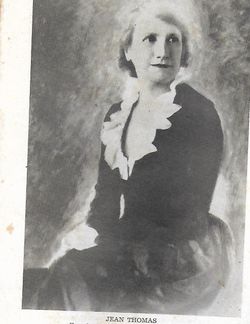
From my point of view, the most important and informational piece of writing in the book is that by Jean Thomas, The Traipsin' Woman, of Ashland, KY.  I must confess that I knew who she was and that she had been an important musicologist who collected and preserved folk songs in the Appalachian Region.  But I had never read her works, done research about her, or written about her in my work about the Big Sandy River and its influence on American culture.   I promise my readers that I will correct those mistakes in the near future.  Jean Thomas was born in Ashland, KY, and lived the great majority of her life there until her death at the age of 100 in Ashland.

Jean Thomas, "The Traipsin' Woman"--Photo by the Thomas Family


Jean Thomas had grown up as Jeanette Mary Francis de Assisi Aloysius Narcissum Garfield Bell in Ashland, Kentucky.  She eventually had a brief marriage which produced no children, traveled America and, perhaps, the world until she went to work as a traveling court reporter in Eastern Kentucky where she became fascinated by the folk ballads and singing styles of the Appalachian mountaineers whom she met in the court house towns.  She went on to found the American Folk Song Society and the American Folk Song Festival which took place at Carter Caves State Park from about 1932 until 1972.  It is a real tragedy that neither the American Folk Song Society or the festival have survived to help perpetuate the unique balladry, the Appalachian balladeers, and the early folk songs which traveled with our ancestors from the British Isles.    But Jean Thomas did write several books which are now hard to find on used book sites and no longer in print.  If you find copies of her books, buy them, preserve them, and pass them on when you die.  They are a major part of the work Jean Thomas devoted her life to in an attempt to preserve this wonderful set of Appalachian cultural assets. 

William M. Justice is also an interesting member of this group.  The personal papers of his daughter, Alice Justice Kinder are in the aforementioned Special Collections Department of the University of Pikeville.  The description of her papers on their website contains this biography of William M. Justice:
"William McKinley Justice was a product of the eastern Kentucky mountains into which he was born on November 27, 1893. Although he did not attend school until he was a teenager and did not receive his high school diploma until his mid-twenties, William Justice thirsted not only for personal knowledge, but to educate others in the mountains as well. A tireless promoter for Pikeville College, her traveled to a number of cities in the mid-west and north to raise money for the local school and help educate the youth of eastern Kentucky. Graduating from Berea College in 1929, Justice spent the next thirty years educating the youth of Pike County. From 1940-1959, Justice served as the principal at Hellier High School.
Justice loved the written word, and published five volumes of poetry. Named a Kentucky Colonel in 1968, Justice had the honor of having one of his poems read by Adlai Stevenson before the United Nations Assembly. He also penned an unpublished biography which was later finished by Alice Kinder and published in Willie-Boy and The Call of the Kentucky Mountains. William McKinley Justice died on July 22, 1968, at seventy-four years of age." (Special Collections Department, University Of Pikeville)
The Jesse Stuart story which is included in the book is "A Penny's Worth Of Character" which is arguably the best known of his half dozen or so children's books which are still being published and sold by the Jesse Stuart Foundation.   It appears to have been an earlier or abridged version of that well known story and there is no notation concerning any previous publication. 

The essay "Our Beloved Hills" by Mrs. Edgar R. May of Langley, Kentucky, in Floyd County addresses the issue of prejudice toward Appalachians and is quite interesting for the time.  It begins: "Much has been written about Eastern Kentucky, but generally only the dark side is seen in print.  While it is true that many undesirable conditions do exist here, progressive citizens have a right to resent being judged by the lowest classes in the mountains.  This is no less unfair than if the slums of cities were regarded as typical of urban life."  While this opening does not clearly defend these "...lowest classes in the mountains...", it does go on the remainder of the essay and make several good points in defense of Appalachian people and addresses some of the negative aspects of the discrimination which has been prevalent against Appalachians for at least a hundred years. 

I know I am repeating myself but if you stray into a copy of this little book buy it, keep it, protect it, and pass it on to someone or some institution which will preserve it for the future researchers into Appalachia and Eastern Kentucky. 

Sunday, March 10, 2019

Sorghum, Eating It, Comparing And Evaluating It

For a little more than a year now, I have been eating sorghum nearly every day in oatmeal at breakfast.  While that is the most consistently I have ever eaten sorghum, it has never been unusual for me to buy, eat, and keep sorghum in my house.  I grew up with sorghum in Knott County Kentucky and one of my fondest memories is of my father taking me with him once when I was about ten years old to buy sorghum where someone was grinding cane with a mule and cooking sorghum at the edge of the field.  For the past twenty-seven years, I have lived in Morgan County Kentucky, the home of the annual Morgan County Sorghum Festival which takes place the last full weekend in September each year. Morgan County is the heart of Kentucky sorghum country although some people in Liberty, Kentucky, the county seat of Casey County in West Central Kentucky, try to make a claim to the title. I must admit that I have never grown cane or actually made sorghum, but I will insist that I am an expert on the subject.  I have eaten three quarts in the last year.  Over the LAST sixty plus years, I have eaten sorghum made in several states, and in several different counties in my native Kentucky.  Deliberately, over the last year, I have chosen to buy different sorghum each time I have bought it and I am now ready to critique and compare these three varieties at least.  

Holbrook Brothers Pure Sorghum--Photo by Holbrook Brothers


For several years, I have been convinced that some of the best sorghum I have ever eaten has been grown and cooked by Holbrook Brothers Pure Sorghum in West Liberty where I live.  Originally, this variety of sorghum was grown and cooked by Dr. William Holbrook, DVM, and his brother Linville Holbrook.  They grew several acres of cane every year and were major influences on the creation and perpetuation of the Morgan County Sorghum Festival.  Sadly, both of the brothers are now dead.  But a second generation son is carrying on the tradition of growing and cooking the best sorghum in the area.  When I buy sorghum, I look for a rich, brown color; a sweet but not overpowering taste; and a level of thickness which shows me that the people running the cooker were both skillful and unafraid to boil the syrup down far enough to achieve that rich color and taste without scorching the product.  I have always said that there are three qualities that should always be avoided when buying and eating sorghum.  Those qualities to avoid are 1) sorghum that is too thin to the point that it runs rapidly off a spoon or a fork at room temperature; 2) sorghum that is mixed with any other form of sugar, syrup, or other additives.  Never, ever buy sorghum which says on the label that it contains any amount of corn syrup, dextrose, sucrose or any other additive or stretcher.  3) scorched sorghum should be never be used for human consumption.  If it has been scorched, it is good only as an additive to animal feed such as sweet feeds for cattle and horses.  There are two early signs that sorghum has been scorched.  The first is the odor when you open the jar.  If it has been scorched, the smell will tell you in an instant if you are an experienced sorghum eater.  The second sign of scorched sorghum is that it will usually be too thick from having been overcooked. But it is also possible to put a fast scorch on it simply by cooking too rapidly with too high heat. While I love thick sorghum, I also hate scorched sorghum.  The operator of the cooker must walk a fine line between achieving that wonderful color, flavor, and thickness and overheating and scorching the product.  If a sorghum producer, at the point of production on the farm, will not provide you a small spoonful to taste test, walk away and look for sorghum elsewhere.  It is also a great idea to look for sorghum which is being made by an active member of the National Sweet Sorghum Producers & Processors Association.  Their members are generally dedicated sorghum producers and fully committed to the art of making high quality sorghum.  Sometimes, such sorghum might be a little more expensive but it will almost always be worth the difference.  They describe their commitment in the following terms: 

  • Recapturing and fostering the study of the art and science of sorghum production.
  • Developing and disseminating information concerning these subjects to interested parties.
  • Encouraging and promoting the combining of the best methods of the old fashioned sorghum maker with the best of today’s technology to make the best possible products from sorghum cane juice. (National Sweet Sorghum Producers & Processors Association)

The second variety of sorghum I have eaten in the past year was made by Oberholtzer's  Kentucky Sorghum.  It can be bought in a variety of stores and even from Amazon.  I have never been to Oberholtzer's production facilities but I can tell you that, based on the large variety of places I have seen it for sale, it is mass produced.  While it has an acceptable taste and color, it is too thin which is common with mass produced product. I have heard the claim made that Oberholtzer's Kentucky Sorghum is made by an Amish family and I have no cause to doubt that because of the German last name.  It is labeled as "Real" and "Not A Blend" and I have no reason to doubt the validity of those statements.  But it is just not the kind of sorghum you can find if you are willing to make a few phone calls, search the Internet diligently, and ask questions of dedicated sorghum eaters in your area.  Take a drive in the country and find a farm family who are raising less than 20 or 30 acres of cane, cooking the syrup themselves according to methods one of them learned from her parents or grandparents, and, if you are really lucky, you will find them sweating over a pan of syrup, stirring it with brand new hoes, and taking a break with a piece of squeezed cane for a snack.  But, if you don't have the time to find your sorghum that way, come to West Liberty, Kentucky, during the last full weekend of September and find a producer who lives locally, speaks with an Eastern Kentucky Appalachian accent, and offers you a free taste whether they think you are a buyer or not.

Oberholtzer's Sorghum Label--Photo by Roger D. Hicks

The third variety of sorghum I have eaten lately is actually made in Monterey, Tennessee by the Mazelin Family.  It is labeled "Pure" and "No Additives".  But I found it at my local Save-A-Lot grocery store which is a sure sign it is mass produced since Save-A-Lot is a fairly large chain with more than a thousand stores. This sorghum has a fairly good taste and color but is too thin which is also a signal that it is mass produced. The Save-A-Lot chain is headquartered in the Saint Louis area more than four hundred miles from Monterey, Tennessee, which is another indicator that the sorghum is most likely mass produced.  I do not have any particular aversion to this variety of sorghum other than the taste and thinness but I doubt that I will ever buy it again unless I run out and can't find one of my favorite varieties.  I do not consider this variety worth recommending although you, as an individual might come to like it.

Mazelin Family Sorghum Label--Photo by Roger D. Hicks

I understand that some veteran sorghum eaters and producers who read this post might disagree with me and I respect that.  If you have a favorite brand of sorghum, please let me know and if I can locate a jar I will definitely try it.  If you are a sorghum producer and have the desire to have me try and write about your product, get in touch with me either through this blog or at my e-mail ( rchicks@mrtc.com )  and we can arrange to have you send me a jar.  I am also always interested in seeing new recipes using sorghum in any form of food but especially in entrees since there are fewer and fewer people cooking with sorghum other than in baked goods.  Now go out in the area near you and find some local sorghum and try it, especially if you have never eaten sorghum.  When you do that, please send me a message or a comment on this blog so all of us can see what you found and your reaction to it. 

Friday, March 8, 2019

"Twentieth Anniversary...of Local Union 5895 United Mine Workers Of America 1933-1953" by UMWA Local 5895--Book Review

During a recent research trip to the Wayland Kentucky Historical Society in Wayland, KY, one of the key coal camp towns of the Big Sandy River drainage in Floyd County KY, I was provided a copy of this fifty page book commemorating the first twenty years of UMWA Local Union 5895.  The book was originally written and published by the local union as part of an anniversary celebration in 1953.  It was reprinted by the Historical Society in May 2005.  It is well worth the reading by any student of UMWA history, Floyd County, Wayland, Kentucky, Appalachia, the Big Sandy River, or trade unionism in general.  The book states that "in a regular meeting in May, 1952 ...a motion was passed to instruct the President to appoint a committee and commission them to prepare a history of our local union to be printed in book form...".   The committee was composed of the following members: Nobel Hobbs, Chairman; J. F. Dixon; Lawrence Mount; Charles Burnett; McKinley Parrigin; Robert Hicks; Joe Hicks, Secretary; Pete Mills; E. Hawk Moore; Guy Coleman; Charles Turner; and Roy Lykins.  Let me state for the record that during my childhood and teen years I knew both E. Hawk Moore and McKinley Parrigin.  It is also likely that I am distantly related to Robert Hicks who, along with his brother Joe Hicks, served the local union in a variety of roles for many years.  They were both born at Mousie, KY, the birthplace of my father, Ballard Hicks.  I did not know Guy Coleman but after his death I spent many hours in the home of his widow, Rusha Coleman, because of my friendship with their son Keith Coleman.  Let me also state at the outset of this review of this book that the committee did an excellent job with the book, especially in light of the fact that they were all working full time jobs in the mines, were generally also performing other unpaid duties for the union, and were, in most cases, only educated at the high school level.  The Wayland Historical Society is also to be commended for their efforts to reprint the book and making it available to a larger audience in the second generation copies.  I had never seen a copy of the original text and I am certain that, like many small publishing projects, few copies of the original exist today.  

This book may be only fifty pages but it contains a treasure trove of information for members of all the groups I listed in my opening paragraph.  There are photos and biographies of many of the early officers of Local 5895.  There are nine brief written chapters detailing the first twenty years in the life of the local union.  There are group photos of the local union officers in 1953 and the committee which produced the book.  There is a list of "Some Of Our Firsts" which enumerates more than a dozen key actions and events in the history of the local union.  There is also a brief description of key achievements in the most recent union contract at the time.  There are lists of local union members and their sons who served in WWII and of those members who died in WWII & Korea.  The book also contains a "Public Service Roll" listing members who held elected or appointed positions in the city government of Wayland.  The book is dedicated to a list of 35 "...industrial soldiers who gave their lives in accidents while producing coal..."  in the previous twenty years.  
I found information in this little book which is priceless to me as both a committed believer in organized labor and a writer committed to preserving the history and culture of Central and Southern Appalachia.  I am sure many of my readers will also cherish much of the information which has been preserved in this little masterpiece.  It is a shame that it was not more widely circulated but it has been preserved in the Wayland Historical Society and can be accessed there by contacting the Historical Society.  I am willing to scan and e-mail specific information from the book to my readers who have a genuine and valid interest in reading it.  It is a real tragedy that every union local in the country has not done such a piece of work.  But, as we all know, frequently union members were literally fighting for their lives on a daily basis, working in dangerous occupations for companies which did not care one whit about an individual life of an employee once that person had been replaced.  That brings to mind the old saying in the coal fields of Appalachia that in the early days of coal mining company officials would have rather lost a man than a mule in the mine since another miner could always be hired but a mule had to be bought.  If you ever visit the Wayland Historical Society, try to get a look at this little book, view their wonderful collection of period antiques, and consider giving them a donation to support work like this.  

Thursday, February 28, 2019

Wayland Kentucky Historical Society Trip And Research

Last Saturday, February 23, 2019, I took  a trip to Wayland, Kentucky, in Floyd County to do some research in the Wayland Historical Society records and to meet and spend time with two newly learned cousins on the Allen side of my genealogy.  Sam Bradley and his grandson Alexander Allen, who are both interested in genealogy, coal camp and UMWA history, and the history of the Floyd, Knott, and Wayland areas.  We met and spent about two hours or so searching the records in the Elkhorn Coal Company personnel files which were miraculously saved from being lost by the fortunate accident of having been found in an abandoned building by someone with enough foresight to donate them to the historical society.  The Wayland Historical Society is located in the Wayland, Kentucky, city hall and it also has decent museum of probably close to 2,000 square feet with a large, but somewhat disorganized collection of items related to the history of the coal camps in the area and to the growth of Wayland.  

We spent a lot of time getting to know each other, sharing our common political ideas in favor of democracy, trade unionism, and Democratic politics.  I was amazed to find the personnel records of several members of my family including my father, Ballard Hicks; my maternal grandfather, Woots Hicks; my maternal uncle, Mabry Hicks; my maternal uncle by marriage, Corbett "Carbide" Terry; and several others whom I had known when I was a child.  I was able to copy these records and will use them to further my knowledge of my own genealogy; the history of Wayland, Beaver Creek, and Floyd County; and the history of the United Mine Workers in Eastern Kentucky. Since Sam Bradley and I knew dozens of people in common it was both wonderful to share stories and a bit confusing to realize that we are roughly the same age and had never met.  I look forward to returning to the historical society to research further in their collections and spend more time with Sam Bradley and Alexander Allen.  

I would strongly recommend that anyone who likes to learn about the history of the coal industry, Beaver Creek, Wayland, Floyd County, or the United Mine Workers contact the Wayland Historical Society and schedule a time to visit there and possibly research their collection.  I do have some misgivings that the historical society has a small number of members, appears to not necessarily be well funded, and could be dealt with less favorably by future administrations in city hall.  If you find it in your heart to do so, it would greatly appreciated if you could make a donation, however small, to the Wayland Kentucky Historical Society.  Here is their contact information if you should find it in your heart to mail them a contribution, call for access to their records, or simply send them a post card to say thank you for working to preserve the history of Eastern Kentucky.  2662 KY Route 7, Wayland, Kentucky, 41666, (606) 358-9471.